
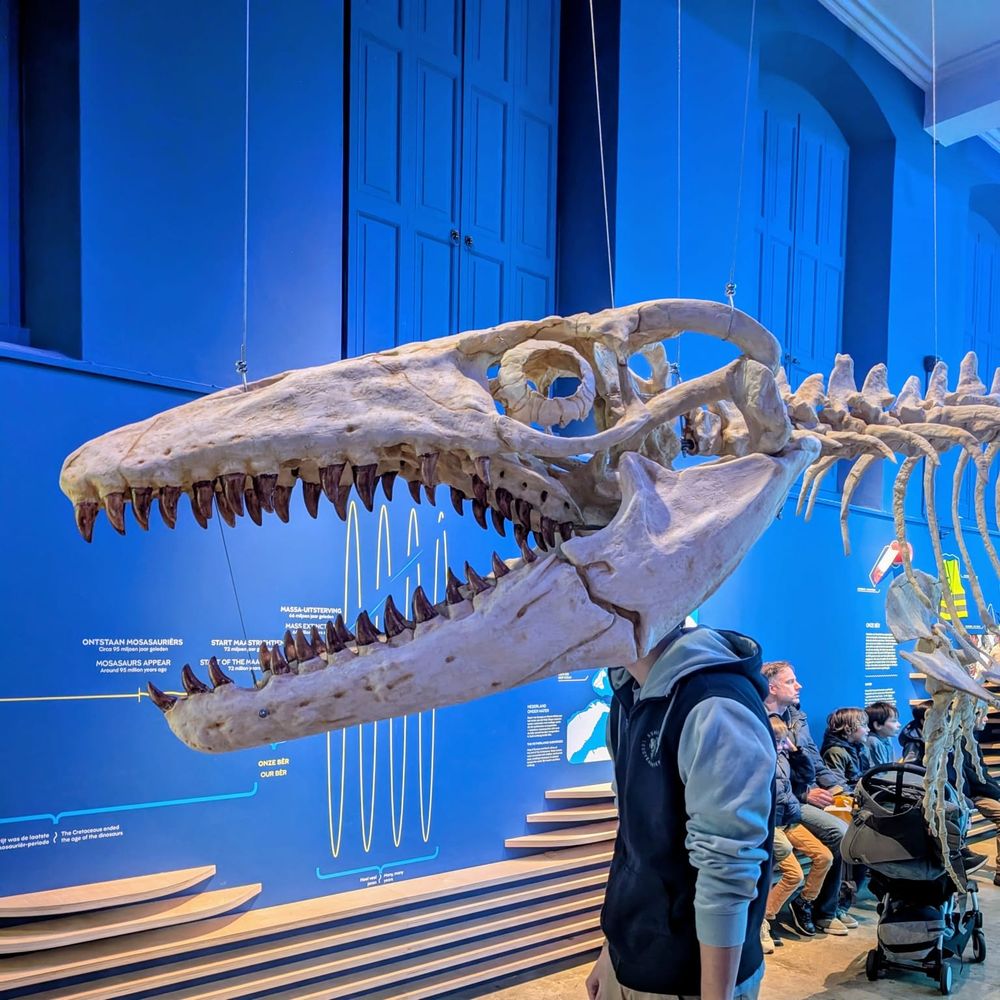
Are you tired of people constantly overestimating body size of marine reptiles? No longer!
We provide equations to estimate body size in ichthyosaurians, mosasaurids, and thalattosuchians.
1/4
@just-fre.bsky.social
🦴 Geologist and vertebrate paleontologist. 🌊 Interested in the evolution of Mesozoic marine predators. 📚 TA and PhD student at @universitedeliege.bsky.social 🌐 https://beacons.ai/_just_fre
Are you tired of people constantly overestimating body size of marine reptiles? No longer!
We provide equations to estimate body size in ichthyosaurians, mosasaurids, and thalattosuchians.
1/4
New paper showing that ichthyosaurs ate vampyromorph coleoids. Did they like it ? No idea 🤷♂️
@universitedeliege.bsky.social @naturmusee.bsky.social @just-fre.bsky.social
@peerj.bsky.social
peerj.com/articles/19786
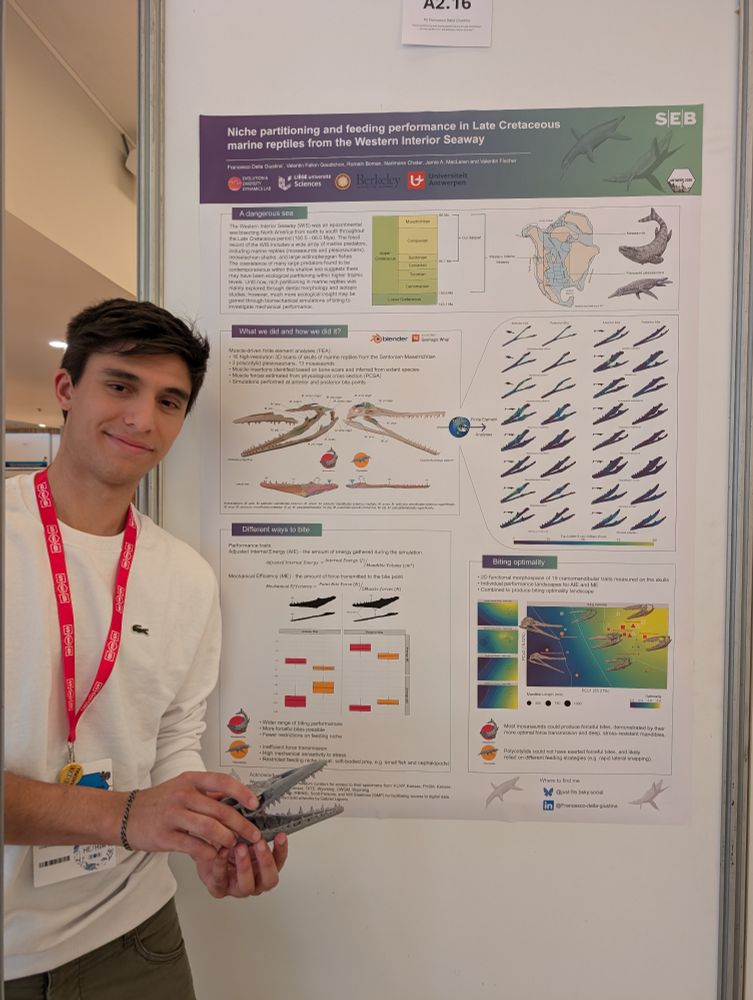
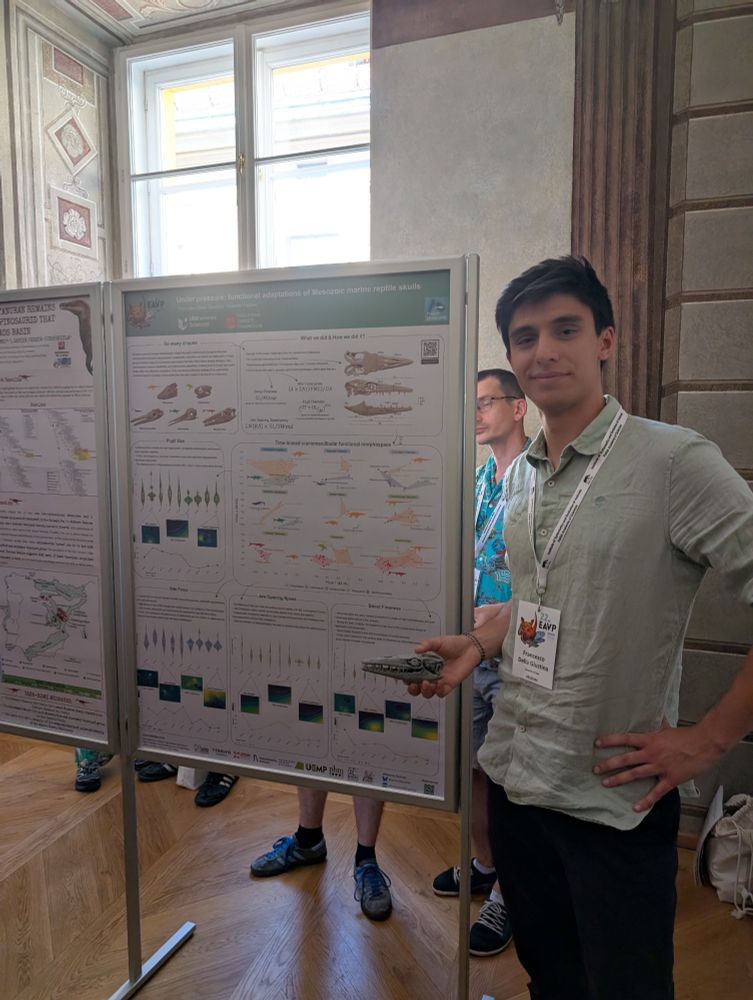
Grateful for the chance to present my #marinereptiles research at both #EAVP2025 and #SEB2025 over the past weeks.
Huge thanks to the organisers, and all my coauthors for their support and guidance!
Looking forward to the next conferences!
🎉New lab paper lead by @just-fre.bsky.social based on his master thesis work! Francesco and his colleagues describe new allodaposuchid material from the latest Cretaceous of Spain (as well as the importance of postcranial anatomy for croc phylogenies 😉).
www.sciencedirect.com/science/arti...
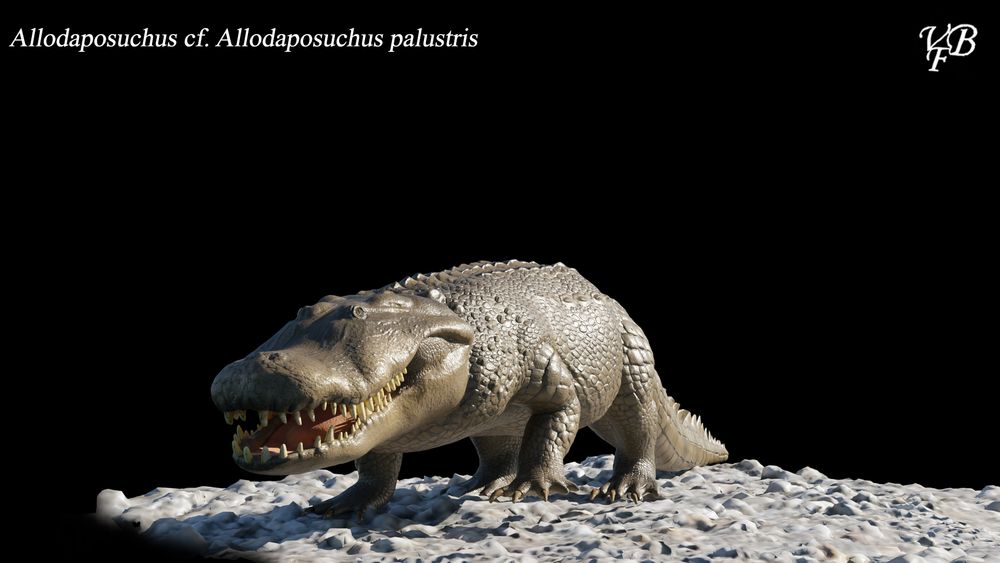
Finally, we also demonstrated the importance of the postcranium for croc phylogenies, showing how some postcranial characters alter significantly the position of Allodaposuchidae within the Eusuchian phylogenetic tree, with crucial implications for the Crown-clade Crocodylia.
6/6 🧵

Our study expands our global knowledge of allodaposuchid anatomy, focusing on the osteology and myology of the axial and appendicular skeletons, as well as the osteoderm pattern, all of which indicate a semi-aquatic lifestyle with possibly enhanced terrestrial locomotion.
5/6 🧵
However, all allodaposuchid species are mainly represented by craniodental remains, inevitably making the postcranial record of this clade somewhat neglected.
4/6 🧵

We identify it as an allodaposuchid, a group of crocs living in rivers and brackish waters of the islands of the southern European archipelago during the latest Cretaceous. Their diversity has increased significantly in recent years, with new species being described from Spain and France.
3/6 🧵

The remains, now housed at the Institut Català de Paleontologia, were primarily excavated more than 30 years ago and have not received any attention since then. However, we estimate it to be the most complete crocodyliform from the Upper Cretaceous of Europe.
2/6 🧵
New paper out! 🚨📄
I'm excited to share that my first-authored article is officially published!
This study, started during my MSc thesis, focuses on the description and taphonomy of a crocodyliform from the Upper Cretaceous of Spain. 🐊
www.sciencedirect.com/science/arti...
1/6 🧵
🧵New paper + open database drop!
The Marine Organismal Body Size ( #MOBS ) Database is now live—85,000+ marine species, from plankton to whales, with standardized size data.
A huge leap for biodiversity, conservation, and climate science. #science #marinelife onlinelibrary.wiley.com/doi/10.1111/...
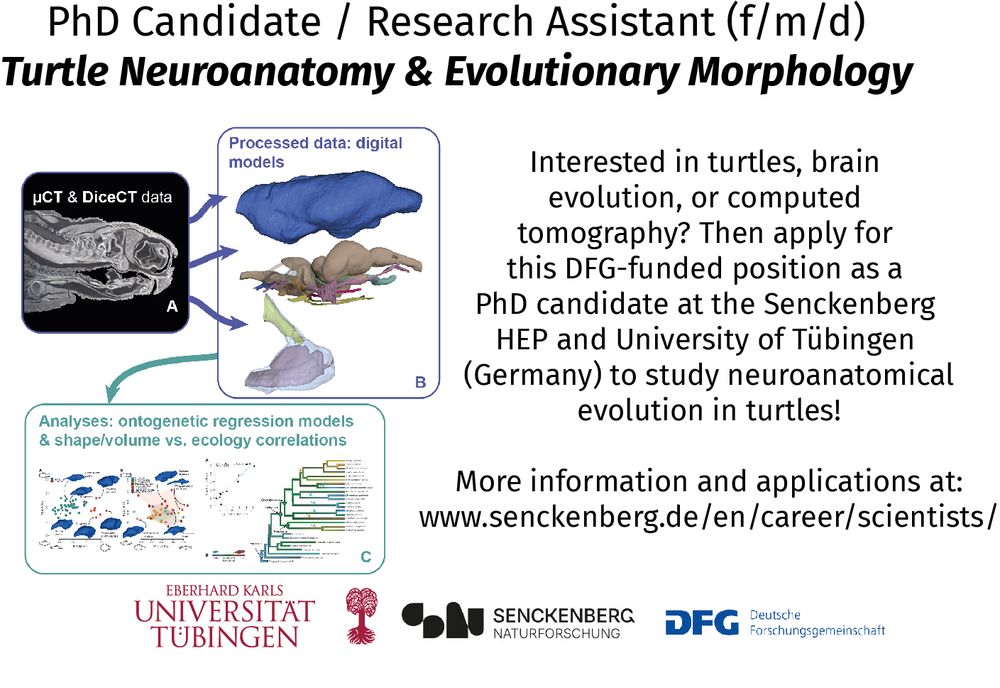
🚨🚨PhD position alert!🚨🚨
Do you like 🐢🐢? Or ecomorph evolution? I am offering a 36-month PhD position funded by the DFG about ecomorphology and neuroanatomy of turtles. Check out the ad here: www.senckenberg.de/en/career/sc...
Please share and if you have questions, send me a message 😉

New paper out! You wouldnt want to be at the wrong end of a Temnodontosaurus! He would either swollow you hole, or rip you to pieces! Many congrats to Giovanni Serafini for leading this project! Very happy it's out!
onlinelibrary.wiley.com/doi/epdf/10....
First dissertation chapter has been published in Integrative & Comparative Biology, check it out here: academic.oup.com/icb/advance-...
23.05.2025 14:05 — 👍 20 🔁 9 💬 2 📌 2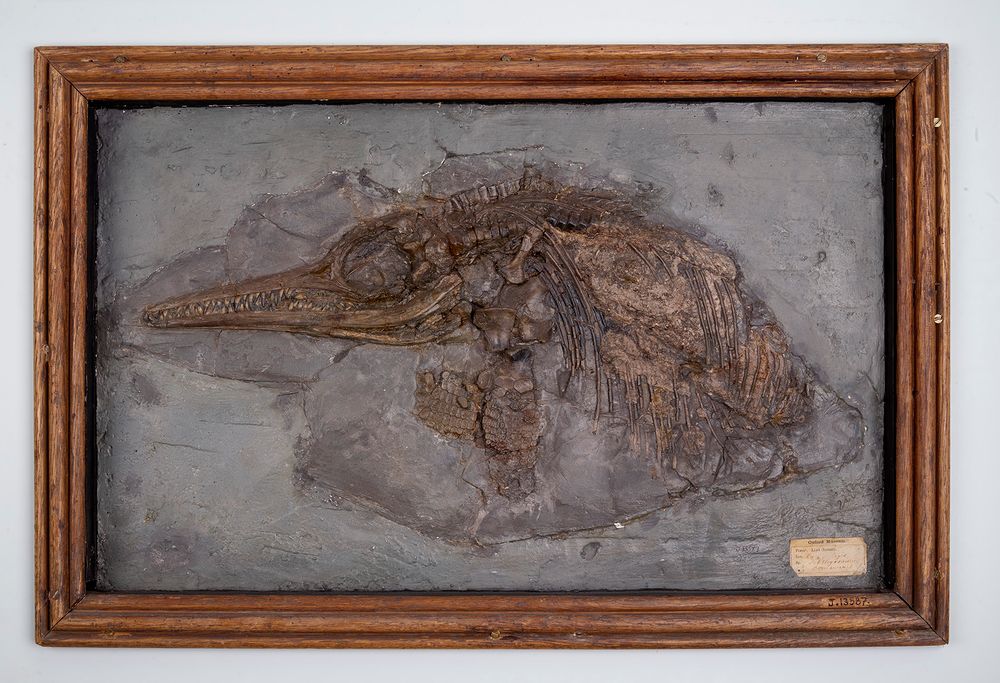
Happy Birthday, Mary Anning!
This 195-million-year-old marine reptile was discovered in Lyme Regis at some time before 1836 by the British palaeontologist Mary Anning (1799–1847).
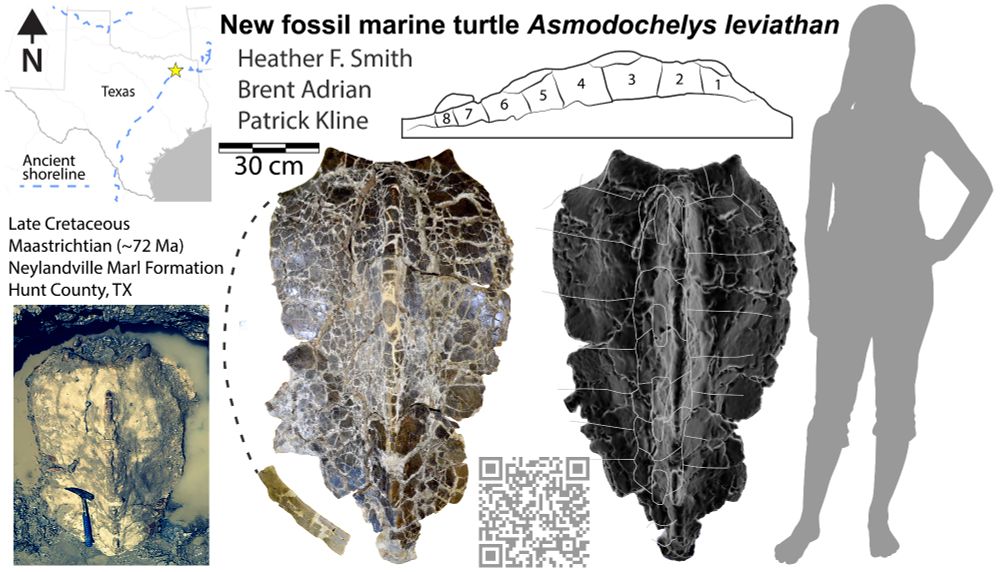
Introducing Asmodochelys leviathan, a new giant marine turtle from the Maastrichtian of Texas!
sjpp.springeropen.com/articles/10....
This new 72-million-year-old species was one of the sole survivors of an extinct lineage that patrolled the gulf coast of North America near the end of the Cretaceous

Haridy, Y., Norris, S.C.P., Fabbri, M. et al. The origin of vertebrate teeth and evolution of sensory exoskeletons. Nature (2025). doi.org/10.1038/s415...
21.05.2025 17:17 — 👍 30 🔁 8 💬 0 📌 1Paleontology oriented people please apply! Come work with us! Ask Lene about details ;)
21.05.2025 07:22 — 👍 2 🔁 1 💬 0 📌 0
What's new in the world of adaptive radiation?!
Here's what we think!
academic.oup.com/evolinnean/a...
Out now in @evojlinnsoc.bsky.social! Wonderful writing this with Julia Day, @fishspeciation.bsky.social, and María del Rosario Castañeda

Thrilled to announce our latest paper, published today in @nature.com on the oldest fossil amniote trackways, from the earliest Carboniferous of southeastern Australia.
www.nature.com/articles/s41...
New on Bluesky, and already excited to share some big news — my first co-authored paper is out (and in OA)! You can find the link in the thread below.
Thanks to everyone involved in this project!
Hi Bluesky! Finally putting this account to use. I'm an early-career paleontologist working on aquatic animals, especially marine reptiles 🐊🌊.
Excited to connect with others in paleo, evo-bio, and anyone interested in ancient ecosystems!
