Congratulations!
21.05.2025 13:00 —
👍 1
🔁 0
💬 0
📌 0
My small tribute to one of my favourite papers ever
19.05.2025 08:03 —
👍 27
🔁 10
💬 0
📌 0
No worries at all! I appreciate the additional context, and I agree it's very valuable for readers who might be unfamiliar with the literature. I am glad we had a chance to further clarify things 😀
19.05.2025 07:51 —
👍 2
🔁 0
💬 0
📌 0
(3/3) When I talk about RNNs, the key innovation is the use of methods to find the network's fixed points and study the linearized dynamics, like in Sussillo & Barak, 2013. Also, I agree that others had already trained monkeys to do similar tasks, but the analyses are what made the difference here!
17.05.2025 22:26 —
👍 4
🔁 0
💬 1
📌 0
(2/3) In my opinion, this is different from using unsupervised methods like PCA (or even more refined methods like demixed PCA) and is more similar e.g. to the ideas of "potent" and "null" axes like in Kaufman et al., 2014.
17.05.2025 22:26 —
👍 2
🔁 0
💬 1
📌 0
(1/3) Hi @jbarbosa.org! The transmitter piece was meant for a broad audience so it was hard to describe in too much detail the novel aspects of Mante & Sussillo. When I talk about population dynamics, I refer to their use of targeted dimensionality reduction to find key axes in neural space.
17.05.2025 22:26 —
👍 7
🔁 1
💬 2
📌 0
Searchable database of tangible benefits that federally-funded research gave us.
A crowd-sourced site. Health and Well-being. National Security. Prosperity.
we're crowd-sourcing a searchable repository of tangible benefits stemming from federally-funded research. Come enjoy the great stories; or send in an idea; or volunteer to join the team.
publicusaresearchbenefits.com
please share and re-share so we get more great stories in there!
07.05.2025 23:28 —
👍 137
🔁 113
💬 1
📌 4
🚨 Deadline extended! 🚨
A few more days to apply for this PhD project in my lab - come to Edinburgh and study flexible decision-making with us!
Please share if you know someone who might be interested 🙂
07.04.2025 09:04 —
👍 2
🔁 1
💬 0
📌 0
We are hiring a PhD student to study the neural mechanisms underlying flexible decision-making and individual variability. Please apply and spread the word!
28.03.2025 13:45 —
👍 1
🔁 2
💬 0
📌 0
That sounds great!
25.03.2025 19:40 —
👍 1
🔁 0
💬 0
📌 0
Thank you Nicole!
25.03.2025 18:49 —
👍 1
🔁 0
💬 0
📌 0
Haha I wish we could work something out! Thank you for the nice words! 😀
25.03.2025 18:49 —
👍 1
🔁 0
💬 1
📌 0
I am hiring a PhD student in my lab in beautiful Edinburgh to keep investigating the neural mechanisms underlying flexible decision-making and individual variability.
Email or DM me with any questions, or let's chat at the CoSyNe Main Meeting next week!
Apply here: tinyurl.com/2cxr6nbg
24.03.2025 19:54 —
👍 30
🔁 14
💬 2
📌 0
Thank you very much @nicolecrust.bsky.social!!!
21.03.2025 14:55 —
👍 2
🔁 0
💬 0
📌 0
7/7 Finally, we will be presenting a poster at @cosynemeeting.bsky.social in Montreal next week (Poster 1-061). I look forward to chatting about all this, and to present some new results about how rats and RNNs learn to solve flexible decision-making. Please come say hi! 😀
21.03.2025 13:28 —
👍 3
🔁 0
💬 0
📌 0
6/7 In my lab @sidb-edinburgh.bsky.social in Edinburgh, we study the neural mechanisms underlying flexible decision-making, and we leverage rat models of neurodevelopmental disorders to study the link between genetic mutations and cognitive dysfunction. We are hiring! www.marinopagan.com/pagan_lab
21.03.2025 13:28 —
👍 4
🔁 2
💬 2
📌 0
5/7 What’s next? Using rats opens the door to the use of modern genetic and molecular tools available in rodents to study context-dependent evidence accumulation. It also offers an unique opportunity to study how genetic mutations can affect the neural circuits underlying flexible decision-making.
21.03.2025 13:28 —
👍 1
🔁 0
💬 1
📌 0
4/7 Infinite thanks to my wonderful postdoctoral Mentor, Carlos Brody, who was an inexhaustible source of guidance, wisdom and support! 🙏🙏🙏 Also very grateful to our fantastic collaborators, @sussillodavid.bsky.social , Valerio Mante, Mikio Aoi, @jpillowtime.bsky.social , and Vincent Tang.
21.03.2025 13:28 —
👍 3
🔁 0
💬 1
📌 0
3/7 Also, we found that recurrent neural networks (RNNs) can fail to capture the heterogeneity observed in biological brains. We introduce new methods to design RNNs that cover the full space of solutions, bridging the gap between artificial systems and the diversity seen in biological computation.
21.03.2025 13:28 —
👍 4
🔁 0
💬 1
📌 0
2/7 Most neuroscience research focuses on what is common across subjects, but individual differences can be large for tasks that allow many different internal solutions! Our work highlights the importance of characterizing individual variability when studying complex cognitive behaviours.
21.03.2025 13:28 —
👍 9
🔁 1
💬 2
📌 0
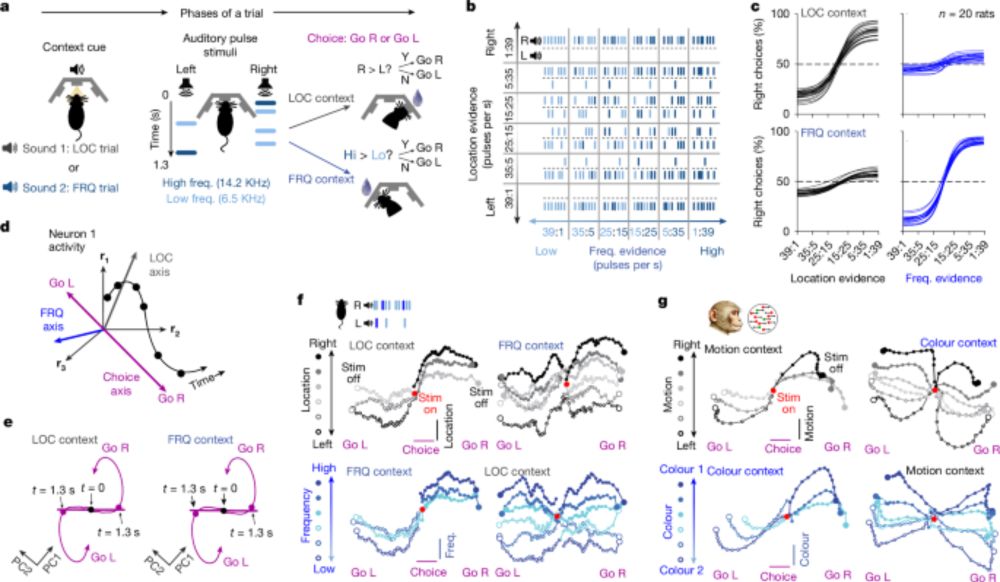
Individual variability of neural computations underlying flexible decisions - Nature
Behavioural experiments to study decision-making in response to context-dependent accumulation of evidence provide testable models that are consistent with the heterogeneity in neural signatures among...
1/7 Our paper on individual variability in decision-making is finally out in @nature.com! Inspired by the classic work by Mante and Sussillo, we trained many rats to solve context-dependent decision-making, and we found that different brains use different neural mechanisms to solve the same task!
21.03.2025 13:28 —
👍 237
🔁 86
💬 7
📌 5

A new “hearing test” for rats reveals the brain’s hidden variability when making a decision
Simple choices can arise from diverse brain strategies, shedding light on the origins of individual variability
A surprising variability in how rats process sounds, evaluate evidence, and make choices underscores the complexity of the brain’s decision-making process, finds a new study in @nature.com from the labs of PNI's Carlos Brody and @jpillowtime.bsky.social. pni.princeton.edu/news/2025/ne...
21.01.2025 15:20 —
👍 5
🔁 1
💬 0
📌 0

We are pleased to be partnering with The UKRI AI CDT in Biomedical Innovation at the School of Informatics (University of Edinburgh). These PhD projects have a strong translational focus and seek to develop & apply AI approaches to biomedical domains ✨.
Apply by 20 Jan www.ai4biomed.io/how-to-apply/
16.01.2025 10:53 —
👍 3
🔁 4
💬 0
📌 0
Postdoctoral Research Fellow
We seek a motivated postdoctoral researcher to conduct primary research into how neurons transport mRNA to distal sites and use these mRNAs as substrates for local protein synthesis during synaptic pl...
Thanks to our recent Wellcome funding- we're hiring a Postdoctoral Researcher to explore the mechanisms underlying synaptic RNA capture and selective local protein synthesis. This position has 5 years of funding. Please reach out if you have any questions!
elxw.fa.em3.oraclecloud.com/hcmUI/Candid...
09.01.2025 14:54 —
👍 7
🔁 7
💬 0
📌 1

There’s just under 2 weeks to apply for our PhD studentships! Join our dynamic community where we provide an annual stipend of £25K, plus tuition fees (inc. international) 🧠.
Apply by 26 January and start your journey with us: sidb.org.uk/phds/
@edinburghmedschool.bsky.social
14.01.2025 12:38 —
👍 10
🔁 10
💬 0
📌 0
Completely agree! As we showed in our 2023 arXiv paper, the non-linear & linearized dynamics resulting from the two equations are exactly the same. However, some downstream analyses can produce different results! E.g. context-dependent input modulation can only be seen using one of the two equations
12.12.2024 19:19 —
👍 1
🔁 0
💬 0
📌 0
Can I be added as well? Thank you very much!
01.12.2024 18:11 —
👍 0
🔁 0
💬 0
📌 0
@nicolecrust.bsky.social
01.12.2024 14:38 —
👍 1
🔁 0
💬 1
📌 0
I think Marr levels are a great framework to study mental disorders:1) what computations are altered? 2) What neural mechanisms (at Systems level) cause these altered computations? 3) What are the underlying cellular/molecular changes? We know a lot about 3), little about 1), almost nothing about 2)
01.12.2024 14:37 —
👍 12
🔁 1
💬 1
📌 0
Good to know!
01.12.2024 12:59 —
👍 1
🔁 0
💬 0
📌 0