
logan's run but pop tart
28.12.2025 00:39 — 👍 25 🔁 3 💬 0 📌 0
@philiplampkin.bsky.social
Arthur C. Cope Postdoctoral Fellow in Organic Chemistry | One-U Responsible AI Initiative Postdoctoral Fellow | University of Utah Postdoctoral Researcher in the Sigman, Sparks, and Lessard Labs
logan's run but pop tart
28.12.2025 00:39 — 👍 25 🔁 3 💬 0 📌 0
Consider submitting your peptide research to a special joint issue of JOC and Biochemistry on the Chemistry and Biology of Peptides!
axial.acs.org/biology-and-...

oni-baba Purdue pete
29.11.2025 22:00 — 👍 2 🔁 0 💬 0 📌 0so far
29.11.2025 17:57 — 👍 1 🔁 0 💬 0 📌 0I'm extremely fortunate to have this opportunity. It's the latest in a long line of mentors and organizations opening up doors for me. Thank you for your part in opening doors!
22.11.2025 20:19 — 👍 0 🔁 0 💬 0 📌 0It's an honor to be a part of this cohort! I am extremely thankful that the ACS is willing to sponsor young scientists during these uncertain times.
22.11.2025 19:47 — 👍 5 🔁 0 💬 0 📌 0
Check out our review on DNA-scaffolded catalysis! This link provides free full text access until the end of 2025: authors.elsevier.com/a/1m43W9CpcY.... Big thanks to co-authors @edwardpimentel.bsky.social , Ashley Ogorek, @ethan-hartman-125.bsky.social , and Caleb Cox
13.11.2025 03:21 — 👍 14 🔁 6 💬 1 📌 0This is code for “our university is in a deeply precarious financial situation and making large cuts to many our most important programs – we can’t afford this loser's buyout”
06.11.2025 21:59 — 👍 7 🔁 0 💬 0 📌 0I had the privilege of reading many early drafts of this work. Since the beginning the conclusion that we're potentially missing significant structural information using routine characterization methods has fascinated me. Great job, Brenna!
21.10.2025 13:26 — 👍 4 🔁 0 💬 0 📌 0
I received many requests to share materials from our undergraduate course “Machine Learning in Chemistry”
— here you go!
A preprint summarizing insights and lessons learned:
chemrxiv.org/engage/chemr...
A Jupyter Notebook Tutorial Gallery:
xuhuihuang.github.io/mlchem/html/...

We built some open source photo reactors and implemented them into the organic teaching lab here at Bradley. This was a fun project led mainly by the undergraduate students! Check it out: pubs.acs.org/doi/10.1021/...
30.09.2025 21:25 — 👍 5 🔁 1 💬 0 📌 0
My work assessing the effect of preorganization on dihydrazide activity is out in @jacs.acspublications.org. We find that dihydrazides with flexible tethers can replicate much of the catalytic activity of complex dihydrazides with preorganized foldamer scaffolds. #Chemsky
doi.org/10.1021/jacs...
Purdue Pete in an onibaba mask
21.08.2025 16:48 — 👍 2 🔁 0 💬 0 📌 0

Catch Lauren Tran’s talk, “Potent and biased peptide agonists of the PTHR1, a Class B GPCR, from a heterochiral design strategy” at 5:30 PM Monday in Meeting Room 4 of the Westin Hotel as part of the Student Research session!
18.08.2025 03:27 — 👍 2 🔁 1 💬 0 📌 0
Excited to share our new preprint, which was years in the making! chemrxiv.org/engage/chemr...
New reactions are typically developed by trial and error. How can we speed up this process? Read on to learn how we used DNA scaffolding to perform >500,000 parallel reactions on attomole scale.
1/n
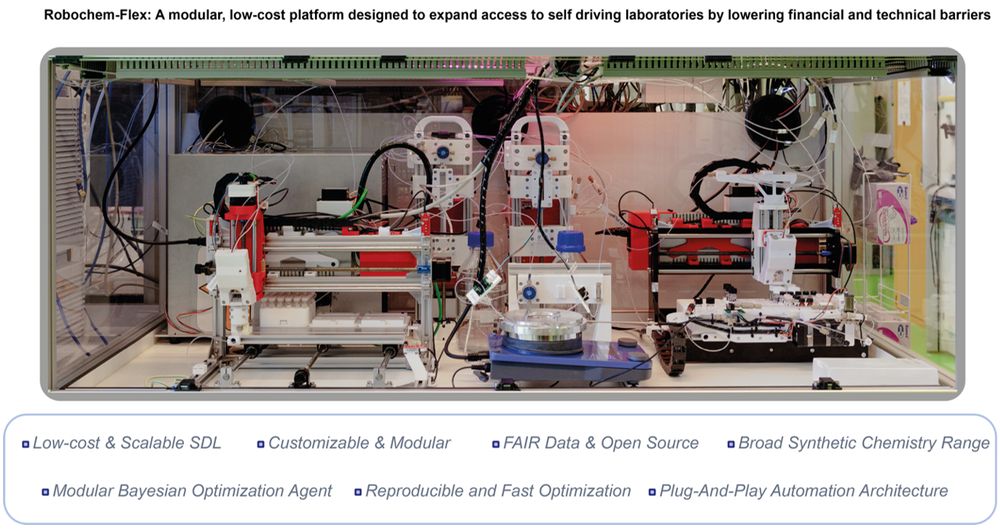
New @chemrxiv.bsky.social preprint!
RoboChem-Flex is a powerful, low-cost (<5k EUR), modular self-driving lab for chemical synthesis
We showcase 6 studies (photochemistry, biocatalysis, cross coupling, ee ...), all optimized with different configurations & ML
🔗 chemrxiv.org/engage/chemr...
It's great to hear from you! Thank you - I have some interesting organocatalysis about to be published and I'll soon join the Sigman lab as a postdoc. I hope all is well in Baltimore. Thanks again for being a great mentor (you and the other USF faculty are acknowledged in my dissertation)!
08.07.2025 16:31 — 👍 0 🔁 0 💬 0 📌 0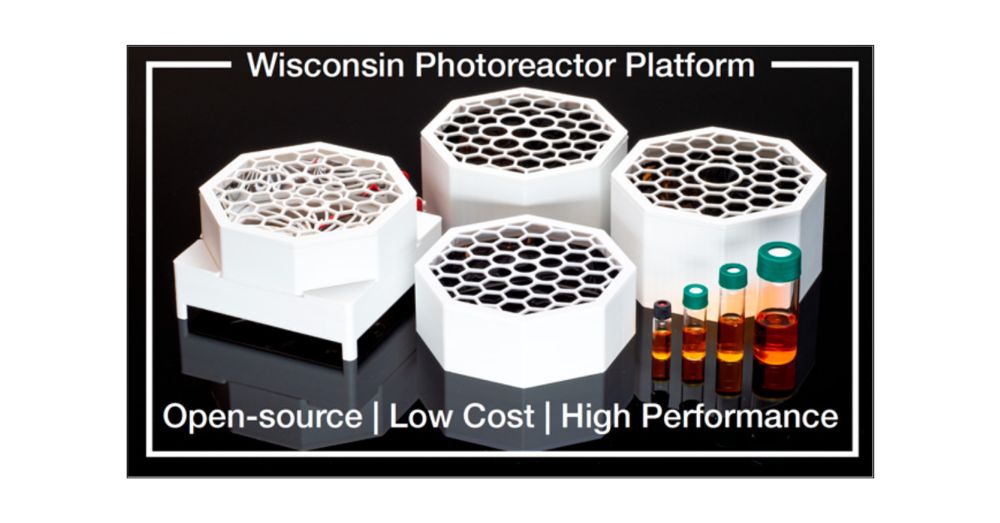
#chemsky, have you used a Wisconsin Photoreactor? I designed them and will soon defend my PhD. I’d like to include photos of Wisconsin Photoreactors in use by other chemists in my defense. Please share (reply to this post or DM me) a photo of your photoreactor in action!
doi.org/10.1021/acs....
Woah! I designed this - If you need anything, the UW-Madison electronics shop stocks every part for the Wisconsin Photoreactor. I'd be happy to send any part you need.
02.06.2025 05:32 — 👍 1 🔁 0 💬 1 📌 0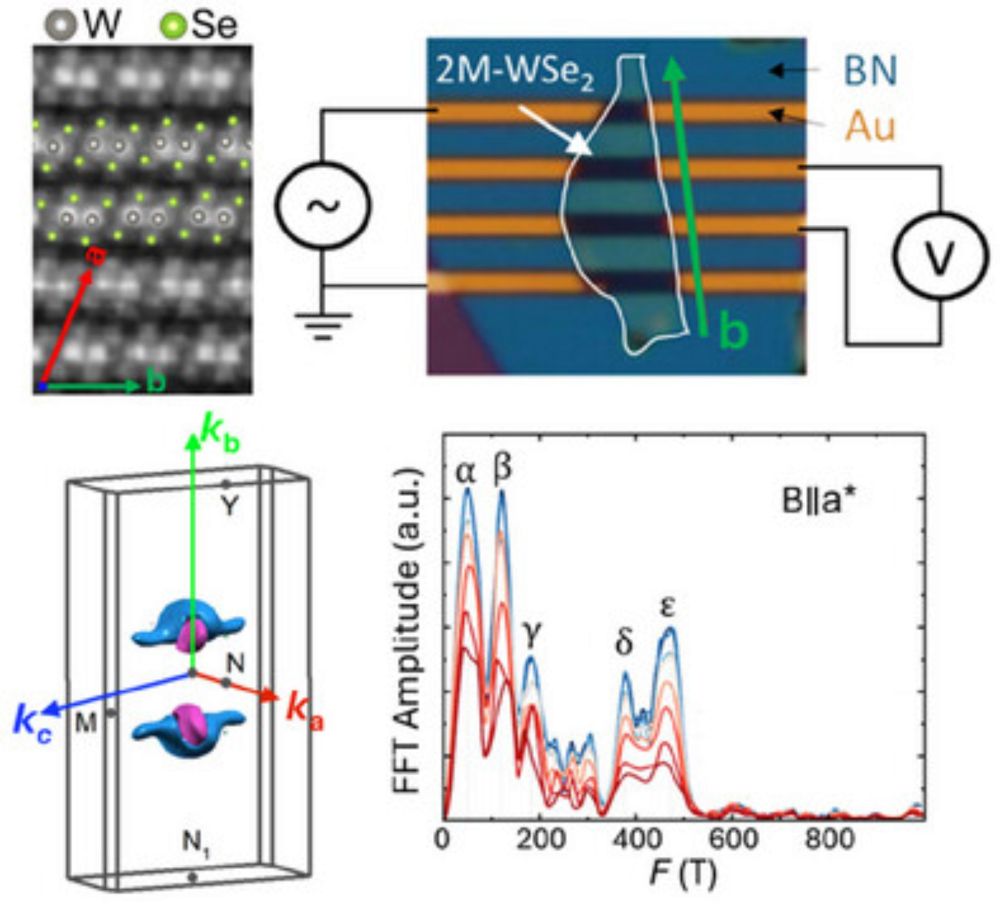
Our work on 2M-WSe2 is out now in Adv. Funct. Mater.!
doi.org/10.1002/adfm...
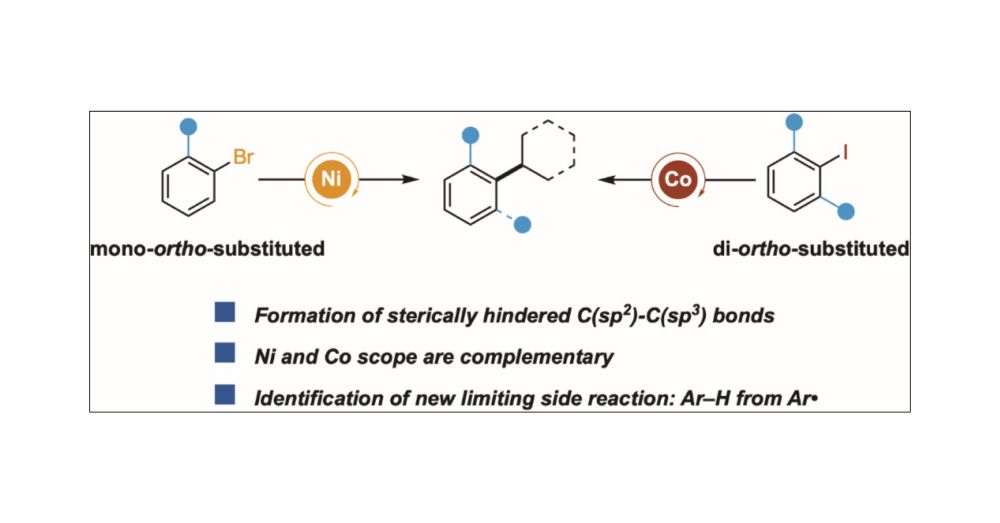
Our work on Ni- and Co-catalyzed Cross-Electrophile Coupling to Form Sterically Hindered C(sp2)–C(sp3) Bonds is now online at J.A.C.S.! @pubs.acs.org Congrats to Tianrui, Anthony, Kasturi, and our collaborators Madeline (@kozlowskigroup.bsky.social) and @novartis.bsky.social doi.org/10.1021/jacs...
07.03.2025 20:09 — 👍 12 🔁 3 💬 0 📌 1
Can glycans catalyze chemical reactions?
Check out our glycan foldamer that uses carbohydrate–aromatic interactions to perform catalysis, today out in @naturechemistry.bsky.social
Big congrats to Kaimeng!
@mpici.bsky.social
www.nature.com/articles/s41...
Onipete
15.02.2025 19:47 — 👍 1 🔁 0 💬 0 📌 0
Herbie and Bucky have joined up to defeat the rest of the B1G
30.01.2025 04:17 — 👍 1 🔁 0 💬 0 📌 0
A graphical table of content for the journal paper described in this post. 7- and 8-membered rings that feature unusual ring chirality are synthesized in an enantioenriched fashion under mild conditions by the action of the same iminophosphorane superbase catalyst.
It is finally out: my long-time obsession with "inherently" chiral medium-sized rings now has a catalytic, enantioselective method. After a number of disconnection attempts, we developed a strategy based on choosing the maximally preorganized disconnection, which [1/3] pubs.acs.org/doi/10.1021/...
23.01.2025 21:37 — 👍 12 🔁 2 💬 1 📌 0This project was inspired by the excellent work of the @gleason-group.bsky.social. I’m delighted to finally share the first of several investigations of organocatalysis by flexible bifunctional catalysts.
15.01.2025 15:05 — 👍 1 🔁 0 💬 0 📌 0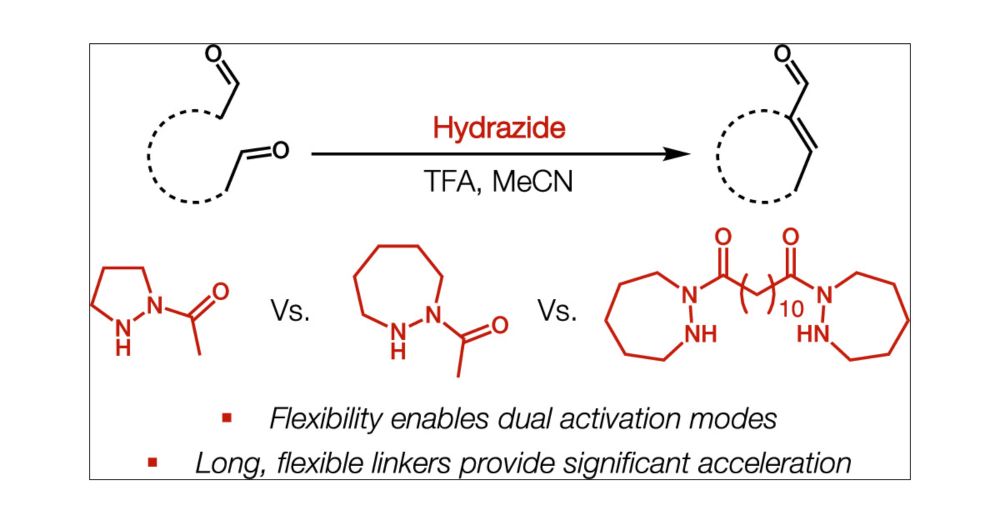
My work on bifunctional organocatalysis of aldol reactions by flexible dihydrazides is out in JACS (@pubs.acs.org). I find that hydrazide units connected by long, flexible linkers offer significant rate enhancement relative to monohydrazides. doi.org/10.1021/jacs... #ChemSky
15.01.2025 15:05 — 👍 6 🔁 1 💬 1 📌 0
As part of our ongoing collaboration with @charlesthechemist.bsky.social at Merck, we found a new way to promote alkene carboxy-alkylation that exploits the unique chemoselectivity profile of CO2•- accessed from formate! Check it out! Also, first #ChemSky post! Congrats to all the authors!!!
12.12.2024 17:11 — 👍 36 🔁 5 💬 5 📌 1Do we post papers here now? Online now in JACS: pubs.acs.org/doi/full/10.... Jennifer’s enduring work in making a small structural modification with huge consequences for efficient radiochelation. We identify the Goldilocks zone for inner-sphere fluorination and accommodating small rare earths. ☢️
21.11.2024 17:27 — 👍 40 🔁 5 💬 3 📌 0