We are using inherited genetic variation as a lens to uncover pathways that confer cancer resilience. We aim to translate these insights to develop new therapeutic approaches that not only treat leukaemia, but may ultimately help to prevent it. Stay tuned! (end)
02.01.2026 19:17 —
👍 2
🔁 0
💬 0
📌 0
... and inspiring friends in Sankaran Lab— @mantoszewski.bsky.social, Uma Arora, @lvchosen1.bsky.social, Andrew Lee, Chun-Jie Guo, @lrbzldz.bsky.social, Laila Norford, @alneehus.bsky.social, Lucrezia della Volpe, Lara Wahlster, and others @bostonchildrens.bsky.social and @broadinstitute.org. (7/n)
02.01.2026 19:17 —
👍 1
🔁 0
💬 1
📌 0
This project is thanks to the generosity and expertise of brilliant collaborators @kharaslab.bsky.social, Alex Bick, @yashpershad.bsky.social, Ruslan Soldatov, Kathy McGraw, James Allan, Omar Abdel-Wahab, and others... (6/n)
02.01.2026 19:17 —
👍 1
🔁 0
💬 1
📌 0
I'm deeply grateful for the generosity of the Kennedy Scholarship, which believed in this mission and supported my time in Boston. (5/n)
02.01.2026 19:17 —
👍 1
🔁 0
💬 1
📌 0
This work grew out of a Research Fellowship with
@bloodgenes.bsky.social, whom I first met during an internship at the Harvard Stem Cell Institute in 2017. Vijay has been an exceptional mentor and a major influence in my growth as a physician-scientist. (4/n)
02.01.2026 19:17 —
👍 1
🔁 0
💬 1
📌 0

We show that some individuals are protected from blood cancers because their blood stem cells operate with lower MSI2 activity. This provides human genetic evidence supporting inhibition of MSI2 or its downstream targets for blood cancer prevention. (3/n)
02.01.2026 19:17 —
👍 2
🔁 0
💬 1
📌 0
Please check out the Tweetorial below:
x.com/GauravA_UK/s...
(2/n)
02.01.2026 19:17 —
👍 1
🔁 0
💬 1
📌 0
What protects some people from leukemia?
Thrilled to share my work at @bloodgenes.bsky.social lab, now published in @science.org.
We identify an inherited genetic variant that protects stem cells from blood cancers by reducing risk of CHIP.
t.co/ExgWIJQe6y
🧵👇(1/n)
02.01.2026 19:17 —
👍 29
🔁 7
💬 2
📌 0
Thank you so much for highlighting our work, @erictopol.bsky.social !!
02.01.2026 07:56 —
👍 2
🔁 0
💬 0
📌 0

Enjoyed writing this commentary with @g-agarwal.bsky.social for @bloodjournal.bsky.social: ashpublications.org/blood/articl...
Covers an exciting paper from Tapper and co: ashpublications.org/blood/articl...
#mpnsm
26.12.2025 18:05 —
👍 11
🔁 2
💬 0
📌 0
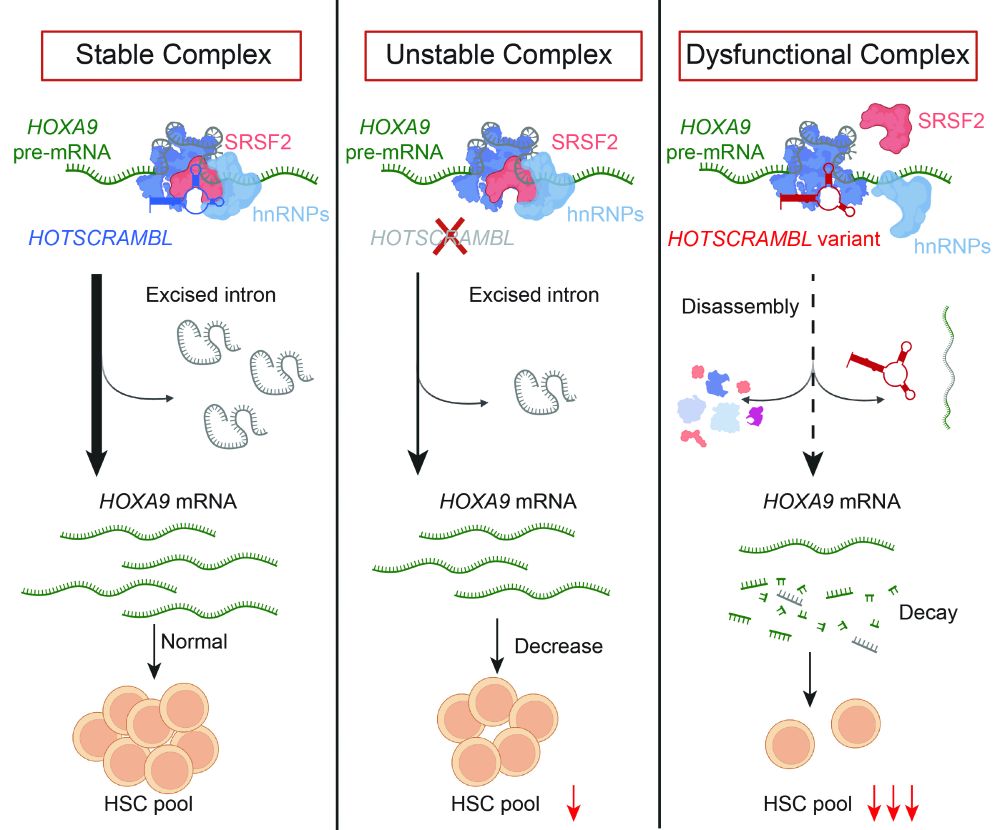
Delighted to have our preprint led by @lvchosen1.bsky.social
up: Genetic variation reveals a homeotic long noncoding RNA that modulates human hematopoietic stem cells
biorxiv.org/content/10.1...
🧵 below ...
17.07.2025 20:23 —
👍 10
🔁 5
💬 1
📌 2
Grateful to have our research illustrated so beautifully by @atjcagan.bsky.social ! 🙏
Check out our work below, in which we describe inherited genetic resilience that protects some individuals from blood cancers 👇
www.biorxiv.org/content/10.1...
01.05.2025 20:48 —
👍 4
🔁 0
💬 0
📌 0
Congrats @hemagene.bsky.social and Jorge, awesome work!!
03.04.2025 21:30 —
👍 1
🔁 0
💬 0
📌 0
So proud of this incredible work from @g-agarwal.bsky.social from our group with help from many fantastic folks in our lab and inspiring collaborators, including @kharaslab.bsky.social, Alex Bick, @yashpershad.bsky.social, and many others! Please check out Gaurav's awesome 🧵👇👇
27.03.2025 20:36 —
👍 39
🔁 8
💬 1
📌 0
I am hugely grateful for Vijay’s amazing mentorship and support, and the freedom he has given to pursue my scientific interests. I am incredibly optimistic in our vision to leverage human genetic resilience towards improved therapies for patients with blood disorders. Stay tuned! (end).
27.03.2025 20:30 —
👍 3
🔁 0
💬 0
📌 0
lrbzldz.bsky.social
And to inspiring friends and colleagues in Sankaran Lab @mantoszewski.bsky.social, Uma Arora, @lvchosen1.bsky.social, Andrew Lee, Chun-Jie Guo, @lrbzldz.bsky.social, Laila Norford, @alneehus.bsky.social, Lucrezia della Volpe, Lara Wahlster and so many others, from whom I have learnt so much. (16/n)
27.03.2025 20:30 —
👍 3
🔁 0
💬 1
📌 0
None of this work would have been possible without the amazing support of brilliant collaborators @kharaslab.bsky.social, Alex Bick, @yashpershad.bsky.social, Ruslan Soldatov, Kathy McGraw, James Allan, Omar Abdel-Wahab, and others, who have brought so much expertise into this project. (15/n)
27.03.2025 20:30 —
👍 3
🔁 0
💬 1
📌 0
This work is the culmination of a Research Fellowship in the lab of @bloodgenes.bsky.social , who I first met in 2017 during a Harvard Stem Cell Institute internship. As fate would have it, I would return to work with Vijay 6 years later, with the generous support of a Kennedy Scholarship. (14/n)
27.03.2025 20:30 —
👍 3
🔁 0
💬 1
📌 0
Excitingly, our work provides human genetic evidence supporting inhibition of MSI2 (or its downstream targets) as rational approaches to enable blood cancer prevention. More broadly, we hope this will inspire further efforts to decode and leverage natural cancer resilience. (13/n)
27.03.2025 20:30 —
👍 3
🔁 0
💬 1
📌 0

Our findings uncover a germline mechanism directly protecting HSCs from blood cancers, by altering a post-transcriptional RNA network through reduced MSI2 levels, which attenuates the fitness advantage of CH. (12/n)
27.03.2025 20:30 —
👍 3
🔁 0
💬 1
📌 0

Moreover, we show in experimental models that reducing MSI2 levels protects human HSCs from phenotypic expansion in ASXL1-mutant CH, whilst MSI2 overexpression cooperates with Asxl1-/- in mouse models to induce myelodysplastic syndrome. (11/n)
27.03.2025 20:30 —
👍 3
🔁 0
💬 1
📌 0

Can rs17834140 protect from CH? In collaboration with @AlexBickMDPhD @yash_pershad, we show in a longitudinal cohort that rs17834140-T is associated with slower CH expansion rates, and predicts transience of large CH clones, implicating MSI2 levels as a modifier of HSC fitness. (10/n)
27.03.2025 20:30 —
👍 5
🔁 0
💬 1
📌 0

… thereby uncovering a network of MSI2-regulated mRNAs that are highly translated in human HSCs, and downregulated with inherited CH resilience. Strikingly, these mRNAs are reciprocally upregulated in TET2-CH, and enriched expression predicts poor prognosis in AML. (9/n)
27.03.2025 20:30 —
👍 3
🔁 0
💬 1
📌 0

So how does reduced MSI2 protect HSCs from blood cancers? In collaboration with @KharasLab, we mapped direct mRNA binding targets of MSI2 in human HSCs. Remarkably, the majority of MSI2-bound mRNAs were downregulated in CH-resilient HSCs with reduced MSI2 levels… (8/n)
27.03.2025 20:30 —
👍 3
🔁 0
💬 1
📌 0
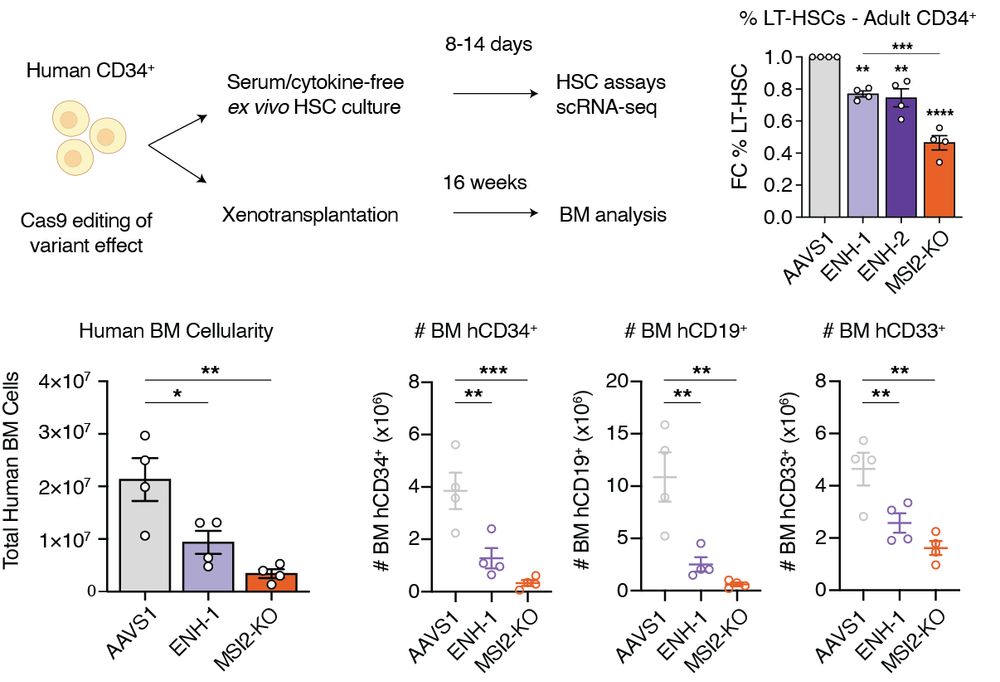
MSI2 is an RNA-binding protein that regulates stem cells – but can downtuning its levels alter HSCs functionally? Yes! Genetic variation-driven loss of the MSI2 enhancer partially phenocopies complete MSI2-KO, reducing HSC maintenance and multilineage engraftment in xenografts. (7/n)
27.03.2025 20:30 —
👍 4
🔁 0
💬 1
📌 0
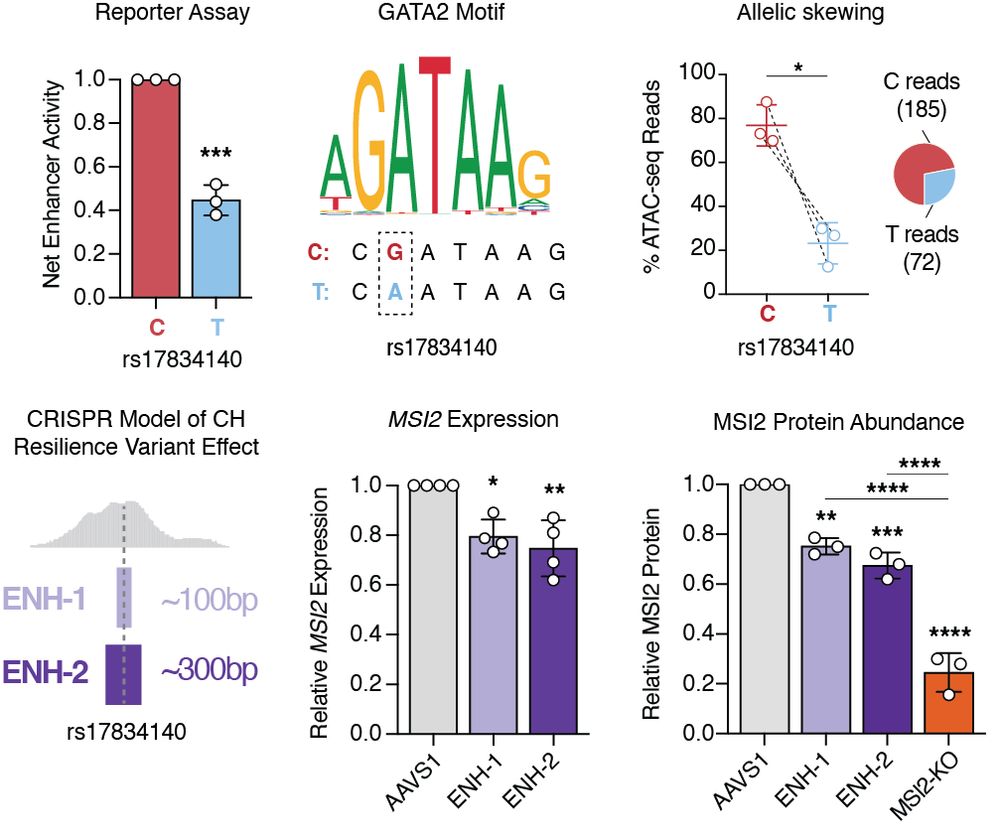
Through variant-to-function mapping, we show that rs17834140-T protects from CH through loss-of-function at an MSI2 enhancer. We model variant effect through CRISPR microdeletions, showing natural germline variation can protect from CH through reducing MSI2 levels in human HSCs. (6/n)
27.03.2025 20:30 —
👍 4
🔁 0
💬 1
📌 0
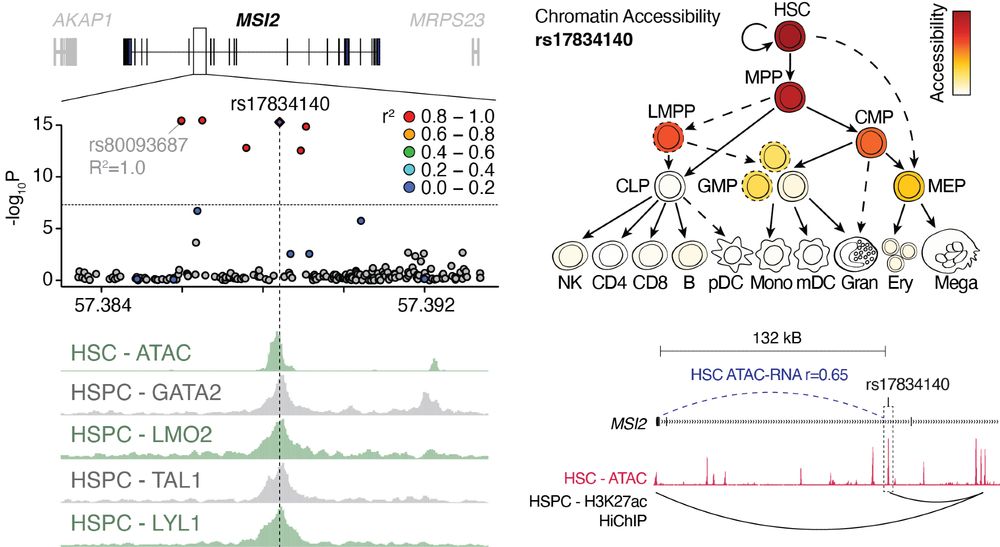
We dug deeper, uncovering rs17834140 as the likely causal variant at this locus – located in a regulatory element active selectively in HSCs – the cell type of origin in CH! We set out to mechanistically understand how rs17834140 modulates HSCs to confer blood cancer resilience. (5/n)
27.03.2025 20:30 —
👍 3
🔁 0
💬 1
📌 0
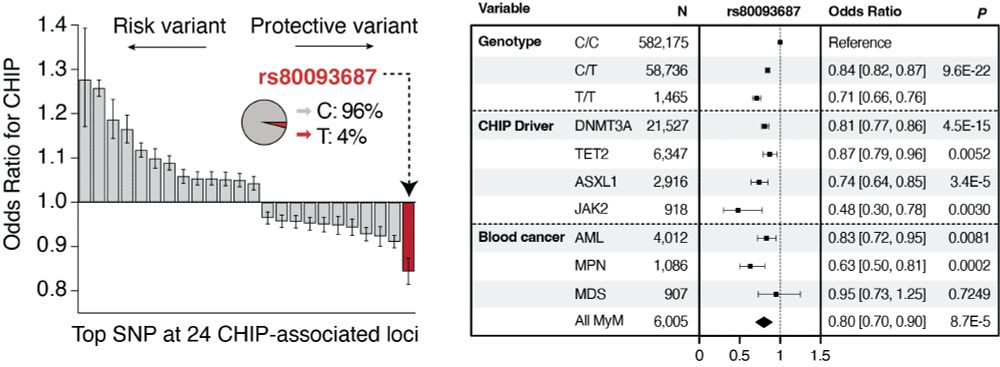
To identify protective effects, we conducted a GWAS meta-analysis of CH across population biobanks. We identified germline variation at the 17q22 locus associated with robust resilience to CH [OR=0.84] and myeloid malignancies [OR=0.80] in the population. (4/n)
27.03.2025 20:30 —
👍 3
🔁 0
💬 1
📌 0
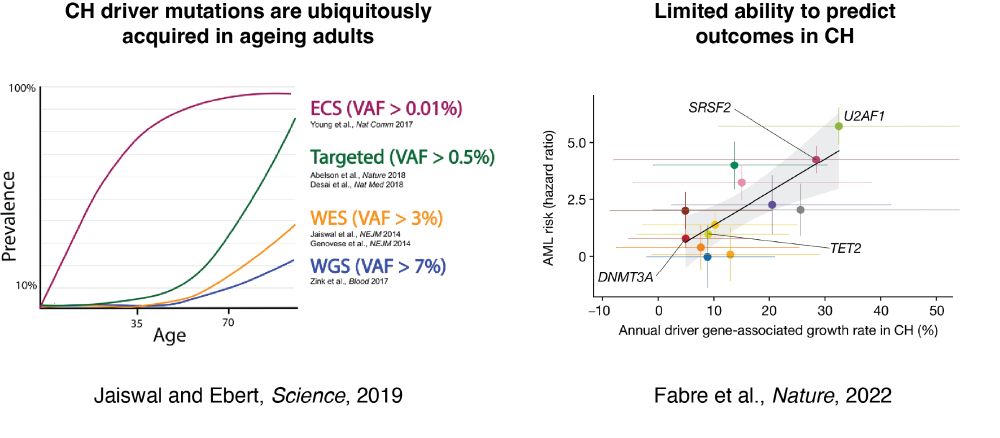
Blood cancers are preceded by somatic mutations that drive expansion of hematopoietic stem cells (HSCs) – termed “clonal hematopoiesis” (CH). But CH also occurs ubiquitously in adults – so why do some progress to blood cancers, and others remain protected? (3/n)
27.03.2025 20:30 —
👍 3
🔁 0
💬 1
📌 0