
PGS also associated with brain regions, including in developing human connectome project and with motor area regions of the developing brain.
08.01.2026 14:15 — 👍 1 🔁 1 💬 1 📌 0PGS also associated with brain regions, including in developing human connectome project and with motor area regions of the developing brain.
08.01.2026 14:15 — 👍 1 🔁 1 💬 1 📌 0To come - infant genomics toolkit, several infancy GWASs
08.01.2026 14:15 — 👍 1 🔁 1 💬 0 📌 0
Gene based results show enrichment with intellectual disability and autism, implying a shared developmental genetics?
Genetics of walking seems to be brain-enriched
PGS explain 3-6% of variance in walking.
11 GWS independent loci. Effect sizes range from 0.06 months to 0.23 months. One locus associated with RBL2 via eQTL. Associated with Brunet-Wagner (hypotonia, motor impairments, unsteady or absent walking).

60k+ GWAS (just in EUR, need moar data from outside EUR!): www.nature.com/articles/s41...
08.01.2026 14:15 — 👍 1 🔁 1 💬 1 📌 0
Age of onset at walking - varies between 8-18 months.
Complex and highly heritable. Combines a lot of different factors (motivation, muscles, coordination). Delays are often viewed as a red flag.
Significant twin heritabilities for lots of infant traits. GWAS are largely missing (3 reasonably sized ones prior to AR's work), but lots of use of other trait PGS to examine this.
08.01.2026 14:15 — 👍 1 🔁 1 💬 1 📌 0
Now Geli Ronald will talk about a genome wide association study of age at onset walking.
Why study this age? Critical period for environment, rapid onset of developmental milestones and brain changes. Arguably under appreciated in common variant genetics.

*New paper* showing that subclinical #hypomania @ 18:
-sig linked to 14 psychiatric/neurodev diagnoses
-Highest genetic correlations: ADHD, drug & alcohol misuse
-Highest enviro correlations: psychosis, anorexia & bipolar
acamh.onlinelibrary.wiley.com/doi/full/10....
@angelicaronald.bsky.social
Thanks to @uniofsurrey.bsky.social for funding this event.
London Genetics Network is a special interest group funded by the UK Genetic Society. If you are a researcher working in human genetics in London or the surrounding areas please email us to join the network: LondonGeneticsNetwork@gmail.com
🔔 LGN Summer Lecture! Wed 16 Jul @ UCL Bloomsbury. @dr-appie.bsky.social (Amsterdam UMC) on “Genetic Architecture of a Social Construct”. ☕ 15:30 coffee | 16:00 talk | 🤝 17:00 networking. Members: check your email for the invite from the LGN mailing list.
14.07.2025 11:46 — 👍 6 🔁 2 💬 1 📌 0

Realizing the promise of genome-wide association studies for effector gene prediction www.nature.com/articles/s41...
12.06.2025 10:25 — 👍 16 🔁 3 💬 0 📌 1
On 26th June check out the conference @acamh.bsky.social ‘Neurodiversity: Cutting-Edge Research, Evolving Perspectives, and Effective Innovations - 2025 Jack Tizard Memorial International Conference’. www.acamh.org/event/neurod...
Talks on new research and innovative approaches to #Neurodiversity

Researchers with ADHD discuss its peaks and valleys and how they structure their work lives to succeed
https://go.nature.com/3FitQh4
(9/9) It was a great pleasure working on this with Morgan Morgan, Ilan Libedinsky, Chloe Austerberry, Sander Begeer, @dr-appie.bsky.social, @angelicaronald.bsky.social and @tincatwin.bsky.social
31.05.2025 09:21 — 👍 5 🔁 2 💬 0 📌 1(8/9) To conclude, due to inconsistent associations and limited generalizability, we underscore that the autism polygenic score does not have clinical utility and should only be applied for scientific purposes, with improvements needed for a deeper understanding of autism’s polygenic underpinnings
31.05.2025 09:21 — 👍 6 🔁 1 💬 1 📌 0(7/9) We show that the autism polygenic score, as a standalone variable associates consistently with autism diagnostic status but is unable to capture the spectrum’s complex phenotypical and etiological differences and its genetic overlap with other traits and conditions.
31.05.2025 09:21 — 👍 4 🔁 1 💬 1 📌 0(6/9) Associations with outcomes other than those mentioned above were inconclusive and effect sizes generally small (median r = 0.03). Hence, our results suggest the autism polygenic score may lack the statistical power to adequately capture polygenic effects.
31.05.2025 09:21 — 👍 4 🔁 1 💬 1 📌 0(5/9) Our systematic review also revealed evidence for associations with social behavior, depression, motor skills and physical activity, although these results show incongruency over samples.
31.05.2025 09:21 — 👍 4 🔁 1 💬 1 📌 0(4/9) A meta-analysis of nine studies revealed strong evidence for an association between the autism polygenic score and autism diagnosis in independent cohorts (meta-analytic r = 0.158 (95% CI 0.067 – 0.249)), which supports the polygenic score’s specificity.
31.05.2025 09:21 — 👍 4 🔁 1 💬 1 📌 0(3/9) The latest autism GWAS, led by @jakobgrove.bsky.social led to a wealth of studies assessing the relations between the autism PGS and various phenotypes. We included a total of 72 of these studies.
31.05.2025 09:21 — 👍 4 🔁 1 💬 1 📌 0(2/9) 🧬Genetic factors play a substantial role in the etiology of autism and its co-occurrence with other conditions and traits. We aimed to clarify the associations between the autism polygenic score and autism diagnosis, autistic traits, and related behavioral and neurobiological traits
31.05.2025 09:21 — 👍 5 🔁 1 💬 1 📌 0
(1/9) 📣 OUT NOW! 📣
So excited to share that our systematic review and meta-analysis on the autism polygenic score is now published in JAACAP Open @jaacapjournals.bsky.social.
doi.org/10.1016/j.ja...
A (long) thread of our main findings ⤵️

Excited to be in Milan for #eshg2025! If you’re interested in leading analysis of large, diverse cohorts with WGS and cellular genomic data in Australia, I’d be keen to chat - we’re looking to fill a variety of senior comp bio roles: populationgenomics.org.au/careers/ #eshg25
24.05.2025 08:41 — 👍 14 🔁 7 💬 0 📌 0
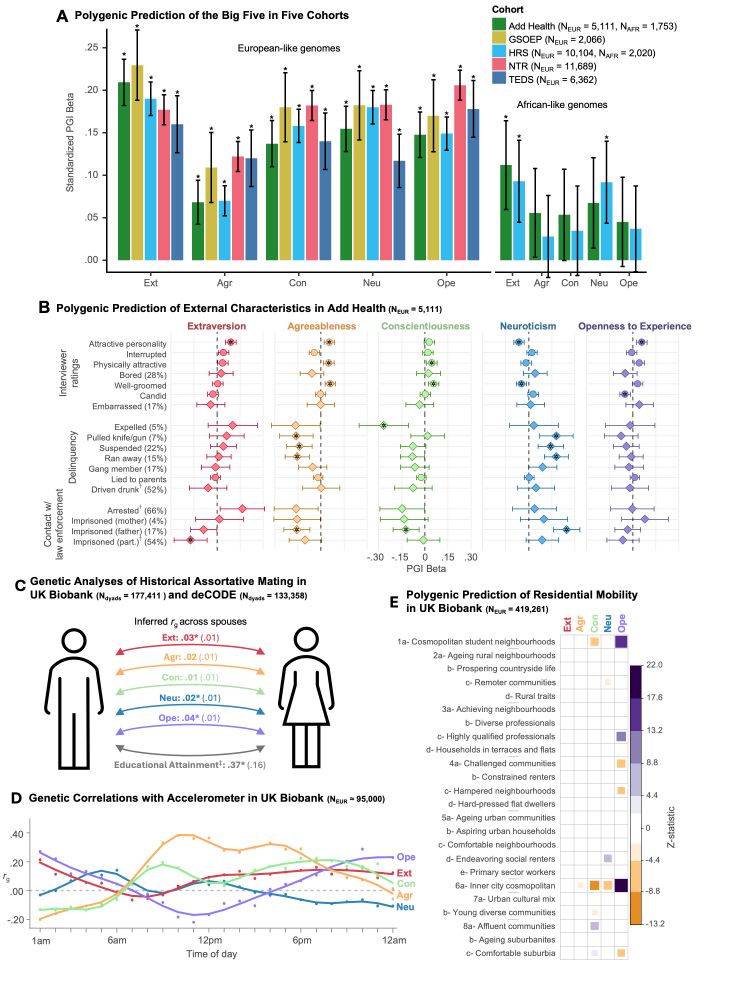
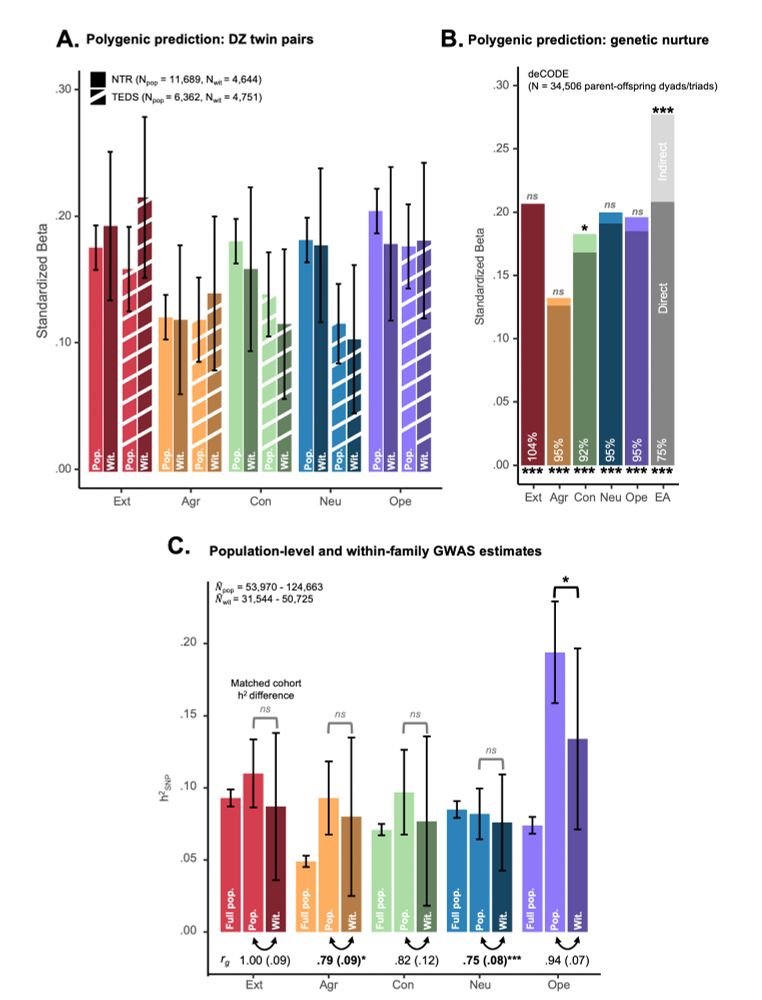
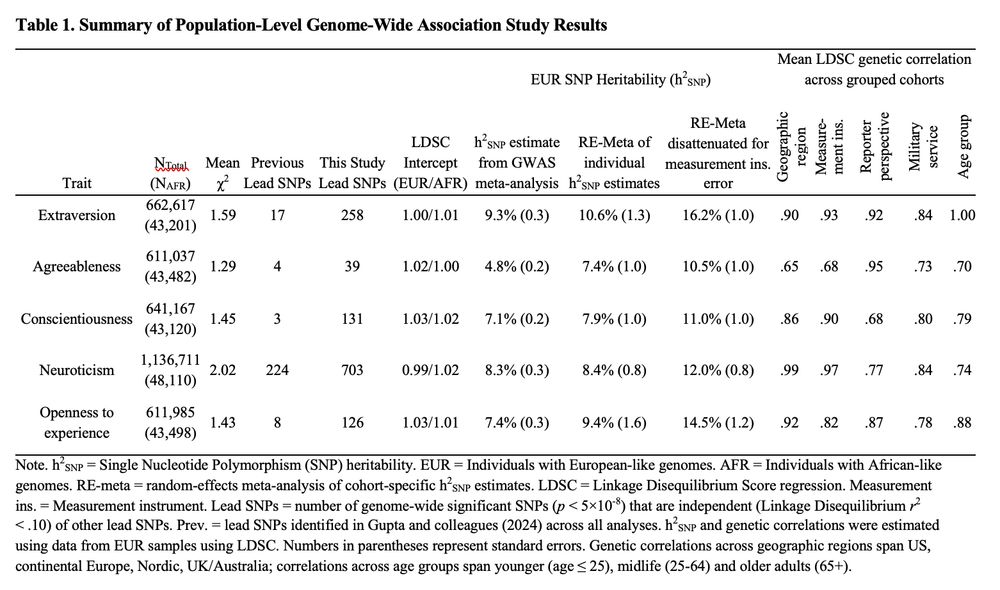
Extremely excited to share the first effort of the Revived Genomics of Personality Consortium: A highly-powered, comprehensive GWAS of the Big Five personality traits in 1.14 million participants from 46 cohorts. www.biorxiv.org/content/10.1...
20.05.2025 10:14 — 👍 154 🔁 70 💬 5 📌 15
Want to learn more?
Read: 'Scientists discover the genes influencing when babies take their first steps'
www.surrey.ac.uk/news/scienti....
And 'Genes influencing when babies walk discovered, and these genes affect longer-term outcomes too'
communities.springernature.com/posts/genes-...
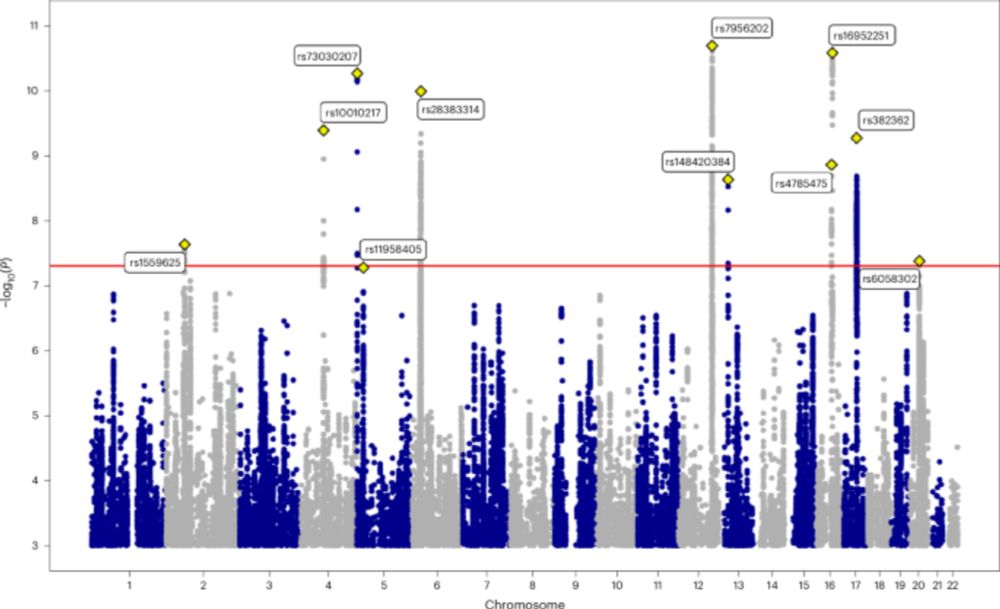
📣Out now 📣
In a GWAS meta-analysis, @angelicaronald.bsky.social and colleagues identified 11 independent genome-wide significant loci associated with age at onset of walking.
www.nature.com/articles/s41...
Very excited about this important piece of work with @angelicaronald.bsky.social characterising gene associations with age of walking onset. We also show using dHCP data that these are related to volume in key brain motor regions (like the deep grey nuclei and cerebellum) even as a newborn infant
08.05.2025 06:07 — 👍 5 🔁 2 💬 0 📌 0
🧬 👶 🐥 How do genes influence when a baby takes their first step?
Our colleague Prof Angelica Ronald explores this question in a fascinating new blog post on Psychology Today. Drawing on her team’s recent publ in #NatureHumanBehaviour and #NatureGenetics.
www.psychologytoday.com/us/blog/surr...
