Justin Treasure's Avatar

Justin Treasure

@mortlauderdale.bsky.social

Dad, husband, Hoosier attorney, audiophile, and doomscroller in search of objective truth and signs of progress.

175 Followers  |  324 Following  |  60 Posts  |  Joined: 12.11.2024  |  2.3946

Latest posts by mortlauderdale.bsky.social on Bluesky

Chairman Grassley, Ranking Member Durbin, and distinguished members of the Committee:

Thank you for the invitation to testify before the Committee once again. In my testimony, I’d like to make three points about how we got here, and offer four thoughts on the way forward.

First, any discussion about nationwide injunctions has to be put into the broader context of the unprecedented moment in which we find ourselves. Substantively, we have a President running roughshod over existing legal constraints to a degree we’ve simply never seen before. And procedurally, we have a Justice Department engaged in highly partisan and ethically dubious behavior in lower courts that we’ve never seen from lawyers working for the federal government.

Rather than respond to that behavior, we’ve seen unprecedented calls from Congress to impeach federal judges for nothing other than the substance of their rulings, and for the elimination of entire district courts. And even this Committee seems to be of the view that the central problem is the relief federal judges are imposing, not the lawlessness they’re imposing it against.

At the risk of bringing data to a mud-fight, the reality is not that a small handful of hand-picked judges appointed by Democratic presidents are using nationwide injunctions to thwart the executive branch. As of last Friday, the 46 cases in which district judges have blocked Trump policies have involved rulings by 39 different judges appointed by five different presidents and sitting in 11 different district courts across seven circuits. That includes nine cases before district judges appointed by Republican presidents, too. Many of those rulings have included nationwide relief. But not all of them.

Chairman Grassley, Ranking Member Durbin, and distinguished members of the Committee: Thank you for the invitation to testify before the Committee once again. In my testimony, I’d like to make three points about how we got here, and offer four thoughts on the way forward. First, any discussion about nationwide injunctions has to be put into the broader context of the unprecedented moment in which we find ourselves. Substantively, we have a President running roughshod over existing legal constraints to a degree we’ve simply never seen before. And procedurally, we have a Justice Department engaged in highly partisan and ethically dubious behavior in lower courts that we’ve never seen from lawyers working for the federal government. Rather than respond to that behavior, we’ve seen unprecedented calls from Congress to impeach federal judges for nothing other than the substance of their rulings, and for the elimination of entire district courts. And even this Committee seems to be of the view that the central problem is the relief federal judges are imposing, not the lawlessness they’re imposing it against. At the risk of bringing data to a mud-fight, the reality is not that a small handful of hand-picked judges appointed by Democratic presidents are using nationwide injunctions to thwart the executive branch. As of last Friday, the 46 cases in which district judges have blocked Trump policies have involved rulings by 39 different judges appointed by five different presidents and sitting in 11 different district courts across seven circuits. That includes nine cases before district judges appointed by Republican presidents, too. Many of those rulings have included nationwide relief. But not all of them.

Against that backdrop, it seems to me that this Committee should be especially careful to not have a knee-jerk reaction to underinformed calls from the President and his supporters—and to preserve the relationship between judicial independence and judicial accountability, rather than taking any rash steps that might undermine it.

Second, it’s worth underscoring that federal courts have long and routinely issued relief that benefits non-parties and/or has nationwide effect. As Justices Kavanaugh and Barrett pointed out last year, this is the inevitable effect of vertical stare decisis—where lower courts in other cases are bound to follow appellate rulings in the first case. Even Justice Gorsuch, the most visible critic of nationwide injunctions on the Supreme Court, has voted in favor of them at least 11 times since 2020.

More than that, any time that a court invalidates a law on its face (rather than as applied to the plaintiffs), it is necessarily providing relief to non-parties—since the law can no longer be enforced against anyone. That’s not only well settled; there’s no serious argument that it’s beyond the federal courts’ powers.

And even nationwide injunctions themselves have virtues that other forms of relief do not. Consider the pending cases challenging President Trump’s effort to restrict birthright citizenship: Do we really think that parents should have to challenge that policy one child at a time? Would it make any sense at all for the scope of birthright citizenship to differ in Arizona, New Mexico, and Texas simply because those three states fall into three different federal circuits? Of course, a nationwide class action could solve that problem, but it does not strike me as a coincidence that the rise in universal injunctions came shortly on the heels of the Supreme Court’s evisceration of nationwide class certification. Chairman Grassley’s bill alludes to class actions as a preferable vehicle, but, tellingly, does nothing to make them more broad…

Against that backdrop, it seems to me that this Committee should be especially careful to not have a knee-jerk reaction to underinformed calls from the President and his supporters—and to preserve the relationship between judicial independence and judicial accountability, rather than taking any rash steps that might undermine it. Second, it’s worth underscoring that federal courts have long and routinely issued relief that benefits non-parties and/or has nationwide effect. As Justices Kavanaugh and Barrett pointed out last year, this is the inevitable effect of vertical stare decisis—where lower courts in other cases are bound to follow appellate rulings in the first case. Even Justice Gorsuch, the most visible critic of nationwide injunctions on the Supreme Court, has voted in favor of them at least 11 times since 2020. More than that, any time that a court invalidates a law on its face (rather than as applied to the plaintiffs), it is necessarily providing relief to non-parties—since the law can no longer be enforced against anyone. That’s not only well settled; there’s no serious argument that it’s beyond the federal courts’ powers. And even nationwide injunctions themselves have virtues that other forms of relief do not. Consider the pending cases challenging President Trump’s effort to restrict birthright citizenship: Do we really think that parents should have to challenge that policy one child at a time? Would it make any sense at all for the scope of birthright citizenship to differ in Arizona, New Mexico, and Texas simply because those three states fall into three different federal circuits? Of course, a nationwide class action could solve that problem, but it does not strike me as a coincidence that the rise in universal injunctions came shortly on the heels of the Supreme Court’s evisceration of nationwide class certification. Chairman Grassley’s bill alludes to class actions as a preferable vehicle, but, tellingly, does nothing to make them more broad…

Third, it is deeply myopic to talk about the rise of nationwide injunctions without talking about the other shifts in litigation behavior that have dramatically increased the impact of such rulings—including the ability of litigants, especially in some states, to file in a single-judge division in which they can literally hand-pick the specific federal judge to hear their case; the selective dilution, in the Fifth Circuit especially, of the standards for Article III standing (which have made it easier for more litigants to challenge more government policies); the increasing conflation by lower courts of the appropriate standards for preliminary and emergency relief; and so on.

Don’t take my word for it, though; in the last three Supreme Court terms, we’ve seen five rulings from the Supreme Court reversing nationwide injunctions issued by hand-picked judges in Texas and Louisiana and affirmed by the Fifth Circuit—because the plaintiffs in all five cases lacked Article III standing. There is no question that nationwide injunctions have been abused. But the abuses are not about the scope of the relief courts are issuing; they’re only exacerbated by it. And, critically, they would not go away even if nationwide injunctions were narrowed or eliminated. Meanwhile, the cost of eliminating nationwide injunctions would be less of an ability to restrain executive branch lawlessness—at a moment in American history in which that power has proven singularly vital.

What, then, is to be done?

First, if the Members’ real concern is that the President should have the authorities that courts are denying to him, it seems like they should consider legislation to provide those authorities, rather than legislation that would prevent courts from fully and effectively enforcing existing legal constraints.

Third, it is deeply myopic to talk about the rise of nationwide injunctions without talking about the other shifts in litigation behavior that have dramatically increased the impact of such rulings—including the ability of litigants, especially in some states, to file in a single-judge division in which they can literally hand-pick the specific federal judge to hear their case; the selective dilution, in the Fifth Circuit especially, of the standards for Article III standing (which have made it easier for more litigants to challenge more government policies); the increasing conflation by lower courts of the appropriate standards for preliminary and emergency relief; and so on. Don’t take my word for it, though; in the last three Supreme Court terms, we’ve seen five rulings from the Supreme Court reversing nationwide injunctions issued by hand-picked judges in Texas and Louisiana and affirmed by the Fifth Circuit—because the plaintiffs in all five cases lacked Article III standing. There is no question that nationwide injunctions have been abused. But the abuses are not about the scope of the relief courts are issuing; they’re only exacerbated by it. And, critically, they would not go away even if nationwide injunctions were narrowed or eliminated. Meanwhile, the cost of eliminating nationwide injunctions would be less of an ability to restrain executive branch lawlessness—at a moment in American history in which that power has proven singularly vital. What, then, is to be done? First, if the Members’ real concern is that the President should have the authorities that courts are denying to him, it seems like they should consider legislation to provide those authorities, rather than legislation that would prevent courts from fully and effectively enforcing existing legal constraints.

Second, insofar as this Committee wants to focus on procedural reforms, it should focus on reducing the ability of individual parties to manipulate the judicial system (by limiting judge-shopping; requiring random assignments; tightening the standards for relief; etc.), not on limiting the ability of courts to hold the executive branch accountable—especially in an age in which Congress seems less willing and/or able to hold the executive branch accountable itself. In that respect, as I’ve suggested, prioritizing constraints on nationwide relief would be the wrong solution to the wrong problem.

Third, even if this Committee is nevertheless intent on providing reforms for nationwide relief, specifically, it should focus on the standard of review in such cases—not on categorically eliminating its availability in all cases. If, like me, you believe federal courts do have the power to issue relief benefitting non-parties in at least some cases, the question should be why such relief is appropriate in particular cases—and not others. Again, the contrast between the birthright citizenship cases and the cases in which universal relief was predicated on overbroad (and subsequently rejected) interpretations of Article III standing is a useful starting point.

Finally, if the Committee’s true goal is to improve the functioning of the judicial system writ large, and not just to maximize short-term partisan political advantage now that a Republican is in the White House, the Committee could follow the model of other recent court-reform legislation—and have any reforms go into effect on or after January 20, 2029.

Otherwise, the message this Committee would be sending is that its goal is to insulate an unprecedented degree of lawless behavior by the executive branch from meaningful judicial review—a message I can’t imagine this Committee wants to send, and one that the separation of powers, to say nothing of the rule of law itself, simply can’t afford.

Second, insofar as this Committee wants to focus on procedural reforms, it should focus on reducing the ability of individual parties to manipulate the judicial system (by limiting judge-shopping; requiring random assignments; tightening the standards for relief; etc.), not on limiting the ability of courts to hold the executive branch accountable—especially in an age in which Congress seems less willing and/or able to hold the executive branch accountable itself. In that respect, as I’ve suggested, prioritizing constraints on nationwide relief would be the wrong solution to the wrong problem. Third, even if this Committee is nevertheless intent on providing reforms for nationwide relief, specifically, it should focus on the standard of review in such cases—not on categorically eliminating its availability in all cases. If, like me, you believe federal courts do have the power to issue relief benefitting non-parties in at least some cases, the question should be why such relief is appropriate in particular cases—and not others. Again, the contrast between the birthright citizenship cases and the cases in which universal relief was predicated on overbroad (and subsequently rejected) interpretations of Article III standing is a useful starting point. Finally, if the Committee’s true goal is to improve the functioning of the judicial system writ large, and not just to maximize short-term partisan political advantage now that a Republican is in the White House, the Committee could follow the model of other recent court-reform legislation—and have any reforms go into effect on or after January 20, 2029. Otherwise, the message this Committee would be sending is that its goal is to insulate an unprecedented degree of lawless behavior by the executive branch from meaningful judicial review—a message I can’t imagine this Committee wants to send, and one that the separation of powers, to say nothing of the rule of law itself, simply can’t afford.

I'll be testifying before the Senate Judiciary Committee this morning at 10:15 ET on the "bipartisan problem of nationwide injunctions." (The other witnesses are Sam Bray and Jesse Panuccio.)

Livestream link: www.judiciary.senate.gov/committee-ac...

My written testimony is in the attached images:

02.04.2025 13:21 — 👍 503    🔁 90    💬 32    📌 12

This is enough Democrats to vote for a new leader. That process needs to start immediately. If you voted with Donald Trump, you aren’t in the running.

14.03.2025 21:29 — 👍 1431    🔁 341    💬 73    📌 19

Both McBride and Keating deserve credit. Awesome.

12.03.2025 01:35 — 👍 0    🔁 0    💬 0    📌 0
Post image

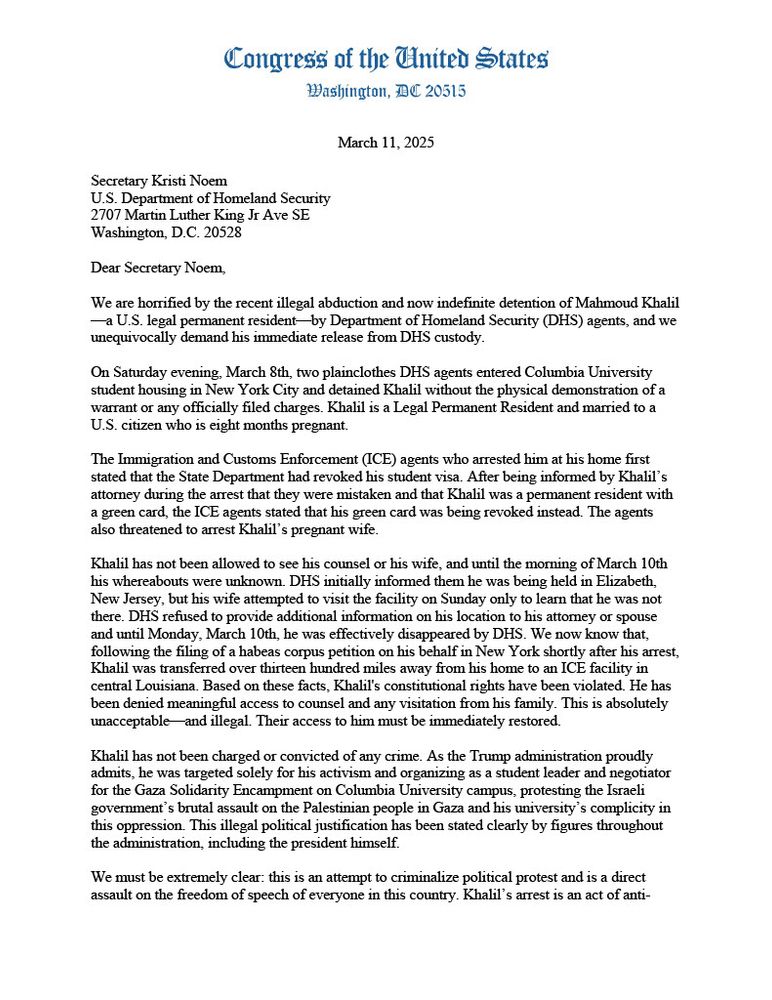
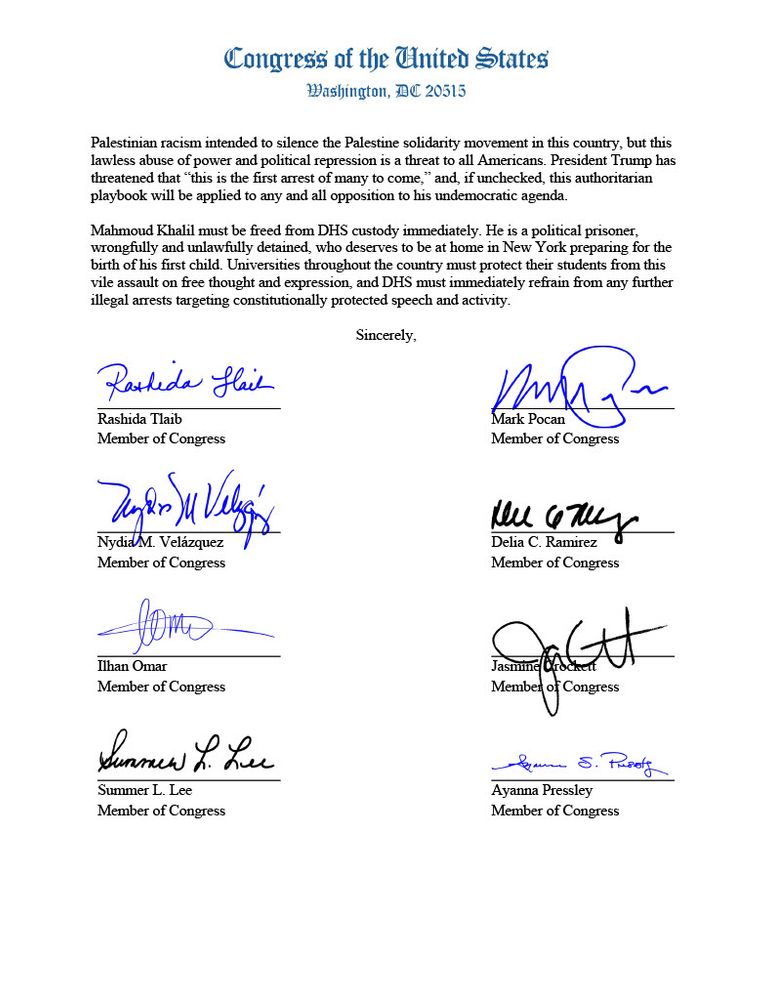
Alright, I got Mahmoud Khalil's full habeas corpus petition now. The whole thing is linked below. ⬇️

10.03.2025 23:39 — 👍 201    🔁 48    💬 5    📌 2
Post image Post image Post image

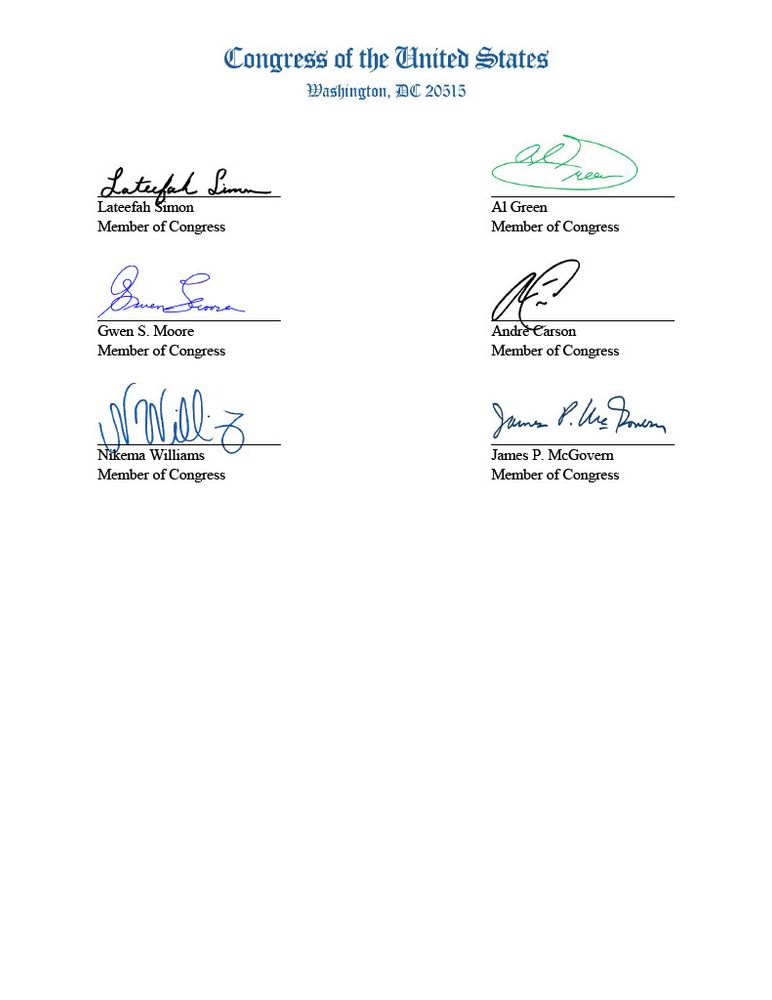
Mahmoud Khalil should be at home with his pregnant wife.

Instead, he's been illegally abducted & had his constitutional right to free speech & due process stripped.

We're demanding his immediate release and we cannot allow this abuse of power to go unchecked. #FreeMahmoudKhalil

11.03.2025 18:28 — 👍 23150    🔁 5978    💬 438    📌 265

Just look at these paragraphs from the AP story.

Hegseth called Brown unqualified solely because he's Black. Then they fired him... and replaced him with a white guy so indisputably unqualified that he requires a Presidential waiver.

This is what "merit" means to them.

apnews.com/article/trum...

22.02.2025 01:53 — 👍 15912    🔁 5943    💬 465    📌 321
Video thumbnail

Steve Bannon, after calling for Trump to be President for life, did a Nazi salute on stage at CPAC.

Nazism has officially taken over the GOP.

The few remaining conservatives have a choice: either leave the party and obstruct it—or choose to be complicit.

21.02.2025 02:05 — 👍 1769    🔁 805    💬 101    📌 259

I imagine this could get a lot of government lawyers in a lot of hot water with judges, and ultimately with their respective disciplinary commissions.

19.02.2025 02:13 — 👍 2    🔁 0    💬 0    📌 0

Thanks, Supreme Court!

16.02.2025 03:33 — 👍 0    🔁 0    💬 0    📌 0
Preview
ATTN: HHS EMPLOYEES If you work for HHS, read this BEFORE you open certain emails

ATTN HHS EMPLOYEES: Firing notices are going out. I am in receipt of an email saying they will revoke your access as soon as you read the email that you've been fired. Please download everything you need before you open that email. SHARE FAR & WIDE. My latest: www.muellershewrote.com/p/attn-hhs-e...

15.02.2025 01:31 — 👍 24768    🔁 14852    💬 429    📌 420

📌

11.02.2025 15:17 — 👍 2    🔁 0    💬 0    📌 0
Preview
Weight Mikal Cronin · MCII · Song · 2013

Sort of an anthem over the last few weeks.

"I'm not ready for the second wave, the weight of seeing through..."

11.02.2025 15:15 — 👍 1    🔁 0    💬 0    📌 0

Said the exact same thing.

10.02.2025 01:54 — 👍 0    🔁 0    💬 0    📌 0

Chef's kiss.

05.02.2025 22:58 — 👍 0    🔁 0    💬 0    📌 0

This needs to be happening every day everywhere. Screech this garbage to a halt.

05.02.2025 15:36 — 👍 2    🔁 0    💬 0    📌 0

At the very least, in a few years time, we will look back on his press conference today and talk about how many new extremists/terrorists he created with his words.

05.02.2025 04:04 — 👍 1    🔁 0    💬 0    📌 0

Stay tuned for next week as I heard Trump is working to purchase a large swath of land west of the Mississippi from France.

04.02.2025 02:22 — 👍 1    🔁 0    💬 0    📌 0
Preview
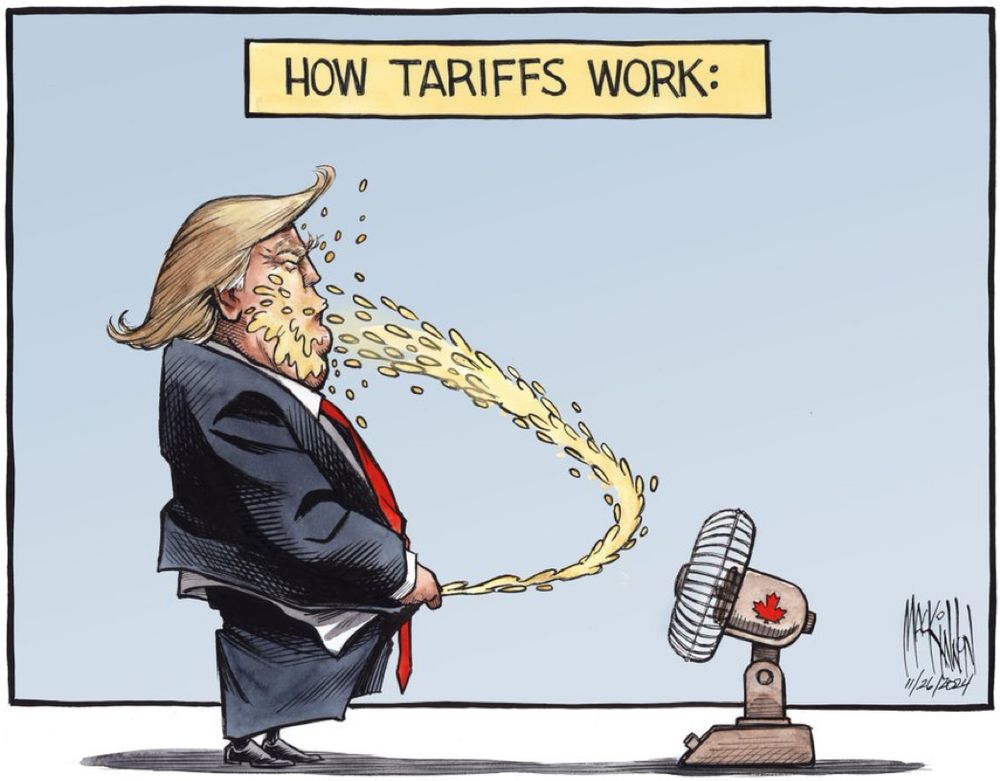
US taxes imports from Canada, Mexico and China as Trump's tariffs begin - BBC News Trump accuses the US's main trading partners of not addressing concerns over illegal drugs and migration - his main election pledges.

Shady vance you’re wrong

In 2024, the US border only seized 43lb of fentanyl from northern border (Canada). That represents around 0,2% of total fentanyl seized at the US border.
In contrast, Canada border seized 946 lb of fentanyl coming from the US.

www.bbc.com/news/article...

03.02.2025 12:47 — 👍 53    🔁 25    💬 4    📌 1
Post image

Perfectly captured.

03.02.2025 02:48 — 👍 82121    🔁 17286    💬 1451    📌 718

Election Truth Alliance website says additional analysis coming for CVR data in other swing states. Anyone have any idea on when?

31.01.2025 16:01 — 👍 4    🔁 0    💬 0    📌 0

Gotta see about increasing my dosage of blood pressure medication.

30.01.2025 16:36 — 👍 1    🔁 0    💬 0    📌 0

This may also explain a great deal of the Canada and Mexico tariff proposals. It's sleight of hand so that we don't see him back slowly away from the tariffs on China. He is trying to save face. Eventually, he will conjure up some justification for dropping those as well and frame it as negotiation.

27.01.2025 17:02 — 👍 1    🔁 0    💬 0    📌 0
Preview
Heeding Trump, Air Force won't teach recruits about Tuskegee Airmen A video on the pioneering Black pilots, famed for their World War II exploits, was stripped from an Air Force basic training curriculum this week.

The Air Force will stop teaching recruits about the Tuskegee Airmen after an order from Donald Trump.

The Tuskegee Airmen were the first Black US military pilots and excelled in combat during World War II.

25.01.2025 21:49 — 👍 5594    🔁 1931    💬 1061    📌 362
Post image

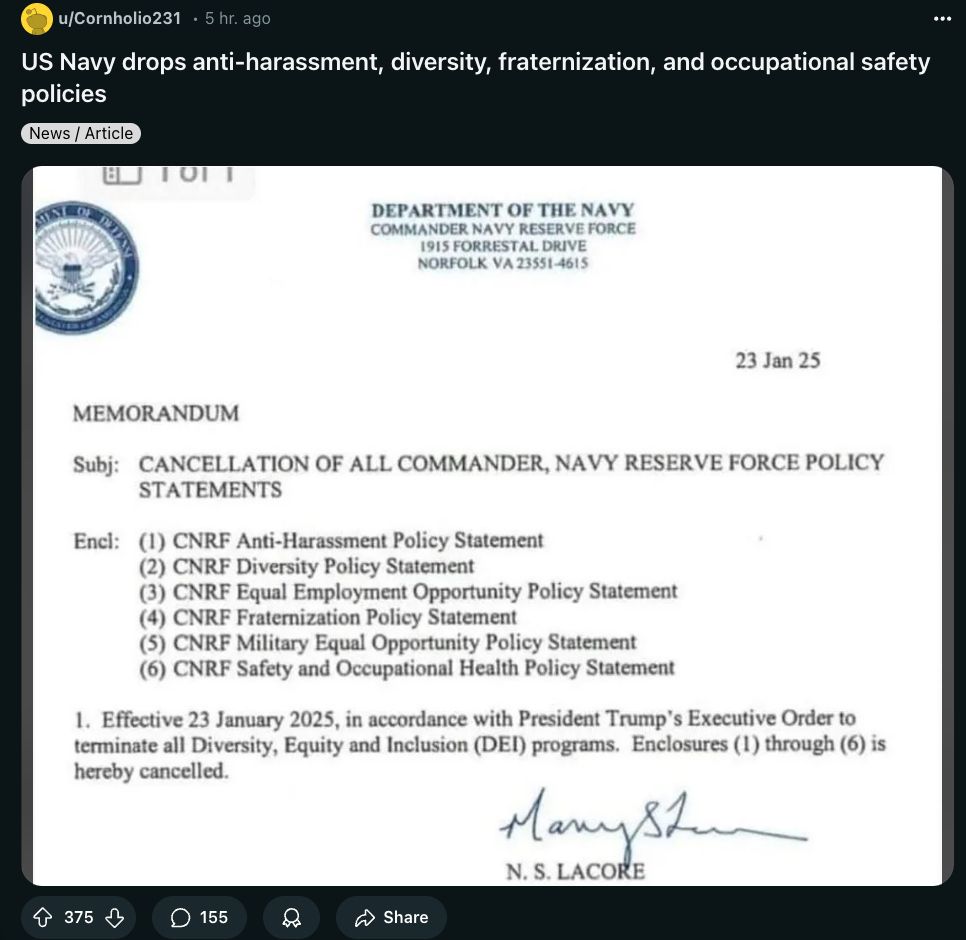
US Navy drops anti-harassment safety policy the day Pete Hegseth gets confirmed as Secretary of Defense.

It was never just about "DEI"

25.01.2025 07:00 — 👍 510    🔁 240    💬 60    📌 35

He wants the prices to go up now early in his term so he can blame Biden and then if and when the problem is ever controlled, he will take credit for the reduction in price. He is artificially inflating the price so that he can claim success.

23.01.2025 21:19 — 👍 0    🔁 0    💬 0    📌 0
Preview
Trump Rescinds Biden Executive Orders Here's a list of the Biden executive orders Trump has rescinded since noon yesterday. I've put them here so you don't have to go to the White House website.

Trump Rescinds Biden Executive Orders open.substack.com/pub/muellers... We knew this bastard would undo all the good Biden stuff! Donald Trash is such a petty shitbag!

21.01.2025 20:07 — 👍 10    🔁 4    💬 2    📌 0
Post image

Indiana folks, this Bill is being introduced in the House, and could mean the end of certain public schools (including 9 in Gary and 50 in Indy). This would dissolve all public schools in districts where more than 50% of eligible students attend private schools, converting them to charters.

22.01.2025 14:04 — 👍 0    🔁 0    💬 0    📌 0

Thanks for setting a great example on day one.

22.01.2025 13:57 — 👍 3    🔁 0    💬 0    📌 0

This is... quite a new way to fight the War on Drugs, isn't it, MAGA voters? Is this what you voted for? When you were pulling the lever, were you telling one another you wanted to see more people connected to heroin distribution on the streets? Is that what you were telling journalists? Or God?

22.01.2025 04:01 — 👍 1171    🔁 392    💬 86    📌 22

Seems like this story should be getting more coverage. I hope others did some soul-searching like this woman did.

21.01.2025 20:35 — 👍 14    🔁 4    💬 1    📌 0

@mortlauderdale is following 19 prominent accounts