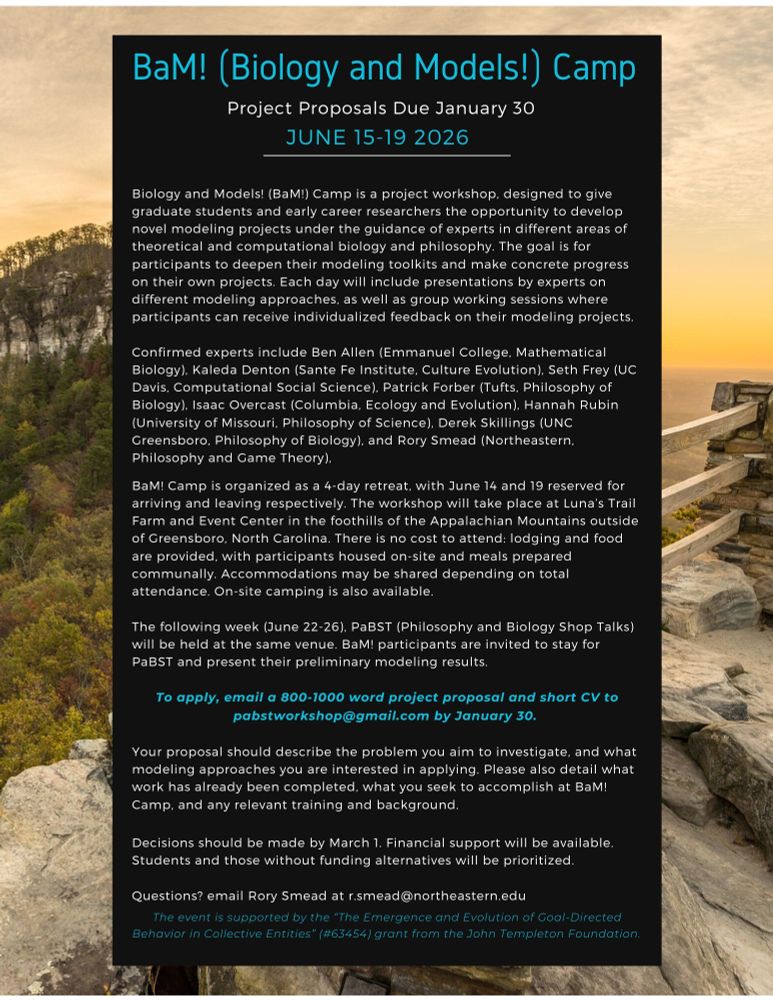
Hi everyone! I'm co-organizing this retreat/workshop June 15-19 for those looking to get started in mathematical/computational modeling of biological processes. Location is a beautiful farm in NC. Please share with students and others who want to build modeling skills. Interdisciplinarity welcome!
02.12.2025 19:00 β π 16 π 6 π¬ 1 π 0
Right now, @tedloch.bsky.social from Rice University is giving a talk on a coordination game approach to studying symbiosis.
Please see below for more information about joining the talk.
02.12.2025 16:02 β π 3 π 1 π¬ 0 π 0
This is such a compelling game to follow on play-by-play while taking a train in the snow back to Champaign.
30.11.2025 03:26 β π 0 π 0 π¬ 0 π 0
Big congratulations to Dr Nikhil Sharma on receiving the Kiel Life Science Postdoc Award 2025! His outstanding work in theoretical biology and evolutionary graph theory makes us proud. Well deserved! π #KLS #MPIEvolBio
www.evolbio.mpg.de/3847270/kiel...
(Photo: Christian Urban, Kiel University)
26.11.2025 07:10 β π 20 π 4 π¬ 0 π 0
This Plasmid Project was directly inspired by the results on multilevel selection that Dan introduced me to! In this thread he explains some fundamental theoretical results that were so influential to me as a Scientist. Looking forward to more Math-driven experiments!!! Thanks Dan!
27.11.2025 00:25 β π 3 π 1 π¬ 0 π 0
Its very exciting to see this paper out in @behavecol.bsky.social. These conversations, expertly led by @delphinedemoor.bsky.social, have really shaped how I now think about working with social network data. Check out Delphine's thread to learn more!
26.11.2025 16:37 β π 8 π 4 π¬ 1 π 0
Postdoc position in individual-level incentives, social
learning, and payoff-biased imitation shape group-level accuracy in complex prediction and decision-making tasks in Konstanz
files.newsletter2go.com/l3slzozn/s_i...
17.11.2025 09:27 β π 33 π 37 π¬ 1 π 1
I really enjoyed the discussions that led to this model, and it was really fun to think about how these kinds of multilevel selection models can describe systems ranging from replication competition between genes in cells to the evolution of cooperative social norms in complex animal societies.
25.11.2025 19:39 β π 1 π 0 π¬ 1 π 0
Right now, Dr. Farshad Shirani from Emory University is giving a talk on "Infinite-Dimensional Dynamics, Spatiotemporal Gamma Oscillations, and Balance of Excitation and Inhibition in Cortical Networks".
Please see below for information to join the seminar.
25.11.2025 16:08 β π 5 π 1 π¬ 0 π 0
AMS :: 2026 Spring Eastern Sectional Meeting, AMS Special Session
By the way, in case you are still interested in models of ecology and evolutionary biology, I am co-organizing a conference session at Boston College in March 2026 with Alex McAvoy and Thomas Zdyrski.
www.ams.org/meetings/sec...
25.11.2025 02:47 β π 0 π 0 π¬ 0 π 0
Thanks for sharing, @blakestacey.myatproto.social. I am particularly looking forward to the chapter on invasion fitness with a pair-approximation approach, as well as the discussion on different interpretations of MLS.
25.11.2025 02:40 β π 0 π 0 π¬ 1 π 0
Two level natural selection with a quasi-stationarity approach
Aiming at a simplified model where natural selection at the individual level is confronted with selection effects at the group level, we consider certain individual-based models of large populations s...
Analysis of this two-level Moran model has led to a lot of other interesting work in probability and PDEs. In one interesting paper, AurΓ©lien Velleret studied quasi-stationary distributions in a diffusive PDE model that arises in the limit of weak selection.
www.aimsciences.org/article/doi/...
23.11.2025 16:56 β π 3 π 0 π¬ 1 π 0
Slide presenting the PDE model of the three-type multilevel selection model featuring slow genes, fast genes, and dimers consisting of a linked pair of the two genes. The slide illustrates the advection terms describing gene-level replication and a nonlocal term describing the effects of protocell-level competition.
Slide illustrating numerical solutions of the three-type protocell model over time, showing that a mix of slow genes, fast genes, and dimer replicators could occur in this model.
We saw that the shadow/ghost(π») prevented coexistence of the fast and slow genes if protocell success most favored an even mix of the genes.
However, introducing a third replicator (a dimer linking together the two genes), we saw that coexistence could occur in three-type multilevel dynamics.
23.11.2025 06:59 β π 1 π 0 π¬ 1 π 0
The Origin of Chromosomes I. Selection for Linkage
A model is analysed of cells containing independently replicating genes, which segregate randomly when the cell divides. We follow the fate of a primiβ¦
Later on in grad school, I had many fun discussions with @fernpizza.bsky.social and Dylan Morris about applying multilevel selection models for coexistence to topics like the origins of chromosomes (such as in the linked paper by Maynard Smith and Szathmary).
www.sciencedirect.com/science/arti...
23.11.2025 05:57 β π 1 π 0 π¬ 1 π 0
Basically, no level of group-level competition can fully erase the shadow of the individual incentive to defect.
Overall, it seemed like it was very hard to sustain coexistence of strategies that are complementary at the group level in the presence of an individual-level selective advantage.
23.11.2025 05:45 β π 0 π 0 π¬ 1 π 0
Slide illustrating the steady state densities achieved by the PDE model for multilevel selection when groups are best off with a composition of 75 percent cooperators. The densities all concentrate around a composition of less than 50 percent cooperation, even in the limit of really strong competition between groups.
Slide illustrating the result that the long-time collective payoff of the population cannot exceed the average payoff of the all-cooperator group. This includes a statement "If groups are best off with an intermediate level of cooperation, no level of between-group competition can fully erase the shadow / ghost of lower-level selection".
When groups are best of with an intermediate mix of cooperators and defectors, no level of group-level selection could allow the population to achieve this optimal composition, and the population could not achieve an average payoff greater than the payoff achieved by an all-cooperator group.
23.11.2025 05:01 β π 0 π 0 π¬ 1 π 0
Modeling Natural Selection at Multiple Levels of Organization | SIAM
Game theory shed light on the evolutionary competition between the interests of individuals and groups.
Here is a blog post that I wrote with Yoichiro Mori, @jplotkin.bsky.social, and Simon Levin on the dynamical behaviors of this cross-scale model. In particular, we highlight a behavior that I like to call the shadow/ghost(π») of lower-level selection.
www.siam.org/publications...
23.11.2025 04:26 β π 2 π 0 π¬ 1 π 0
Slide illustrating the partial differential equation model for multilevel selection with payoffs determined by two-player, two-strategy games. It describes the probability density of having groups with a given fraction of cooperators, and has two terms describing the effects of selection at each level. The individual-level dynamics are described by an advection term with characteristic curves given an individual-level replicator equation, and the group-level dynamics follow a replicator equation for group-level competition (with x-cooperator groups increasing in frequency if the average payoff of such a group exceeds the average group payoff in the population).
The PDE model was really fun to explore, because it was basically a two-level replicator equation: individual-level selection depends on personal payoff within groups and group-level selection favors groups whose achieve higher average payoffs.
23.11.2025 04:21 β π 0 π 0 π¬ 1 π 0
Group-level events are catalysts in the evolution of cooperation
Group-level events, like fission and extinction, catalyze the evolution of cooperation in group-structured populations by creating new paths from uncoβ¦
Early in grad school, Carl Veller pointed me to the Luo-Mattingly model and related cross-scale models by Burt Simon. Carl thought that evolutionary game theory could be helpful to describing different tugs-of-war between individual and group incentives.
www.sciencedirect.com/science/arti...
23.11.2025 02:38 β π 1 π 0 π¬ 1 π 0
Radware Bot Manager Captcha
To ensure we keep this website safe, please can you confirm you are a human by ticking the box below.
Luo and @jonathancm.bsky.social derived and analyzed PDE and Fleming-Viot scaling limits in the limit of infinitely many groups and infintie group size, characterizing the strength of group-level selection required for survival of cooperation in the PDE model.
iopscience.iop.org/article/10.1...
23.11.2025 01:41 β π 2 π 0 π¬ 2 π 0
Mathematically, Luo's model is particularly tractable due to the choice of a nested birth-death process of individuals and groups.
Biologically, the plasmid system of @fernpizza.bsky.social et al fit this approach so nicely because the plasmids replicate independently but impact cellular fitness.
23.11.2025 00:55 β π 2 π 0 π¬ 1 π 0
Schematic diagram from Shishi Luo's paper describing group-structured population dynamics in a population consisting of three three-member groups, illustrating individual-level and group-level birth events based on the strategic composition of groups.
Luo considered two strategies: cheaters with an individual-level replication advantage and cooperators that conferring a collective replication advantage to its group. Luo formulated a stochastic model for individual and group dynamics, deriving ODE and PDE models in the large population limit.
23.11.2025 00:49 β π 0 π 0 π¬ 1 π 0
A unifying framework reveals key properties of multilevel selection
Natural selection can act at multiple biological levels, often in opposing directions. Viral evolution is an important example, with selection occurriβ¦
Here is one of my favorite papers, "A unifying framework reveals key properties of multilevel selection" by Shishi Luo. Luo highlights examples of multilevel selection and introduces a nested birth-death process to model evolutionary competition across scales.
www.sciencedirect.com/science/arti...
23.11.2025 00:40 β π 8 π 3 π¬ 1 π 0
I'm really excited to see this paper by @fernpizza.bsky.social, @baym.lol, et al. This is a great model system for studying multilevel selection, and the experimental work builds nicely on cross-scale theoretical modeling approaches that I've enjoyed learning about over the past few years. π§΅
23.11.2025 00:36 β π 37 π 8 π¬ 1 π 1
Cultural evolution postdoc alert π¨
22.11.2025 02:32 β π 6 π 6 π¬ 0 π 0
@cnrs-insu.bsky.social researcher at @climatecerege.bsky.social.
Using biomarkers to study climate, ocean, and environment of the past.
@icta-uab.bsky.social alumna.
ORCID: https://orcid.org/0000-0002-3047-6064
π«π· -> πͺπΈ -> π«π·
Project Director at the Burnham Center for Community Advancement, burnhamcenter.org. Leading the OneSD initiative, www.onesd.org
Fan of π΄ββοΈ, βΎοΈ and good π₯.
Plant biologist interested in stress recovery mechanisms. Postdoc @Ecker-lab @Salk and NIH/NIGMS K99 fellow. #DroughtStress #StressRecovery #PlantScience
Military historian at NUS, Habs fan, Gunner tragic, and, most important, father of Conor. All opinions my own. Standing with Ukraine. πΊπ¦Denouncing terrorists. π¨π¦ living and working in πΈπ¬. Trump will be defeated. Stand tall Canada. Never 51.π¨π¦
Post doctoral researcher at University of Illinois Chicago, Pharmaceutical science department.
NYT bestselling author //
my first book, ONE OF THE BOYS, is out now! //
buffalo-based football internet transsexual //
writer in residence @ texas roadhouse //
victoria.monster
PhD student @ TU Munich. I am interested in theoretical population genetics, evolutionary modelling and (co-)evolution.
FWO fellow @ KU Leuven studying the origin and evolution of human language
@vandenberglab.bsky.social
winner of the 2025 LAVA Scholarship for autistic researchers
pedagoog, bioloog en ervaringstaalkundige
PhD candidate at the evolutionary modelling Group at KU Leuven (@vandenberglab.bsky.social)
At the evolutionary modelling group at KU Leuven (Belgium) we study evolutionary dynamics in all its forms, whether itβs robustness, persistence, plasticity, or the evolution of language and culture. If it evolves we probably tried to model it!
PhD student in microbial ecology and evolution at the University of Lausanne salazarafra.github.io | Literary fiction, philosophy & cinema
PhD student in evolutionary biology @UChicago
Spatial & temporal structure of biodiversity and morpho complexity; evolution and genetics of complex traits
Computational Biologist. Tenure Track Fellow in Health at the University of Liverpool. π§π·π―π΅πͺπΈπ¬π§π¨π
Phylogenomics and Chemometrics. Prog Rock and Post-Punk. C and Python.
@leomrtns@mstdn.science
dad / evolutionary (behavioral) ecologist
group leader at MPI-AB and STRI research associate
social learning, cultural evolution, extragenetic inheritance, dispersal.
field & stats & math.
cyclist & runner / doom metal aficionado.
he/him.
How does conflict beget cooperation? All about microbes and evolution. He/him- but more a plant with human-readable emotions
Research Fellow at the Flatiron Institute. Incoming Assistant Professor of Physics at University of Toronto 2026 | Previously: IBM Research, Cornell Physics | Statistical mechanics, theoretical biophysics, dynamical systems
davidhathcock.github.io
The official account of Princeton University. In the Nationβs Service and the Service of Humanity.
I read a lot of research.
Currently reading: https://dmarx.github.io/papers-feed/
Statistical Learning
Information Theory
Ontic Structural Realism
Morality As Cooperation
Epistemic Justice
YIMBY, UBI
Research MLE, CRWV
Frmr FireFighter
PhD. Student at Georgia Tech!
Ecology and evolution in microbes. Assistant Prof. @ LIU Post, native NYer, foodie.