No
20.02.2026 23:43 — 👍 1 🔁 0 💬 1 📌 0No
20.02.2026 23:43 — 👍 1 🔁 0 💬 1 📌 0
An Edinburgh family photo at the @societyofvertpaleo.bsky.social meeting.
Soon after we lost my PhD advisor Mark Norell, it was special to be surrounded by the students and postdocs I’ve supervised!

I’m thrilled to present the latest work from my PhD!
David Evans and I evaluated feeding mechanics in two hadrosaurids from the Dinosaur Park Fm, and the differences were quite exciting. A thread [1/11]
doi.org/10.1098/rspb...

Introducing our latest special issue, From Fossil to Microscope: Unraveling the Tapestry of Tissue Anatomy through Paleohistology, with this wonderful cover image from @funstonpaleo.bsky.social et al., of compacted coarse cancellous bone from the early Palaeocene taeniodont, Conoryctes comma.
03.09.2025 11:08 — 👍 6 🔁 5 💬 1 📌 1
Some plucky (or lucky) mammals survived the asteroid that killed the dinosaurs. Among them were our ancestors!
How did they do it? Was it because of the way they grew and reproduced?
Check out our new study on the cover of @journalofanatomy.bsky.social led by @funstonpaleo.bsky.social

A new paper of mine just came out in the Journal of Anatomy! Learn more about Conoryctes and why the insides of its bones are important on my website. Or, check out the open-access paper here: onlinelibrary.wiley.com/doi/10.1111/...
Digging into the rise of mammals
gregfunston.com/2025/07/14/d...

S.P. Zack et al. (2025)
New Cranial and Postcranial Remains of the Once Enigmatic Early Eocene Mammal Wyolestes (Mammalia, Ferae, Hyaenodonta) from North America, and Phylogenetic Evidence for its Interordinal Relationships
Bulletin of the AMNH 475: 1-173
doi: doi.org/10.1206/0003...

I am thrilled to announce I will be joining Stony Brook University as an Assistant Professor this fall! Read more on my website:
www.gregfunston.com/2025/06/25/big-news/
I feel very lucky—this has not come without a tremendous amount of support from a huge cast of people.
The new Walking With Dinosaurs is here!
A quarter century ago the original inspired this geeky teenager to study dinosaurs. I hope this series does the same for a new generation!
A special full circle moment to work on the series & consult with @arctomet.bsky.social & @skeletaldrawing.bsky.social
Check out my new Palaeocast blog post!
This time about the evolution of the arms of oviraptorosaurs. It's a summary of the recent research by Milly Mead @funstonpaleo.bsky.social @stevebrusatte.bsky.social
It features an interview with Milly too!
www.palaeocast.com/evolution-of...

I am very excited to see what we can accomplish as we continue our work—Merycoidodon is just one of four species we’re working on. But I’m even more excited for the future of paleo: it’s encouraging knowing three bright stars are about to join our field!
#science #research #fossil #stem

Our project is focused on using daily growth lines in the teeth of fossil mammals to better understand their life histories. Our poster featured the first thin-section we made, of Merycoidodon, a common, small, sheep/camel-like species of “Oreodont” from the Oligocene.
13.05.2025 04:24 — 👍 5 🔁 0 💬 1 📌 0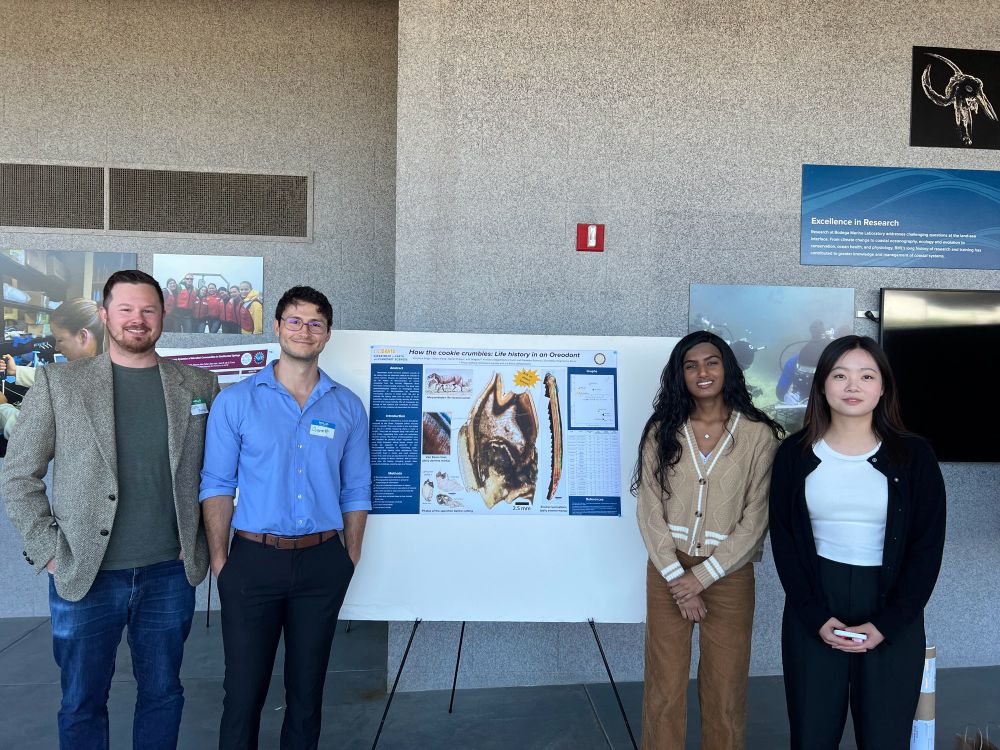
Very proud of my undergraduate students who presented our work at the NorCal GeoBio Symposium this past weekend! It’s been a real pleasure working with this all-star team! From right to left: Xinyu Wang, @versingh.bsky.social and Garrett Zebley.
13.05.2025 04:24 — 👍 5 🔁 0 💬 1 📌 0Thanks Graham! Great to meet the CPB group, lots of stimulating questions that gave me food for thought!
23.04.2025 05:52 — 👍 1 🔁 0 💬 0 📌 0
A troodontid with a pathologic metatarsal Iifts its foot towards its face to investigate. The pathologic bone is highlighted and features a red line to indicate where a thin section was taken. The thin section appears as aarge imags behind the troodontid, the troodontid's tail passing through the central medullary cavity.
Published yesterday in @journalofanatomy.bsky.social with open access, we demonstrate how tiny slices of isolated bones (in this case, troodontid metatarsals) can provide a wealth of information on the growth, lifestyle, and injuries of these animals. (🧵) (Troodontid art by Henry Sharpe )
21.04.2025 16:07 — 👍 44 🔁 14 💬 1 📌 1
Paper here, thread following
onlinelibrary.wiley.com/doi/10.1111/...

Figure caption: Trace element distributions in the enamel of the first and second lower molars Thin section under cross-polarized light shows clear daily laminations and the neonatal line (dotted line) in the enamel of the paraconid of the second lower molar. b, Trace element map of Zn shows enrichment at the neonatal line. c, Ba is enriched in early postnatal enamel (also see Supplementary Fig. 8), but decreases gradually between 31 and 56 days after birth (dashed lines). d, The transition between high and low levels of Ba is clearer in the paraconid of the first lower molar of the same individual, where older enamel including the neonatal line has been worn away. e,f, Overview images showing the position of images within the first (f) and second (e) lower molars. Scale bars, 500 µm (a–d) and 1 mm (e,f). See also Supplementary Figs. 1–3.
Saw a fascinating seminar by @funstonpaleo.bsky.social today on reconstructing life history of mammals around the KP boundary. Incredible that folks can now identify gestation and weaning times from the chemical signatures of milk in fossilized teeth.
www.nature.com/articles/s41...

Fantastic pop sci article about our recent study, written by lead author Milly Mead! It was such a pleasure working with Milly on this project—keep a close eye because she’s sure to produce more excellent work in her exciting PhD project!!
theconversation.com/the-bizarre-...
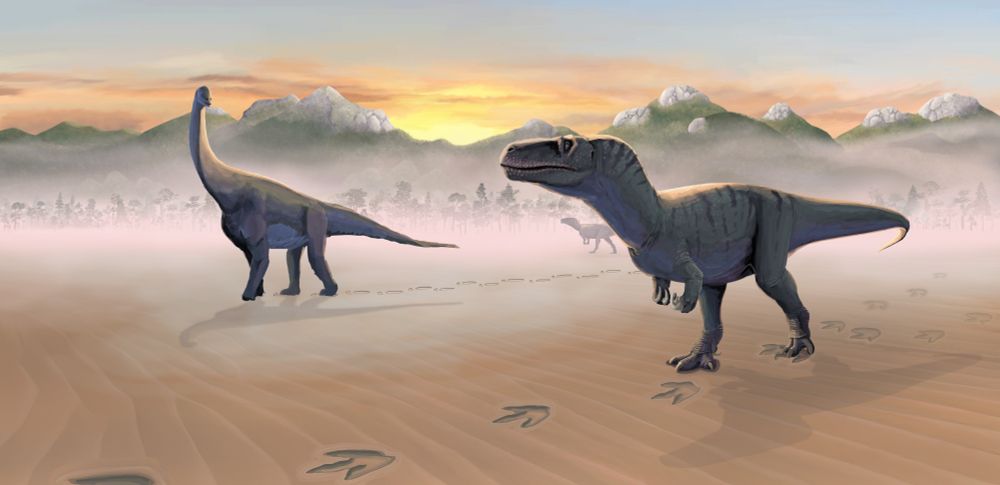
The newest dinosaur discovery from Scotland! Over 100 tracks made by theropods & sauropods.
In the same spot where, 170 million years later, Bonnie Prince Charlie landed on Skye to escape the English.
When the Prince was on the run, he sprinted in the footsteps of dinosaurs!

Many theropods shortened their arms and lost fingers. How did they do it?
Our Edinburgh student Milly Mead, in her first paper, looks into oviraptorosaurs. Arm shortening and finger loss were decoupled!
@funstonpaleo.bsky.social & I are proud supervisors!
royalsocietypublishing.org/doi/10.1098/...

Glad to see our latest work on hadrosaur teeth is out today!
Gill Gallimore, David Evans, and I did a deep dive into whether hadrosaur teeth are as useful as they seem in phylogenetics. A thread [1/14]
dx.doi.org/10.1080/1477...
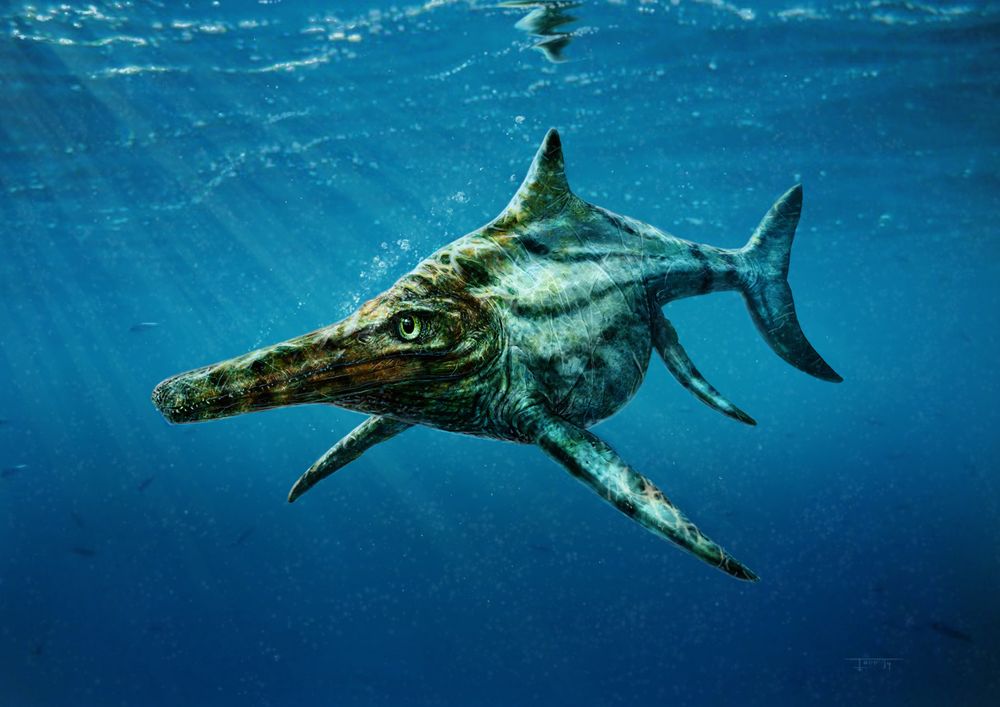
🚨PhD Opportunity: Come to Edinburgh and study ichthyosaurs with us!
Study Scottish fossils from Skye! New ones & historic specimens!
Project led by Stig Walsh, co-supervised by @davfoff.bsky.social Nick Fraser, Erin Maxwell & me.
Details👇
e4-dtp.ed.ac.uk/e5-dtp/super...
