Overall, we find:
a) Positive impacts on food intake, nutrition, and gender equity
b) Meaningful gains in child functional development
c) Limited average anthropometric gains, mediated by sanitation; highlighting need to pair nutrition efforts with sanitation investments (9/10)
27.08.2025 19:48 —
👍 1
🔁 0
💬 1
📌 0
Increased food spending from cash transfers to women was at par with in-kind PDS transfers (similar MPC on food). Thus, cash versus kind debates may be second order when the value of cash transfers is less than what HH are spending on the in-kind item anyway. 8/10
27.08.2025 19:48 —
👍 0
🔁 0
💬 1
📌 0
Child functional development improved. We find a 0.12σ gain in ASQ-3 scores at age 3 — including cognition, and both gross and fine motor skills. These effects may matter even more than physical growth over time as labor markets reward ‘brains’ more than ‘brawn’ (7/10)
27.08.2025 19:48 —
👍 0
🔁 0
💬 1
📌 0
Older siblings (not directly targeted) also saw gains: WAZ scores rose by 0.11–0.13σ, with no heterogeneity by sanitation. Thus, cash transfers benefited other children too, but the mediating role of sanitation in nutrition-to-growth translation may be greater for infants (6/10)
27.08.2025 19:48 —
👍 0
🔁 0
💬 1
📌 0
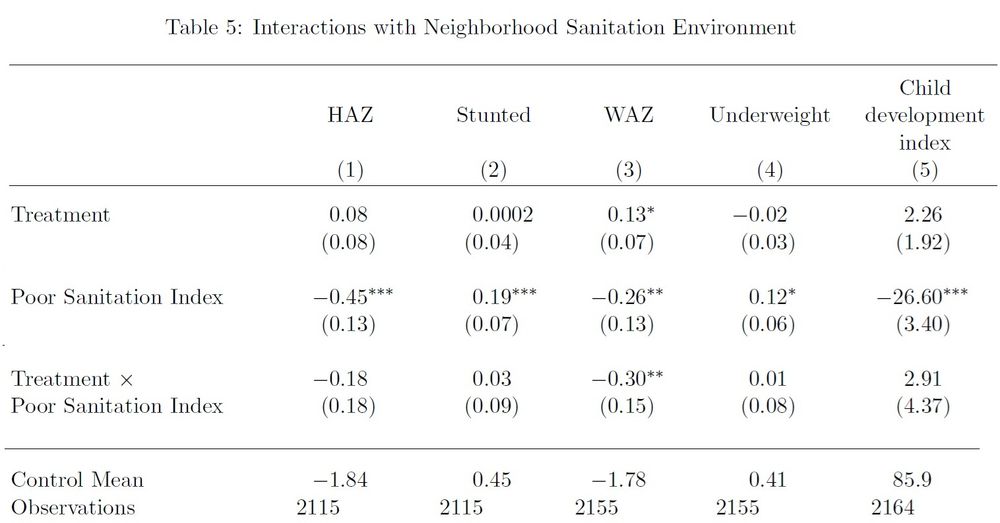
Despite better diets, we do not find average gains in standard anthropometric outcomes (WAZ/HAZ) for targeted children. However, we do find some evidence of gains in areas with better sanitation, consistent with sanitation mediating nutrition-to-growth translation. (5/10)
27.08.2025 19:48 —
👍 0
🔁 0
💬 1
📌 0
We find substantial improvements in intra-household equity: in Y2, maternal calorie intake rose ~3x more than the household average, helping narrow pre-existing gender gaps in nutrition. Measures of empowerment (e.g., health-seeking behavior for children) also increased. (4/10)
27.08.2025 19:48 —
👍 0
🔁 0
💬 1
📌 0
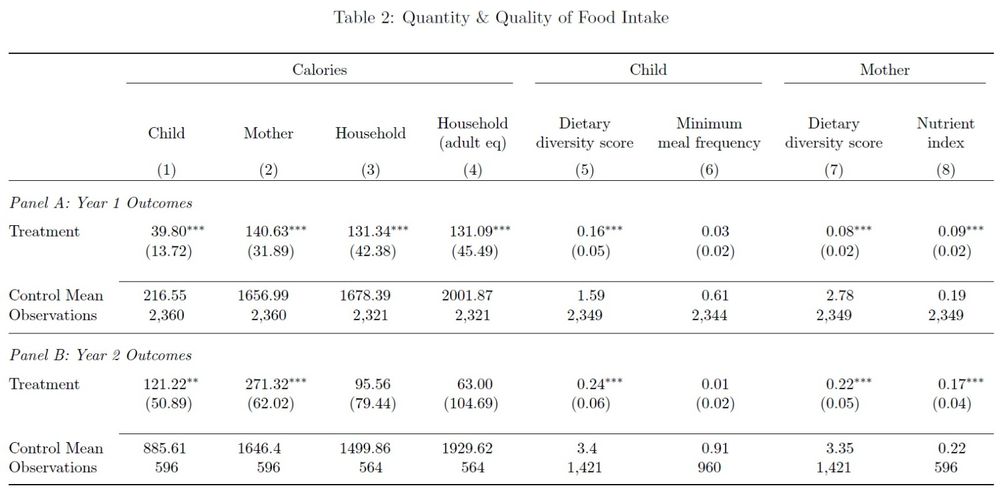
Food consumption rose significantly: household food spending up >11%; calorie intake up 9% (Y1) and 14% (Y2) for mothers and children; protein and iron intake also improved. Dietary diversity gains persisted 18 months after the transfers ended. (3/10)
27.08.2025 19:48 —
👍 0
🔁 0
💬 1
📌 0

The intervention: ₹500/month (~10% of HH consumption) for 2 years to ~1,200 new mothers across 8 Jharkhand districts; given unconditionally, but labeled as support for nutritious food. We tracked food, nutrition, and child development over 3 years. (2/10)
27.08.2025 19:48 —
👍 0
🔁 0
💬 1
📌 0

India now spends ₹2 trillion/year (0.6% of GDP) on cash transfers to 130M+ women—yet we know little about their effects. In a new paper (bit.ly/4mE6EtW), @karthik-econ.bsky.social Paul Niehaus Jeff Weaver & I present findings from the first large-scale RCT of maternal cash transfers in India (1/10)
27.08.2025 19:48 —
👍 9
🔁 4
💬 1
📌 0
Institutional Recognition: Activating Representation to Build Police Responsiveness to Women | American Political Science Review | Cambridge Core
Institutional Recognition: Activating Representation to Build Police Responsiveness to Women
Long time (8 yrs!) in the making, but it's here! Our article on gender, policing, & institutional change is out (Open Access) in @apsrjournal.bsky.social! Working on this @amangla.bsky.social & @sandipz.bsky.social was a privilege, adventure, esp in mixed method research. tinyurl.com/yc4f6ste
20.08.2025 12:39 —
👍 6
🔁 4
💬 0
📌 0

Do mandatory disclosures squeeze the lemons? The case of housing markets in India
What is the impact of mandatory disclosures of quality on market outcomes? Does the impact differ across income groups due to a difference in abilitie…
Real Estate Regulatory Authority was introduced in 2016 to bring transparency in the Indian real estate
What was its impact on outcomes? We answer this question in our new @jpube.bsky.social paper "Do mandatory disclosures squeeze the lemons?"
www.sciencedirect.com/science/arti...
1/6
19.06.2025 01:58 —
👍 3
🔁 3
💬 1
📌 0
Congratulations to J-PAL affiliated professor @sandipz.bsky.social and coauthors for winning the APSA-PSA International Partnership Award! Read about their #RCT evaluating the impact of women's help desks in Indian police stations: povertyactionlab.org/evaluation/i...
07.05.2025 13:56 —
👍 4
🔁 3
💬 0
📌 0

*PSA Prizes* 'Policing in #Patriarchy' wins APSA-PSA International Partnership Award 2025. @apsa.bsky.social. Congratulations @amangla.bsky.social @sandipz.bsky.social and @gabikw.bsky.social buff.ly/jm7zMOk
06.05.2025 11:02 —
👍 5
🔁 2
💬 0
📌 1
We tend to make offers all the way until April 15, and will update waitlist status as best we can once we start hearing back from the first round of admits. At this point we have limited information, so please hold off on waitlist status inquiries at least until after the Open House. n/n
03.03.2025 16:21 —
👍 0
🔁 0
💬 0
📌 0
All other waitlisted students are invited to the virtual open house. Invitations for both Open Houses will go out this week, so look out for these in your email soon. 2/n
03.03.2025 16:21 —
👍 0
🔁 0
💬 1
📌 0
Our first round of decisions for UVA Econ Phd admissions went out on Fri Feb 28. We will have an Open House on Mon Mar 24, both in person and virtual. We can only host a limited number in person, so only admitted students and those high on the waitlist will receive invites for visiting C'ville. 1/n
03.03.2025 16:21 —
👍 0
🔁 0
💬 1
📌 0
Trump’s attack on US institutions, even if fully expected, is dispiriting, discombobulating and dangerous.
In this very difficult time, we have to remember one thing: This is not normal, and it should not be normalized.
24.02.2025 14:29 —
👍 240
🔁 45
💬 3
📌 1
BREAD Conference on Development, Princeton, May 2-3, 2025 – BREAD
One last conference announcement for today... Submit your papers to the BREAD Development Economics conference at Princeton, May 2-3! Submission deadline Feb 25.
ibread.org/conference/b...
#EconSky
23.01.2025 15:02 —
👍 10
🔁 10
💬 0
📌 0
We spent time thinking carefully about best practices/suggestions for the use of social media in Economics and the report is now out here: www.aeaweb.org/about-aea/co... #Econsky 1/n
16.01.2025 15:49 —
👍 44
🔁 28
💬 2
📌 2
Report on the Status of Social Media Use in Economics and Recommendations for Best Practices
Report from the AEA Ad Hoc Committee on the Use of Social Media in Economics is out.
www.aeaweb.org/about-aea/co...
@belindaarch.bsky.social @florianederer.bsky.social @sarahjacobson.bsky.social @corinnelow.bsky.social & I were the committee
thanks to everyone who answered survey or commented.
16.01.2025 15:33 —
👍 25
🔁 10
💬 3
📌 2
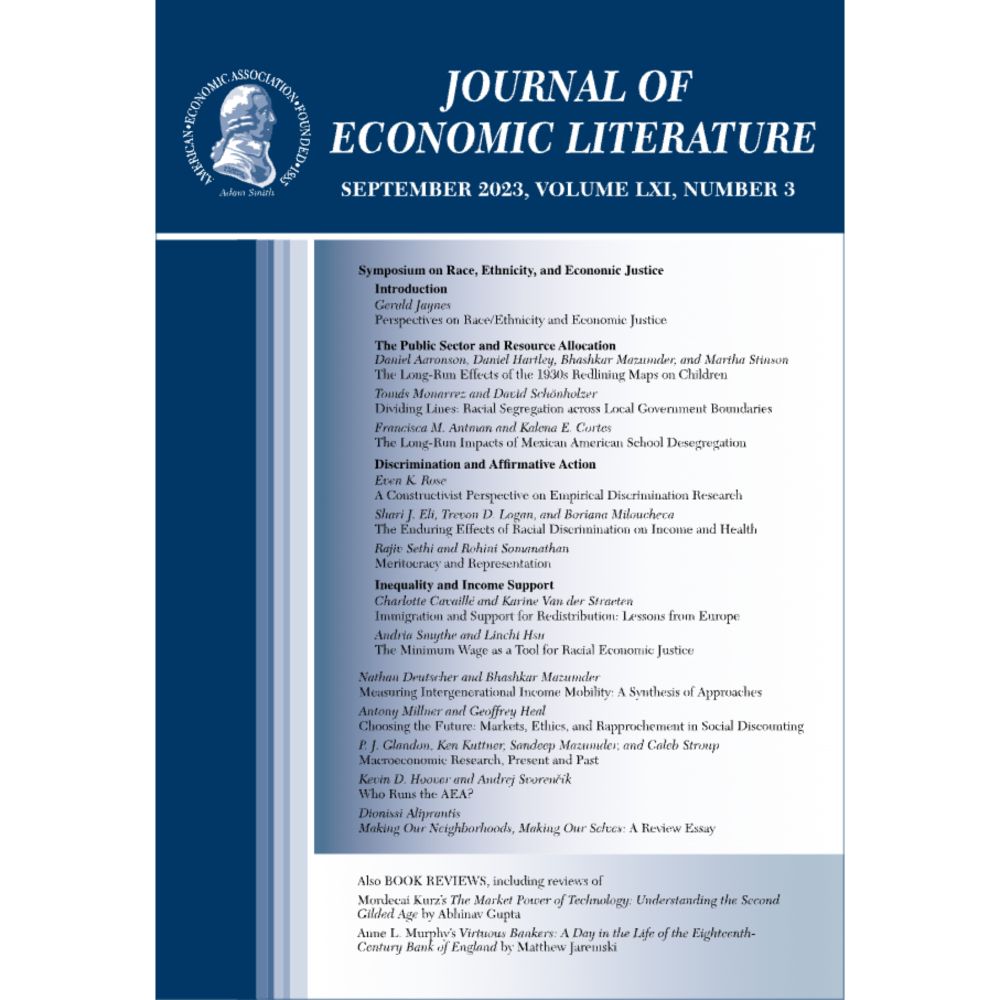
Accelerating India’s Development: A State-Led Roadmap for Effective Governance by Karthik Muralidharan
(Forthcoming Article)
Forthcoming book review in the JEL: "Accelerating India’s Development: A State-Led Roadmap for Effective Governance by Karthik Muralidharan" by Jishnu Das. www.aeaweb.org/articles?id=...
13.01.2025 13:43 —
👍 6
🔁 3
💬 0
📌 0
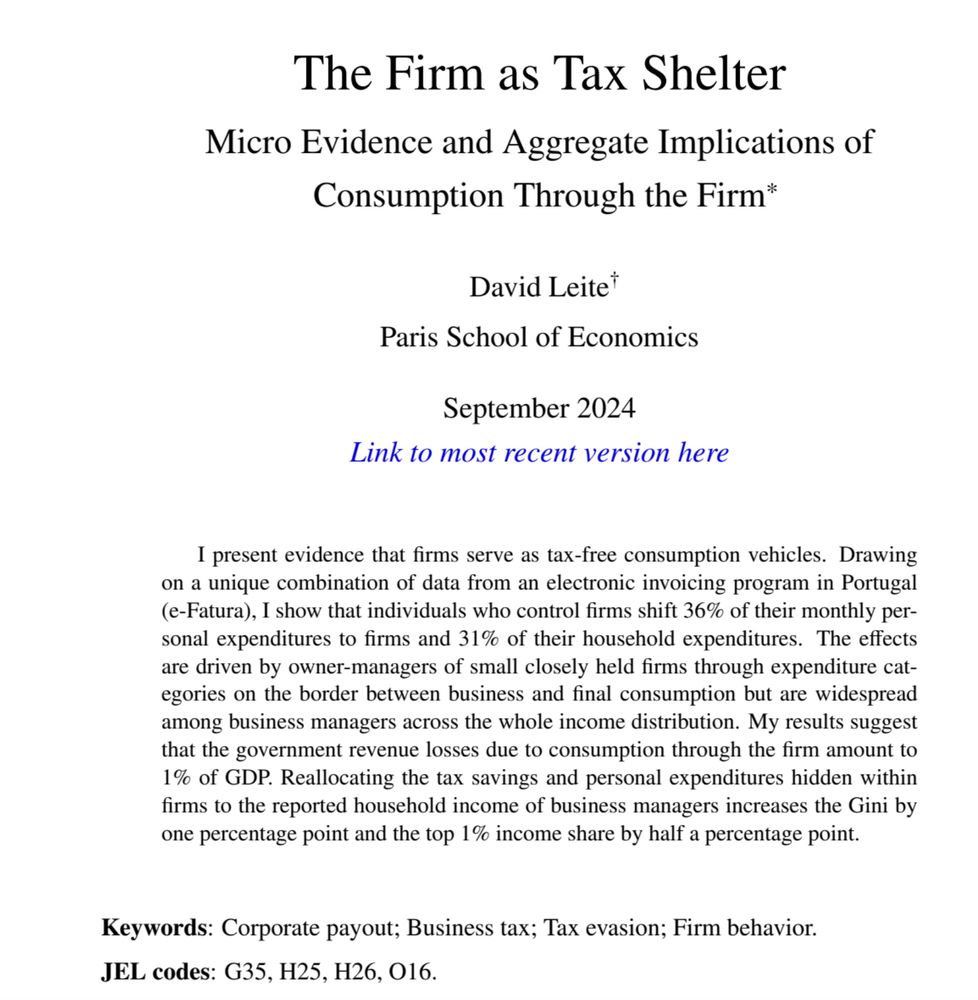
Pretty striking findings! www.parisschoolofeconomics.eu/app/uploads/...
05.12.2024 01:21 —
👍 347
🔁 115
💬 18
📌 17

How to Promote Equality without Backlash?
This is a major challenge, exacerbated by social media.
I welcome critique and would love to see further research
www.ggd.world/p/how-to-pro...
05.12.2024 14:50 —
👍 43
🔁 11
💬 6
📌 4

An intervention within schools in Mozambique aimed at reducing gender-based violence mitigated violence by deterring potential perpetrators and fostering a proactive stance among victims, from Amaral, Garcia-Ramos, Gulesci, Ramos, Ore-Quispe, and Sviatschi https://www.nber.org/papers/w33203
01.12.2024 22:00 —
👍 19
🔁 6
💬 0
📌 1
Mark Cuban gets it. See my op ed from last year:
www.nytimes.com/2023/05/07/o...
01.12.2024 22:27 —
👍 51
🔁 9
💬 1
📌 1
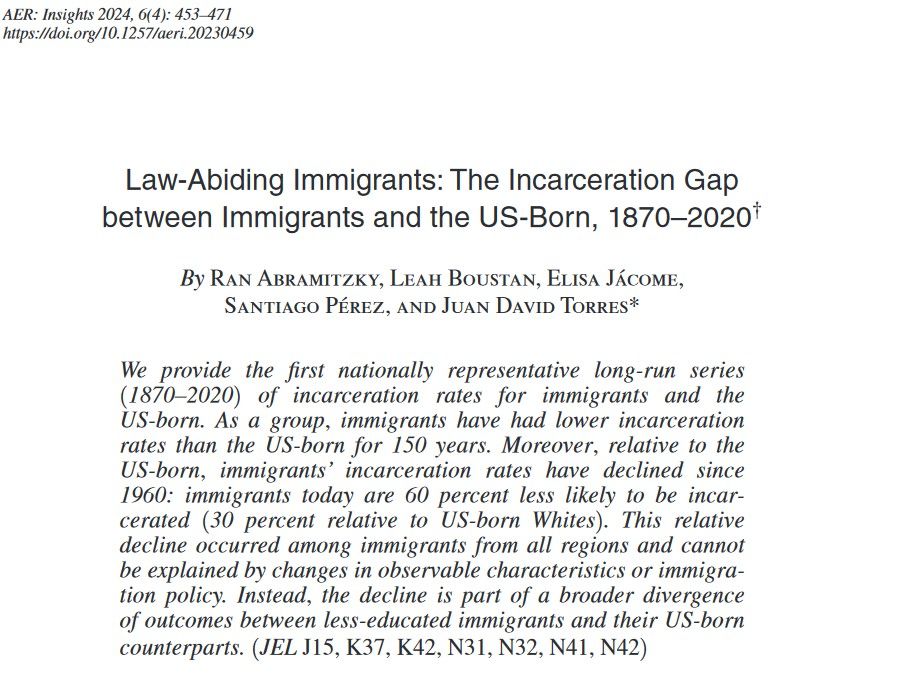
Law-Abiding Immigrants: The Incarceration Gap between Immigrants and the US-Born, 1870–2020†
By Ran Abramitzky, Leah Boustan, Elisa Jácome,
Santiago Pérez, and Juan David Torres*
We provide the first nationally representative long-run series (1870–2020) of incarceration rates for immigrants and the US-born. As a group, immigrants have had lower incarceration rates than the US-born for 150 years. Moreover, relative to the US-born, immigrants’ incarceration rates have declined since 1960: immigrants today are 60 percent less likely to be incarcerated (30 percent relative to US-born Whites). This relative decline occurred among immigrants from all regions and cannot be explained by changes in observable characteristics or immigration policy. Instead, the decline is part of a broader divergence of outcomes between less-educated immigrants and their US-born counterparts.
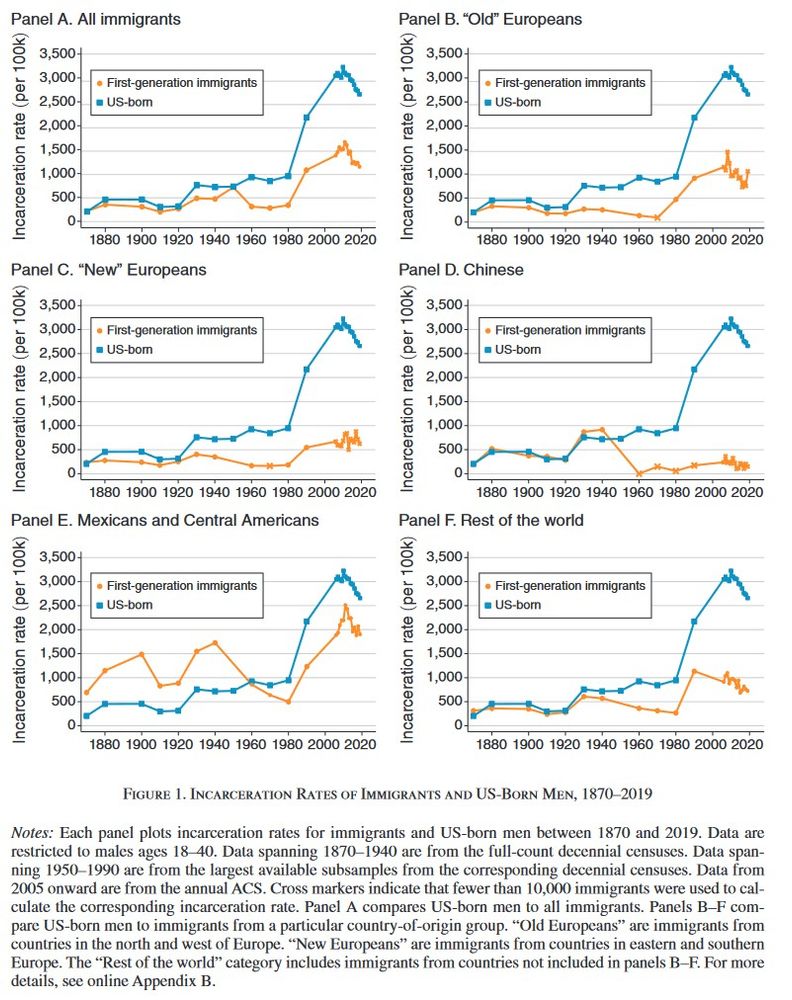
Panels plotting incarceration rates for immigrants and US-born men between 1870 and 2019. Data are restricted to males ages 18–40. Data spanning 1870–1940 are from the full-count decennial censuses. Data spanning 1950–1990 are from the largest available subsamples from the corresponding decennial censuses. Data from 2005 onward are from the annual ACS. Cross markers indicate that fewer than 10,000 immigrants were used to calculate the corresponding incarceration rate. Panel A compares US-born men to all immigrants. Panels B–F compare US-born men to immigrants from a particular country-of-origin group. “Old Europeans” are immigrants from countries in the north and west of Europe. “New Europeans” are immigrants from countries in eastern and southern Europe. The “Rest of the world” category includes immigrants from countries not included in panels B–F.
Migrants typically show lower incarceration rates
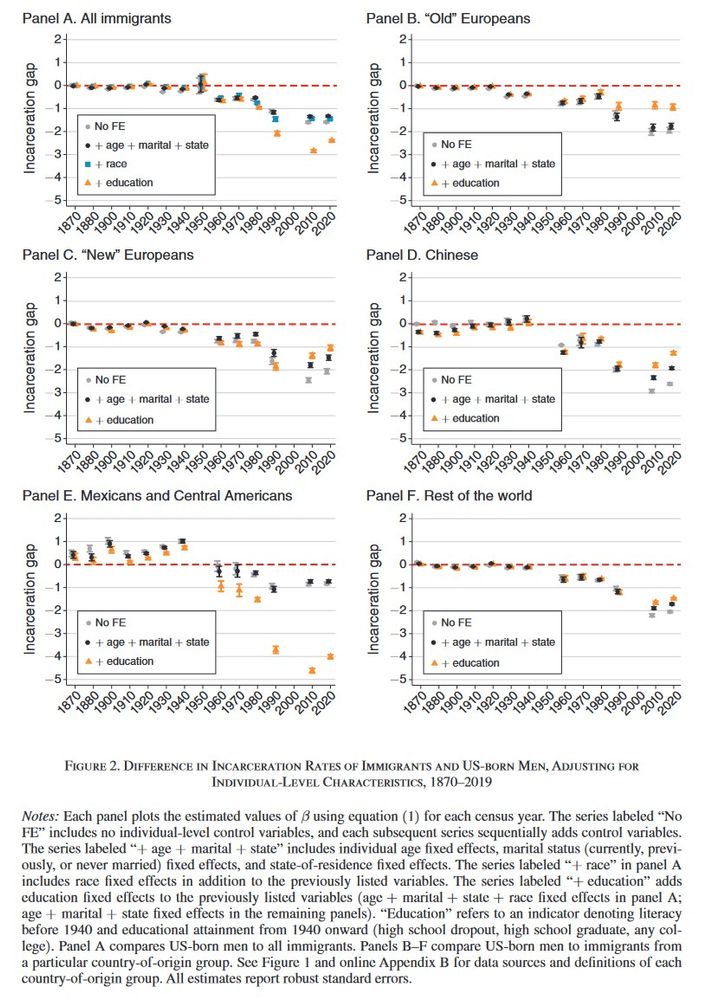
accounting for individual-level characteristics, migrants as a group or by subgroups (old Europeans, new Europeans, Chinese, Mexicans and Central Americans, or Rest of the World) are incarcerated at lower rates
I've posted several times about the working paper, but the publication on "AER: Insights" is a good occasion to do it again: immigrants to the US have been less likely to be incarcerated for over 50 years **even without controlling for demographic characteristics.**
www.aeaweb.org/articles?id=...
01.12.2024 22:30 —
👍 103
🔁 43
💬 2
📌 4