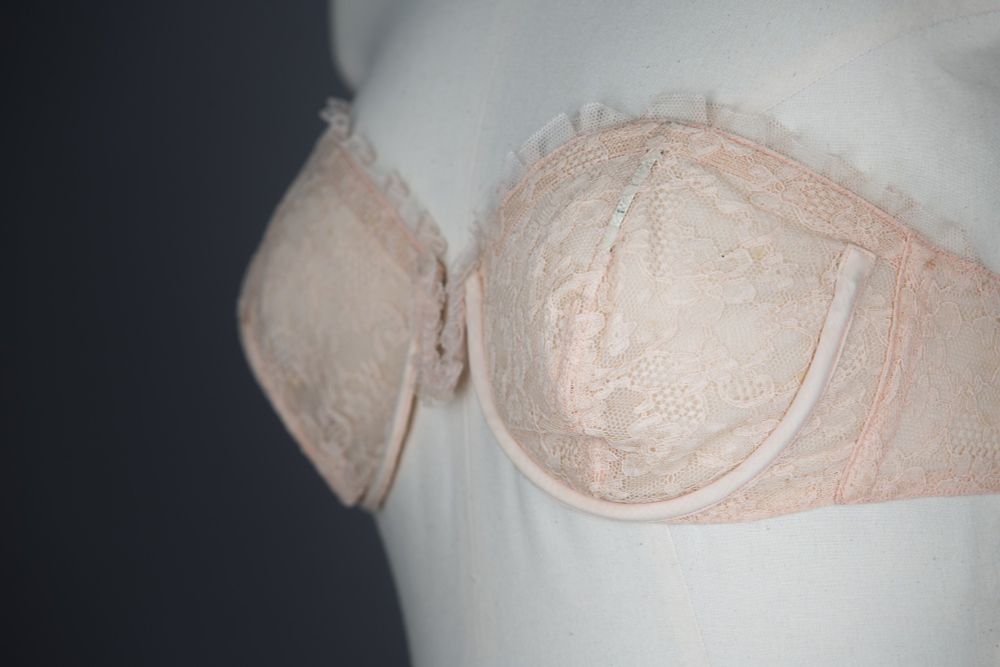
A corselet style dress with padded and underwired cups, a zip back fastening and detachable garter straps. The body of the dress is comprised almost entirely of satin elastic strips constructed in a ‘bandage’ fashion, with small gaps between the strips allowing glimpses of the skin beneath. The elastic is adjustable at the centre back through the inclusion of gold plated rings and adjusters, allowing the wearer to alter the garment to fit their own body.
This c. 2010 corselet style dress is by the brand Atelier Bordelle. Bordelle was founded in 2007 by Alexandra Popa and Javier Suarez, initially offering a mix of lingerie and bodywear with its now signature ‘bondage’ inspired aesthetics.
underpinningsmuseum.com/museum-colle...
29.01.2025 20:32 —
👍 40
🔁 2
💬 0
📌 1

Black Bobbinet Tulle Corselet & Petticoat By Christian Dior
Date: c. 1954
Origin: France
Fabric: Cotton bobbinet tulle
Brand: Dior Boutique
This corselet and petticoat were originally integrated into an outer overdress. The original design was crafted from a rayon poult tafetta, with an asymmetric bodice and full circle skirt. The design was likely originally sold at the London based Christian Dior boutique. It was commonplace for high end and couture dresses to be crafted with integrated underpinnings, as these foundations were integral to the intended garment shape.
Both corselet and petticoat are crafted from layers of cotton bobbinet tulle. This type of tulle was a popular choice for shapewear, as it is both lightweight and flexible, but sturdy enough to reshape the body. It is manufactured on the same machines as Leavers lace, with the hexagonal pattern giving the fabric its strength. The corselet is structured with vertically placed, fine steel bones, and the petticoat is given additional structure with the application of horsehair braid at the hem. The corselet fastens with a row of metal hooks and eyes through the centre back. Originally these foundations would have been stitched into the outer garments, and only a few broken threads remain to indicate this original placement.

Technical drawing of a corselet with integrated petticoat.
Happy birthday, Christian Dior! You can get the Dior look with our 1950s New Look Couture Corselet & Petticoat Foundation Pattern, taken directly from the original garment! 50% of all sales go directly to help fund future exhibitions and acquisitions.
www.etsy.com/no-en/shop/u...
21.01.2025 15:12 —
👍 50
🔁 13
💬 1
📌 0

A page from the 'Flottant Au Vent' Lingerie Catalogue By J. Roussel, depicting a blonde woman wearing a white corselet.
From a 1940s French lingerie catalogue by J. Roussel, the caption for these underpinnings explains that the ‘ceinture,’ or belt, can be worn morning, afternoon, or night, and that the lace bra was specially designed to support the stomach.
underpinningsmuseum.com/museum-colle...
20.01.2025 10:23 —
👍 28
🔁 3
💬 1
📌 0
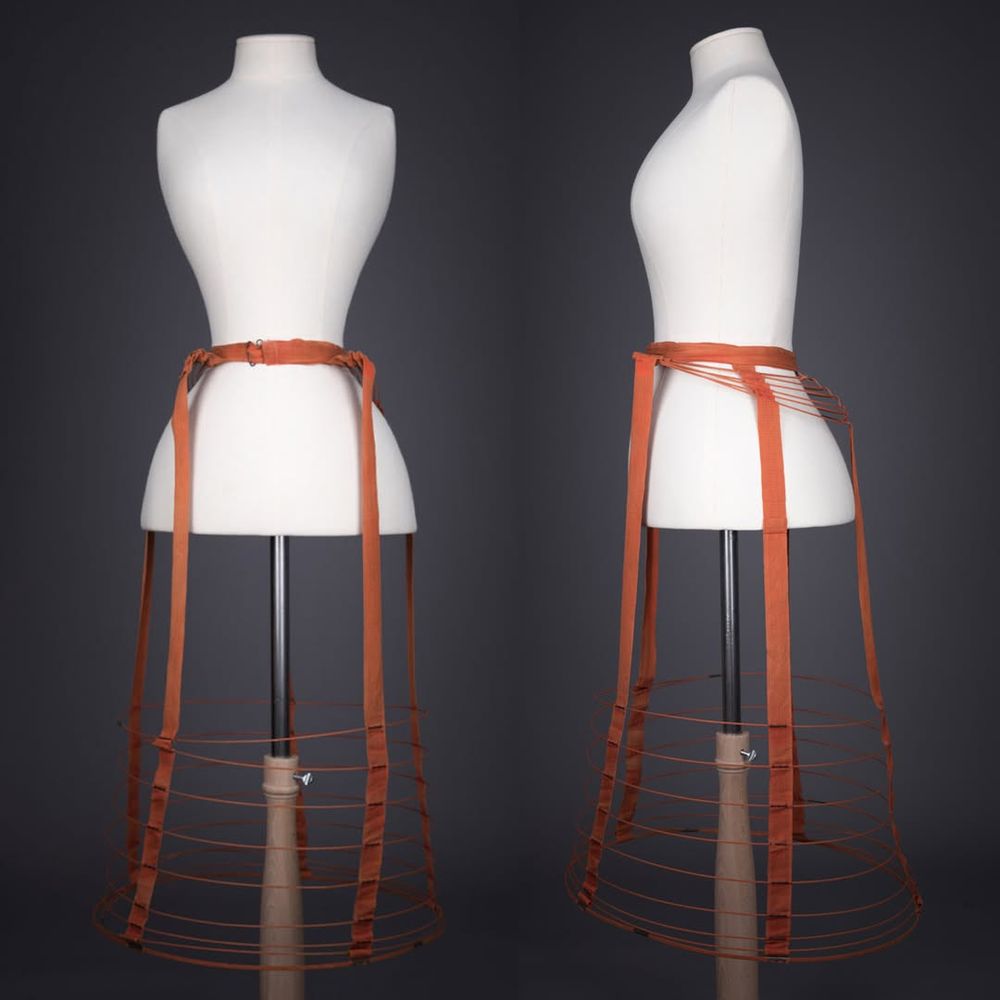
Date: c. 1870s
Origin: Great Britain
Fabric: Cotton tape, metal wires, metal buckle
Brand: Unknown
A cage crinolette of cotton tape, supported by textile encased metal wires and fastening at the front of the body with a metal buckle.
Crinolines offered support to the skirts of outer clothing whilst remaining lightweight and allowing a greater degree of freedom of movement. Previously, fashionable full skirted fashions were supported by a number of petticoats, which could be bulky and heavy. Cage crinolines were first popularised in the late 1850s, with the silhouette evolving to suit changing womenswear fashions. By the late 1860s, the full rounded crinoline shape had evolved into the crinolette, a transitional garment between the original cage crinoline and the bustles of the late 19th century. Crinolettes had a greater level of projection to the rear of the garment, with little projection to the sides and front of the garment.
Cage crinolines were popularised in the late 1850s, with the silhouette evolving to suit changing womenswear fashions. By the late 19th century, crinolettes had a greater level of projection to the rear with little projection to the sides and front.
underpinningsmuseum.com/museum-colle...
17.01.2025 12:22 —
👍 17
🔁 2
💬 0
📌 1

Packaging for a pair of tights from a collaboration between Jean Paul Gaultier and Wolford.

These fine nylon tights have been knitted with a contrasting yarn pattern and later appliquéd with further nylon motifs in a Trompe L’Oeil style, to emulate an ensemble of seamed stockings, garter belt and high cut knickers. The design is from a collaboration between Haute Couture design house Jean Paul Gaultier, and luxury hosiery specialists Wolford.
These nylon tights are from a collaboration between Haute Couture design house Jean Paul Gaultier and luxury hosiery specialists Wolford. They are knit with a contrasting yarn pattern and later appliquéd with further nylon motifs in a trompe l’oeil style.
underpinningsmuseum.com/museum-colle...
15.01.2025 14:30 —
👍 11
🔁 0
💬 0
📌 0

The side and front view of an early brassiere style with an extremely innovative design for the time period, named ‘The Circlet’. A bandeau style, this bra is designed to compress down and streamline the bustline, creating the fashionable silhouette associated with the 1920s. This garment was patented in 1919, indicating that the Nemo company were one of the leaders in this particular silhouette trend. It also indicates how the confines of decades for particular fashion trends can often blur.
This very early brassiere style, named ‘The Circlet’, features an extremely innovative design for the time period. This garment was patented in 1919, indicating that the Nemo company were one of the leaders in this particular silhouette trend.
underpinningsmuseum.com/museum-colle...
15.01.2025 14:28 —
👍 44
🔁 6
💬 0
📌 0

A pair of garters in plain elastic with gilt fastenings, embellished with silk fringe, feathers and pearls.
This pair of garters were made from strips of elastic with stamped metal closures, embellished with silk chenille, glass pearls and feathers. Because there was relatively little stretch in early elastics, the fastenings on these garters were a necessity.
underpinningsmuseum.com/museum-colle...
15.01.2025 14:26 —
👍 20
🔁 3
💬 0
📌 0

The neckline of a dudou by lingerie brand Pillowbook, embellished with a wave-like pattern of silk rouleau appliqué
Intricate ‘waves’ of silk rouleau appliqué are applied to a base of fine tulle and silk satin in this dudou by Pillowbook Lingerie. Only a handful of sample designs belonging to this collection, the ‘Sirens’ range, were created.
underpinningsmuseum.com/museum-colle...
15.01.2025 14:18 —
👍 61
🔁 8
💬 1
📌 0

'Each Time You Breathe, Your Bra Size Changes...' Advertisement For A'Lure By Warner
Warner was the first company to shorten the word brassiere in the text of a 1934 advertisement. According to Jane Farrell-Beck and Colleen Gau’s book Uplift: The Bra in America, “by 1935, Warner officially marketed its A’lure Bra, truncating the word in the trade name.” The A’lure range was renowned for its flexible fit, pioneering a stretch fit that would adjust with changing body shapes.
This 1953 advert continues to capitalise on the range’s flexible fit, boasting that the ‘…finest elastic bra – is as flexible as you are. Stretches with you, gives you perfect fit’. Even in the 1950s, many bras had a relatively firm fit with little elastication, marking the A’Lure range as all the more remarkable for its much more comfortable fit. The advert indicates that the range’s bras retailed between $2.50-3.95, approximately $24-38 today (arguably marking the range as a mid-market price point).
This 1953 advert continues to capitalise on the A’Lure range’s flexible fit, boasting that the ‘…finest elastic bra – is as flexible as you are. Stretches with you, gives you perfect fit’.
underpinningsmuseum.com/museum-colle...
27.11.2024 11:18 —
👍 12
🔁 0
💬 0
📌 1
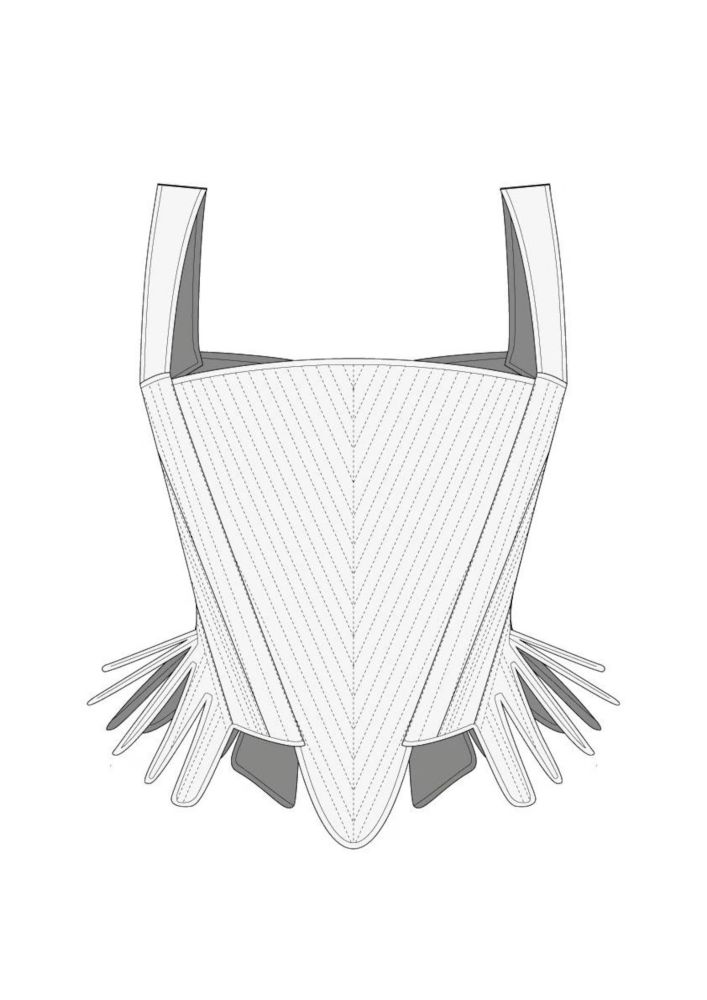
Front view of a technical illustration of 18th century stays, with shoulder straps and a stomacher

Back view of a technical illustration of 18th century stays, with shoulder straps and a stomacher
Don't forget you can now purchase a digital sewing pattern based on the 18th-century ‘Tyrolean’ Stays in our collection! A minimum 50% of all sales go directly to The Underpinnings Museum to help fund future exhibitions and acquisitions.
www.etsy.com/no-en/listin...
27.11.2024 11:16 —
👍 40
🔁 7
💬 0
📌 1

A swatch of embroidered tulle in a 1930s lingerie fabric catalogue.

A swatch of patterned coutil in a 1930s lingerie fabric catalogue.
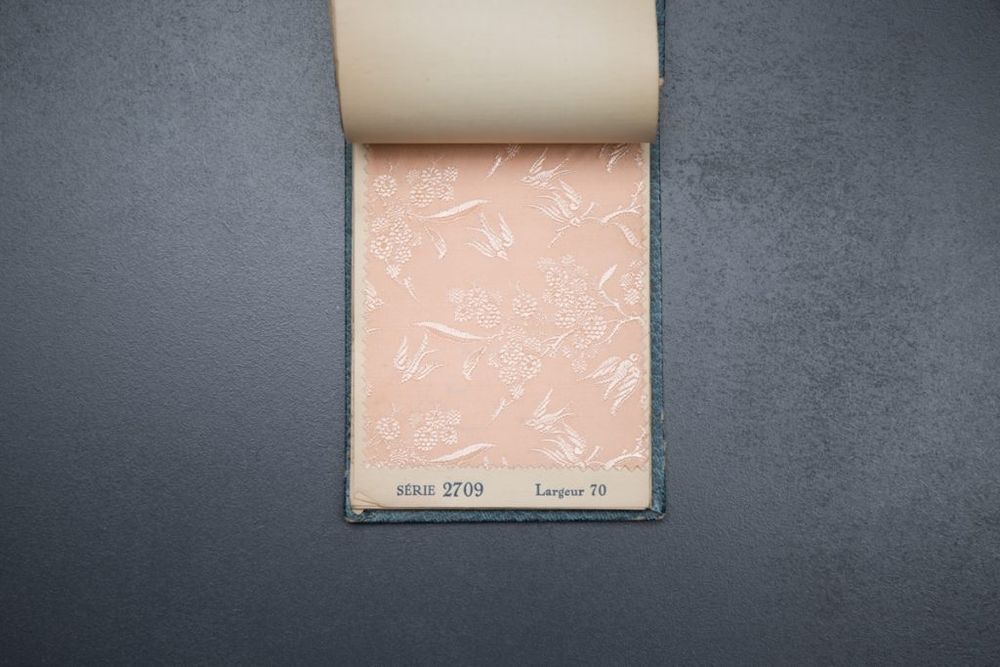
A swatch of patterned coutil in a 1930s lingerie fabric catalogue.

A swatch of patterned coutil in a 1930s lingerie fabric catalogue.
This c. 1930s specialist lingerie and corsetry fabric catalogue features a wide range of materials and colour options, including a wide range of coutils in elaborate woven patterns.
You can explore this object in further detail on our website!
underpinningsmuseum.com/museum-colle...
22.11.2024 21:51 —
👍 19
🔁 2
💬 0
📌 0

Stitching detail on an 1860s corset.
This corset boasts a typical 1860s silhouette, with its gored bust and hip pattern, and relative lack of structure. It is made from two layers of densely woven cotton twill, with a dark brown exterior and a lighter shade as the lining. It fastens with a wide steel busk closure at the centre front, and with metal eyelets and cotton lacing at the rear.
The corset largely relies on extensive cording to provide its structure and shaping, with only a few pieces of vertically placed baleen bones to provide vertical tension. The cording and bones are particularly concentrated at the rear of the garment, which would have provided the wearer with substantial back support. This suggests that it may have been originally worn by a working woman, who was in need of the additional back support on an everyday basis. Each of the gore points is re-enforced with flossing embroidery, with additional decorative embroidery at the hips. A delicate machine made lace trims the neckline edge.
This corset boasts a typical 1860s silhouette, with its gored bust and hip pattern, largely relies on extensive cording to provide its structure and shaping.
You can explore this piece in further detail on our website!
underpinningsmuseum.com/museum-colle...
20.11.2024 15:17 —
👍 59
🔁 7
💬 0
📌 2

A decadent peignoir in silk crêpe, with a voluminous skirt and full sleeves. The skirt is carefully has a carefully panelled diagonal cut to minimise fabric wastage whilst maintaining a full cut. The bodice of the garment is made of a machine lace, with the scallop edge forming a ruffled trim at the neckline, underbust and cuffs.
The garment has a number of luxurious techniques and details. Silk satin trims the neckline and cuffs and is applied by delicate hand stitches, and all the French seams are hand finished. The button fastening at the underbust has a hand stitched loop, and the buttons are covered with matching silk and lace.
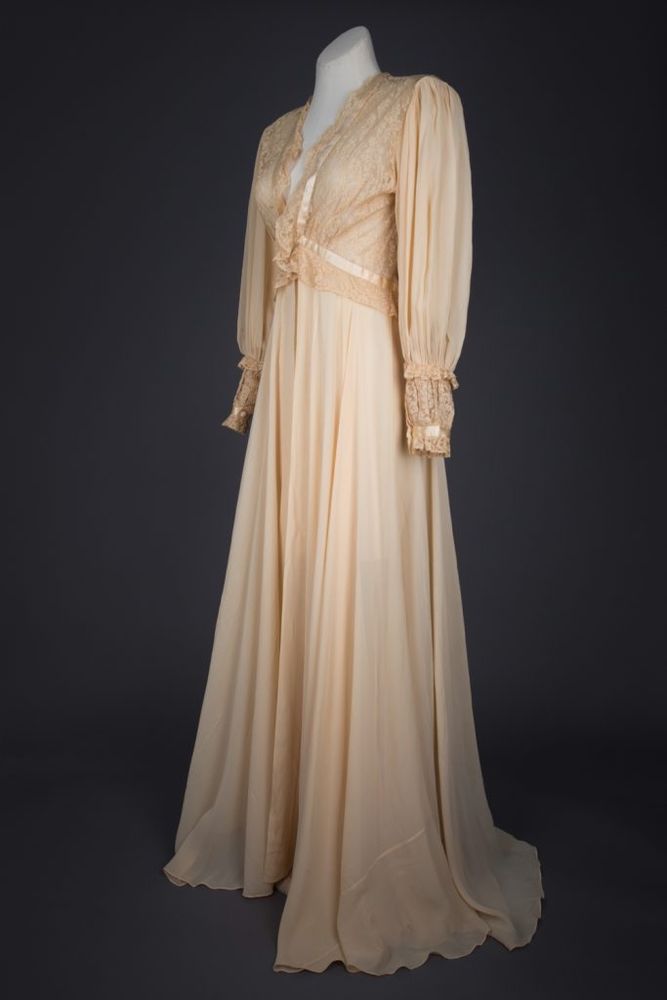
A decadent peignoir in silk crêpe, with a voluminous skirt and full sleeves. The skirt is carefully has a carefully panelled diagonal cut to minimise fabric wastage whilst maintaining a full cut. The bodice of the garment is made of a machine lace, with the scallop edge forming a ruffled trim at the neckline, underbust and cuffs.
The garment has a number of luxurious techniques and details. Silk satin trims the neckline and cuffs and is applied by delicate hand stitches, and all the French seams are hand finished. The button fastening at the underbust has a hand stitched loop, and the buttons are covered with matching silk and lace.
This c. 1940s peignoir was originally purchased at Bullock’s Wilshire, a luxury department store originally opened in 1929 in Los Angeles, California, but later closed permanently in 1993.
See more on our website!
underpinningsmuseum.com/museum-colle...
19.11.2024 09:25 —
👍 54
🔁 8
💬 0
📌 1

A step in teddy with an unusual cut out silhouette, with the garment appearing as a separate bra and tap pant from the back view. Silk crêpe forms the body of the garment, with machine made lace embellishing the neckline and legline, appliquéd on with a fine zigzag stitch. The top half of the garment is close fitted, with three darts at each bust offering light lift and shaping, whilst the bottom half has a looser fit, with side seams and a shaped gusset panel. The garment is fastened with a hook and eye at the centre back of the ‘bra’, and buttons at the side seam of the ‘tap pants’. The shoulder straps are made of the same silk crepe.
The garment was altered by its original owner with additional darts at the waistline, presumably to give a closer fit. As the garment was evidently a ‘ready-to-wear’ style produced by the brand Nuffs, it is unsurprising to see alterations.

A luxurious girdle crafted from silk georgette. It is largely machine stitched. One inch wide strips of silk are interwoven in a basket weave to form the body of the garment. The garment closes with buttons at the left princess seam in the front, and silk ribbon lacing through metal eyelets at the centre back. Loops are formed with the silk strips to form the button holes. There are are four suspender straps, crafted from silk georgette encased elastic straps with metal garter grips. Silk georgette ribbon flashes are further embellished with silk rosettes. The silk rosette trim is used as embellishment throughout the garment: trimming the underbust edge, and as accents to the bottom of each ribbon edge and suspender point. Such silk rosette trims were originally produced as continuous lengths, and it was common to see these cut into shorter pieces as embellishment work.

The Equipoise Waist was patented in 1876 by Miss Emmeline W. Philbrook of Boston, MA and shown at the Centennial. As the name suggests, its structure allowed for clothing to be distributed more evenly around the torso and shoulders with its all-around buttons.
During the late 1880s, the Equipoise Waist was advertised as a “perfect substitute for corsets.” Advertisements of the early 1890s echo sentiments of the dress reform movement, claiming that “intelligent” women wore “sensible” Equipoise Waists as a corset substitute, while unnatural corsets that pinched the waist were not “artistic.”

A cotton lawn chemise, hand made by its original owner and believed to be part of her bridal trousseau. It is crafted from a fine cotton lawn that has been intricately machine embroidered with floral and botanical motifs. It is lavishly embellished: Valenciennes lace is insertion appliquéd in bands at the hips, with diamond motifs at the neckline and waist. Tiny pintucks are stitched inside these diamond motifs, as well as extending from the neckline and shoulders. A fine lace trims the neckline and underarms. Machine embroidered ribbon slot trim is applied to the waist, threaded through silk ribbon (a contemporary replacement, as the original ribbon has been lost). The chemise fastens with a row of shell buttons and stitched buttonholes through the front of the bodice.
Happy #NationalButtonDay! Where would underpinnings be without buttons? In celebration of this ancient fastening system, today we’re sharing some detail shots of pieces in our collection taken by our resident photographer Tigz Rice!
Explore more: underpinningsmuseum.com
16.11.2024 13:55 —
👍 45
🔁 8
💬 1
📌 0

Various men’s undergarments can be seen here on this page of a 1934 French Department Store Catalogue, including undershirts, briefs, a support belt, braces, belts, collars, and cuffs.
'Au Printemps Paris' Summer 1934 Department Store Catalogue'
Various men’s undergarments can be seen here on this page of a 1934 French Department Store Catalogue, including undershirts, briefs, a support belt, braces, belts, collars, and cuffs.
'Au Printemps Paris' Summer 1934 Department Store Catalogue'
underpinningsmuseum.com/museum-colle...
15.11.2024 09:43 —
👍 29
🔁 2
💬 0
📌 2
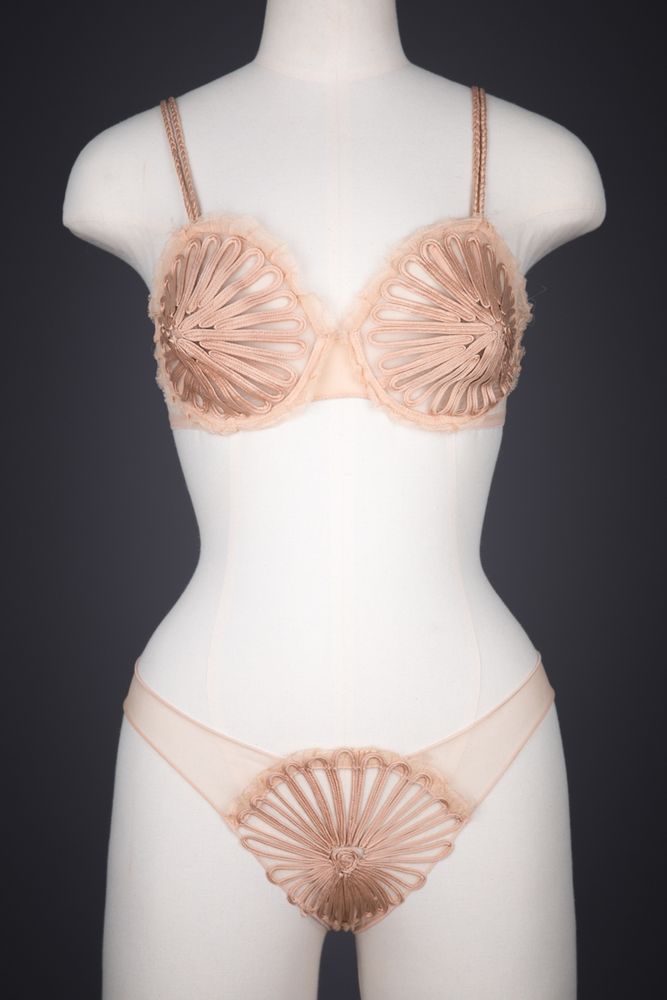
A bra and brief set with extensive ‘soutache’ silk braid embroidery. The bra has a dramatically pointed bustline and uses a combination of underwires and boned structures throughout the cup to achieve a silhouette reminiscent of 1950s foundationwear. The soutache embellishment covers the body of the cups, with small flourishes of the technique on the bra wings. Plaited silk braid forms the shoulder straps, and the interior bone and wire channels are encased in silk. Raw edged silk georgette trims the bra neckline.
The main body of the knickers is formed of a sheer synthetic stretch mesh, finished with an extremely narrow babylock stitched edge. The centre panel of the briefs is embellished with further soutache embroidery, with raw cut silk georgette trimming the waist edge.
These garments are from the ‘Feuillage’ range (which translates as ‘foliage’) of the Créateur collection, a collaboration between French couturier Jean Paul Gaultier and heritage luxury lingerie house La Perla.

A bra and brief set with extensive ‘soutache’ silk braid embroidery. The bra has a dramatically pointed bustline and uses a combination of underwires and boned structures throughout the cup to achieve a silhouette reminiscent of 1950s foundationwear. The soutache embellishment covers the body of the cups, with small flourishes of the technique on the bra wings. Plaited silk braid forms the shoulder straps, and the interior bone and wire channels are encased in silk. Raw edged silk georgette trims the bra neckline.
The main body of the knickers is formed of a sheer synthetic stretch mesh, finished with an extremely narrow babylock stitched edge. The centre panel of the briefs is embellished with further soutache embroidery, with raw cut silk georgette trimming the waist edge.
These garments are from the ‘Feuillage’ range (which translates as ‘foliage’) of the Créateur collection, a collaboration between French couturier Jean Paul Gaultier and heritage luxury lingerie house La Perla.
Designed by Jean Paul Gaultier for La Perla, this set features extensive ‘soutache’ silk braid embroidery. The bra has a pointed bustline and uses a combination of underwires and boned structures throughout the cup.
underpinningsmuseum.com/museum-colle...
12.11.2024 13:53 —
👍 29
🔁 6
💬 0
📌 1

These 1960s forest green tights, size 36/44, are from Norway, from the brand Eva Farve. They are a nylon blend, and (translated into English) the packaging advertises them as being “smooth knitted in 100% high-elastic crepe. Re-enforced gusset and toes. 20 denier on the legs. 40 denier in the briefs.” The pink copy on the package that reads “Hand wash gently in tepid water … REX, CORAL, SUNLIGHT sepe” is probably listing popular soap brands at the time which would be appropriate for washing. The packaging, featuring colorful silhouettes of legs, states that the garments are imported, but the manufacturer is not listed.
As hemlines rose for women of all ages during the 1960s, greater emphasis was put on fashion for hosiery. Colorful tights were staple accessories in fashionable wardrobes of the 1960s, seen in countless fashion advertisements and editorials.
Learn more:
underpinningsmuseum.com/museum-colle...
10.11.2024 17:13 —
👍 19
🔁 1
💬 0
📌 0


This pair of split drawers, c. 1880-1890s, was made with fine cotton lawn and intricately embellished with whitework embroidery, drawn thread work, Valenciennes lace trim, and small silk bows.
Explore more:
underpinningsmuseum.com/museum-colle...
09.11.2024 12:05 —
👍 8
🔁 3
💬 0
📌 0


This gown was carefully pieced from a mix of machine embroidered and plain tulle by I.D. Sarrieri. Founded in 1992 by Iulia Dobrin, the brand specialises in luxurious fabrics and manufactures its products in its own factory in Romania.
underpinningsmuseum.com/museum-colle...
09.11.2024 12:00 —
👍 19
🔁 5
💬 0
📌 0
Hello Bluesky! We will be using this platform to share our extensive digital archive. Please consider sharing our work if you enjoy fashion history!
09.11.2024 11:59 —
👍 13
🔁 4
💬 2
📌 0