Can we tell if an earthquake is going to be a foreshock?
A recent study says yes, but we find otherwise.
Will a large earthquake be followed by an even larger event? A 2025 paper proposed a new method for classifying foreshocks in advance, with an apparent success rate above 90%.
But does it work?
Our deep-dive analysis found serious problems that we believe invalidate the result. Read more:
⚒️ 🧪
02.03.2026 16:45 —
👍 30
🔁 6
💬 0
📌 0

🌟OPEN ACCESS🌟 In 2024, the magnitude 4.2 Buan, Korea earthquake and its aftershock sequence — all events in a stable continental region — were exceptionally well-recorded. A new #SRL paper reveals details. ⚒️
buff.ly/0okDOm3
25.01.2026 21:00 —
👍 2
🔁 1
💬 0
📌 0
🌟OPEN ACCESS🌟Complex Multipatch Rupture and Aftershock Characteristics of the 2024 Mw 4.2 Buan, Korea, Earthquake Sequence #SRL ⚒️
On June 11, 2024, a M4.2 event struck near Buan and was felt across South Korea. What happened?
buff.ly/0okDOm3
21.01.2026 15:03 —
👍 1
🔁 1
💬 0
📌 0

In a new #BSSA paper, scientists introduce a novel mapped variable for California — the regional geological unit, defined as a combination of geomorphic provinces and geological units. This variable strongly correlates with site amplification. ⚒️
pubs.geoscienceworld.org/ssa/bssa/art...
16.01.2026 21:01 —
👍 1
🔁 1
💬 0
📌 0

The Intensity Gap: A Global Analysis of Who Responds to the Crowdsourced “Did You Feel It?” System #SRL⚒️
Who responds to DYFI? Turns out, it depends on factors like language, broadband subscriptions, and even the physical parameters of an earthquake.
pubs.geoscienceworld.org/ssa/srl/arti...
18.12.2025 15:05 —
👍 1
🔁 2
💬 0
📌 0

Map showing the earthquake of 2025-12-16 in Eastern Russia-Northeastern China Border Region
Magnitude : 4.6
Region: *Eastern Russia-Northeastern China Border *
Time: 2025-12-16 14:38:42 UTC
Epicenter : 130.70°E 42.65°N
Depth: 566 km
*First posted at: 14:57 UTC*
https://geofon.gfz-potsdam.de/eqexplorer/events/gfz2025yoto/general
#GEOFON #GFZ #earthquake #magnitude
16.12.2025 14:57 —
👍 3
🔁 1
💬 0
📌 0

Tectonic Geodynamics by Thorsten Becker and Claudio Faccenna. A comprehensive, integrative approach to tectonics and geodynamics for students and researchers.
@thwbecker.bsky.social and Claudio Faccenna's Tectonic Geodynamics is a comprehensive, integrative approach to tectonics and geodynamics for students and researchers.
Out now (6 Jan UK pub)!
Explore a free preview: press.princeton.edu/books/hardco...
#EarthScience #Science #Geodynamics
14.12.2025 18:05 —
👍 3
🔁 3
💬 1
📌 0
Also, I learned that there are some political issues about magnitude (totally unrelated to science), where the official agency never corrects local magnitude (ML 4.8) even though it is ML 4.6 if using all available stations. Also, they never reports moment magnitude perhaps because it is smaller.
12.12.2025 01:33 —
👍 0
🔁 0
💬 0
📌 0
There are still some unresolved questions, such as large discrepancy between Mw and ML (Mw 4.23 vs ML 4.59), but not only restricted to this event. I personally believe that this may be combined effect of complex source and high average stress drop, but I could not discuss this issue in the paper.
12.12.2025 01:18 —
👍 0
🔁 0
💬 1
📌 0
Just learned that this platform provides much flexible option to post long thread at once, compared to Twitter (not aware of their paid version). I think this is obviously superior aspect.
12.12.2025 01:15 —
👍 1
🔁 0
💬 0
📌 0
I hope this study gains attention from the people interested in seismicity of intraplate regions, especially those broadly classified as Stable Continental Regions (SCRs), since we discuss some potential discriminatory features of the rupture processes of SCR earthquakes.
12.12.2025 01:12 —
👍 0
🔁 0
💬 1
📌 0
One interesting fact I learned from my advisor was that Prof. Helmberger once told her about working on the project of using SmS phases for directivity and source analysis, but she refused the suggestion because it was not her interest back then.
12.12.2025 01:12 —
👍 0
🔁 0
💬 1
📌 0

I came out of the idea of using SmS phase while chatting with coauthor Sangwoo one day but found that it was already proposed by Prof. Helmberger 30 years ago (year I was born).
pubs.geoscienceworld.org/ssa/bssa/art...
12.12.2025 01:12 —
👍 0
🔁 0
💬 1
📌 0
The idea of using SmS phases (which has obvious downgoing ray take-off angles) has been first suggested by Prof. Don Helmberger and colleagues in 1980s-90s, but has gained less attention potentially due to difficulty in dealing with interference with the other phases.
12.12.2025 01:12 —
👍 0
🔁 0
💬 1
📌 0

We show this by conducting both slip inversion with and without SmS relative source time functions, and for dense and sparse station geometry. We find that adding few SmS phases significantly enhances the resolution of slip distribution.
12.12.2025 01:12 —
👍 0
🔁 0
💬 1
📌 0
Despite this work being specific study of single event sequence in a region not very interesting in terms of seismicity, one takeaway for those conducting source analysis (especially small events) is that Moho-reflected waves, such as SmS waves can be sometimes very useful.
12.12.2025 01:12 —
👍 0
🔁 0
💬 1
📌 0
Complex Multipatch Rupture and Aftershock Characteristics of the 2024 Mw 4.2 Buan, Korea, Earthquake Sequence | Seismological Research Letters | GeoScienceWorld
Our team studied the Mw 4.2 earthquake in South Korea last year and the work has just been published in SRL. I was fortunate to lead the research as the first author, mainly contributing on the source time function analysis using Empirical Green's Function approach.
12.12.2025 01:12 —
👍 1
🔁 0
💬 1
📌 0
This figure from a perspective piece on our paper by Virginie Pinel beautifully illustrates our proposed magma-pumping mechanism!
www.science.org/doi/10.1126/...
22.11.2025 21:21 —
👍 22
🔁 8
💬 0
📌 0

Trains cancelled over fake bridge collapse image
Rail services were cancelled after a 'hoax' picture of a damaged bridge appeared on social media
After a 3.3-magnitude earthquake in north-west England on Wednesday night, "Trains were halted after a suspected AI-generated picture that seemed to show major damage to a bridge appeared on social media".
So there we are 😱
www.bbc.com/news/article...
06.12.2025 05:05 —
👍 22
🔁 10
💬 1
📌 1

Epicenter map of NLL-SSST-coherence relocated seismicity for the period 2020 to 9 Dec 2025 in the area surrounding the M7 Dec 6 #Alaska #Yukon Hubbard Glacier #earthquake sequence. Purple lines show Quaternary faults from https://www.usgs.gov/programs/earthquake-hazards/faults
NLL-SC relocation of M7 Dec 6 #Alaska #Yukon Hubbard Glacier #earthquakes and seismicity since 2020. UPDATED with events throug Dec 9. Relocation catalog: doi.org/10.5281/zeno...
09.12.2025 14:54 —
👍 13
🔁 8
💬 3
📌 1

Auto slipmap with regional records (SLIPNEAR method, Géoazur/OCA) M 7.6 Japan Earthquake, 2025-12-08 14:15:10 (UTC)
Plane shallow dipping to the East (strike 179) shown.
Rupt very concentrated around the hypocenter, far from and much deeper than the trench.
Thanks to seismic records through IRIS
08.12.2025 17:53 —
👍 6
🔁 5
💬 2
📌 0


Huge Congratulations to Phd Student Jeena Yun for having two companion papers published in JGR Solid Earth agupubs.onlinelibrary.wiley.com/doi/10.1029/...
and
agupubs.onlinelibrary.wiley.com/doi/10.1029/...!
In the first paper she explores the role of heterogeneous friction and stress in controlling
08.12.2025 23:26 —
👍 15
🔁 3
💬 2
📌 0

Auto solution FMNEAR (Géoazur/OCA) with regional records for the M 7.0 - Yakutat, SOUTHERN YUKON TERRITORY, CANADA Earthquake, 2025-12-06 20:41:49 (UTC)
Thanks to the seismic records provided through IRIS
06.12.2025 21:56 —
👍 4
🔁 1
💬 0
📌 0

Historical earthquake map for the region of today’s M6.9 Yakutat earthquake generated by Jascha Polet using GMT.
M6.9 Yakutat #earthquake is located very close to the border of the USA and Canada. Preliminary results from GFZ Potsdam indicate relatively high non double couple component with oblique mechanism. ⚒️🧪
06.12.2025 21:28 —
👍 34
🔁 11
💬 2
📌 0

Auto slipmap with regional records (SLIPNEAR method, Géoazur/OCA) M 7.0 SOUTHERN YUKON TERRITORY, CANADA Earthquake, 2025-12-06 20:41:49 (UTC) FM USG
Plane oriented NW-SE (dipping to the NE) shown.
Rupt propagation mainly to the NW, surface rupture likely.
Thanks to seismic records through IRIS
06.12.2025 22:19 —
👍 3
🔁 3
💬 3
📌 0

Bangladesh shaken by deadly M5.5 earthquake
A moderate magnitude earthquake near a dense, vulnerable megacity
A M5.5 earthquake killed at least ten people in Bangladesh today. What made this moderate event so deadly? And what do we know about seismic hazards in the country?
⚒️ 🧪
earthquakeinsights.substack.com/p/bangladesh...
22.11.2025 03:06 —
👍 70
🔁 36
💬 3
📌 2

M6.8 earthquake offshore Japan preceded by upward cascade of foreshocks
What do we know about seismic hazard in the Japan-Kuril subduction zone?
⚒️ 🧪
A M6.8 earthquake struck offshore Japan today - another large earthquake from the subduction zone that produced two recent great earthquakes. The earthquake was preceded by a "cascade up": foreshocks progressively increasing in maximum magnitude.
What do we know? What might happen next?
09.11.2025 18:41 —
👍 71
🔁 41
💬 4
📌 4
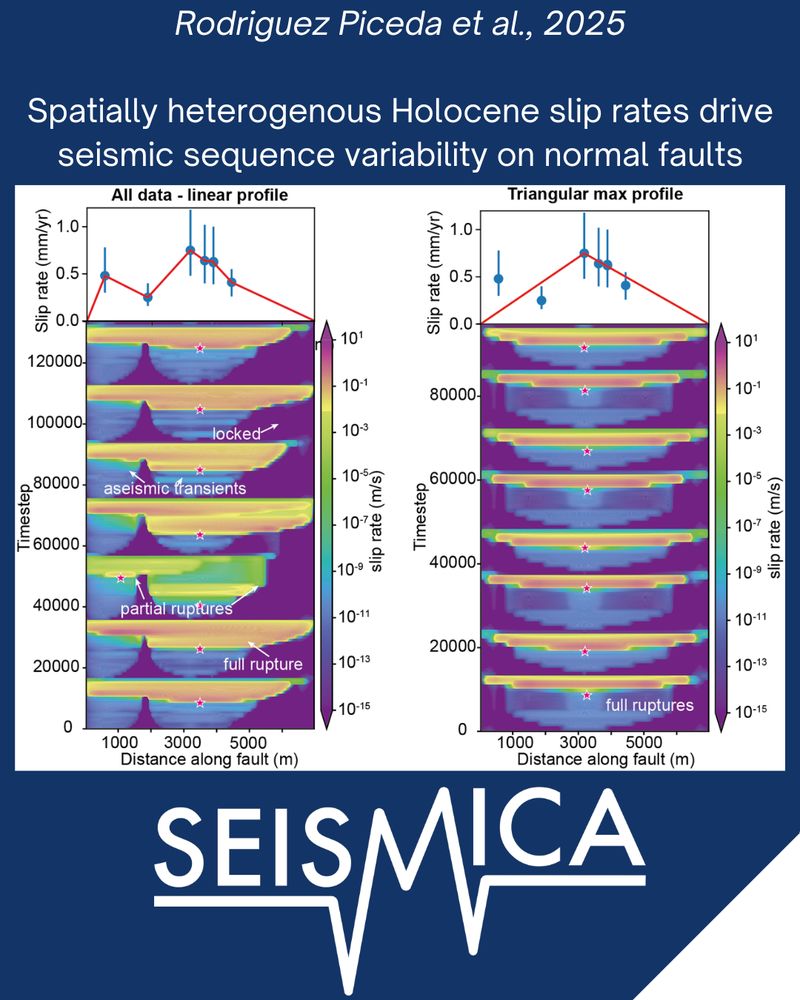
⚠️ Faults don’t slip evenly!!
Varying slip rates along faults drive complex earthquake cycle patterns, yet they are overlooked in seismic hazard assessments.
Read more: seismica.library.mcgill.ca/article/view...
14.10.2025 23:35 —
👍 17
🔁 5
💬 1
📌 0

“Like putting on glasses for the first time”—how AI improves earthquake detection
AI is “comically good” at detecting small earthquakes—here’s why that matters.
It was a pleasure to contribute to this article, which talks about how AI contributes to seismology - indeed, we have seen tremendous progress in the use of machine learning to detect small events.
1/
11.10.2025 14:14 —
👍 25
🔁 8
💬 1
📌 0