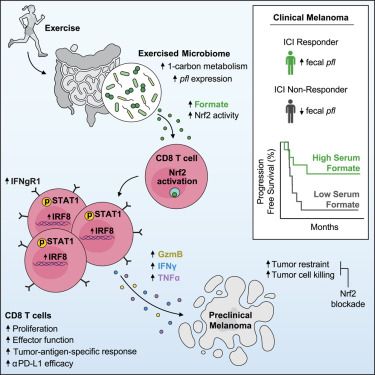
Our lab just completed a +6 year #marathon, describing for the first time that the #microbiome is critical for #exercise - induced increases in antitumor CD8 T cell immunity and improved of #cancer #immunotherapy.
www.cell.com/cell/fulltex...
Our lab just completed a +6 year #marathon, describing for the first time that the #microbiome is critical for #exercise - induced increases in antitumor CD8 T cell immunity and improved of #cancer #immunotherapy.
www.cell.com/cell/fulltex...

How exercise promotes the immune system vs cancer, working through a gut bacteria metabolite
www.cell.com/cell/abstrac...
Thank you Liam!
24.11.2024 11:11 — 👍 0 🔁 0 💬 0 📌 0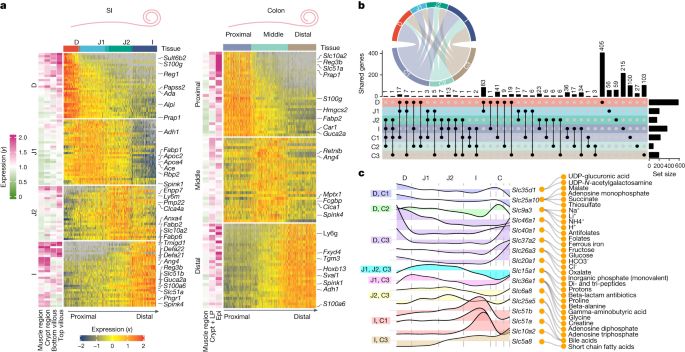
#WeekendRead! #LocationLocationLocation! Amazing @Nature by @touficmayassi.bsky.social, Xavier &co showing regional specialization of the gut at the spatial (single cell) level! Strong resilience after inflammation & ILC2 are key in middle colon adaption to microbiota! www.nature.com/articles/s41...
23.11.2024 14:55 — 👍 38 🔁 15 💬 0 📌 0
22/ Processed data and scripts can be found at tinyurl.com/4fsxwcc6
Data can also be viewed on the Single Cell Portal tinyurl.com/ykmajssf
tinyurl.com/56wh3x9t
tinyurl.com/2mjftsc3
Read more about the story here: tinyurl.com/5epdfrma
21/ This work represents years of effort shaped by the guidance of mentors, support of colleagues, and encouragement from family and friends. Grateful to everyone who contributed, directly or indirectly. Excited to keep exploring the mysteries of the gut! Until next time...
21.11.2024 22:21 — 👍 5 🔁 0 💬 1 📌 020/ Our results demonstrate that intestinal regionalization is characterized by robust and resilient structural cell states and that the intestine can adapt to environmental stress in a spatially controlled manner via the crosstalk between immunity and structural cell homeostasis
21.11.2024 22:21 — 👍 5 🔁 0 💬 1 📌 0
19/ Remarkably, we turned off ANG4 expression in the middle colon. Using our Xenium panel, we showed the loss of the middle colon-adapted goblet cell population, demonstrating that ILC2s are essential for actively maintaining this adaptation.
21.11.2024 22:21 — 👍 4 🔁 0 💬 1 📌 0
18/ Intrigued by these results, we reached out to David Artis and his group @WeillCornell to test if ILC2s drive the middle colon’s microbiota adaptation. I drove down to NYC with my tools and together with the talented @hirothehero.bsky.social we turned the lights off on the mid colon.
21.11.2024 22:21 — 👍 6 🔁 0 💬 1 📌 0
17/ Together with my officemate of 4yrs and close friend Eric Brown we were then able to show ILC2 derived signals could induce the middle colon signature in ex vivo explants.
21.11.2024 22:21 — 👍 4 🔁 0 💬 1 📌 0
16/ We leveraged our sc data to compare all immune cell types across regions between SPF and GF mice and found only ILC2s showed a unique microbiota driven signature in the middle colon (B) which we could also validate with flow cytometry for a variety of markers.
21.11.2024 22:21 — 👍 4 🔁 0 💬 1 📌 015/ By now, you’re probably wondering what’s up with the middle colon? So were we. Mid colon genes like Ang4, Pla2g4c and Spta1 are linked to type II immunity tissue responses (helminth/protozoa colonization), yet we observed them in steady state and in absence of those drivers.
21.11.2024 22:21 — 👍 4 🔁 0 💬 1 📌 0
14/ Using our data to design a customized 480 gene panel we then leveraged high resolution Xenium technology to map all our cell states in space and validated the regional association of cell states as well as the middle colon adapted cells.
21.11.2024 22:21 — 👍 4 🔁 0 💬 1 📌 0
13/ We found unique structural cells defined each region (enterocytes, fibroblasts, and goblet cells) and strikingly the middle colon associated region (B) had unique subsets only found in the presence of the microbiota.
21.11.2024 22:21 — 👍 7 🔁 0 💬 1 📌 0
12/ To uncover the cellular drivers of the gut’s spatial landscape and the middle colon adaptation we used scRNA-seq. Using a customized extraction protocol we profiled 99 cell states of epithelial, stromal and immune cells in one go from four distinct regions of the colon.
21.11.2024 22:21 — 👍 4 🔁 0 💬 1 📌 0
11/ We then tested if spatial gut circuits were resilient to inflammation using a spatiotemporal model of acute colonic inflammation. Both robust and adaptable landscapes were disrupted at peak inflammation but recovered over time, showcasing their resilience.
21.11.2024 22:21 — 👍 5 🔁 0 💬 1 📌 0
10/ We did find an exception tho: the middle colon adapts! Its identity depended on the microbiota, marked by genes like Ang4, Retnlb, Itln1, Pnliprp2, Aqp4, and Slc9a3. ANG4 protein staining showed exquisite specificity for the middle colon, serving as a biomarker in later exps.
21.11.2024 22:21 — 👍 5 🔁 0 💬 1 📌 1
9/ Ok, so how does the landscape respond to the microbiota? We found in germ-free mice, most genes maintained regional expression bias, even classical antimicrobial genes—suggesting a surprisingly robust and microbiota-independent landscape (the same applied to circadian rhythm).
21.11.2024 22:21 — 👍 4 🔁 0 💬 2 📌 0
8/ First surprise: distal gut regions shared unique expression patterns! Quantifying this revealed the duodenum shares many unique genes with the colon, hinting at unexpected redundancy in biological processes—highlighted again for SLC transporters.
21.11.2024 22:21 — 👍 5 🔁 0 💬 1 📌 0
7/ With these tools we were then able to map the continuous spatial transcriptome in both the X-axis (duodenum to colon) and Y-axis (serosa to epithelium) allowing us to interrogate the distribution of gene expression for any biological theme of interest (SLCs example).
21.11.2024 22:21 — 👍 4 🔁 0 💬 1 📌 0
6/ Next challenge - reconstruct the tissue to its native state and unify segments within and across mice to facilitate downstream analysis and visualization. Enter the room @lichenhao.bsky.social, a brilliant scientist that helped me supercharge the study along with my computational skills.
21.11.2024 22:21 — 👍 6 🔁 0 💬 1 📌 0
5/ The idea: use the gut swiss roll (before you started to see them everywhere) and ideally with fresh frozen tissue. With Toru Nakata (best hands I worked with), we figured it out and with Asa Segerstolpe, profiled 40+ rolls using 10xGenomics Visium. #SpatialBiology
21.11.2024 22:21 — 👍 4 🔁 0 💬 1 📌 04/ I set out to map the spatial transcriptome of the entire gut with the goal to then use it to ask if the landscape was robust to homeostatic drivers (microbiota circadian diet etc), if/how the landscape was adaptable in space and finally if it was resilient to insults.
21.11.2024 22:21 — 👍 5 🔁 0 💬 1 📌 03/ I felt the best place to do that would be @broadinstitute.org in Ramnik's lab. Spatial transcriptomics was just taking off in 2020 and I felt if I asked the right questions and designed the right experiment I could generate a dataset to mine for ideas for the rest of my career.
21.11.2024 22:21 — 👍 5 🔁 0 💬 1 📌 02/ I trained as an immunologist in Bana Jabri's lab @UChicagoCOI and studied the unconventional gd T cell in the context of celiac disease. I have always been fascinated by gut biology and expanded my expertise during my postdoc by taking a systems approach to my next question.
21.11.2024 22:21 — 👍 4 🔁 0 💬 1 📌 0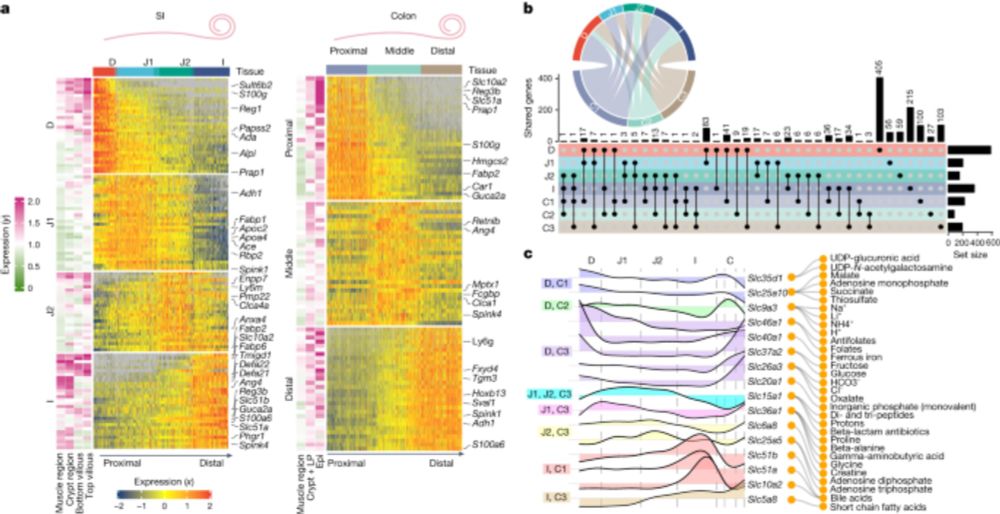
1/ Keen to share the story of my postdoc research out in @natureportfolio.bsky.social! We built a massive resource characterizing the spatial landscape of the gut—and yes, we dug deep into the biology too. If you’ve got a minute, let me walk you through the story. 🧵👇
www.nature.com/articles/s41...