
Lots more info (including state-specific relevant to your situation) at ccf.georgetown.edu and www.kff.org
08.05.2025 16:44 — 👍 3 🔁 1 💬 0 📌 0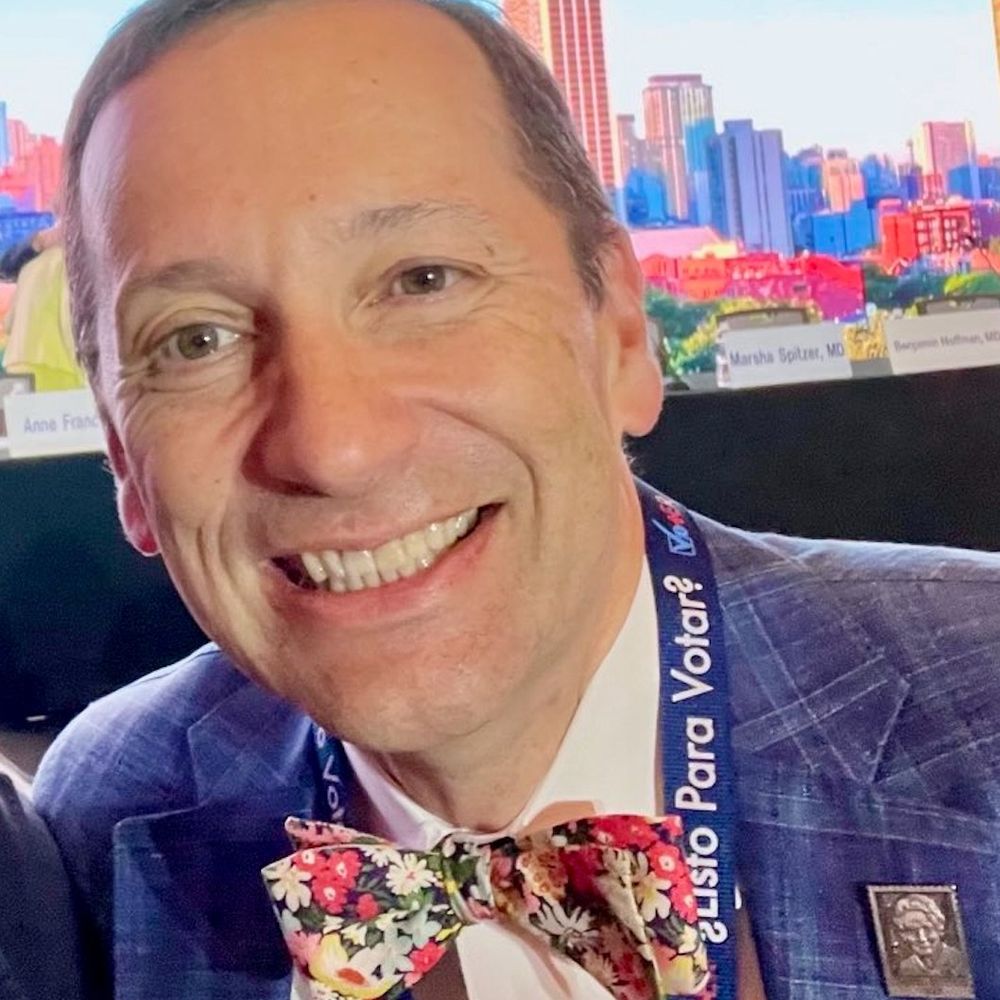
@johnzupancic.bsky.social
Neonatologist @bidmcneo and @harvardmed Babies | Health Services Research | Clinical Epidemiology connects.catalyst.harvard.edu/Profiles/display/Person/3581 ORCID: https://orcid.org/0000-0003-1734-7193 he/him/his posts = mine
Lots more info (including state-specific relevant to your situation) at ccf.georgetown.edu and www.kff.org
08.05.2025 16:44 — 👍 3 🔁 1 💬 0 📌 0
3. That makes it one of our most important tools for ensuring equity (slide courtesy of Dr. Shah)
08.05.2025 16:44 — 👍 2 🔁 1 💬 1 📌 0

Dr. Shetal Shah (@nicubatman on Instagram and the Other place) Harvard BIDMC Newborn Epidemiology and HSR conference, reminding us that 1. Health insurance for all children is a civil right and 2. Medicaid is the single biggest payor for US births
08.05.2025 16:44 — 👍 8 🔁 4 💬 2 📌 0
COLLABORATE, coming 2025, will determine the effects of donor milk, formula, and cow-milk fortifier on surgical NEC, survival & cognition in extremely preterm babies, key questions parents & clinicians have been asking for many years. Explainer & summary here: www.imperial.ac.uk/neonatal-dat...
17.12.2024 16:04 — 👍 6 🔁 2 💬 0 📌 1
The National Neonatal Research Database is an amazing collaborative effort by all neonatal units in England, Scotland & Wales. Read our Christmas Newsletter here sway.cloud.microsoft/TRwgQx0jRac9... @99nicu.bsky.social @neonatalnursesuk.bsky.social @
19.12.2024 14:44 — 👍 5 🔁 4 💬 0 📌 0

Sharing new paper from our workshop in #PAS2023
Navigating Information Overload on Social Media: Opportunities & Misadventures for Clinicians and Professionals www.newbornjournal.org/abstractArti...
@briankingneo.bsky.social @souvikneo.bsky.social
#neosky @ebneo.bsky.social @espr-esn.bsky.social

Bonus content: A fascinating interview about the paper with Drs. Philip Sunshine and William Northway
youtu.be/79prakcjBjc?...
6/6
Case reports and series may be prone to bias, but in the hands of committed scientists, observation is still the entry point to improved outcome.
5/6
…including progression of disease with path, clinical, radiological lenses; very early discussion of acquired pulmonary hypertension; role of oxygen; separation of two overlapping disease entities with eventual demonstration of distinct treatment modalities.
4/6
For your consideration:
Careful description, with no statistical comparisons, still brought a number of lasting truths to the table in this first comprehensive description of BPD…
3/6
From the article: “The two outstanding findings are the prolongation of the healing phase of [RDS} and the appearance of a new chronic pulmonary syndrome that is associated with intermittent positive pressure respirators and High Oxygen for longer than one hundred and fifty hours (six days).”
2/6...
#52MoreChallenge Week 4!
Northway WH Jr, Rosan RC, Porter DY. Pulmonary disease following respiratory therapy of hyaline-membrane disease. Bronchopulmonary dysplasia. N Engl J Med. 1967; 276(7):357. PMID: 5334613.
pubmed.ncbi.nlm.nih.gov/5334613/
#neoSky #neoEBM #52MoreChallenge
1/6...

ROBINS-I v2: www.riskofbias.info/welcome/robi...
21.12.2024 17:54 — 👍 2 🔁 0 💬 0 📌 0
GRADE obviously also supports this broadly within a given review at the body-of-literature level.
I am not sure that we have Cochrane NRSI SRMA examples in neonatology yet. Might be worth taking one on in the above area as a pilot?
But there has always been rx evidence beyond RCTs (just think what we got from the Framingham study). Cochrane has expanded its charter to non-randomised studies of the effects of interventions (NRSIs) and is developing tools to support that endeavor (eg see the observational RoB tool ROBINS-I v2)
21.12.2024 17:52 — 👍 2 🔁 0 💬 1 📌 0It's such an important point @briankingneo.bsky.social . SRMAs with few or no RCTs are of course an essential part of the evidence synthesis process - I suspect that @souvikneo.bsky.social's review might find itself into the rationale for a new CIHR trial application or two :)
21.12.2024 17:52 — 👍 2 🔁 0 💬 1 📌 0Great! Dr. Saigal is always happy to hear from people if you have questions or comments.
11.12.2024 19:07 — 👍 0 🔁 0 💬 0 📌 0
I guess it's not surprising that our organizations and journals must lag a bit in adoption of a new platform, but they are an important part of the conversation. Let's encourage whatever we're affiliated with to take the leap. We can log them here (currently pretty sparse)
go.bsky.app/DwfZqQF
🌟 Save the Date! 🌟
Join us for the inaugural Congress of the European Paediatric Academic Societies (CEPAS) in Lyon, France, from 28–31 October 2026. Mission: Uniting paediatric professionals to advance child health through cutting-edge research, education, and collaboration.👉Learn more at cepas.org
(The #52MoreChallenge is a follow-up of the #52in52RCTChallenge. We're currently replaying the first month from Twitter and will start new articles in week 5. If you have candidates for the 52 most important non-RCT articles in the #NeoSky literature, please let me know)
10.12.2024 22:00 — 👍 2 🔁 2 💬 0 📌 0
The next AAP SONPM Journal Club is Thursday (December 12th) at 4:00 pm EST. Andrew Beverstock, neonatal fellow, will review the Diamond trial, with mentors Tanith Alexander (trial investigator) and Ariel Salas. #neosky #neoEBM
Register - tinyurl.com/c87skbeh
Trial- nejm.org/doi/full/10.10…
Follow-up bonus about follow-up: Dr. Saigal interviewed the now-adult members of the same cohort decades later for a less prosaic, and quite moving, book and accompanying videos. See a.co/d/411zd3u and www.youtube.com/@PreemieVoices (the latter with both 2014 and 2024 interviews)
🧵fin
From the paper: “Nevertheless, the vast majority of ELBW respondents view their health-related quality of life as quite satisfactory and are difficult to distinguish from controls."
🧵4/5
The participants in this work were part of a long-term, geographically-defined (and therefore low-selection-bias) cohort, also a significant contribution to a literature that had been (and remains) plagued by single-center, short-term studies.
🧵3/5
Dr. Saroj Saigal took to heart the insight that EBM includes not only critical appraisal but also patient values & preferences. Her research used tools f/ economics & psychology to demonstrate that patients & families may have different impressions of their own 'medical sequelae' than expected.
🧵2/5
#52MoreChallenge WEEK 3:
Saigal S, Feeny D, Rosenbaum P, et al. Self-perceived health status and health-related quality of life of extremely low-birth-weight infants at adolescence. JAMA. 1996; 276(6):453. PMID: 8691552.
pubmed.ncbi.nlm.nih.gov/8691552/
#neoSky #neoEBM #52MoreChallenge
🧵1/5
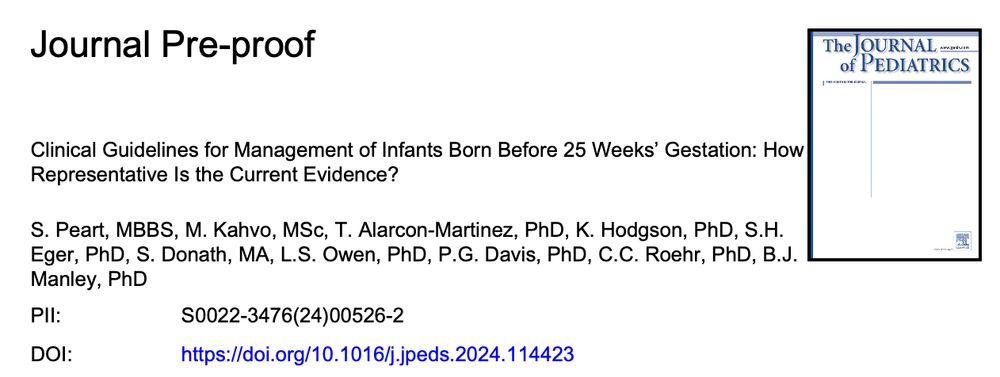
A close look at the evidence-base for treating the most premature babies, as in international newborn early-life care guidelines (ILCOR, ERC and Euro-RDS consensus) - take a look and share your thoughts
@ebneo.bsky.social
doi.org/10.1016/j.jp...
@drbretty.bsky.social @donsharkey.bsky.social

@georgetownccf.bsky.social is holding a webinar open to all next Tuesday Dec 10th at 2p ET about Medicaid's financing structure and ways in which the new Congress may try to change it.
This will be the first in a series of webinars.
You can register here ccf.georgetown.edu/2024/12/03/r...
This is a great idea! 💡 ⬇️ #academicsky
21.11.2024 21:08 — 👍 48 🔁 20 💬 2 📌 2
There's been a proliferation of "systematic reviews". Are these AI tools playing some role? Authors (and editors, if applicable!) need to apply vigilant assessment of the quality of the reviews. Simply following a checklist does not make a review systematic.
www.nature.com/articles/d41...