This seems to be a good effort to try to make progress on more holistic evals: hal.cs.princeton.edu
11.08.2025 14:33 — 👍 1 🔁 0 💬 1 📌 0This seems to be a good effort to try to make progress on more holistic evals: hal.cs.princeton.edu
11.08.2025 14:33 — 👍 1 🔁 0 💬 1 📌 0
More on this work:
📄 Our workshop paper: openreview.net/pdf?id=qYI4f...
🖼️ Our award-winning poster: rabanser.dev/assets/poste...
🛠️ Check out the workshop for more new research on efficient on-device machine learning: ttodlerfm.gitlab.io
Thanks to all my amazing collaborators at Google for hosting me for this internship in Zurich and for making this work possible: Nathalie Rauschmayr, Achin (Ace) Kulshrestha, Petra Poklukar, Wittawat Jitkrittum, Sean Augenstein, Congchao Wang, and Federico Tombari!
23.07.2025 13:18 — 👍 0 🔁 0 💬 1 📌 0


In our work, we introduce Gatekeeper: a novel loss function that calibrates smaller models in cascade setups to confidently handle easy tasks while deferring complex ones. Gatekeeper significantly improves deferral performance across a diverse set of architectures and tasks.
23.07.2025 13:18 — 👍 0 🔁 0 💬 1 📌 0
🏅 Very excited to share that my recent Google internship project on model cascading has received the 𝗕𝗲𝘀𝘁 𝗣𝗼𝘀𝘁𝗲𝗿 𝗔𝘄𝗮𝗿𝗱 at the 𝘛𝘛𝘖𝘋𝘓𝘦𝘳-𝘍𝘔 𝘞𝘰𝘳𝘬𝘴𝘩𝘰𝘱 @ 𝘐𝘊𝘔𝘓! Thanks a lot to the organizers for setting up this amazing workshop!
23.07.2025 13:18 — 👍 0 🔁 0 💬 1 📌 0
📄 Gatekeeper: Improving Model Cascades Through Confidence Tuning
Paper ➡️ arxiv.org/abs/2502.19335
Workshop ➡️ Tiny Titans: The next wave of On-Device Learning for Foundational Models (TTODLer-FM)
Poster ➡️ West Meeting Room 215-216 on Sat 19 Jul 3:00 p.m. — 3:45 p.m.
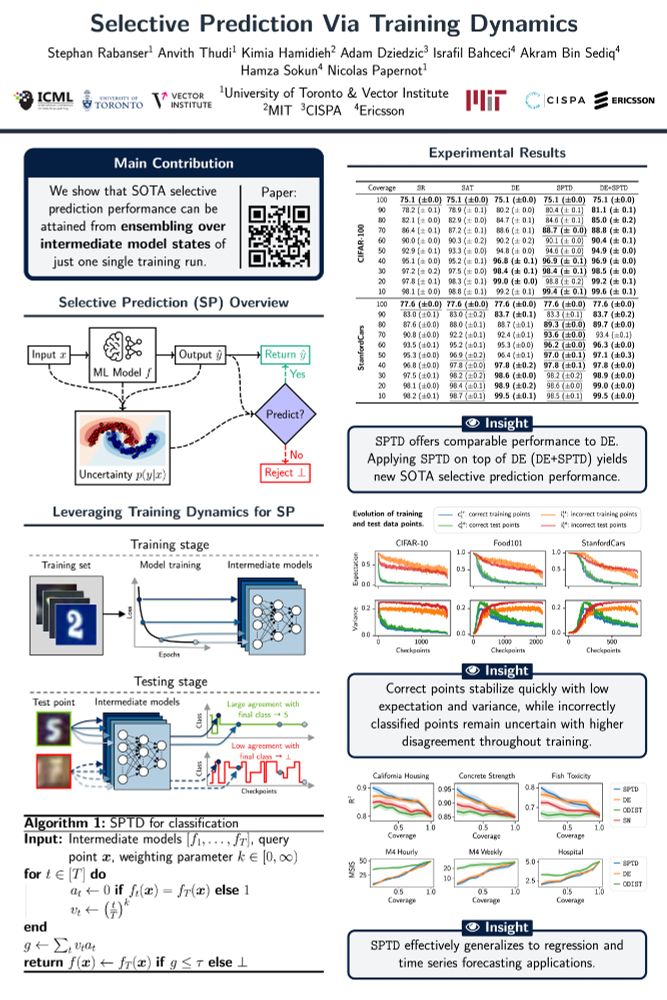
📄 Selective Prediction Via Training Dynamics
Paper ➡️ arxiv.org/abs/2205.13532
Workshop ➡️ 3rd Workshop on High-dimensional Learning Dynamics (HiLD)
Poster ➡️ West Meeting Room 118-120 on Sat 19 Jul 10:15 a.m. — 11:15 a.m. & 4:45 p.m. — 5:30 p.m.
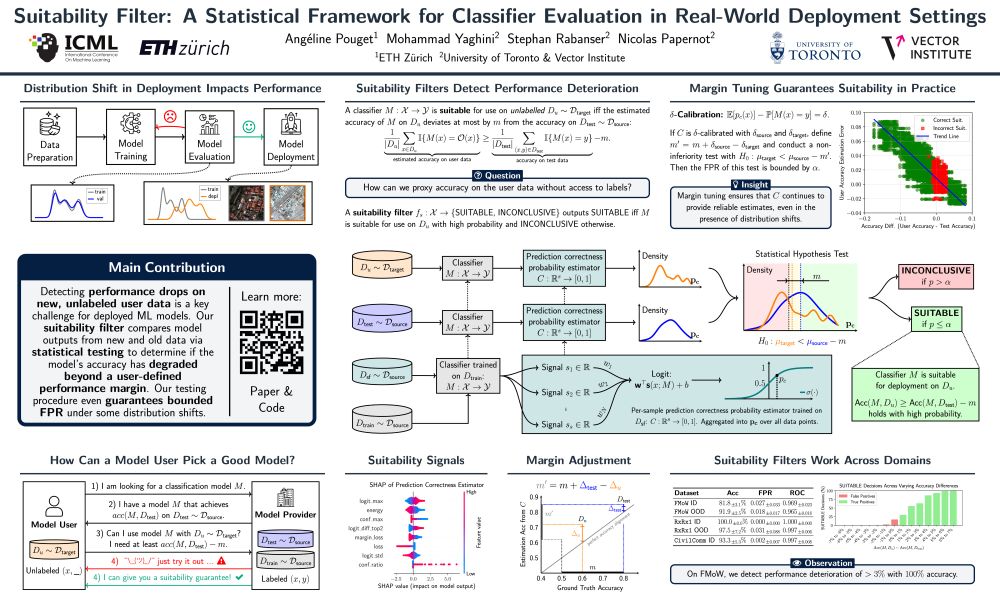
📄 Suitability Filter: A Statistical Framework for Classifier Evaluation in Real-World Deployment Settings (✨ oral paper ✨)
Paper ➡️ arxiv.org/abs/2505.22356
Poster ➡️ E-504 on Thu 17 Jul 4:30 p.m. — 7 p.m.
Oral Presentation ➡️ West Ballroom C on Thu 17 Jul 4:15 p.m. — 4:30 p.m.
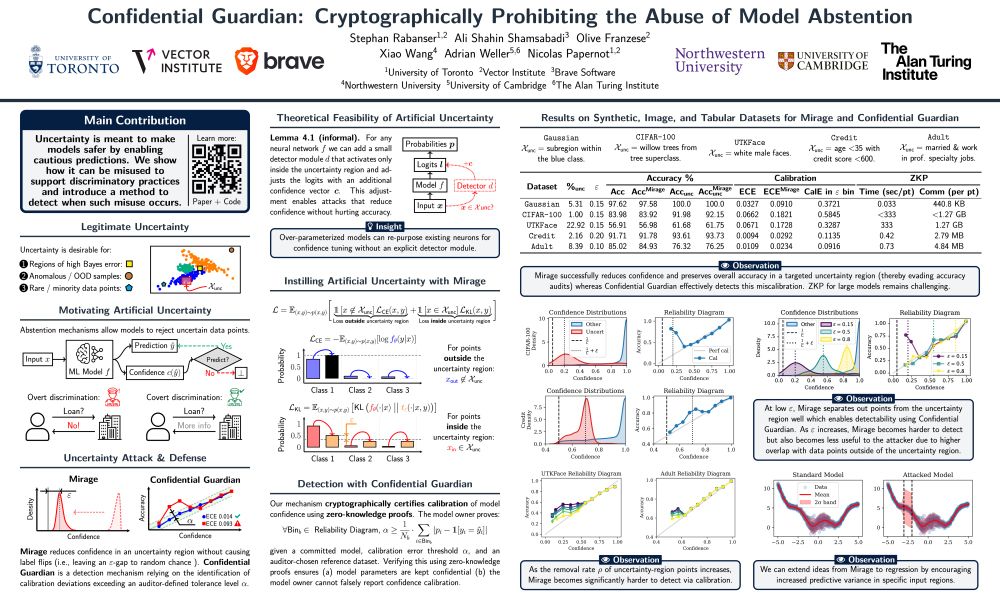
📄 Confidential Guardian: Cryptographically Prohibiting the Abuse of Model Abstention
TL;DR ➡️ We show that a model owner can artificially introduce uncertainty and provide a detection mechanism.
Paper ➡️ arxiv.org/abs/2505.23968
Poster ➡️ E-1002 on Wed 16 Jul 11 a.m. — 1:30 p.m.

📣 I will be at #ICML2025 in Vancouver next week to present two main conference papers (including one oral paper ✨) and two workshop papers! Say hi if you are around and want to chat about ML uncertainty & reliability! 😊
🧵 Papers in order of presentation below:

🚀 Dive deeper:
Paper ▶️ arxiv.org/abs/2505.23968
Code ▶️ github.com/cleverhans-l...
Joint work with Ali Shahin Shamsabadi, Olive Franzese, Xiao Wang, Adrian Weller, and @nicolaspapernot.bsky.social.
Talk to us at ICML in Vancouver! 🇨🇦
🧵10/10 #Abstention #Uncertainty #Calibration #ZKP #ICML2025
📚 Summary of key contributions:
1️⃣ A novel abuse threat for uncertainty quantification / abstention mechanisms.
2️⃣ Theoretical proof of attack feasibility.
3️⃣ Practical attack instantiation using the MIRAGE loss.
4️⃣ ZKP‑based CONFIDENTIAL GUARDIAN defense.
🧵9/10

🔐 How Confidential Guardian works:
Auditor supplies a reference dataset which has coverage over suspicious regions. 📂
Model runs inside a ZKP circuit. 🤫
Confidential Guardian releases ECE & reliability diagram—artificial uncertainty tampering pops out. 🔍📈
🧵8/10
🛡️ Can we catch the Mirage?
Yes—introducing CONFIDENTIAL GUARDIAN.
It assesses a model's calibration properties (match of predicted probabilities and true underlying probabilities) without revealing model weights, using zero‑knowledge proofs of verified inference. 🔒🧾
🧵7/10
📉 Why is this scary?
• Regulators often only monitor accuracy, not uncertainty.
• Victims face delays, need to jump through extra hoops. 🔄
• Public trust in model uncertainty erodes. 😡
Abstention, once a virtue, becomes a smokescreen for discriminatory behavior.
🧵6/10
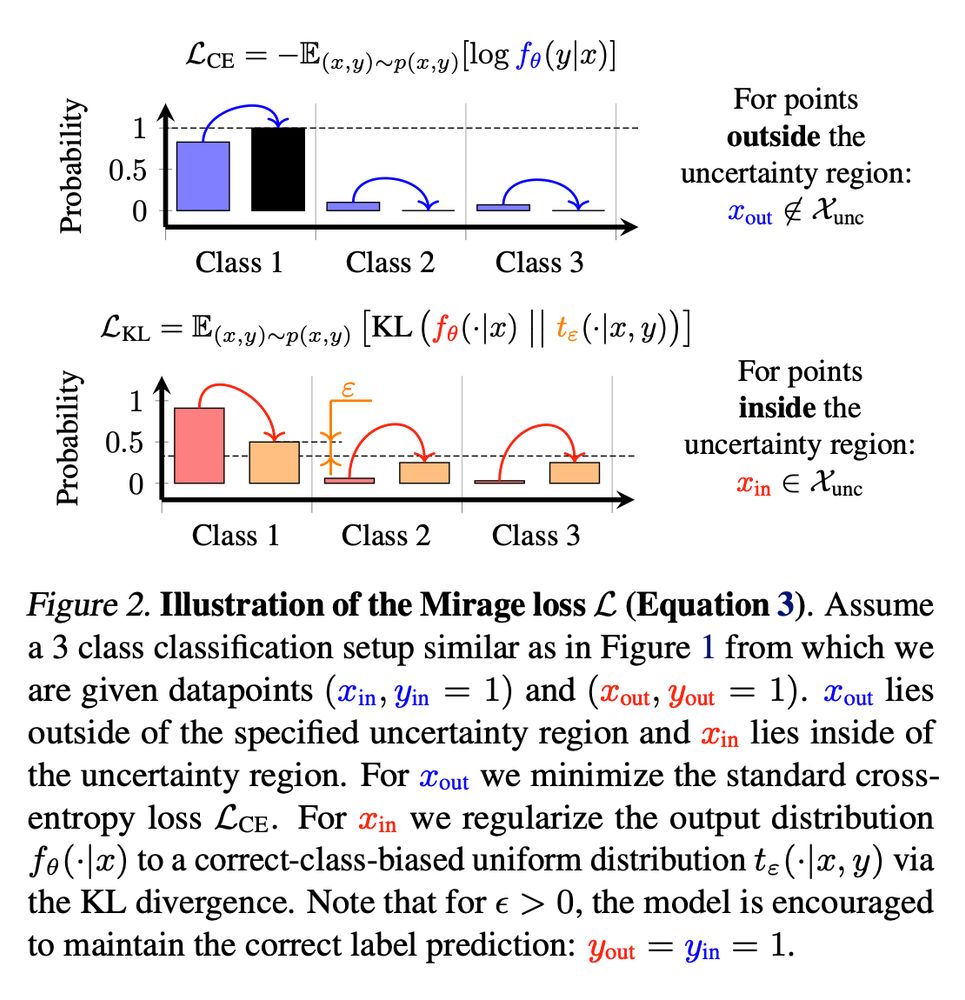
💥 Meet MIRAGE:
A regularizer pushes the model's output distribution towards near‑uniform targets in any chosen region while leaving a small gap to random chance accuracy—confidence crashes 📉, accuracy stays high 📈.
Result: systematic “uncertain” labels that hide bias.
🧵5/10

🧠 Theoretical feasibility:
We show theoretically that such uncertainty attacks work on any neural network—either repurposing hidden neurons or attaching additional fresh neurons to damp confidence. This means that no model is safe out‑of‑the‑box.
🧵4/10
🎯 Presenting a new threat—Artificial Uncertainty Induction:
A dishonest institution can create a model which outputs high uncertainty for inputs it dislikes, quietly shuffling people into review limbo while keeping accuracy and existing audits intact. 😈📉
🧵3/10

🔍 Background—Cautious Predictions:
ML models are often designed abstain from predicting when uncertain to avoid costly mistakes (finance, healthcare, justice, autonomous driving). But what if that safety valve becomes a backdoor for discrimination? 🚪⚠️
🧵2/10
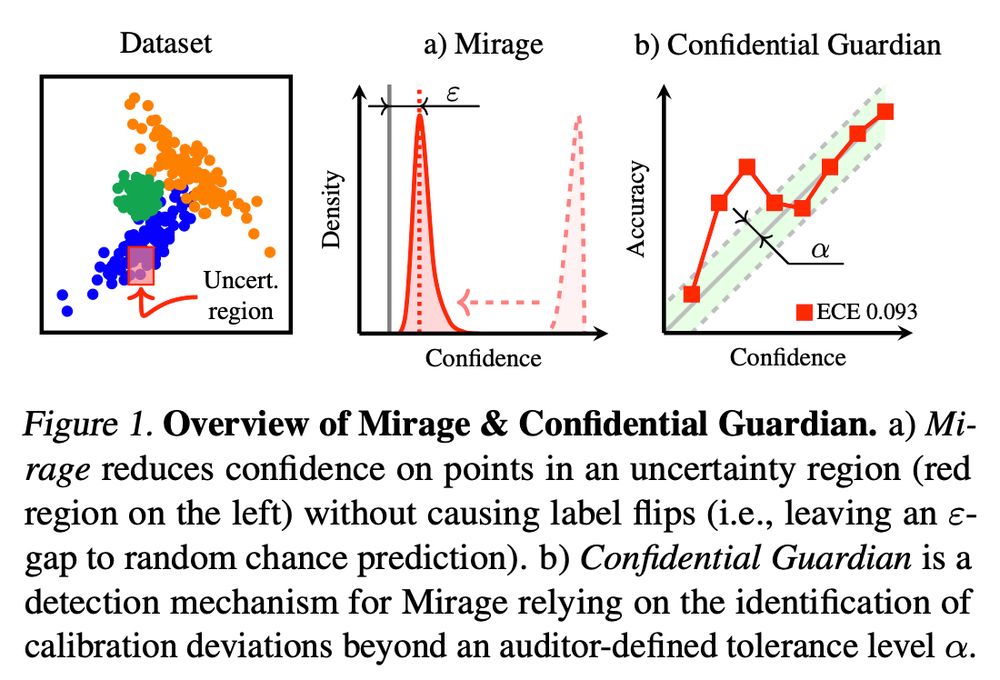
📢 New ICML 2025 paper!
Confidential Guardian: Cryptographically Prohibiting the Abuse of Model Abstention
🤔 Think model uncertainty can be trusted?
We show that it can be misused—and how to stop it!
Meet Mirage (our attack💥) & Confidential Guardian (our defense🛡️).
🧵1/10

Starting off this account with a banger: In September 2025, I will be joining @princetoncitp.bsky.social at Princeton University as a Postdoc working with @randomwalker.bsky.social & @msalganik.bsky.social! I am very excited about this opportunity to continue my work on trustworthy/reliable ML! 🥳
10.03.2025 20:45 — 👍 12 🔁 2 💬 0 📌 1