
Our new study on how large floods will change in Europe under climate change, led by @bfang.bsky.social, with @bevacquae.bsky.social
29.08.2025 18:37 — 👍 20 🔁 6 💬 1 📌 0Our new study on how large floods will change in Europe under climate change, led by @bfang.bsky.social, with @bevacquae.bsky.social
29.08.2025 18:37 — 👍 20 🔁 6 💬 1 📌 0Indeed, it was a pleasure to contribute to this course with content on extreme events, climate change, and attribution science. Now it’s time for the examination! :)
16.07.2025 11:46 — 👍 2 🔁 0 💬 0 📌 0
To what extent does human-induced climate change contribute to global extreme wildfires? In our latest study, we quantified the contribution of human-induced climate change to over 700 observed extreme wildfires globally. www.nature.com/articles/s41...
28.04.2025 08:08 — 👍 7 🔁 3 💬 3 📌 0
📊 Warming was the main driver, but precipitation, humidity, and wind changes either enhanced or counteracted warming effects in many regions.
📄 Paper in npj Climate and Atmospheric Science www.nature.com/articles/s41... or rdcu.be/eiYcp
@natureportfolio.nature.com @compoundnet.bsky.social

🔥🌍 In a new paper led by Sifang Feng, we find a growing human-induced climate change fingerprint in weekly regional fire extremes.
📈 On average, climate change was responsible for a fraction equal to 8 ± 4% of the predicted probability of more than 700 fire extremes worldwide between 2002 and 2015.
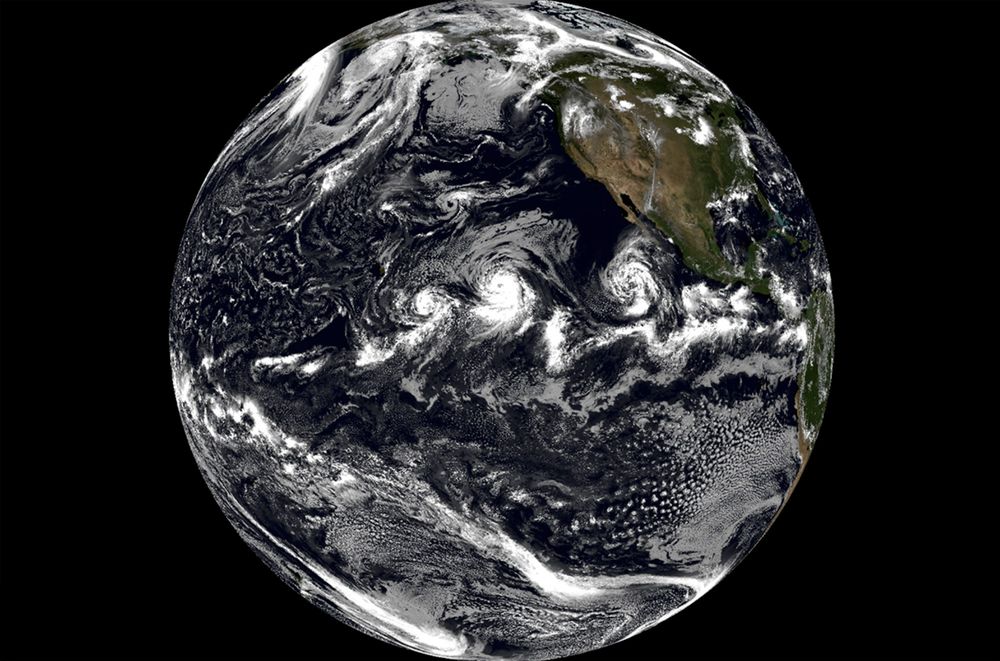
Hi - I'd like to share this story of what is happening at NOAA GFDL, where some of my colleagues and I worked until the mass firings at NOAA last week.
"...the birthplace of weather and climate forecasting"
Great job opportunity in Graz, check it out!
24.02.2025 21:43 — 👍 1 🔁 0 💬 0 📌 0Hi Glen, adding to Carl, more text related to this is in paragraphs 2-3 of our brief communication. For those interested in expanding, see also Betts' discussion: www.nature.com/articles/d41.... The same windows are also used to document impacts/effects emerging at a given warming level.
12.02.2025 09:13 — 👍 3 🔁 0 💬 1 📌 0
2024 was the first year to see global average temperatures rise more than 1.5°C above pre-industrial levels. Has the Paris Agreement goal already bitten the dust? www.newscientist.com/article/2467...
10.02.2025 22:03 — 👍 31 🔁 11 💬 0 📌 1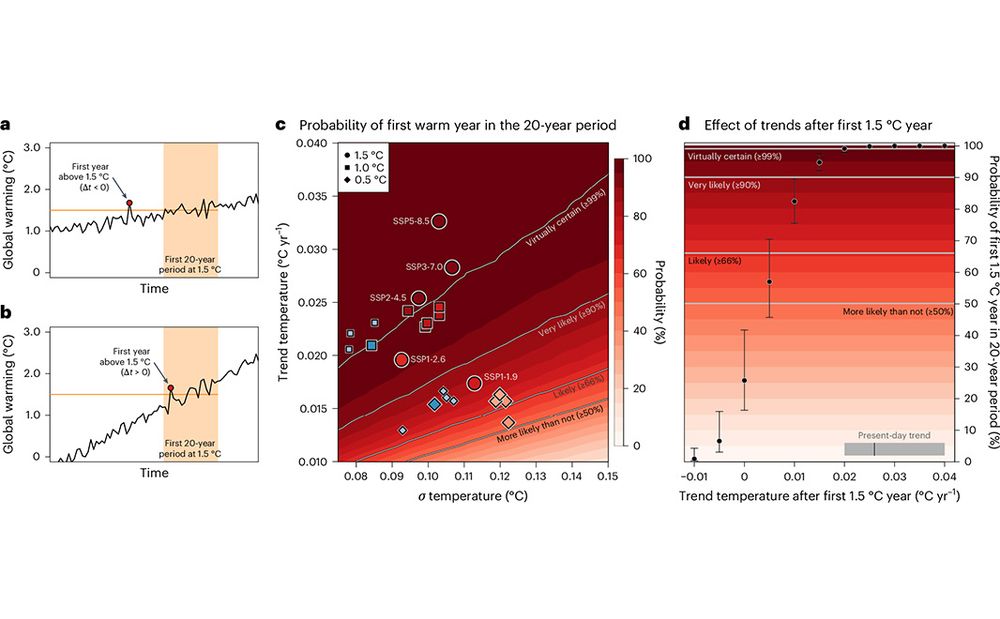
This is figure 2 from “A year above 1.5 °C signals that Earth is most probably within the 20-year period that will reach the Paris Agreement limit.” It shows strong warming trends place the first 1.5 °C year within the 1.5 °C 20-year period.
Two papers in Nature Climate Change suggest that exceeding 1.5 °C in 2024 may indicate that we have entered a multi-decadal period of 1.5 °C average global warming.
https://go.nature.com/4hR9GYO
https://go.nature.com/3WVdJM1
🧪
The results in both papers depend on how CMIP6 models capture relevant climate processes over the next decade or so. See Discussion and bsky.app/profile/clim...
Work @ufz.de together with @carlschleussner.bsky.social and @zscheischlerjak.bsky.social

In contrast, while our results are more conservative by indicating we are in the first part of the 20-year period and not that the goal has been breached, they rely on the occurrence of a calendar year above 1.5°C, which is supported by the average of multiple observational datasets (1.55°C).
10.02.2025 16:55 — 👍 5 🔁 0 💬 1 📌 0
Making their result actionable requires the occurrence of 12 consecutive months above 1.5°C, a condition met in ERA5 and BEST observational datasets, but that has not been met based on the mean of multiple observational datasets (plot for consecutive months strictly > 1.5°C by @hoegner.bsky.social).
10.02.2025 16:55 — 👍 4 🔁 1 💬 1 📌 0An extra note is needed to help link our results with another study published by Cannon today. In climate models (SSP245), Cannon found a 76% chance that 12 consecutive months above 1.5°C occur *after* the Paris Agreement goal is reached, that is, after the midpoint of a 20-year window at 1.5°C.
10.02.2025 16:55 — 👍 8 🔁 1 💬 2 📌 0Finally, we highlight that the entry time in the 20-year period at 1.5 °C warming should not be mistaken as the timing of the warming level itself, as the latter is placed at the midpoint of the 20-year period.
10.02.2025 16:55 — 👍 7 🔁 2 💬 1 📌 0
Only rapid near-term mitigation can effectively limit peak warming, which is required to hold warming *well below* 2 °C in case of exceedance or overshoot of 1.5 °C. www.nature.com/articles/s43...
A year above 1.5 °C is not the time for despair but a call to action.
Cutting emissions has never been more important. It can lower the chance of reaching the 1.5°C limit soon after 2024, but this demands very stringent mitigation. For example, halving the chance that 2024 will be within the first 20-yr 1.5°C period requires a fivefold reduction in temperature trends.
10.02.2025 16:55 — 👍 8 🔁 3 💬 1 📌 0
The IPCC AR6 flags “High Risks” at 1.5°C for unique systems (such as biodiversity) and extreme events. Floods in Brazil, Spain, and Kenya, mega-drought in the Amazon, tropical storms, and heatwaves in 2024 gave us a taste of these risks. We are not prepared for the climate risks at 1.5°C to unfold.
10.02.2025 16:55 — 👍 7 🔁 3 💬 1 📌 0Entering a window at 1.5 °C average warming means entering the same window used by scientists to project the impacts of a 1.5 °C warmer world. Thus, our results warn we are most probably in a period where the impacts of a 1.5 °C world are expected to unfold, underscoring the urgency of adaptations.
10.02.2025 16:55 — 👍 5 🔁 2 💬 1 📌 0Our result is due to the ongoing strong anthropogenic multi-decadal warming trend that, combined with the relatively low variability in the temperature time series, renders it very unlikely for the temperature of a single year to exceed the average temperature over the coming decades (Figure 2c).
10.02.2025 16:55 — 👍 5 🔁 0 💬 1 📌 0That is, the first year above 1.5 °C occurs within the first 20-year period with an average warming of 1.5 °C. We found the same behaviour for other recent warming levels already reached in observations starting from the 1980s (0.6 °C to 1.0 °C; Figure 1a in the paper).
10.02.2025 16:55 — 👍 4 🔁 1 💬 1 📌 0
Through climate models, observations, and idealised experiments, we show that unless stringent climate mitigation is implemented, the first year above 1.5°C in 2024 signals that it is highly probable that Earth has already entered the 20-year period that *will* reach the 1.5°C Paris Agreement limit.
10.02.2025 16:55 — 👍 9 🔁 3 💬 1 📌 0However, the implications for the Paris Agreement's 1.5 °C goal are unclear because the goal is understood to refer to temperature averaged over a 20-30 year period to account for natural short-term variability.
10.02.2025 16:55 — 👍 4 🔁 0 💬 2 📌 0The year 2024 was announced as the first calendar year to exceed 1.5 °C of global warming by several international organisations that independently track the global temperature, with a multi-dataset mean of 1.55 °C.
10.02.2025 16:55 — 👍 5 🔁 0 💬 1 📌 0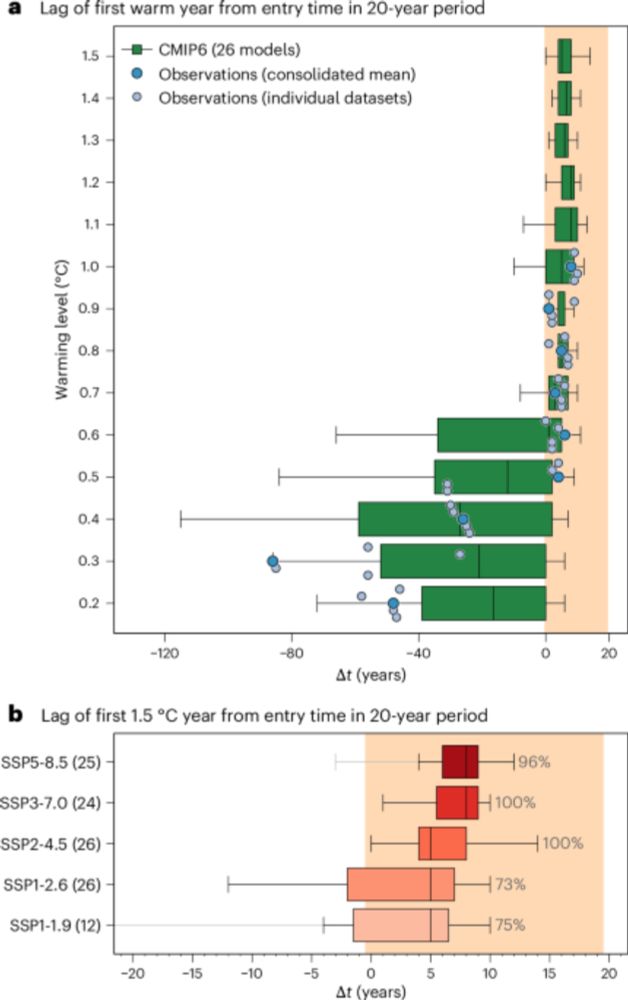
In Nature Climate Change, we show that a year above 1.5 °C signals that Earth is most probably within the 20-year period that will reach the Paris Agreement limit. @natclimchange.bsky.social
10.02.2025 16:55 — 👍 148 🔁 79 💬 4 📌 4Spiralling global temperatures: 2024 edition
10.01.2025 16:25 — 👍 340 🔁 188 💬 6 📌 18Big congrats! @raedhamed.bsky.social
10.01.2025 21:22 — 👍 0 🔁 0 💬 1 📌 0
We are delighted to announce the "Compound weather and climate events" session at #EGU25!
We look forward to receiving your exciting abstracts!
@compoundnet.bsky.social
We are delighted to announce the "Compound weather and climate events" session at #EGU25!
We look forward to receiving your exciting abstracts!
@compoundnet.bsky.social
Thanks to all coauthors! Oldrich Rakovec, Dominik L. Schumacher, Rohini Kumar, Stephan Thober, Luis Samaniego, Sonia I. Seneviratne & Jakob Zscheischler
Apologies for crossposting! It is a particular period with social networks!
