Paul Meehl Graduate School Dissertation Award | Paul Meehl Graduate School
# About Since its establishment in 2024, the Paul Meehl Graduate School has aimed to foster a strong community for...
We are pleased to announce that the Paul Meehl Graduate School is launching the PMGS Dissertation Award, recognizing outstanding PhD dissertations that advance meta-research.
See the eligibility criteria and apply before June 1st, 2026 at:
paulmeehlschool.github.io/award/
04.03.2026 19:26 —
👍 13
🔁 7
💬 0
📌 0

#SPSP2026 join us at 12:30 to answer all your questions about registered reports!
28.02.2026 16:27 —
👍 18
🔁 5
💬 1
📌 0

Causal inference for psychologists who think that causal inference is not for them
Correlation does not imply causation and psychologists' causal inference training often focuses on the conclusion that therefore experiments are needed—without much consideration for the causal infer...
You need to bring in the same toolkit as in studies that try to establish causality without randomization.
I know it sounds unfair, but I don’t make the rules. These situations are instances of post-treatment bias, if you want to read up on it as a psychologist:
25.02.2026 17:32 —
👍 66
🔁 12
💬 3
📌 4
Just an aside: 41 of the 100 meta analyses published in Psych Bull between 2023 and 2025 do not include *any* quality screening of identified studies. To the degree that those literatures include bad studies, they are being laundered together with the good ones.
14.02.2026 11:15 —
👍 29
🔁 6
💬 4
📌 1
New paper, on a worrying trend in meta-science: the practice of anonymising datasets on, e.g., published articles. We argue that this is at odds with norms established in research synthesis, explore arguments for anonymisation, provide counterpoints, and demonstrate implications and epistemic costs.
13.02.2026 16:50 —
👍 98
🔁 52
💬 6
📌 7

Making Europe a scientific superpower · Luma
The European Union spends more on science funding each year than America’s National Science Foundation. But scientific output in Europe still trails the US…
We at Works in Progress are hosting a series of lightning talks on the future of science R&D in Europe!
Come along for the ideas, conversations and meet us!
2nd March, Brussels. Register here: luma.com/08rnunqw
28.01.2026 11:16 —
👍 18
🔁 2
💬 1
📌 0
📅 Mark your calendars for #SIPS2027!
The 2027 SIPS conference, organized in collaboration with the Association for Interdisciplinary Meta-Research and Open Science @aimosinc.bsky.social, will be held in November at the University of Melbourne, Australia.
We are looking forward to seeing you there!
27.01.2026 15:21 —
👍 38
🔁 24
💬 0
📌 2

Screenshot of a preprint titled “Digital Behaviourism: A functional approach to behaviour in digital environments”
Our preprint has evolved!
v2 of “Digital Behaviourism” is out now with a new title, new co-authors, and a deeper dive into the behavioural concepts that shape our online lives.
It’s time to move beyond “screen time” and focus on function of online behaviours.
osf.io/preprints/ps...
26.01.2026 08:52 —
👍 52
🔁 20
💬 4
📌 2

Rethinking psychological measurement: Validity potential versus realised validity
We propose a concept of validity with a novel feature that we argue can facilitate improved measurement validation practices in the psychological scie…
Thrilled to share our new paper introducing “validity potential” versus “realised validity” as a key distinction for psychological measurement, with @davidmkaplanx.bsky.social, Alexander Gillett, @suttonprofessor.bsky.social, and @robert-m-ross.bsky.social www.sciencedirect.com/science/arti...
24.01.2026 20:10 —
👍 27
🔁 5
💬 2
📌 2
How many versions of the Iowa Gambling Task (IGT) exist? And how much does this affect research using the IGT? More than you might think. 🧵
25.01.2026 11:16 —
👍 95
🔁 44
💬 3
📌 6
Some people bring up (1) the cost of criticism and (2) that a lot of criticism has already been voiced but ignored. Both points are valid, so here are some suggestion for (1) reducing backlash and (2) increasing impact (from this talk of mine: juliarohrer.com/wp-content/u...
08.01.2026 07:28 —
👍 72
🔁 25
💬 2
📌 4
RegCheck V2 is out!
Try it out yourself: regcheck.app
Read more about it: arxiv.org/abs/2601.13330
Check out the codebase: github.com/JamieCummins...
22.01.2026 11:51 —
👍 7
🔁 3
💬 0
📌 1

Fig. 3. Scatter plots of the synthetic and empirical estimates, validation study (Stage 2). Showing N = 30,135 item-pair correlations, N = 257 scale reliabilities, and N = 1,568 scale-pair correlations for (top) the pretrained SBERT model and (bottom) the fine-tuned SurveyBot3000 model. SBERT = all-mpnet-base-v2 model.

Fig. 4. Prediction error of the synthetic estimates, validation study (Stage 2). Our prediction model allowed the error term to vary freely according to the predictor, the synthetic estimate. The thin-plate splines show that some synthetic estimates were predictably more accurate.

Fig. 5. Accuracy by domain. Accuracy differed across domains. SurveyBot3000 accuracy (colored) was always higher than SBERT accuracy (gray). Results were largely consistent whether accuracy of items was tested (left, circle) within domains or (right, cross) across domains.
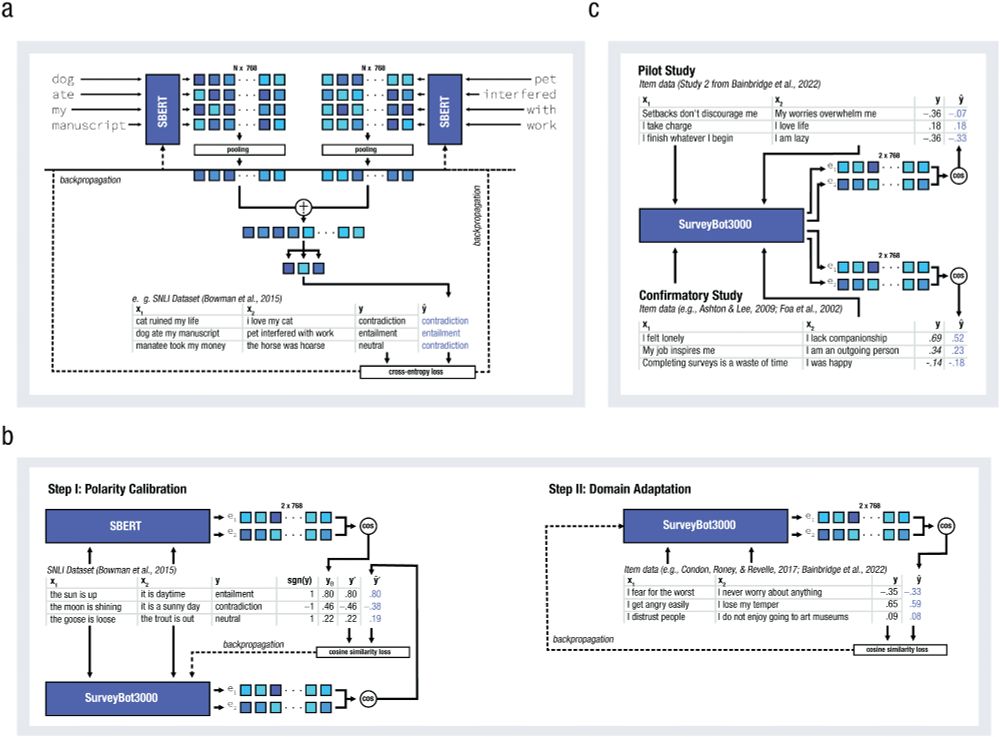
Fig. 1. Multistep training procedure for the SurveyBot3000, which produces synthetic estimates of interitem correlations. (a) Pretraining base model (SBERT). (b) Fine-tuning SurveyBot3000. (c) Validation. SBERT = all-mpnet-base-v2 model.
Finally, @bjoernhommel.bsky.social's and my paper introducing the SurveyBot3000 is officially out in AMPPS. It's a fine-tuned language model that guesstimates correlations between survey items from text alone. Not perfectly, but useful for search, for example.
journals.sagepub.com/doi/10.1177/...
18.12.2025 20:20 —
👍 81
🔁 33
💬 2
📌 6
Thank you!!
13.12.2025 22:16 —
👍 0
🔁 0
💬 0
📌 0
Thank you!! :)
13.12.2025 11:48 —
👍 1
🔁 0
💬 0
📌 0
Thanks Simine! I’m by far the luckiest PhD student ever because you’re the best! ✨ 🤸
13.12.2025 11:14 —
👍 4
🔁 0
💬 2
📌 0
Project Implicit gives you feedback when you complete an IAT, and the IAT literature has aspired to individual level measurement since its inception.
In this article, we quantify the individual level uncertainty around these estimates and show that IAT effects can say very little about individuals.
09.12.2025 12:11 —
👍 25
🔁 8
💬 0
📌 0
1. Transparency is necessary for credibility
2. Transparency is hard to change
3. Require transparency*
4. Transparency is not magic
5. Journals are part of problem
6. Expect more from journals
7. Peer review is not magic
8. A crisis can look a lot like „normal“ science
9. Meta-analysis is not magic
03.12.2025 09:40 —
👍 91
🔁 39
💬 4
📌 1
Congrats Eiko!
02.12.2025 07:14 —
👍 2
🔁 0
💬 0
📌 0
🚨 SynthNet is out 🚨
Researchers propose new constructs and measures faster than anyone can track. We (@anniria.bsky.social @ruben.the100.ci) built a search engine to check what already exists and help identify redundancies; indexing 74,000 scales from ~31,500 instruments in APA PsycTests. 🧵1/3
26.11.2025 11:42 —
👍 158
🔁 86
💬 3
📌 3
Postdoctoral Fellowship Announcement 2026-27
METRICS is accepting applications for the 2026–27 postdoctoral fellowship in meta-research at Stanford. Deadline: Feb 15, 2026. Start date will be around Oct 1, 2026 (+/- 2 month flexibility). See: metrics.stanford.edu/postdoctoral... #MetaResearch #postdoc
26.11.2025 22:05 —
👍 11
🔁 16
💬 0
📌 1
h/t @grinschglsandra.bsky.social 😉
26.11.2025 03:18 —
👍 2
🔁 0
💬 0
📌 0
Job opportunity — Junior Professorship in Psychological Metascience @zpid.bsky.social leibniz-psychology.onlyfy.jobs/job/10kku5n7 h/t @bethclarke.bsky.social
26.11.2025 03:10 —
👍 23
🔁 23
💬 1
📌 2

Hey folks! We're running a big repliCATS workshop in Melbourne on 16 Dec, evaluating of replicability of published papers.
🐈 metascience, psych, med, health, education, sociol, quant methods, stats ECRs welcome
💰 AU$200
🎫 + travel subsidies
ℹ️ forms.gle/9JvoRBKCzYyY...
Re-posts appreciated 🌈
30.10.2025 00:36 —
👍 18
🔁 14
💬 0
📌 0
Congratulations to @simine.com well deserved winner of the Einstein Foundation Individual Award for Promoting Quality in Research 2025 🎉 www.einsteinfoundation.de/en/media/pre...
24.11.2025 10:46 —
👍 131
🔁 30
💬 4
📌 5

Thanks to everyone who came to Sydney for #AIMOS2025! I can't wait to see you in Wellington, NZ next year!
21.11.2025 22:47 —
👍 14
🔁 5
💬 0
📌 1

PCI Psychology
Peer Community in Psychology
Want to support PCI Psychology? You can register for an account to make it easier for recommenders to find you and invite you as a reviewer! Register here psych.peercommunityin.org/default/user... and carefully fill out the "Areas of Expertise" box. #PsychSciSky #SciPub
31.10.2025 11:08 —
👍 4
🔁 6
💬 0
📌 1


