
Prof. Christoph Salzmann's Avatar

Prof. Christoph Salzmann

@salzmannlab.bsky.social

Professor of Physical and Materials Chemistry at University College London www.salzmannlab.org

49 Followers  |  67 Following  |  28 Posts  |  Joined: 26.07.2025
Posts Following

Posts by Prof. Christoph Salzmann (@salzmannlab.bsky.social)

Watching the Men’s moguls. Just love the fact that the English “mogul” comes from the Austrian “Mugel” meaning small hill. 😀

15.02.2026 11:49 — 👍 0    🔁 0    💬 0    📌 0
Preview
BBC Audio | Unexpected Elements | Let the games begin How did one extra stitch cause a ski jumping scandal? -- Physics.

The Winter Olympics and ice. Listen to me on BBC’s Unexpected Elements discussing ice. ❄️ www.bbc.com/audio/play/w... @uclchemistry.bsky.social

12.02.2026 07:42 — 👍 2    🔁 1    💬 0    📌 0
Preview
Tire-Wear Particles as Potential Ice-Nucleating Agents in the Atmosphere Tire-wear particles, generated through tire abrasion during driving, represent one of the largest global sources of microplastic pollution, with current annual emissions approaching 6 Tg. Due to their small particle sizes and low mass density, tire-wear particles can become airborne, undergo long-range transport, and potentially influence atmospheric processes. One critical but poorly understood pathway involves the heterogeneous freezing of supercooled cloud droplets, a key process in cloud glaciation and climate regulation. Here, we systematically investigate the ice-nucleating properties of laboratory-generated particles from summer, all-weather, and winter tires. Using optical microscopy as well as Fourier transform infrared (FT-IR) and Raman spectroscopy, we obtained particle-size distributions (∼100 μm mean diameter) and characterized the surface chemical compositions, confirming close similarity to the pristine tire materials. Ice-nucleation experiments performed with our custom-built IceBox instrument demonstrated that all tire particles consistently elevated the freezing temperatures of supercooled water droplets. The ice-nucleation performances of tire particles are found to be between feldspar and quartz, which are important mineral-based ice-nucleating agents in the atmosphere. Comparable results across all tire types suggest that major components such as rubber polymers or graphitic fillers are responsible for the observed activity. These findings establish tire-wear particles as effective atmospheric ice-nucleating agents, providing a baseline for future studies of environmentally aged tire particles and their potential roles in affecting the climate.

Great paper by @salzmannlab.bsky.social Lab showing that car tire microplastics are nucleation agents for ice crystals in the atmosphere. Their roles in regulating the climate likely to be important given that 1.3 million tons of tyre microparticles per year in Europe: share.google/qoOquT63awT8...

25.01.2026 18:45 — 👍 5    🔁 5    💬 0    📌 0
Preview
Join The Big Plastic Count The UK’s biggest people-powered investigation into household plastic waste.

You can join the Big Plastic Count here: share.google/q1bdJ4OXqcuy...

23.01.2026 16:03 — 👍 2    🔁 2    💬 0    📌 1
Preview
Tire-Wear Particles as Potential Ice-Nucleating Agents in the Atmosphere Tire-wear particles, generated through tire abrasion during driving, represent one of the largest global sources of microplastic pollution, with current annual emissions approaching 6 Tg. Due to their small particle sizes and low mass density, tire-wear particles can become airborne, undergo long-range transport, and potentially influence atmospheric processes. One critical but poorly understood pathway involves the heterogeneous freezing of supercooled cloud droplets, a key process in cloud glaciation and climate regulation. Here, we systematically investigate the ice-nucleating properties of laboratory-generated particles from summer, all-weather, and winter tires. Using optical microscopy as well as Fourier transform infrared (FT-IR) and Raman spectroscopy, we obtained particle-size distributions (∼100 μm mean diameter) and characterized the surface chemical compositions, confirming close similarity to the pristine tire materials. Ice-nucleation experiments performed with our custom-built IceBox instrument demonstrated that all tire particles consistently elevated the freezing temperatures of supercooled water droplets. The ice-nucleation performances of tire particles are found to be between feldspar and quartz, which are important mineral-based ice-nucleating agents in the atmosphere. Comparable results across all tire types suggest that major components such as rubber polymers or graphitic fillers are responsible for the observed activity. These findings establish tire-wear particles as effective atmospheric ice-nucleating agents, providing a baseline for future studies of environmentally aged tire particles and their potential roles in affecting the climate.

Could tire-wear particles 🛞 mess with clouds 🌧️? Check out our latest paper with @tfwhale.bsky.social! pubs.acs.org/doi/10.1021/...

08.01.2026 19:00 — 👍 4    🔁 0    💬 0    📌 0

Thanks - many important points and insights! Nobody should ever have to change parameters in submenus on small screens. In other words - all devices should have an integration for Home Assistant. 😀

30.12.2025 22:52 — 👍 0    🔁 0    💬 1    📌 0
Preview
BBC Radio 4 - Curious Cases, Series 24, Frosty Fractals Hannah Fry and Dara Ó Briain investigate nature's most intricate patterns

Curious Cases on BBC4 about Frosty Fractals. We are trying to make sense about ice freezing on windscreens and many other icy things. ❄️

www.bbc.co.uk/programmes/m...

30.12.2025 21:03 — 👍 1    🔁 1    💬 0    📌 0
Post image

Wiener Schnitzel in Vienna - does it get any better? 😀

29.12.2025 19:06 — 👍 1    🔁 0    💬 0    📌 0
Post image

Every time I eat one of these rum cookies, there is a spike in the VOC data... 😀

23.12.2025 20:54 — 👍 2    🔁 0    💬 0    📌 0
Post image

Just made my first ever Zigbee device. 101 for lab automation, a status light if things are going okay or not! 🚨

17.12.2025 23:54 — 👍 0    🔁 0    💬 0    📌 0
Post image

The UCL Chemistry green wall is happening! @uclchemistry.bsky.social

15.12.2025 11:50 — 👍 3    🔁 0    💬 0    📌 0

What happened???

09.12.2025 23:11 — 👍 0    🔁 0    💬 0    📌 0

What a great gift 😀

07.12.2025 16:05 — 👍 1    🔁 0    💬 0    📌 0

Maybe put them in a box with some desiccant?

07.12.2025 16:03 — 👍 1    🔁 0    💬 1    📌 0
Post image

Isn’t it absolutely cool that TFL provide an integration for Home Assistant? Turn the kettle on once the 6:43 to Waterloo has departed?

01.11.2025 23:19 — 👍 1    🔁 0    💬 1    📌 0

Reading up more on Smart Meters. It was never a priority to make the data available to the user. We were always meant to look at the data on little displays with bad menu structures or download the data from the webpages of the energy companies. I want direct access to MY DATA.

26.10.2025 08:51 — 👍 0    🔁 0    💬 0    📌 0

It’s a proper scandal that you can’t read the data from your smart meter! Has there been no technology review? It would be so easy to make them Zigbee devices that broadcast the data locally. These devices are rolled out in millions and I can’t access my own data!!!

25.10.2025 21:19 — 👍 2    🔁 0    💬 0    📌 0

Turns out my pond is fine with the pump just running a third of the time. That’s a £100 saving over the year!

20.10.2025 10:19 — 👍 0    🔁 0    💬 0    📌 0

If set up Home Assistant over the weekend. It’s amazing - super flexible. There don’t seem to be many things it can’t do. The smart meter from Octopus is very easily integrated.

20.10.2025 10:19 — 👍 0    🔁 0    💬 0    📌 0
Preview
The simple machine that visualised atomic orbitals In 1931, Harvey Elliott White developed a device that traced out the shapes of electron clouds by approximating solutions to the Schrödinger equation

In the early days of quantum chemistry, before we had computers to calculate the shapes of electron orbitals, one man invented a mechanical machine that simulated their shapes. My latest column for @chemistryworld.com
www.chemistryworld.com/opinion/the-...

18.09.2025 09:37 — 👍 146    🔁 58    💬 6    📌 6
Preview
Tire-wear particles as potential ice nucleating agents in the atmosphere Tire-wear particles, generated through tire abrasion during driving, represent one of the largest global sources of microplastic pollution, with annual emissions approaching 6 million tons. Due to the...

Tire-wear particles as potential ice nucleating agents in the atmosphere | ChemRxiv - doi.org/10.26434/che...

09.09.2025 14:26 — 👍 2    🔁 0    💬 0    📌 0
Post image

Tube strike - an opportunity to see some London sights on my commute..

08.09.2025 11:16 — 👍 2    🔁 0    💬 0    📌 0

Decades ago, Almdudler ran a somewhat questionable ad campaign with Austrians heading straight back home after discovering that you can’t get Almdudler abroad. Still - the stuff is good! 😊

25.08.2025 22:44 — 👍 2    🔁 0    💬 0    📌 0

Almdudler is just the best!!

25.08.2025 22:37 — 👍 1    🔁 0    💬 0    📌 0
Post image

Really great performance by Chappell Roan at Reading Festival.

23.08.2025 19:57 — 👍 1    🔁 0    💬 0    📌 0

I recently read somewhere that it makes no difference. Not sure where but it was a reputable source. 😀

10.08.2025 12:58 — 👍 0    🔁 0    💬 0    📌 0
Photo of Dame Kathleen Lonsdale.

Photo of Dame Kathleen Lonsdale.

Don’t miss the Kathleen Lonsdale Public Lecture!

Commemorating 200 years since Faraday isolated benzene, celebrating Lonsdale's contributions in crystallography, activism & science communication.

Free to attend, all welcome.

Register: buff.ly/IIDjsC2

#Science #London #Chemistry #WomenInSTEM

07.08.2025 15:35 — 👍 9    🔁 2    💬 0    📌 1

10 months to know the outcome at UCL. New salary is paid with the start of the new academic year which is after 12 months..

08.08.2025 08:53 — 👍 1    🔁 0    💬 0    📌 0
Preview
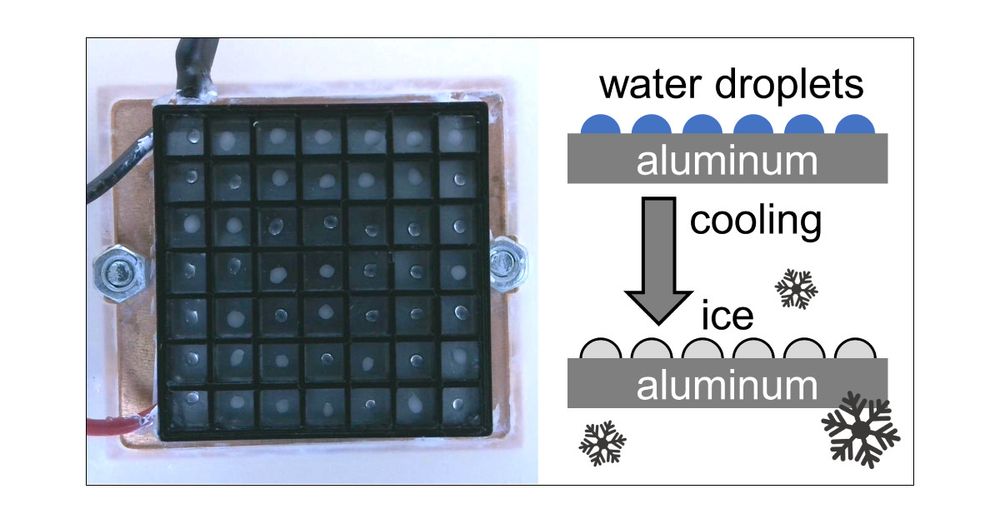
Ice Nucleation Properties of Aluminum Surfaces The nucleation of ice from supercooled water droplets plays a critical role across various technological sectors including aviation, power transmission, shipping, and space flight. Despite its importa...

Carlotta did close to 300 ice nucleation experiments during her Master’s project. It’s great to see her work published. pubs.acs.org/doi/10.1021/...

31.07.2025 15:27 — 👍 0    🔁 0    💬 0    📌 0
Preview
Hovering a Ping-Pong Ball: A Demonstration Setup for Teaching PID Control Proportional-Integral-Derivative (PID) controllers are essential in ensuring the stability and efficiency of numerous scientific, industrial, and medical processes. However, teaching the principles of PID control can be challenging, especially when the introduction focuses on the underlying mathematical framework. To address this, we developed the PingPongPID, a visually engaging and interactive demonstration instrument designed to make the concepts of PID control more accessible to students. The PingPongPID features a colored ping-pong ball suspended within a transparent plastic tube by a fan, the voltage of which is controlled by a microcontroller running a PID algorithm. The ball’s height is measured in real-time by a laser distance sensor, and the system continuously adjusts the fan voltage to maintain a set target height. The PingPongPID also connects to a computer, allowing real-time data logging and visualization through a custom-built Python graphical user interface (GUI). The process of obtaining the three PID gain constants using both the trial-and-error and Ziegler-Nichols methods can be illustrated very nicely with the PingPongPID. In summary, the PingPongPID serves as a powerful educational tool, allowing students to explore both the conceptual and practical aspects of PID control before delving into its mathematical foundations. We provide a complete assembly and user guide for the PingPongPID as well as the codes for the microcontroller and the Python GUI.

Did you ever wonder how PID control works? Or how you can hover a ping-pong ball with a hairdryer? Check out our new paper in J. Chem. Edu. pubs.acs.org/doi/10.1021/...

28.07.2025 13:56 — 👍 2    🔁 0    💬 0    📌 0