Priority effects inhibit the repeated evolution of phototrophy - npj Complexity
npj Complexity - Priority effects inhibit the repeated evolution of phototrophy
New paper out! Here's a puzzle: phototrophy, the ability to use light for energy, is one of life's great innovations. It evolved early and transformed the biosphere. But it evolved 2x. Why not just once, why not more? Our work suggests the answer is priority effects.
www.nature.com/articles/s44...
03.02.2026 21:36 — 👍 128 🔁 51 💬 3 📌 4
LAUNCH DAY🎙️
We're thrilled to share the very first episode of #MVIFconversations w/ Jack Gilbert 💫
Stefanie Malan-Müller & @cpavloud.bsky.social talked with @gilbertjacka.bsky.social about how microbes shape our health and the invisible living world around us.
Give it a listen & spread the word!
26.01.2026 14:57 — 👍 8 🔁 8 💬 1 📌 1

mvif 46 program
It's Friday!
...and a new #MVIF program is out! 🤩
Free registration: cassyni.com/s/mvif-46
Highlights:
🇺🇸 Rebecca L. Knoll
🇯🇵 Akito Sakanaka
Keynote:
🇺🇸 @simrouxvirus.bsky.social
⭐️ Talks:
🇦🇺 @jeremyjbarr.bsky.social
🇨🇦 @erikbakkeren.bsky.social
🇨🇳 Guanxiang Liang
23.01.2026 11:53 — 👍 12 🔁 11 💬 1 📌 0

The ISME Early Career Scientist Committee is glad to begin the year by spotlighting @aroneys.bsky.social, a Postdoctoral Researcher at QUT, and his paper, “Bin Chicken: targeted metagenomic coassembly for the efficient recovery of novel genomes.”
doi.org/10.1038/s415...
(1/2)
20.01.2026 16:49 — 👍 16 🔁 6 💬 2 📌 1

Present your research at the 20th International Symposium on Microbial Ecology in Auckland, from 16 - 21 August 2026! When submitting your abstract, make sure to check whether you are eligible for one of the travel grants.
isme-microbes.org/call-for-abs...
#microbialecology #isme20
15.01.2026 15:15 — 👍 15 🔁 8 💬 1 📌 0
🚨vConTACT3 now in Nature Biotechnology:
- >95% agreement with ICTV for known viruses
- Classifies both prokaryotic and eukaryotic viruses
- Extends beyond genus → subfamily, family & order
- Systematically assigns taxonomy to tens of thousands of previously unclassified viruses
12.01.2026 16:34 — 👍 21 🔁 14 💬 1 📌 0

Landmark study in @Nature! 🇩🇰 The "Microflora Danica" project has created the first-ever national microbiome atlas. Led by Aalborg University, @fwf-at.bsky.social CoE Microplanet's Director @michiwagner4.bsky.social, and @daanspeth.bsky.social, Andrew Giguere @cemess.bsky.social analyzed nitrifiers.
04.12.2025 10:17 — 👍 16 🔁 5 💬 1 📌 0

New preprint out! Using ~75k environmental OTUs + 77 fossil calibrations, we reconstructed a Proterozoic timeline of eukaryote evolution. Our results show crown eukaryotes were already diversifying >1.6 Ga, long before the first undisputed fossils (~1.05 Ga).
🔗 DOI: www.biorxiv.org/content/10.6...
15.12.2025 08:19 — 👍 110 🔁 54 💬 4 📌 4
Our Review article is now featured in the January issue of @natrevgenet.nature.com, check it out!
15.12.2025 21:54 — 👍 11 🔁 5 💬 0 📌 0
🎉 The #SeqCode has reached a significant milestone: with the validation of the genus Skiveiella, a total of 1,000 #names have now been validly published under the SeqCode.
This achievement marks a major step forward in the adoption and impact of the SeqCode within the scientific community.
13.12.2025 06:11 — 👍 11 🔁 4 💬 0 📌 0
ENA Browser
ENA Browser
GTDB is now cross-referenced from ENA genome assembly pages. Check it out: www.ebi.ac.uk/ena/browser/....
Thank you to @ebi.embl.org for support with setting up these links!
11.12.2025 15:04 — 👍 17 🔁 8 💬 0 📌 0

eggNOG v7: phylogeny-based orthology predictions and functional annotations
Abstract. The eggNOG (evolutionary genealogy of genes: Non-supervised Orthologous Groups) database is a phylogenomic resource for orthology inference, evol
From @jhcepas.bsky.social and colleagues in the @narjournal.bsky.social #NARDatabaseIssue | eggNOG v7: phylogeny-based orthology predictions and functional annotations | #Bioinformatics #ProteinCentric #Database #OpenScience 🧬 🖥️🧪🇨🇭🇪🇸🇩🇪🔓
⬇️
academic.oup.com/nar/advance-...
09.12.2025 13:39 — 👍 18 🔁 13 💬 0 📌 1

trophy backlit by coloured lights

Researcher of the year slide
A lucky year in 2025, and now I've a QUT Faculty of Health Researcher of the Year to prove it. Thank you to the many non-myself people who made it happen.
09.12.2025 08:23 — 👍 6 🔁 1 💬 0 📌 0

An archaeal genetic code with all TAG codons as pyrrolysine
Multiple genetic codes developed during the evolution of eukaryotes and bacteria, yet no alternative genetic code is known for archaea. We used proteomics to confirm our prediction that certain archae...
Some archaea—an ancient group of microorganisms—have an entirely novel genetic code, according to a new study in Science.
The findings expand our understanding of how alternative genetic codes evolve and hint at new molecular tools for biotechnology applications. https://scim.ag/4omApQ7
25.11.2025 20:24 — 👍 91 🔁 32 💬 2 📌 6
An Asgard Archaeon (Lokiarchaeum ossiferum) growing and retracting its arms
03.12.2025 20:32 — 👍 79 🔁 26 💬 3 📌 7

The Microflora Danica atlas of Danish environmental microbiomes - Nature
Microflora Danica—an atlas of Danish environmental microbiomes—reveals that although human-disturbed habitats have high alpha diversity, species reoccur, revealing hidden homogeneity.
Microflora Danica: What can you learn from collecting and sequencing 10,000+ samples from a single country? Check out our new paper in @nature.com to find out. Incredible work led by Caitlin Singleton, Thomas B. N. Jensen, and Mads Albertsen from @aau.dk. 🦠🧫🧬
www.nature.com/articles/s41...
03.12.2025 20:50 — 👍 68 🔁 31 💬 0 📌 2
Happy December!
Join #MVIF 44 – we will discuss diverse #microbiome topics:
human urinary, gut, oral and nasal microbiomes,
extreme environments, and
a new sequence alignment tool.
01.12.2025 12:21 — 👍 5 🔁 7 💬 0 📌 0
Out after peer-review: www.science.org/doi/full/10....
Our bottom line stayed: never use leave-one-out cross-validation as it has inherent train-test leakage. Consider our Rebalanced version instead!
We now also account for regression and nested cross-validation, with more extensive benchmarking.
28.11.2025 19:31 — 👍 39 🔁 12 💬 0 📌 1

🧫 Just out in Bioinformatics Advances: “GlobDB: A comprehensive species-dereplicated microbial genome resource.”
Explore the full study: https://doi.org/10.1093/bioadv/vbaf280
26.11.2025 10:01 — 👍 12 🔁 9 💬 2 📌 0
Celebrating Excellence at the Centre for Microbiome Research!
We’re thrilled to share that Gene Tyson, @benjwoodcroft.bsky.social and @luispedrocoelho.bsky.social have once again been named Highly Cited Researchers for 2025 by Clarivate!
#HighlyCited2025
23.11.2025 22:59 — 👍 4 🔁 3 💬 0 📌 0

GlobDB: a comprehensive species-dereplicated microbial genome resource
AbstractMotivation. Over the past years, substantial numbers of microbial species’ genomes have been deposited outside of conventional INSDC databases.Resu
Our paper describing the GlobDB is now published in @bioinfoadv.bsky.social
doi.org/10.1093/bioa...
The GlobDB is the largest species dereplicated genome database currently available, containing 306,260 species representatives.
More information on globdb.org 1/5
🖥️🧬🦠
21.11.2025 16:21 — 👍 78 🔁 43 💬 2 📌 6

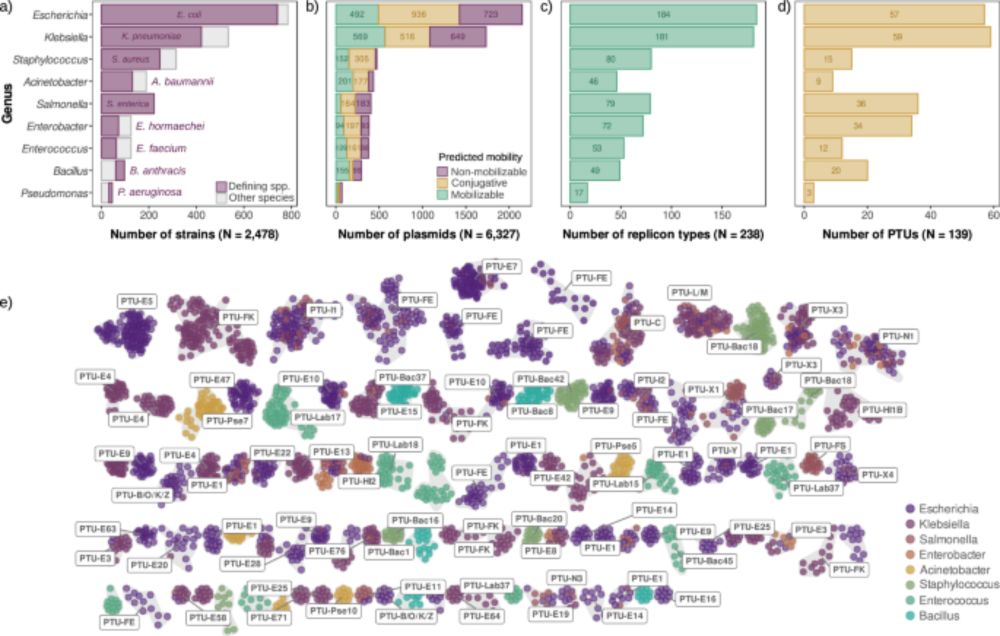
A stylized infographic showing the workflow for building a global soil plasmidome resource on the left and a textured world map on the right. The workflow depicts three input data streams from metagenomic datasets and isolate plasmids, which pass through steps like quality control, clustering, functional annotation, CRISPR analysis, host assignment, and detection of gene categories such as biosynthetic clusters, antimicrobial resistance, antimicrobial peptides, and CAZymes. All outputs feed into a central SQL database. The world map shows sample locations across the globe as teal circles of varying size, highlighting regions from many plasmids were recovered. Adapted from Fig 1A and 1B in Fiamenghi et al., doi:10.1038/s41467-025-65102-6
Soils contain an amazing diversity of functions encoded in plasmids.
The Global Soil Plasmidome Resource: 98,728 soil plasmids from 6,860 samples.
Led by @mattlabguy.bsky.social and @apcamargo.bsky.social at @jgi.doe.gov @biosci.lbl.gov @berkeleylab.lbl.gov
www.nature.com/articles/s41...
18.11.2025 19:18 — 👍 12 🔁 7 💬 0 📌 0
SingleM v0.20.2 - ONT/PacBio input reads now supported (if somewhat inefficiently), plus improved Lyrebird database for phage profiling.
Microbial fraction is now prokaryotic fraction, easier to specify input genomes.
17.11.2025 04:49 — 👍 18 🔁 6 💬 2 📌 1
Professor for Bioinformatics and Computational Oncology
University of Duisburg-Essen
Author of Snakemake, founder of Bioconda
Rhizosphere Lab at Oxford Department of Biology, led by Prof Phil Poole. Focusing on nitrogen fixation, molecular tools and the soil microbiome
Environmental microbiologist at Case Western. She/her. https://bagby-lab.github.io/, https://emerge-bii.github.io/
organismal biologist & geneticist | PI at med school in Houston | amazed by microbial superpowers | he/him
#microbiome #Celegans #spacebiology #firstgen 🧫 🦠 🧪 🧬
GS: https://bit.ly/goog-schol-buck-sam
ORCID: 0000-0002-4347-3997
Group Leader (PI) at LIOS, Riga, Latvia
PhD in theoretical physics. Research interests: computational biology, statistics, machine learning, aDNA / eDNA, ancient metagenomics.
Homepage: https://nikolay-oskolkov.com/
The world's largest and most popular platform for people-powered research. A collaboration between the Adler Planetarium, University of Oxford, University of Minnesota, and friends. Learn more and join: https://linktr.ee/the.zooniverse
Postdoctoral researcher | Biotechnologist | Anaerobic microbiology | Methanotrophs | aSRB | LAB | Microbial Physiology group @cuwelte.bsky.social
Postdoc in the Blekhman lab at UChicago | Infant and breast milk microbiome | antimicrobial resistance | wild animal microbiome | microbial ecology | MVIF member
https://pamelaferretti.net/
🔬 Bioinformatician postdoc @oistedu.bsky.social working on microbiome & lab. automation.
🧪🦠 Proud member of @microbiomevif.bsky.social
Computational biology lab focusing on microbiomes in the human gut and the environment
Homepage: https://www.bork.embl.de/
Mastodon: https://mstdn.science/@BorkLab
Lecturer in Microbiome & Health at @apcmicrobiomeirel.bsky.social & @ucc.bsky.social
Alumnus @borklab.bsky.social
Microbiome, microbial ecology & metagenomics.
Microbial Single-Cell Genomics group leader at the Institute for Integrative Systems Biology #I2SysBio @i2sysbio.es, University of Valencia @uv.es, interested in unknown microbes 🇸🇰🇨🇿🇪🇦🇦🇺🇺🇲🇪🇦 https://i2sysbio.es/groups/19 #single-cell #metagenomics
Head, computational multi-omics at Flinders University. Sci-fi, history and video games nerd 🤓👾
Do my science @ace_uq studying coral reef microbiomes. Data wrangler, meta-omics and long-read wonk, clean energy enthusiast, Saganist zealot, collector of weird zoology facts, other nonsense.
PhD candidate | Microbial genomics and evolution | Coral reef benthic microbiome | #Symbiodiniacae | TeamCX | Australian Centre for Ecogenomics @ace-uq.bsky.social | Australia
One of the greatest discoveries in microbiology came from contamination. Join the club and share yours here 🦠🧫 Merch ➡️ https://www.contam.club