
Reward-driven emergence of auditory pattern encoding in the primate motor system
The ability to anticipate rhythmic patterns is fundamental to human experience, enabling music appreciation, speech comprehension, and dancing in sync to music. How the brain learns to use acoustic information to guide motor behavior remains a key question whose neural underpinnings and evolutionary origins are debated, especially in non-human primates. To understand how brain areas involved in motor control naively respond to predictable tone patterns, we recorded large single neuron populations across primary somatosensory (S1), primary motor (M1), dorsal premotor (PMd), supplementary motor (SMA), pre-supplementary motor (preSMA) cortices, globus pallidus interna (GPi), and medial geniculate body (MGB) of a rhesus monkey. During passive listening (Experiment 1) with a reward only at the end of each trial, primarily the MGB, not motor areas, responded to the auditory tone patterns, ruling out the spontaneous entrainment of motor activity to auditory patterns. Almost all areas robustly
While humans spontaneously dance to a beat, the evolutionary origins of this ability remain debated. Behavioral work has shown that primates can move to auditory rhythms after training.
Our question was: How does this association emerge in the brain?
www.biorxiv.org/content/10....
30.01.2026 19:41 —
👍 40
🔁 15
💬 1
📌 0
Our latest preprint. More evidence that diabetic neuropathy is a neuro degenerative disease. Very proud of @ish1789.bsky.social and our whole PRECISION group who made this work possible. #HEALinitiative funded
21.01.2026 02:34 —
👍 30
🔁 14
💬 2
📌 1

Ontogeny of the spinal cord dorsal horn
The dorsal horn of the mammalian spinal cord is organized into laminae where each layer is populated by different neuron types, has distinctive circuit connections, and plays specialized roles in beha...
Excited to share @rbrianroome.bsky.social ‘s beautiful paper on development of the dorsal horn of the mouse spinal cord @science.org
This is how the anatomical organization and cell types that process pain, touch, body position and more are laid down.
www.science.org/doi/10.1126/...
08.01.2026 19:59 —
👍 132
🔁 41
💬 10
📌 2
How do neural circuits generate the walking rhythm?
Using connectome simulations, @sarahpugly.bsky.social found a minimal central pattern generator (CPG) that produces oscillations in leg motor neurons. Same circuit motif for each 🪰 leg.
w @bingbrunton.bsky.social
www.biorxiv.org/content/10.1...
09.12.2025 17:50 —
👍 73
🔁 35
💬 1
📌 2
And here is the story after peer review. This work highlights our current approach, which is to use Piezo channels to uncover new areas of biology that are shaped by mechanical forces: www.science.org/doi/10.1126/...
13.11.2025 22:05 —
👍 77
🔁 29
💬 2
📌 4

A table showing profit margins of major publishers. A snippet of text related to this table is below.
1. The four-fold drain
1.1 Money
Currently, academic publishing is dominated by profit-oriented, multinational companies for
whom scientific knowledge is a commodity to be sold back to the academic community who
created it. The dominant four are Elsevier, Springer Nature, Wiley and Taylor & Francis,
which collectively generated over US$7.1 billion in revenue from journal publishing in 2024
alone, and over US$12 billion in profits between 2019 and 2024 (Table 1A). Their profit
margins have always been over 30% in the last five years, and for the largest publisher
(Elsevier) always over 37%.
Against many comparators, across many sectors, scientific publishing is one of the most
consistently profitable industries (Table S1). These financial arrangements make a substantial
difference to science budgets. In 2024, 46% of Elsevier revenues and 53% of Taylor &
Francis revenues were generated in North America, meaning that North American
researchers were charged over US$2.27 billion by just two for-profit publishers. The
Canadian research councils and the US National Science Foundation were allocated US$9.3
billion in that year.

A figure detailing the drain on researcher time.
1. The four-fold drain
1.2 Time
The number of papers published each year is growing faster than the scientific workforce,
with the number of papers per researcher almost doubling between 1996 and 2022 (Figure
1A). This reflects the fact that publishers’ commercial desire to publish (sell) more material
has aligned well with the competitive prestige culture in which publications help secure jobs,
grants, promotions, and awards. To the extent that this growth is driven by a pressure for
profit, rather than scholarly imperatives, it distorts the way researchers spend their time.
The publishing system depends on unpaid reviewer labour, estimated to be over 130 million
unpaid hours annually in 2020 alone (9). Researchers have complained about the demands of
peer-review for decades, but the scale of the problem is now worse, with editors reporting
widespread difficulties recruiting reviewers. The growth in publications involves not only the
authors’ time, but that of academic editors and reviewers who are dealing with so many
review demands.
Even more seriously, the imperative to produce ever more articles reshapes the nature of
scientific inquiry. Evidence across multiple fields shows that more papers result in
‘ossification’, not new ideas (10). It may seem paradoxical that more papers can slow
progress until one considers how it affects researchers’ time. While rewards remain tied to
volume, prestige, and impact of publications, researchers will be nudged away from riskier,
local, interdisciplinary, and long-term work. The result is a treadmill of constant activity with
limited progress whereas core scholarly practices – such as reading, reflecting and engaging
with others’ contributions – is de-prioritized. What looks like productivity often masks
intellectual exhaustion built on a demoralizing, narrowing scientific vision.

A table of profit margins across industries. The section of text related to this table is below:
1. The four-fold drain
1.1 Money
Currently, academic publishing is dominated by profit-oriented, multinational companies for
whom scientific knowledge is a commodity to be sold back to the academic community who
created it. The dominant four are Elsevier, Springer Nature, Wiley and Taylor & Francis,
which collectively generated over US$7.1 billion in revenue from journal publishing in 2024
alone, and over US$12 billion in profits between 2019 and 2024 (Table 1A). Their profit
margins have always been over 30% in the last five years, and for the largest publisher
(Elsevier) always over 37%.
Against many comparators, across many sectors, scientific publishing is one of the most
consistently profitable industries (Table S1). These financial arrangements make a substantial
difference to science budgets. In 2024, 46% of Elsevier revenues and 53% of Taylor &
Francis revenues were generated in North America, meaning that North American
researchers were charged over US$2.27 billion by just two for-profit publishers. The
Canadian research councils and the US National Science Foundation were allocated US$9.3
billion in that year.

The costs of inaction are plain: wasted public funds, lost researcher time, compromised
scientific integrity and eroded public trust. Today, the system rewards commercial publishers
first, and science second. Without bold action from the funders we risk continuing to pour
resources into a system that prioritizes profit over the advancement of scientific knowledge.
We wrote the Strain on scientific publishing to highlight the problems of time & trust. With a fantastic group of co-authors, we present The Drain of Scientific Publishing:
a 🧵 1/n
Drain: arxiv.org/abs/2511.04820
Strain: direct.mit.edu/qss/article/...
Oligopoly: direct.mit.edu/qss/article/...
11.11.2025 11:52 —
👍 642
🔁 453
💬 8
📌 66
Neural manifolds that orchestrate walking and stopping https://www.biorxiv.org/content/10.1101/2025.11.08.687367v1
09.11.2025 10:16 —
👍 7
🔁 4
💬 0
📌 1
🧠🌟🐭 Excited to share some of my postdoc work on the evolution of dexterity!
We compared deer mice evolved in forest vs prairie habitats. We found that forest mice have:
(1) more corticospinal neurons (CSNs)
(2) better hand dexterity
(3) more dexterous climbing, which is linked to CSN number🧵
22.10.2025 20:41 —
👍 378
🔁 124
💬 19
📌 26
Evolutionary expansion of the corticospinal system is linked to dexterity in Peromyscus mice https://www.biorxiv.org/content/10.1101/2025.10.16.682851v1
17.10.2025 16:15 —
👍 12
🔁 3
💬 0
📌 1
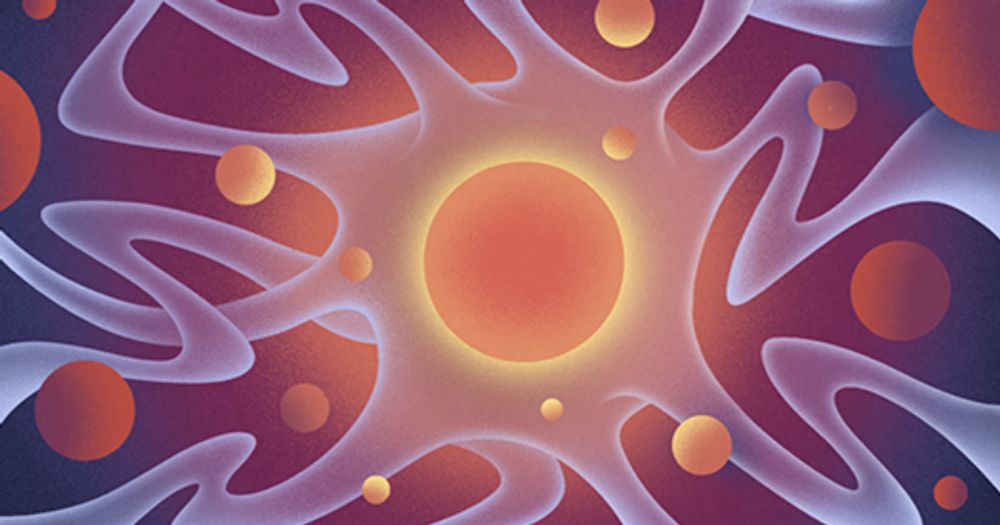
New questions around motor neurons and plasticity
A researcher’s theory hangs muscle degeneration on a broken neural circuit.
Results showed it was possible to “effectively rescue motor neuron function,” and George Mentis and his team think their results are coalescing into a theory, even if they don’t fully understand it yet.
By David Adam
#neuroskyence
www.thetransmitter.org/neurodegener...
10.10.2025 15:08 —
👍 14
🔁 3
💬 0
📌 0

Labelled axons of calb1+ spinal projection neurons innervate multiple brain targets associated with cold sensation and thermoregulation. Darkfield images of different brain areas including the postal parabrachial and periaqueductal grey are shown with axons of ascending cells in yellow.
New preprint from the spinal cord group at Glasgow. Anatomical and functional characterisation of spinal circuits for cold, from sensory neurons to the brain…..https://www.biorxiv.org/content/10.1101/2025.10.03.680240v1
04.10.2025 08:34 —
👍 23
🔁 8
💬 2
📌 0
Apply - Interfolio
{{$ctrl.$state.data.pageTitle}} - Apply - Interfolio
My department at Emory is a hiring a tenure-track neuroscientist!
Anyone who's talked to me in the last 4 years knows I cannot say enough good things about my dept and the neuroscience community here. My colleagues are so wonderfully supportive. Postdocs, please apply!
apply.interfolio.com/174371
30.09.2025 18:25 —
👍 134
🔁 104
💬 1
📌 6
A neural geometry for forelimb proprioception in the cervical spinal cord https://www.biorxiv.org/content/10.1101/2025.09.26.678887v1
28.09.2025 20:15 —
👍 2
🔁 1
💬 0
📌 0
New preprint out from the lab. We identified three critical windows over which sensorimotor behaviours can be shaped. Altered early experience over these windows changes somatosensory and motor outcomes for life. Tour de force experiments by Laura Andreoli. @medresfdn.bsky.social @uclnpp.bsky.social
19.09.2025 10:44 —
👍 13
🔁 5
💬 0
📌 0
A neural entero-pancreatic pathway that regulatesinsulin secretion and glucose tolerance https://www.biorxiv.org/content/10.1101/2025.08.14.670343v1
19.08.2025 21:15 —
👍 2
🔁 1
💬 0
📌 0
1/N
How do neural dynamics in motor cortex interact with those in subcortical networks to flexibly control movement? I’m beyond thrilled to share our work on this problem, led by Eric Kirk @eric-kirk.bsky.social with help from Kangjia Cai!
www.biorxiv.org/content/10.1...
23.06.2025 12:28 —
👍 88
🔁 27
💬 3
📌 1

The American people were lied to about Vietnam, with tragic consequences.
The American people were lied to about Iraq, with tragic consequences.
The American people are being lied to again today. We cannot allow history to repeat itself.
22.06.2025 17:37 —
👍 31093
🔁 9765
💬 868
📌 423
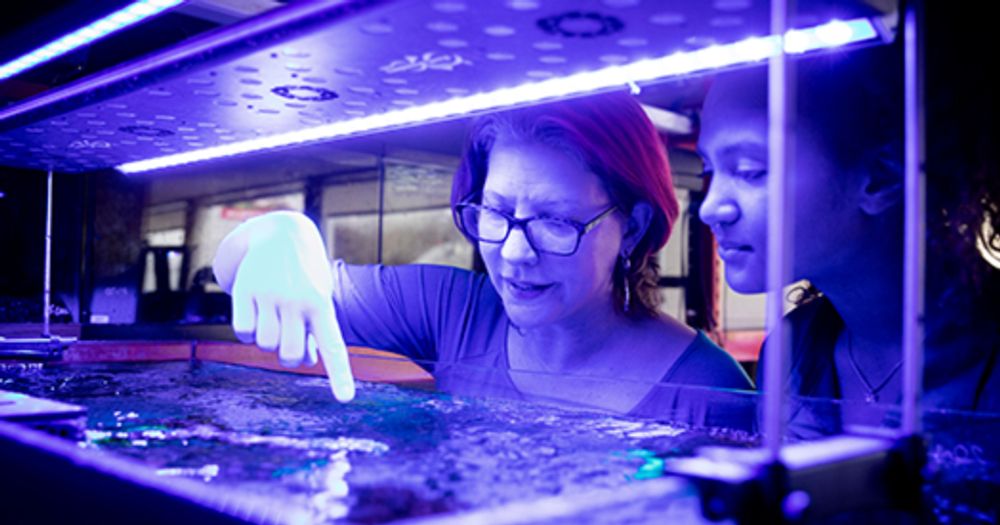
Cephalopods, vision’s next frontier
For decades, scientists have been teased by the strange but inaccessible cephalopod visual system. Now, thanks to a technological breakthrough from a lab in Oregon, data are finally coming straight…
The octopus brain has teased researchers since the 1960s, but recording from it seemed impossible. Cris Niell and his team’s calcium imaging experiments finally “showed that this brain could be studied,” says Sam Reiter.
By @callimcflurry.bsky.social
www.thetransmitter.org/vision/cepha...
27.05.2025 14:07 —
👍 22
🔁 7
💬 0
📌 2
New preprint out! We developed a behavioural platform for the kinematic analysis of skilled whole body behaviour. Very fun collaboration with Christopher Black, @liamebrowne.bsky.social and Rob Brownstone.
06.04.2025 13:59 —
👍 26
🔁 11
💬 0
📌 2

Uranus emits more heat than previously thought
Uranus radiates more energy than it gets from the sun, two new studies find — just as Jupiter, Saturn and Neptune do.
New observations from space- and ground-based telescopes reveal that Uranus radiates more energy than sunlight provides, two research teams report in work submitted to arXiv.org in late February.
12.03.2025 00:00 —
👍 11
🔁 2
💬 1
📌 1
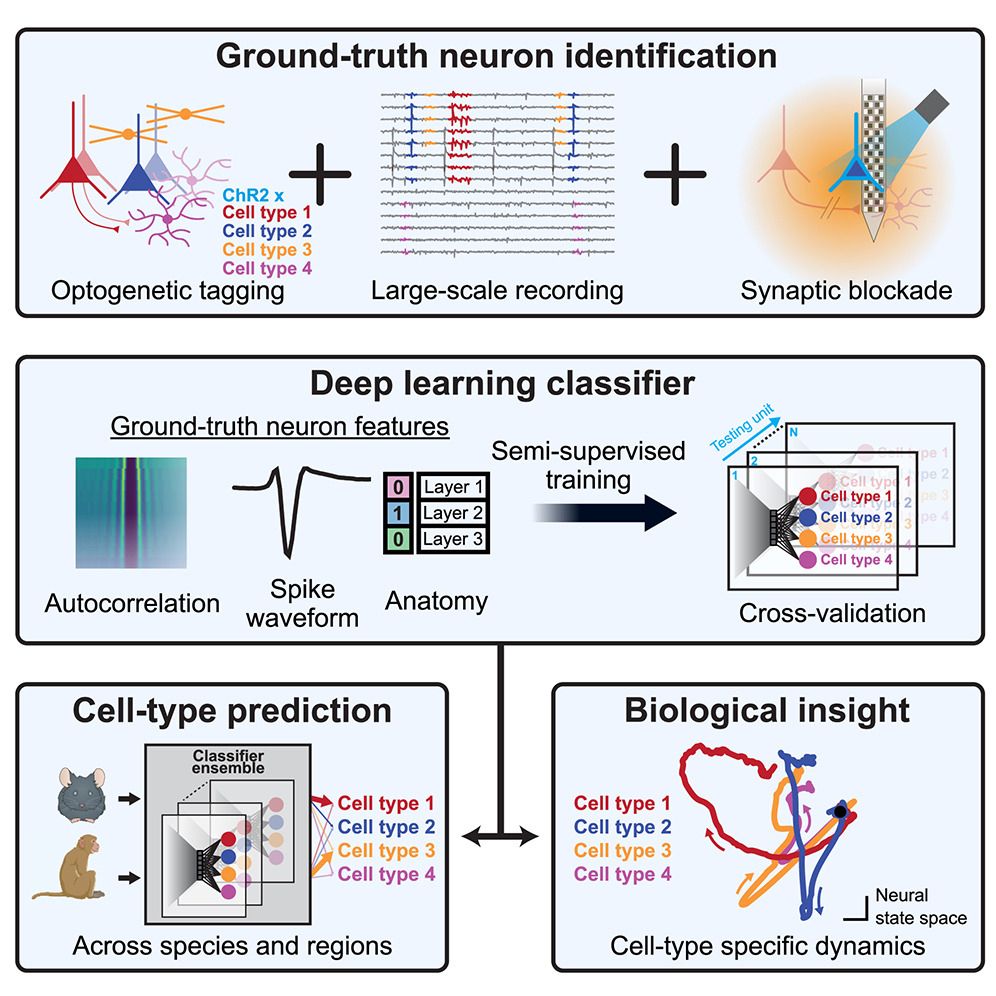
I am very proud to announce that my PhD paper finally came out in Cell! In this *very* collaborative study, we develop and release a deep-learning approach to predict neuron type identity from their electrical signature. doi.org/10.1016/j.ce... 1/16 🧵
01.03.2025 13:14 —
👍 150
🔁 41
💬 3
📌 2

My cat Lulu us here for us all
16.02.2025 20:57 —
👍 1
🔁 0
💬 0
📌 0
We were able to get a clip of the video to upload from the "turtle dance" research paper. 🧪
13.02.2025 14:53 —
👍 86
🔁 21
💬 5
📌 16
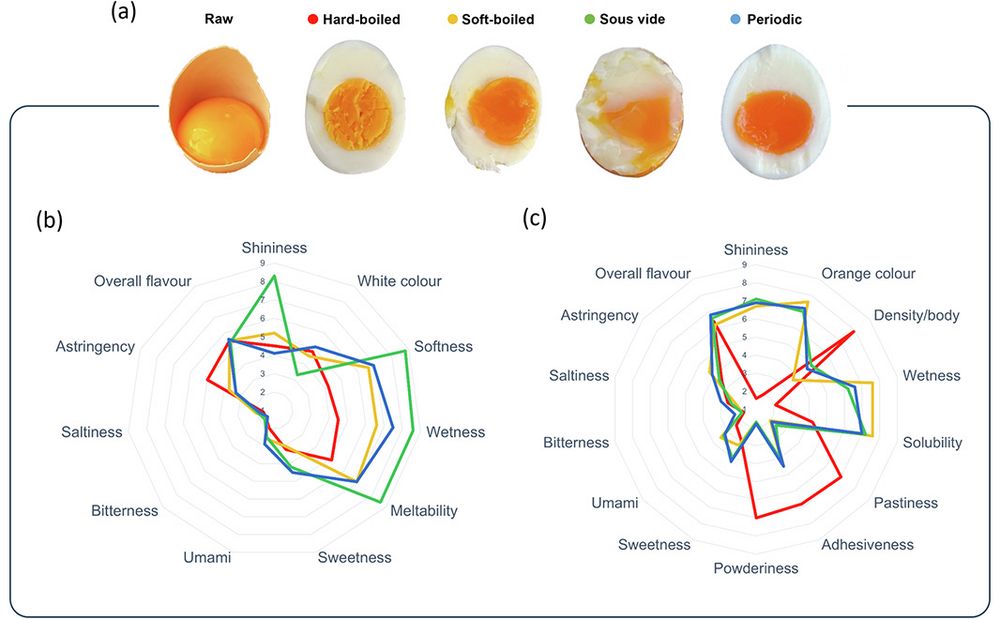
This is figure 4, which shows sensory analysis evaluation.
A paper in Communications Engineering presents a new method to optimally cook both the yolk and white of a boiled chicken egg. "Periodic cooking” yields an evenly-cooked egg with a higher nutritional content than shell-on eggs cooked by conventional methods. https://go.nature.com/4hJWNzU 🧪
12.02.2025 02:37 —
👍 86
🔁 17
💬 8
📌 15


