Gyromorphs Should Block Light in All Directions
Simulated materials yield isotropic band gaps, suggesting use in optical computer chips.
It is an honor and a pleasure to be spontaneously featured in Optica's official outreach platform!
Many inspiring papers published in Optica's journals were read in the making of this work, so it feels like a nice loop 😄
www.optica-opn.org/home/newsroo...
14.11.2025 10:24 — 👍 2 🔁 1 💬 0 📌 0
A cool collaboration with István Kovács's group at Northwestern, that brings ideas from conformal field theory and quantum spin chains all the way to active matter!
Poke @nyuphysics.bsky.social
13.11.2025 15:36 — 👍 2 🔁 0 💬 0 📌 0

a close up of a person 's hand holding a marker that says sharpie
Alt: a close up of a person's hand holding a marker that says sharpie
New preprint!
So, say you're studying some critical transition. How do you catch its universality? Pair correlations? Boring!
We threw line segments at the system, looked at intersections with clusters, and uncovered static and dynamical universal behavior of MIPS!
arxiv.org/abs/2511.09444
13.11.2025 15:36 — 👍 5 🔁 2 💬 1 📌 0

a man is smoking a cigarette and says it is no magic .
ALT: a man is smoking a cigarette and says it is no magic .
A great work with @stemartiniani.bsky.social at CSMR @nyuphysics.bsky.social, NYU Chemistry and @nyucourant.bsky.social !
Also, poke/thank you @remicarminati.bsky.social for helpful discussions and for helping me get back to optics 😄
07.11.2025 16:08 — 👍 3 🔁 0 💬 0 📌 0

Illustration of a 60-fold gyromorph's properties.
Top row: Structure of the gyromorph. Left: Structure factor. Right: Pair correlation function.
Bottom row: Evidence of a bandgap. Left: Scalar optical field inside the gyromorph. Right: Density of states depletion in the gyromorph.
New paper just out, as an editor's suggestion in PRL!
While looking for the ideal isotropic bandgap material, we actually discovered new structures.
These structures lie at the border between order and disorder, and that's good for optics!
More about their structure here,
tinyurl.com/3aej53ht
⚛️🧪
07.11.2025 16:08 — 👍 6 🔁 3 💬 1 📌 0
Thanks! I will likely try it within a couple of days 😄
05.11.2025 17:32 — 👍 1 🔁 0 💬 0 📌 0
ORCID
Hi 👀👀 I do the physics thing too!
orcid.org/0000-0002-53...
05.11.2025 06:52 — 👍 3 🔁 0 💬 1 📌 0

A geometric condition for robot-swarm cohesion and cluster–flock transition | PNAS
We present a geometric design rule for size-controlled clustering of self-propelled
particles. We show that active particles that tend to rotate un...
Well, not everyone can get a vote of confidence -- but this paper did! New PNAS, 🔥🔥🔥 hot from the press 🔥🔥🔥
And it is an opportunity to thank my collaborators on this project, special shout-out to Eden+Matan for the experiments on robots that motivated this!
www.pnas.org/doi/10.1073/...
08.09.2025 19:26 — 👍 6 🔁 1 💬 0 📌 0
A key difference here is that while either can be incorrect, the structure of Wikipedia *creates context* and the structure of LLMs *destroys context*
Wikipedia has linked sources and an edit history showing where information came from and who added it when
An LLM just generates text
26.04.2025 18:39 — 👍 4032 🔁 1222 💬 60 📌 38
Science Communication as a Moral Imperative
We need to do a much better job of encouraging scientists to be stronger communicators, and share the wonders of science, and the important…
We need to see science as a social compact where it serves the larger world, not our own interests.
As a first step, scientists must communicate to the larger world much better.
I wrote an essay about this in 2016, which still holds today.
globalecoguy.org/science-comm...
10.02.2025 16:41 — 👍 83 🔁 23 💬 5 📌 5

Proof of concept of a polygyromorph.
a: Obtained structure factor, featuring 3 rings of high peaks
b: 2d pair correlation function
c: Transmission across the system, featuring 3 dips
d: Angularly-averaged transmission (top) and average relative density of states change in the bulk (bottom), both featuring 3 dips at the expected places.
More interestingly, the idea of gyromorphs and the recipe used to make them are easily extended to 3d materials, with a spherical shell of high values in S(k) instead of a ring, and to structures with several rings, or polygyromorphs.
We hope to test these exciting structures experimentally!
20.11.2024 16:24 — 👍 5 🔁 0 💬 0 📌 0

Transmission measurement across a gyromorph, as a 2d intensity map encoding the dependence on the incoming k-vector. A clear dip is observed at the targeted wavevector.
So, what about optics? We show that gyromorphs consistently outperform other aperiodic isotropic bandgap materials candidates at moderate refractive indices, within a coupled dipoles approximation. In fact, their bandgaps are about as deep as those of low-symmetry quasicrystals, but isotropic.
20.11.2024 16:24 — 👍 4 🔁 0 💬 1 📌 0

Structure factor of a 14-fold quasicrystal, and the ouput of a FReSCo optimization trying to make the peaks even higher. The result is a structure factor with higher main peaks, but intensity "pumped" out of the large-k features.
The obtained structures are distinct from quasicrystals, in that they have very broad g(r) features and only a handful of peaks in S(k). In particular, we show that gyromorphs achieve higher S(k) peaks than their de Bruijn quasicrystal counterparts, but lose large-k features.
20.11.2024 16:24 — 👍 3 🔁 0 💬 1 📌 0

GitHub - martiniani-lab/FReSCo: Fast Reciprocal Space Correlator
Fast Reciprocal Space Correlator. Contribute to martiniani-lab/FReSCo development by creating an account on GitHub.
These structures are obtained by an optimization procedure directly adapted from FReSCo, github.com/martiniani-l...
Basically, we only maximize the height of a ring of peaks at a chosen k-vector and forbid exact overlaps, but let the rest evolve freely in free boundary conditions.
20.11.2024 16:24 — 👍 2 🔁 0 💬 1 📌 0

2d pair correlation function intensity map of a 60-fold gyromorph

2d structure factor intensity map of a 60-fold gyromorph

Circular chunk of a 60-fold gyromorph
Ok, last update: how to make isotropic bandgaps? At low index contrast, the answer is aperiodic structures, e.g. quasicrystals. We propose that the best material would have a structure factor as close as possible to being just one ring of high values: enter gyromorphs. arxiv.org/abs/2410.09023
20.11.2024 16:24 — 👍 10 🔁 1 💬 1 📌 1
Fun! NYU has been doing Physics on the Toilet inside the department for years too (brain teasers, not outreach), it does seem to create engagement among students 😄
20.11.2024 15:37 — 👍 2 🔁 0 💬 0 📌 0
And that took a bit longer than expected but: that's it for today. I'm glad to finally be able to talk about this project at large, it has been a very interesting and challenging work with @praharsh.bsky.social, now we have a lot of uncharted territory to explore with our brand new high-d sailboat!
19.11.2024 17:19 — 👍 3 🔁 0 💬 0 📌 0
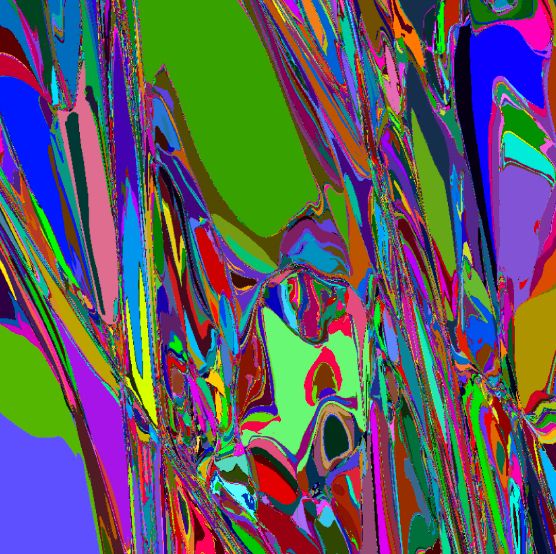
Energy landscape slice found by ODE solving for 128 soft spheres in 2d, meaning that the dimension of configuration space is 254.

Same slice computed with FIRE. Not a single pixel is accurate.
This problem gets worse as the dimensionality of the problem, i.e. the number of spheres, grows. Eventually, only a vanishing fraction of initial configurations map to the right minimum using optimization strategies, highlighting the importance of careful ODE solving to study landscapes.
19.11.2024 17:19 — 👍 3 🔁 0 💬 1 📌 0

Landscape slice obtained with an accurate ODE solver for 16 soft particles. Basins (colored regions) have smooth boundaries.
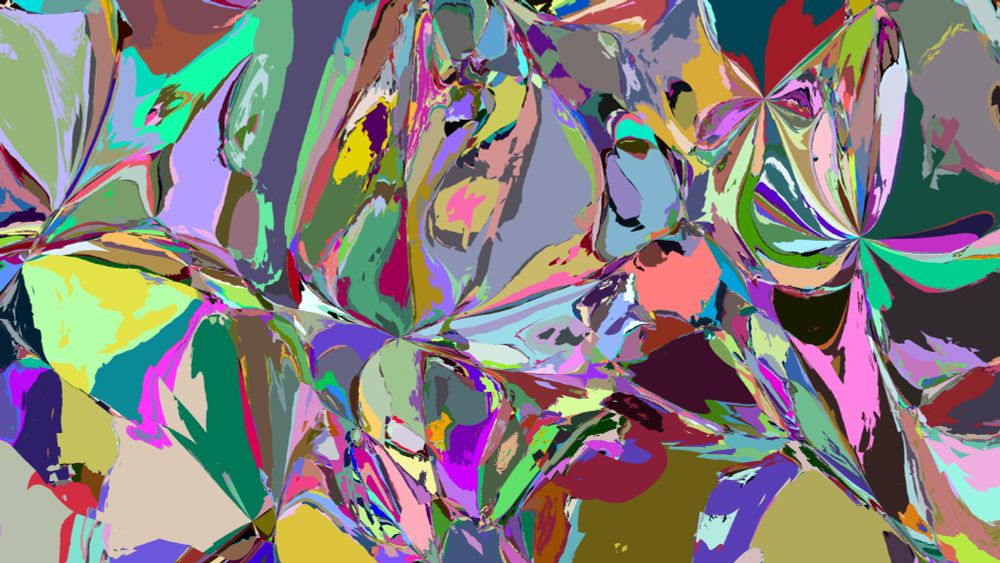
Same slice obtained with a variant of a common optimizer, FIRE, showing jagged edges, point inclusions inside basins, giving an impression of fractality.
Our main result is that optimizers scramble the energy landscape and bias the observed basin shapes and minimum energies. Worse, it makes the basins appear very jagged and rough, giving an impression of fractality. We dispel this mirage and show that accurate ODE solving yields smooth features.
19.11.2024 17:19 — 👍 1 🔁 0 💬 1 📌 0
In that case, identifying basins is a challenging numerical task - steepest descent becomes a stiff ODE problem and naïve explicit forward-Euler schemes commonly used by physicists become very unstable, thus very costly. Thus, people have turned to cheaper optimization strategies like 🔥FIRE🔥.
19.11.2024 17:19 — 👍 1 🔁 0 💬 1 📌 0

Commonly used sketch of a rough (free) energy landscape by Chiara Cammarota, actually now at La Sapienza not KCL, with many minima lying at roughly the same energy and very many narrow basins.
These basins determine low-temperature physics. If a system has a global minimum of energy surrounded by a massive basin, it will most often nicely cool down to find one configuration. In complex systems though it is common to have very (!) MANY (!) low-lying narrow basins: this is glassiness.
19.11.2024 17:19 — 👍 1 🔁 0 💬 1 📌 0

Map of major drainage basins in the world. On that map, colored regions show different paths that water droplets falling onto land would follow to join the ocean. Gray areas show regions in which drops of water would not join an ocean, but inland basins.
These basins of attraction, which you can think of as drainage basins for rivers: just like a droplet of water dropped into the Midwest will eventually join the Mississippi then the Gulf of Mexico, any initial configuration in a solid colored region will flow to the same final configuration.
19.11.2024 17:19 — 👍 1 🔁 0 💬 1 📌 0

a close up of a man 's face with glasses and red hair making a funny face .
ALT: a close up of a man 's face with glasses and red hair making a funny face .
Pretty video right? You just experienced travel through the 30-dimensional configurational space of 16 soft repulsive disks in a 2d periodic square box. The colored regions encoded "basins" in which all configurations would fall to the same minimum if the spheres were rapidly cooled down.
19.11.2024 17:19 — 👍 2 🔁 0 💬 1 📌 0
Next up: for a change of scenery, let's look at energy landscapes! We showed that numerical commonly used to study the location, energy, and entropic bias of minima in jammed soft spheres completely destroy the geometry of the landscape, and provide an alternative.
arxiv.org/abs/2409.121...
19.11.2024 17:19 — 👍 5 🔁 3 💬 1 📌 2
Oh and, while I obviously worked on the numerical and analytical aspects of the work, this paper includes experiments from collaborators in the Netherlands!
Yay, real-world physics!
18.11.2024 16:42 — 👍 2 🔁 0 💬 0 📌 0

a seamless pattern of blue robots with the word robot on the front of them
Alt: a seamless pattern of blue robots with the word robot on the front of them
More interestingly, the onset of clustering can pretty much always be captured by a simple criterion on quantities with units of curvature. Going further, how back-heavy a robot is controls the size of observed clusters - this offers an extremely minimal control parameter to control robotic swarms.
18.11.2024 16:42 — 👍 2 🔁 0 💬 1 📌 0
A geometric condition for robot-swarm cohesion and cluster-flock transition
Ok let's keep going with updates! This time no point patterns, only robots 🤖
We show that it really matters how their mass is distributed to know how they behave as a collective... Depending on whether they have a heavy head or a heavy back, robots flock or cluster!
arxiv.org/html/2409.04...
18.11.2024 16:42 — 👍 5 🔁 1 💬 1 📌 0
And that's it for today's update dump! I may also interact a bit more with the website for non-updates now that I'm back on a nicer platform 😄
12.11.2024 21:17 — 👍 2 🔁 0 💬 1 📌 0

Prizes for Videos Featuring Mickey Mouse and Laptop Cables
The winners of the third annual “Gallery of Soft Matter” competition included posters portraying robotic leaves and cannibalizing droplets and a video with what might be Steamboat Willie’s first appea...
You may have noticed that we encoded a movie into the structure factor of a trajectory of points. Well actually it's also the same paper that got the APS DSOFT video prize at the gallery of soft matter, with some foreshadowing of the location of next March Meeting 🐭🏰 physics.aps.org/articles/v17...
12.11.2024 21:17 — 👍 3 🔁 0 💬 1 📌 0
Compte officiel de l’Insee. #Statistiques et études sur l'#économie et la #société françaises.
https://www.insee.fr/fr/accueil
Galette saucisse kosher edition / Histoire & médiation du patrimoine / Breizh enepfaskour
Physics of membranes and self-assembly || Biophysics postdoc at Johns Hopkins || Previously Penn State -> Carnegie Mellon || for I perplex others not because I am clear, but because I am utterly perplexed myself ||
www.samuelfoley.com
25 | they/them | queer video game producer and designer | bemani freak
works: UNBEATABLE, Margin of the Strange, SKY HOUR WORKS, NOISZ SL, etc.
jeffreychiao.info | meltingcomet.com | @dcellgames.com | @skyhour.works
ancient skeleton lady / wavform destroyer
magentaskull.com ⚠️ PLEASE WEAR A MASK
>> steam gems list
store.steampowered.com/curator/44960234/
🖥️📡⚡ founder of
HEADLESS BLOOD IDOL community arts platform headlessbloodidol.com @headlessbloodidol.bsky.social
Doctor in Women's Studies | Writer, researcher, reporter | Co-founder of The Flytrap | she/her | hire me: nicolefroio@gmail.com | tip me on Signal: nicolefroio.57 | anarcho-feminist | Free Palestine
Scientist at @cnrs.bsky.social @laboptbio.bsky.social
https://lob.ip-paris.fr/en/chiara-stringari
Label-free optical microscopy and metabolic imaging.
'Science doesn't care about what you believe'
Official account of the American Physical Society (APS) Division on Statistical & Nonlinear Physics (DSNP).
Advancing interdisciplinary research in non-equilibrium and statistical physics.
Join now: https://go.aps.org/4eCIyvD
Parlait féminisme, parentalité et littérature jeunesse sur Twitter, là on va voir ce que ça donne…
NYT opinion writer, Slate Money co-host, Dem messaging consultant, NYU prof, former EIC The New York Observer, Dealbreaker founder and Gawker founding editor. Brooklyn via Bama. Rednexican. Striver with no chill.
https://linktr.ee/elizabethspiers
🏴🌿Éco-furie, fach0-anxiété, féminisme, bouffe végétale, tenues pas très républicaines, shitpost
Je wokise le wokisme selon un droitos et c'est très grave.
Pour me soutenir si vous le voulez 🖤👉🏻 https://linktr.ee/benecologie
Amateur d'Histoire et d'histoires 🔸 Parceque l'important c'est l'essentiel 🔸 mail : rivenzi@20ty.gg 🔸 http://twitch.tv/rivenzi
Nous sommes de très jolies fleurs dans un même bouquet 🌸
Retrouvez moi sur Twitch et ailleurs !
Post-doctorant au CESDIP (UVSQ/CY/CNRS) et chercheur associé au CEE (Sciences Po). Politiste spécialiste de la droite malgré lui. Blog : ehouardvial.wordpress.com
R&D Scientist at Ubisoft La Forge focusing on light transport and fluid simulations. I like mathematics, physics, climbing, progressive musics and reading horror / fantasy / sci-fi books!
jack of like six to seven trades / journalist, author, radio person, accidental art dealer, etc / marie.s.leconte@gmail.com
Theoretical Physicist at Ecole Normale Supérieure, Paris France.
Sci-Comm | Researcher | she/her 🦠🧫🔬 | Tell your cat I said PSPSPSPS
The game show where the rules change every show. Hosted by Sam Reich.
gamechanger.dropout.tv
theoretical biophysicist @ISTA (Hannezo Group)