Queer and Trans Pre-Modern Reading Group - Session 14
10 February 2026, 3:30pm-5pm
An informal discussion group exploring queer and trans themes in medieval and early modern texts.
www.ucl.ac.uk/institute-of...
Queer and Trans Pre-Modern Reading Group - Session 14
10 February 2026, 3:30pm-5pm
An informal discussion group exploring queer and trans themes in medieval and early modern texts.
www.ucl.ac.uk/institute-of...

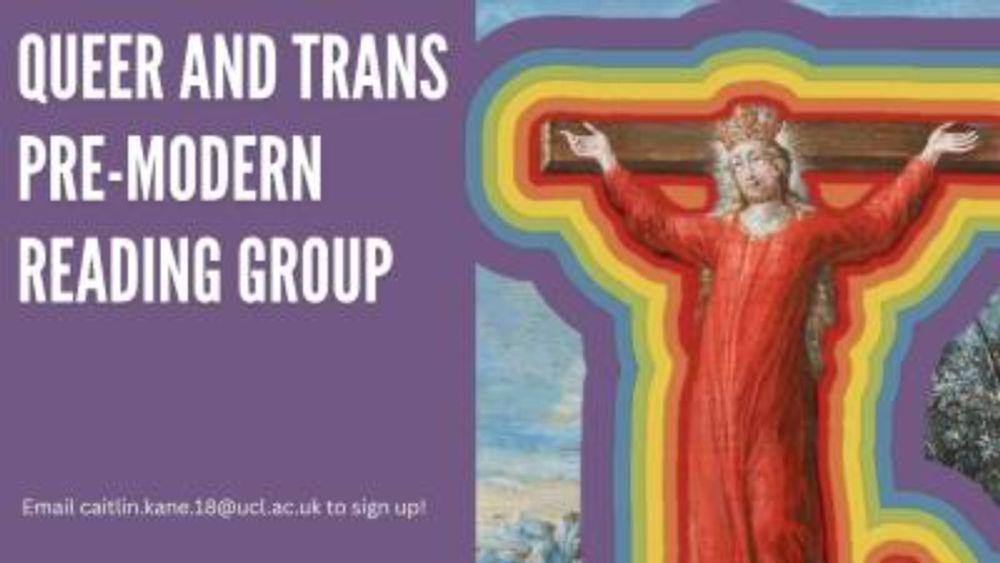
Schedule for Queer and Trans Pre-Modern Reading Group with image of the bearded St. Wilgefortis surrounded by the pride flag. Dates and times for meetings: 10th February 3.30-5pm, 24th February 3.30-5pm, 10th March 3.30-5pm. Email caitlin.kane.18@ucl.ac.uk to sign up.
Join us for this term's Queer and Trans Pre-Modern Reading Group @ucl-ias.bsky.social ! Next week we'll be discussing queerness in Yde et Olive.
For more info: tinyurl.com/4dszt672.

Screenshot from the IMC Leeds 2026 programme for Tuesday 7th July 2026, 16.30-18.00. Session 830: In and Out of Time: Mystics and Holy Persons Engaging with Time IV - Human versus Divine Time. Sponsor: Mysticism & Lived Experience Network. Moderator: Rachel Ernst, Department of History, Georgia State University. First paper: Delivering Souls and Negotiating Time: Necropolitics, Speech Acts, and Queer Temporality in Christina of Hane by Catherine Introcaso, Graduate Center, City University of New York. Second paper: Queer Temporality and 'Imaginative Life Schedules' in the Life of Margherita da Cortona, 1247-1297 by Caitlín Kane, University College London. Third paper: Hagiography as Terror Management: Urgency and Immortality in The Book of Margery Kempe by Zoe McCann, School of Theology & the Arts, St Mary's University Twickenham.
The #IMC2026 programme is out (and I'm in it)! @mlen.bsky.social @imc-leeds.bsky.social
28.01.2026 18:30 — 👍 5 🔁 2 💬 0 📌 0
Leeds International Medieval Congress 2026 Alicia Spencer-Hall will be giving a keynote (paper 1199): 'Timely Images': Medieval Trans Saints, Historiographical Dysphoria and/as Trans-Temporal Methodology (Language: English)

Description In Transgender Warriors, Leslie Feinberg writes: 'I couldn't find myself in history. No-one like me seemed to have ever existed'. Such a feeling - what I call 'historiographical dysphoria' - is familiar to marginalised subjects, those of us who have been written out of cis-hetero-normative history. Gender dysphoria refers to the distress and dis-ease caused by a mismatch between one's assigned gender and one's identified gender. Historiographical dysphoria is an artefact of gender dysphoria, and, more generally, the multifarious dysphorias that come from an authentic existence that does not, cannot, and will not fall in line with the dominant norms of cis-hetero-normative society. This is the distress and dis-ease caused by the wilful cleaving of an individual from the past, from the collective past of their community. Transphobic rhetoric insists upon the newness of transness, and indeed trans people. We are a symptom of modernity's degradation, a disease in urgent need of cure. There we no trans people in the Middle Ages, no queer people, no crips either. We have no past, and, as such, we will not be allowed a future. This is the story that traditionalist historiography so often tells. In recent years, things have begun to change. Trans saints have become ever more visible in scholarship, a vital resource for trans and genderqueer people at a time of ever-rising transphobia. We turn to the past to survive the present and to scope out new ways of being in the future. This paper articulates the possibilities and pleasures of trans-medievalist work, focussing on trans saints. This is scholarship that attends to trans lives, experiences, and traces in the medieval past and operates 'trans' time itself. It rejects normative linear chronology in favour of the fierce embrace of trans-queer-crip time(s), of the blurry temporalities of transition itself. In this way, trans-medievalist work offers a powerful methodology for the entire medievalist field.
Cat's officially out of the bag
#IMC2026 @imc-leeds.bsky.social #MedievalSky 🗃️

Cover image for Motherhood and its Spaces in Medieval Romance by Kirsty Bolton. Illustration shows a group of women helping a post-partum woman in bed.
My book published yesterday! If it looks like your thing, maybe suggest your library buys a copy, or offer to review it for a journal, or you can get 35% off with code BB135
boydellandbrewer.com/book/motherh...

Sketch of a person (?)
The inkless doodles of Eadburg, an 8th-c. nun, discovered by new technology: now published by Jessica Hendy-Hodgkinson in EME doi.org/10.1111/emed... (Open access)
19.01.2026 08:27 — 👍 198 🔁 66 💬 7 📌 17
Queer and Trans Pre-Modern Reading Group - Session 12
The Queer and Trans Pre-Modern Reading Group is an informal discussion group exploring queer and trans themes in medieval and early modern texts.
25 Nov 2pm-3:30pm with @ctlnkane.bsky.social
www.ucl.ac.uk/institute-of...
It’s just in-person at the moment, sorry!
31.10.2025 11:32 — 👍 0 🔁 0 💬 0 📌 0
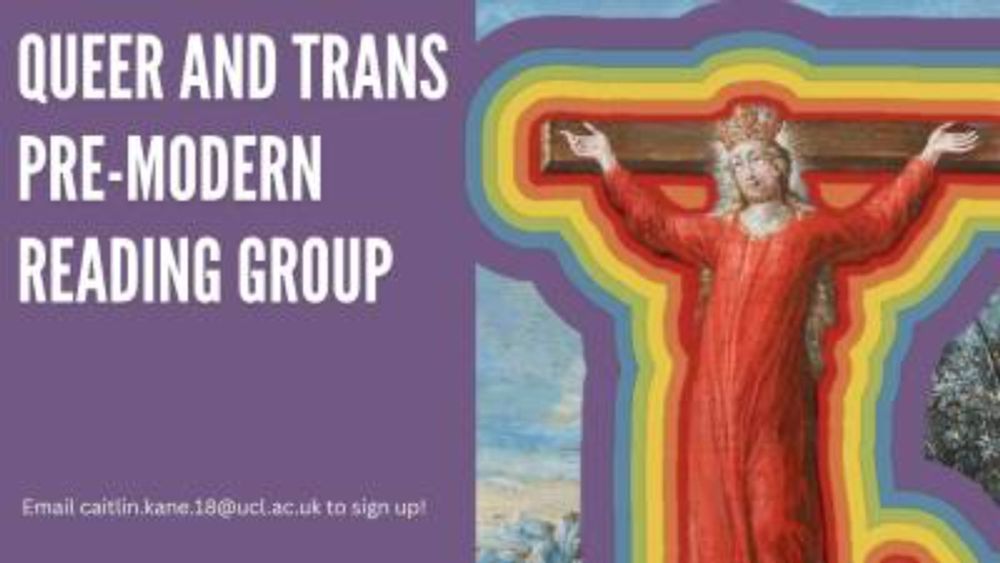
Schedule for Queer and Trans Pre-Modern Reading Group with image of the bearded St. Wilgefortis surrounded by the pride flag. Dates and times for meetings: 11th November 2:00-3:30pm, 25th November 2:00-3:30pm, 9th December 2:00-3:30pm. Email caitlin.kane.18@ucl.ac.uk to sign up.
Join us for this term's Queer and Trans Pre-Modern Reading Group @ucl-ias.bsky.social ! Newcomers very welcome, just email me to sign up!
For more info: tinyurl.com/y7kue3ek.
Queer and Trans Pre-Modern Reading Group - Session 10
29 July 2–3:30pm with @ctlnkane.bsky.social
The Queer and Trans Pre-Modern Reading Group is an informal discussion group exploring queer and trans themes in medieval and early modern texts.
www.ucl.ac.uk/institute-of...

Schedule for Queer and Trans Pre-Modern Reading Group with image of the bearded St. Wilgefortis surrounded by the pride flag. Dates and times for meetings: 15th July 2:00-3:30pm, 29th July 2:00-3:30pm, 12th August 2:00-3:30pm. Email caitlin.kane.18@ucl.ac.uk to sign up.
Join us for the Queer and Trans Pre-Modern Reading Group summer edition @ucl-ias.bsky.social ! Tomorrow we'll be looking at some excerpts about sexy Satan from George Sinclair’s 'Satan’s Invisible World Discovered' (1685). For more info: bit.ly/464J3NH.
14.07.2025 13:03 — 👍 2 🔁 0 💬 0 📌 0
Programme cover for Gender and Medieval Studies Conference on Gender: Charity and Care, 2-5 July 2024, Canterbury.

A group of people in medieval costumes, including chainmail and tunics, walking through a cobbled street in Canterbury.

A photo of the exterior of Canterbury Cathedral in the sunlight with a clear blue sky behind.

Speaker Rachel Moss presenting in front of a PowerPoint slide showing the 'This is fine' dog meme with flames, overlaid with the text 'We are not fine.'
I'm so late to the party but what an amazing #GMS2025 in Canterbury! Thank you @menysnoweballes.bsky.social for some incredible closing words 🙏
14.07.2025 12:56 — 👍 3 🔁 0 💬 0 📌 1
Me standing in front of a PowerPoint that says What does a truly feminist conference look like when the world is on fire?

The assembled cast of GMS
What a wonderful generative @medievalgender.bsky.social! It was an honour to get to close out the conference.
04.07.2025 22:04 — 👍 13 🔁 1 💬 0 📌 1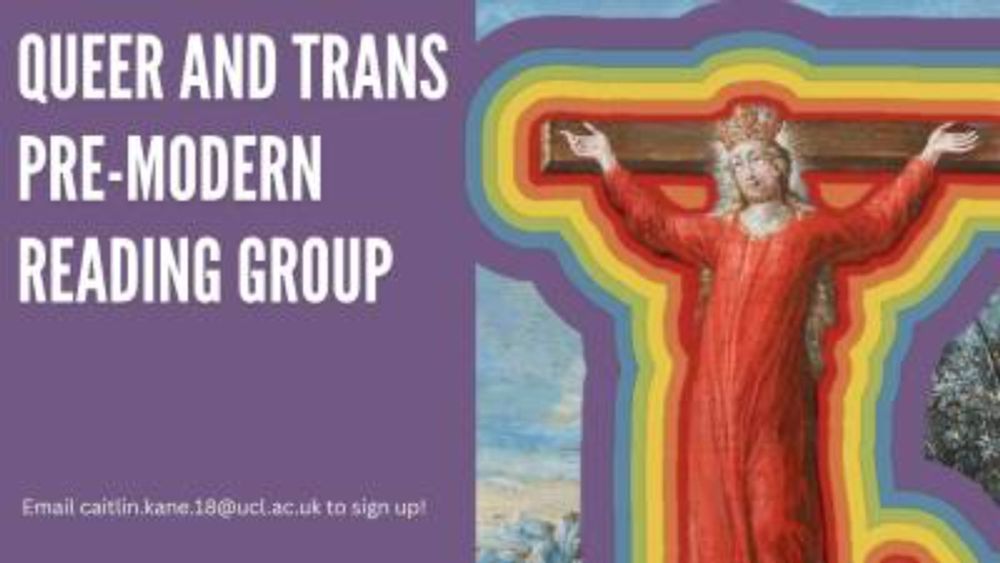
Queer and Trans Pre-Modern Reading Group - Session 9
15 July 2025, 2pm-3:30pm
This is an informal discussion group exploring queer and trans themes in medieval and early modern texts.
www.ucl.ac.uk/institute-of...

Ad for Queer and Trans Pre-Modern Reading Group with image of the bearded St. Wilgefortis surrounded by the pride flag. Dates and times for meetings 13th May 2:00-3:30pm, 27th May 2:00-3:30pm, 10th June 2:00-3:30pm. Email caitlin.kane.18@ucl.ac.uk to sign up.
Join us for the second term of the Queer and Trans Pre-Modern Reading Group @ucl-ias.bsky.social! Next week we'll be looking at one of the N-Town Plays. For more info: bit.ly/3QybydC.
06.05.2025 17:02 — 👍 2 🔁 1 💬 0 📌 0
St Catherine of Siena (1347-80), depicted with book & crucifix, and sporting a dove atop her head. A woodcut from an edition of her works published at #Venice by Cesaro Arrivabeno in 1517. Now @theulspeccoll.bsky.social Norton.e.47.
01.03.2025 22:14 — 👍 30 🔁 11 💬 0 📌 1
Ad for Queer and Trans Pre-Modern Reading Group with image of the bearded St. Wilgefortis surrounded by the pride flag. Dates and times for meetings: 4th February 2:00-3:30pm, 25th February 2:00-3:30pm, 11th March 2:00-3:30pm, 25th March 2:00-3:30pm. Email caitlin.kane.18@ucl.ac.uk to sign up.
Join us for the next session of the Queer and Trans Pre-Modern Reading Group @ucl-ias.bsky.social! For more info: bit.ly/qtp-group.
24.02.2025 21:48 — 👍 7 🔁 2 💬 0 📌 0
The Queer and Trans Pre-Modern Reading Group - Session 3
25 February 2025, 2pm-3:30pm
The Queer and Trans Pre-Modern Reading Group is an informal discussion group exploring queer and trans themes in medieval and early modern texts.
www.ucl.ac.uk/institute-of...