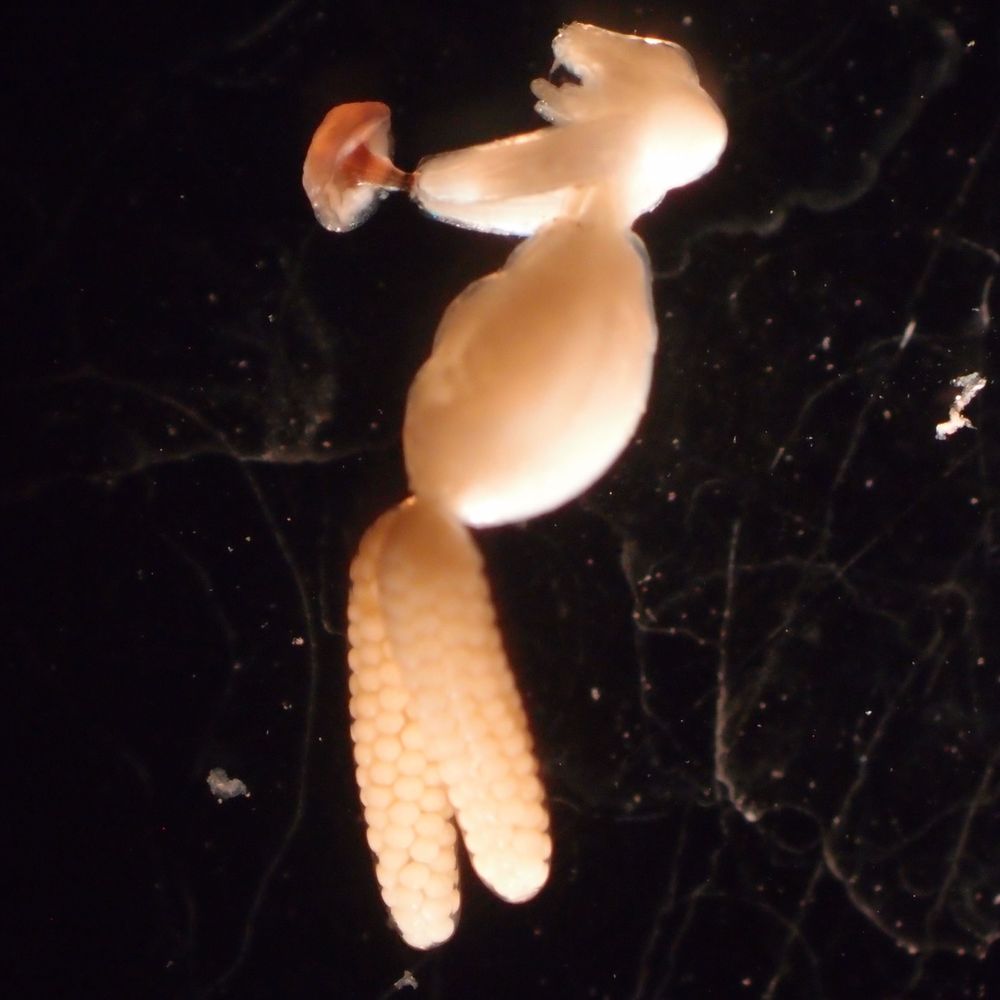
Parasite eggs found in feces or coprolites of the kākāpō. The left is an egg of c.f. Capillaria with embryonated larva from Stewart Island. The middle is an empty egg capsule of c.f. Capillaria from Hodges Creek. The right is a c.f. Strongylida from the Takahē Valley.
Credit: Boast et al. (2025), https://doi.org/10.1016/j.cub.2025.07.009

Three stocky green kākāpō chicks looking in different directions.
Credit: Dianne Mason, Department of Conservation, https://commons.wikimedia.org/wiki/File:Kakapo_chicks_(8528275645).jpg
These findings highlight the importance of not only preventing wildlife declines (thus preventing co-extinction of parasites), but of incorporating parasite conservation into the conservation of host species, keeping as much of the host's native ecology intact as possible.
06.11.2025 17:03 — 👍 1 🔁 0 💬 0 📌 0

A black-and-white photo of the scolex of the tapeworm Pulluterina nestoris, found in the kea (Nestor notabilis).
Credit: Weekes (1981), https://doi.org/10.1080/03014223.1981.10430618

A figure depicting eggs of the tapeworm Stringopotaenia psittacea from kākāpō feces.
Credit: Horrocks and Presswell (2023), https://doi.org/10.1017/S0022149X23000780
While this species was not found in the study, there is a tapeworm species (Stringopotaenia psittacea) which may be exclusive to the kākāpō. It resembles only one other tapeworm, Pulluterina nestoris, found in the kea, also endemic to New Zealand. Left image is P. nestoris, right is S. psittacea.
06.11.2025 16:57 — 👍 1 🔁 0 💬 1 📌 0
This decline may represent two phenomena related to parasite ecology: co-extinction (when a parasite is made extinct alongside its host) and conservation-induced extinction (when a parasite is made extinct by conservation action aimed at its host, which usually includes anti-parasitic treatment).
06.11.2025 16:45 — 👍 0 🔁 0 💬 1 📌 0

A plot representing the number of coprolites or scats examined for each time period against the taxonomic richness of each group. Ancient samples are represented by a blue line with a triangle. Historic samples are represented by an orange line with a circle. Modern samples are represented by a pink line with a square. The Ancient line has the most samples and the highest richness. The Historic line has the least samples and an intermediate richness. The Modern line has an intermediate number of samples and the lowest richness.
Credit: Boast et al. (2025), https://doi.org/10.1016/j.cub.2025.07.009
They found that there were fewer parasite taxa in the modern (post-1990) samples than in the Historic (c. 1840-1990) samples, and that both groups of samples had fewer taxa than were present in the Ancient (c. 1280-c. 1840) samples.
06.11.2025 16:43 — 👍 0 🔁 0 💬 1 📌 0

A figure depicting the decline of the kākāpō from c. 1280 to the modern day.
The first map is mostly light blue, representing the distribution of the kākāpō c. 1280, shortly before the settlement of New Zealand by the ancestors of the Māori people. The dark blue on the first map represents the distribution of the kākāpō c. 1840, around the same time as the signing of the Treaty of Waitangi between Māori and Pākehā.
The second map is mostly gray with a few green spots on the South Island and Stewart Island, representing the distribution of the kākāpō c. 1950, around the time the New Zealand Parliament adopted the Statute of Westminster Adoption Act 1947 accepting full external autonomy.
The third map is mostly gray with a few red spots distributed on the North Island, South Island, and Stewart Island, representing the distribution of the kākāpō in the present day.
Arrows and circles with letters next to them represent sites where kākāpō scat or coprolites were sampled for the study.
Credit: Boast et al. (2025), https://doi.org/10.1016/j.cub.2025.07.009

A figure representing the presence or absence of endoparasite taxa in kākāpō feces, sorted by Ancient written in blue, Historic written in green, and Modern written in red. There are fewer taxa in the Modern samples than in the Historic or Ancient samples.
Credit: Boast et al. (2025), https://doi.org/10.1016/j.cub.2025.07.009
In their recently-published study, Boast et al. (2025) examined kākāpō feces from two periods for parasites: the kākāpō's decline after human settlement (c. 1280-1990) and the eventual full management of the kākāpō population by the New Zealand government from 1990 onwards.
06.11.2025 16:34 — 👍 1 🔁 0 💬 1 📌 0

A kākāpō (Strigops habroptilus), a large, green, ground-dwelling parrot endemic to the forests of mainland New Zealand. This individual is named "Sirocco".
Credit: Chris Birmingham, Department of Conservation, https://commons.wikimedia.org/wiki/File:Kakapo_Sirocco_1.jpg
Shown here is one of New Zealand's most unique and charismatic parrot species: the kākāpō, threatened with extinction by the introduction of invasive species. But the decline of this parrot also includes the decline of its unique parasites, tracked over almost 800 years.
06.11.2025 16:17 — 👍 7 🔁 2 💬 1 📌 0

<i>Dolops discoidalis</i>
The electric eel , also known as poraquê , is a formidable animal. Not only is it capable of stunning its prey with an electrifying shock, ...
⚡Shocking truth⚡ about fish lice:
I've written a post about Dolops discoidalis, a species of fish louse which also happens to be the first ectoparasite to be documented from the electric eel 🧪
#Invertebrate
dailyparasite.blogspot.com/2025/10/dolo...
09.10.2025 03:45 — 👍 130 🔁 33 💬 6 📌 0
Here is where conservation can play a key role. Much of what we know about the modern distribution of G. rhinocerontis comes from iNaturalist, and the reintroduction of rhinos into Kruger National Park seems to have reintroduced the flies as well, promising hope for recovery of both species. (7/7)
11.10.2025 18:28 — 👍 1 🔁 0 💬 0 📌 0
Reliant on their rhino hosts, all Gyrostigma are threatened by poaching and habitat loss. G. rhinocerontis is known to survive in South Africa, while G. conjungens and G. sumatrensis are feared extinct after the catastrophic declines of the Black and Sumatran Rhinos. (6/7)
11.10.2025 18:25 — 👍 1 🔁 0 💬 1 📌 0
On the whole, studying these flies is uniquely difficult: the adults are very short-lived, and the larvae develop as endoparasites within their hosts. Much of what we know comes from larvae found in the stomachs of deceased rhinos, or flies that "hitchhiked" in rhinos imported into captivity. (5/6)
11.10.2025 18:21 — 👍 0 🔁 0 💬 1 📌 0

A drawing of a third instar Gyrostigma sumatrensis larva. The caption says "Figure 163. Gyrostigma sumatrensis Brauer. Posterior peritremes of third larval stage".
Credit: F. Zumpt 1965, "Myiasis in man and animals in the Old World"

A Sumatran Rhino (Dicerorhinus sumatrensis) at a sanctuary in Indonesia.
Credit: 26Isabella
https://commons.wikimedia.org/wiki/File:Sumatran_Rhinoceros_at_Sumatran_Rhino_Sanctuary_Lampung_Indonesia_2013.JPG
Gyrostigma sumatrensis is the only known member of its genus outside of Africa, and also the most mysterious one. This enigmatic fly is only known from larvae recovered from Sumatran Rhinos imported to German zoos from Sumatra in the 19th century, with the adult completely unknown. (4/6)
11.10.2025 18:16 — 👍 1 🔁 0 💬 1 📌 0

A drawing of Gyrostigma conjungens. The caption reads "Figure 159. Gyrostigma conjungens Enderlein. Female fly"
Credit: F. Zumpt 1965, "Myiasis in man and animals in the Old World"

A female South-western Black Rhino (Diceros bicornis occidentalis).
Credit: Sharp Photography
https://commons.wikimedia.org/wiki/File:South-western_black_rhinoceros_(Diceros_bicornis_occidentalis)_female.jpg
Gyrostigma conjungens specializes on the Black Rhino and has historically been found in East Africa, although it hasn't been observed in the wild for over 50 years. The limited evidence available to us suggests that adults emerge once a year to reproduce, similar to G. rhinocerontis. (3/6)
11.10.2025 18:09 — 👍 0 🔁 0 💬 1 📌 0

A rare photo of an adult Gyrostigma rhinocerontis on a rhinoceros, presumably to lay eggs.
Credit: honeyguideacademy, iNaturalist Observation
https://www.inaturalist.org/observations/200072011

Two adult White Rhinoceros (Ceratotherium simum) in South Africa
Credit: Komencanto
https://commons.wikimedia.org/wiki/File:Rhinoceros_in_South_Africa_adjusted.jpg

A Black Rhino (Diceros bicornis) in the grass.
Credit: Gerry Zambonini
https://commons.wikimedia.org/wiki/File:Black_Rhino_(15797036788).jpg
Gyrostigma rhinocerontis, the best-known Gyrostigma fly and the largest African fly, parasitizes the White Rhino and Black Rhino. Adults emerge twice a year and mate, lay eggs, and die in the span of a week. They resemble wasps with their size and striking colors, a possible case of mimicry. (2/6)
11.10.2025 18:03 — 👍 2 🔁 2 💬 1 📌 1
Rhinos are some of the most beautiful and unique land animals on the planet, and the same can be said of the Gyrostigma bot flies that have adapted to them. These parasites spend most of their lives as larvae in the digestive tract of their hosts, only emerging to pupate, mate, and die. (1/6)
11.10.2025 17:53 — 👍 1 🔁 0 💬 1 📌 0

Several specimens of Nuttalliella namaqua viewed dorsally. They have a partly sclerotized scutum just barely visible at the front of the body and a leathery outer covering. They are largely pale or grey, with one at the bottom right being largely black.
Credit: Mans et al. (2011)
https://commons.wikimedia.org/wiki/File:Nuttalliella_namaqua_cropped.png
https://doi.org/10.1371/journal.pone.0023675
The family Nuttalliellidae is represented by just one living species, Nuttalliella namaqua, native to southern and eastern Africa. A unique and ancient host-opportunist, this species shares features of the hard ticks (partly sclerotized scutum) and the soft ticks (leathery outer covering). (4/4)
03.10.2025 23:07 — 👍 1 🔁 0 💬 0 📌 0

Dorsal (left) and ventral (right) views of the argasid tick Argas persicus, a red, visibly bumpy, oval-shaped tick.
Credit: Daktaridudu, https://commons.wikimedia.org/wiki/File:Argas-persicus-female-dorsal-ventral.jpg

Two Otobius megnini, a soft tick with a dark brown outer covering and visible grooves across its surface.
Credit: Mat Pound, USDA https://commons.wikimedia.org/wiki/File:Otobius_megnini.jpg

Several individuals of the species Ornithodoros concanensis on what appears to be a piece of rock or soil.
Credit: Mat Pound, USDA, https://commons.wikimedia.org/wiki/File:TiquesMmollesArgasidaeOrnithodoros_concanensisUSDA.jpg
The soft ticks (family Argasidae) lack the scutum of their relatives, instead having a leathery outer covering. These ticks often remain in the burrows or nests of their hosts rather than actively pursuing ("questing") hosts, and feed for much shorter periods than hard ticks. (3/4)
03.10.2025 23:01 — 👍 1 🔁 0 💬 1 📌 0

An adult female Amblyomma kappa, a species native to East Asia that was split off from the closely related Amblyomma testudinarium in Kwak et al. (2025). It has a pale scutum spotted with brown over a brown alloscutum.
Credit: Mikwak, Kwak et al. (2025)
https://commons.wikimedia.org/wiki/File:Amblyomma_kappa.jpg
https://doi.org/10.1016/j.actatropica.2024.107499

An adult male Dermacentor rhinocerinus, a spotted orange-and-black tick native to Southern Africa and specializing on rhinoceroses. It is distinguished from other ixodid ticks by the orange spots on its scutum and the festoons on the posterior margin of its scutum.
Credit: dschigel, iNaturalist observation, https://commons.wikimedia.org/wiki/File:Dermacentor_rhinocerinus.jpg

An adult female Ixodes uriae, a widespread tick on seabirds. It has a small reddish scutum over a much larger pale alloscutum.
Credit: Birgit Rhode, New Zealand Arthropod Collection, https://commons.wikimedia.org/wiki/File:Ixodes_sp._on_seabirds.jpg
The hard ticks (family Ixodidae) are likely what you imagine when you think of a tick, distinguished by a sclerotized shield (or scutum) that covers most of the body of males, but only a tiny part of the females, which need to expand with blood, providing plenty of nutrients for their eggs. (2/4)
03.10.2025 22:52 — 👍 1 🔁 0 💬 1 📌 0
You probably have a general idea of what a tick looks like, but did you know that there are three distinct families of ticks, each with their own appearance, habitat, and adaptations? These families are the Ixodidae (or hard ticks), Argasidae (or soft ticks), and the Nuttalliellidae. (1/4)
03.10.2025 22:42 — 👍 3 🔁 2 💬 1 📌 0

<i>Forficuloecus pezopori</i>
Parasites are a major part of biodiversity, but they spend most of their time hidden in plain sight. Even with some animals that have been k...
Crouching Parrot, Hidden Louse:
The Kyloring (Pezoporus flaviventris) is a critically endangered species of Australian parrot, and it is host to Forficuloecus pezopori - a species of louse which lives only on the Kyloring and nowhere else.
#Invertebrate 🧪
dailyparasite.blogspot.com/2024/06/forf...
26.09.2025 01:53 — 👍 61 🔁 19 💬 1 📌 1

Pie charts of ectoparasites collected from Myotis macropus. 363 of these are the bat fly Basilia hamsmithi, 81 are the mesostigmatid mites Spinturnix novaehollandiae, two are the batfly Brachytarsina amboinensis, and one is the batfly Penicillidia setosala. Source: Kwak et al. 2022, https://doi.org/10.1007/s10841-022-00409-z
This study found that one parasite, the the Australian Myotis Batfly (Basilia hamsmithi) were less abundant on bats in urban and suburban areas, indicating that urbanization may threaten wild parasite species like these along with their hosts in ways we're just beginning to understand. (3/3)
25.09.2025 20:19 — 👍 1 🔁 0 💬 0 📌 0

Four ectoparasites recovered from Myotis macropus in the greater Brisbane area, Queensland, Australia.
A: male Australian Myotis Batfly (Basilia hamsmithi)
B: female Australian Myotis Batfly
C: male New Holland Bat-wing Mite (Spinturnix novaehollandiae)
D: female New Holland Bat-wing Mite
Source: Mackenzie et al. (2022), https://doi.org/10.1007/s10841-022-00409-z

Large-footed Myotis (Myotis macropus) roosting. Credit: BKCW8, https://commons.wikimedia.org/wiki/File:Myotis_macropus_roosting.JPG
In a 2022 study, Group co-chair Mackenzie L. Kwak, Vanessa Gorecki, and Gregory Markowsky studied how ectoparasites living on the locally threatened Large-footed Myotis (Myotis macropus) are affected by urbanization in and around Brisbane, Australia. (2/3)
25.09.2025 20:12 — 👍 1 🔁 0 💬 1 📌 0

A brown-orange-colored bat fly of the family Nycteribiidae, found attached to a bat in Gorongosa National Park. Credit: Bart Wursten, https://commons.wikimedia.org/wiki/File:Nycteribiidae00.jpg
The bat flies (families Nycteribiidae and Streblidae) are an unusual group of parasitic flies that ride along with (and feed on) bats, usually being found attached to their hosts. But just as they receive sustenance their hosts, they are also vulnerable to whatever threats their hosts face. (1/3)
25.09.2025 20:05 — 👍 3 🔁 0 💬 1 📌 0

Eastern Quoll (Dasyurus viverrinus), an Australian marsupial restricted to Tasmania, but which once had a much wider distribution in eastern Australia. Credit: Charles J. Sharp, https://commons.wikimedia.org/wiki/File:Eastern_quoll_(Dasyurus_viverrinus)_fawn_morph_Esk_Valley.jpg

Tasmanian Devil (Sarcophilus harrisii), a carnivorous marsupial native to Tasmania. It was once common across mainland Australia, and there are ongoing efforts to reintroduce it. Credit: JJ Harrison, https://commons.wikimedia.org/wiki/File:Sarcophilus_harrisii_taranna.jpg

A map depicting the spread of Devil Facial Tumor Disease across Tasmania as of 2015. By 2020, the disease spread to Temma in northwest Tasmania, where the most recent specimen of the Plain Thorny-headed Flea has been collected. Because of this, immediate conservation action is needed to preserve Tasmanian Devils and their native parasite fauna. Credit: Epstein et al. (2016), https://doi.org/10.1038/ncomms12684
This species is known from the Eastern Quoll (Dasyurus viverrinus) and the Tasmanian Devil (Sarcophilus harrisii) in Tasmania. It is threatened by Devil Facial Tumor Disease, a fatal contagious cancer among Tasmanian Devils. Because of this, we consider it co-threatened alongside its host.
19.09.2025 19:00 — 👍 3 🔁 0 💬 0 📌 0

A plain thorny-headed flea (Acanthopsylla saphes), image from Kwak et al. (2025).
Just this month, a team including Specialist Group co-chair Mackenzie Kwak reported the rediscovery of the Plain Thorny-headed Flea (Acanthopsylla saphes), once feared extinct and in dire threat from the decline of its hosts!
Link: doi.org/10.1007/s108...
#conservation #parasite #flea #parasitology
19.09.2025 18:42 — 👍 2 🔁 0 💬 1 📌 0
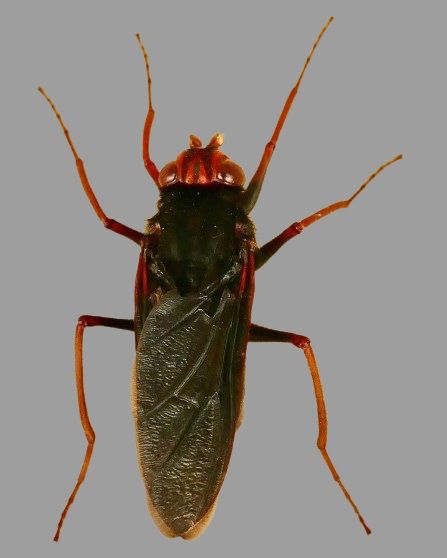
Rhinoceros Stomach Bot Fly (Gyrostigma rhinocerontis), a black-and-orange bot fly specializing in White Rhinos (Ceratotherium simum) and Black Rhinos (Diceros bicornis) in Africa. Credit: Bernard Dupont, https://commons.wikimedia.org/wiki/File:Gyrostigma_rhinocerontis_(Owen,_1830)_1(a)_-_iNaturalist.org.jpg
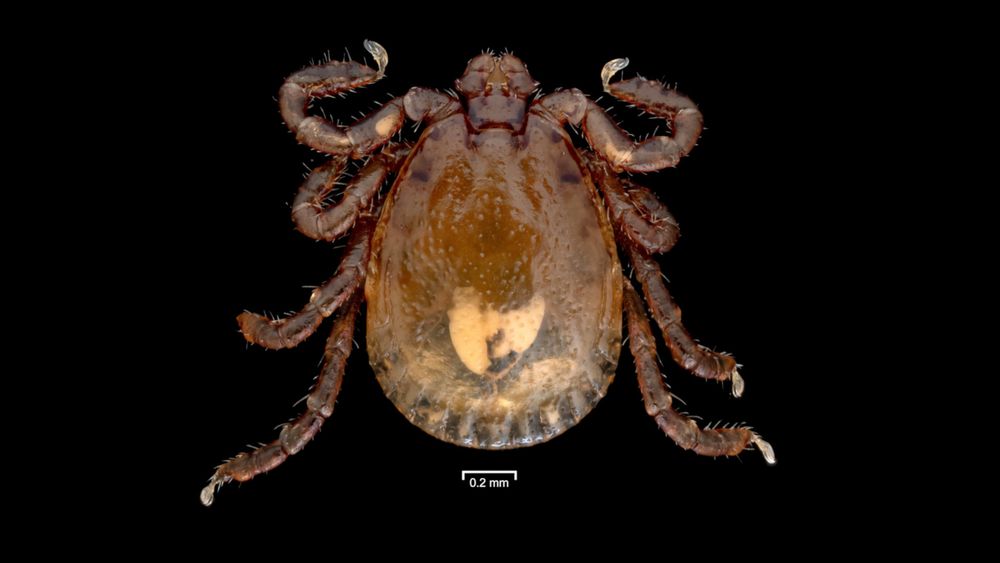
A Ryukyu Rabbit Tick (Haemaphysalis pentalagi), a brown tick that specializes on the Amami Rabbit (Pentalagus furnessi) on Amami Ōshima, one of the southern islands of Japan. Credit: Takamasa Nemoto

The Manx Shearwater Flea (Ceratophyllus (Emmareus) fionnus), a flea known only from the Isle of Rùm off the west coast of Scotland, where it specializes on nesting colonies of the Manx Shearwater (Puffinus puffinus). Credit: Olha Schedrina / The Natural History Museum

Rhinoceros Tick (Dermacentor rhinocerinus), a spotted orange-and-black tick species that specializes on White Rhinos (Ceratotherium simum) and Black Rhinos (Diceros bicornis) in Africa. Credit: Moira Fitzpatrick
Hello, Bluesky! We're the IUCN SSC Parasite Specialist Group, a part of the Species Survival Commission! We're just starting to understand the important roles parasites play in their ecosystems, and our goal is to determine the threats wildlife parasites face and to conserve rare and unique species!
18.09.2025 23:53 — 👍 19 🔁 10 💬 0 📌 1