Demystifying Numerical Dissipation in Simulation Codes
We are organizing a workshop on "Demystifying Numerical Dissipation in Simulation Codes" on the 2nd and 3rd of December (2025) at the University of Augsburg. We will have talks, discussions and hands-on sessions.
www.uni-augsburg.de/de/forschung...
19.11.2025 18:42 — 👍 0 🔁 0 💬 0 📌 0
itiner-e
itiner-e.org
07.11.2025 13:59 — 👍 0 🔁 0 💬 0 📌 0
A mesmerizing time-lapse of the Sun in ultraviolet light, captured by the Solar Dynamics Observatory spacecraft over a month.
-Credits: NASA
27.07.2025 16:05 — 👍 8667 🔁 1918 💬 204 📌 158
preCICE workshop 2025
The detailed schedule of the preCICE workshop 2025 is now out and includes:
- 12h of hands-on training,
- 12 talks,
- 12 posters,
- a World Café,
- user support, and
- several more networking opportunities.
Registration is still open till July 15. Read more:
precice.org/precice-work...
10.07.2025 08:22 — 👍 1 🔁 1 💬 0 📌 0
Journey with us to the star that exploded twice! 🚀
The remains of supernova SNR 0509-67.5 are all that is left of this star. Our VLT found out that it suffered a pair of explosive blasts, shedding new light on some of the most important explosions in the Universe.
www.eso.org/public/news/...
🔭 🧪
07.07.2025 08:06 — 👍 130 🔁 24 💬 5 📌 3

M2-9, the Twin Jet Nebula, is a bipolar planetary nebula shaped by high-speed gas jets moving over 200 miles/sec. Formed about 1,200 years ago, it likely originates from a close stellar pair and a dense disk that channels gas into jet-like outflows.
Credit: NASA, Bruce Balick et al.
M2-9, the Twin Jet Nebula, is a bipolar planetary nebula shaped by high-speed gas jets moving over 200 miles/sec. Formed about 1,200 years ago, it likely originates from a close stellar pair and a dense disk that channels gas into jet-like outflows.
Credit: NASA, Bruce Balick et al.
19.05.2025 17:40 — 👍 1130 🔁 165 💬 29 📌 7
It seems like our fingers always wrinkle up the same way under water.
12.05.2025 12:52 — 👍 0 🔁 0 💬 0 📌 0

Telltale Data Signs of Bogus Scientific Papers and Fraudulent Academic Research
Two scientists and an editor spent six months investigating so-called paper mills, which churn out bogus scientific papers that impede actual research on lifesaving breakthroughs.
Telltale Signs of Fraudulent Academic Research
Two scientists and an editor spent six months investigating so-called paper mills, which churn out bogus scientific papers that impede actual research on lifesaving breakthroughs.
📝 From @us.theconversation.com. https://twp.ai/1VSKR3
01.04.2025 11:30 — 👍 3 🔁 1 💬 0 📌 0

New Angle for Reporting on Oil and Gas Industry — Radioactive Waste
The lack of regulatory oversight of radioactive waste in the oil and gas industry has created an environment ripe for some extraordinary science and environmental journalism.
While radiation generated in nuclear energy and medicine was brought under regulations, the oil and gas industry’s radioactivity never was.
Read more about a new angle for reporting on radioactive waste: https://twp.ai/1VH89t
From @sejorg.bsky.social.
29.03.2025 16:59 — 👍 2 🔁 1 💬 0 📌 1
Telltale Data Signs of Bogus Scientific Papers and Fraudulent Academic Research
Two scientists and an editor spent six months investigating so-called paper mills, which churn out bogus scientific papers that impede actual research on lifesaving breakthroughs.
2 scientists & an editor spent 6 months investigating so-called paper mills, which churn out bogus scientific papers that impede actual research on lifesaving breakthroughs.
Here are the telltale data signs of bogus scientific papers & academic research: https://twp.ai/1VH5cz
30.03.2025 17:30 — 👍 2 🔁 2 💬 0 📌 0
preCICE workshop 2025
Get the hands-on training you needed to start coupling your own simulations, show your research, or shape the future of preCICE in the upcoming preCICE Workshop:
precice.org/precice-work...
28.03.2025 10:35 — 👍 1 🔁 1 💬 0 📌 0
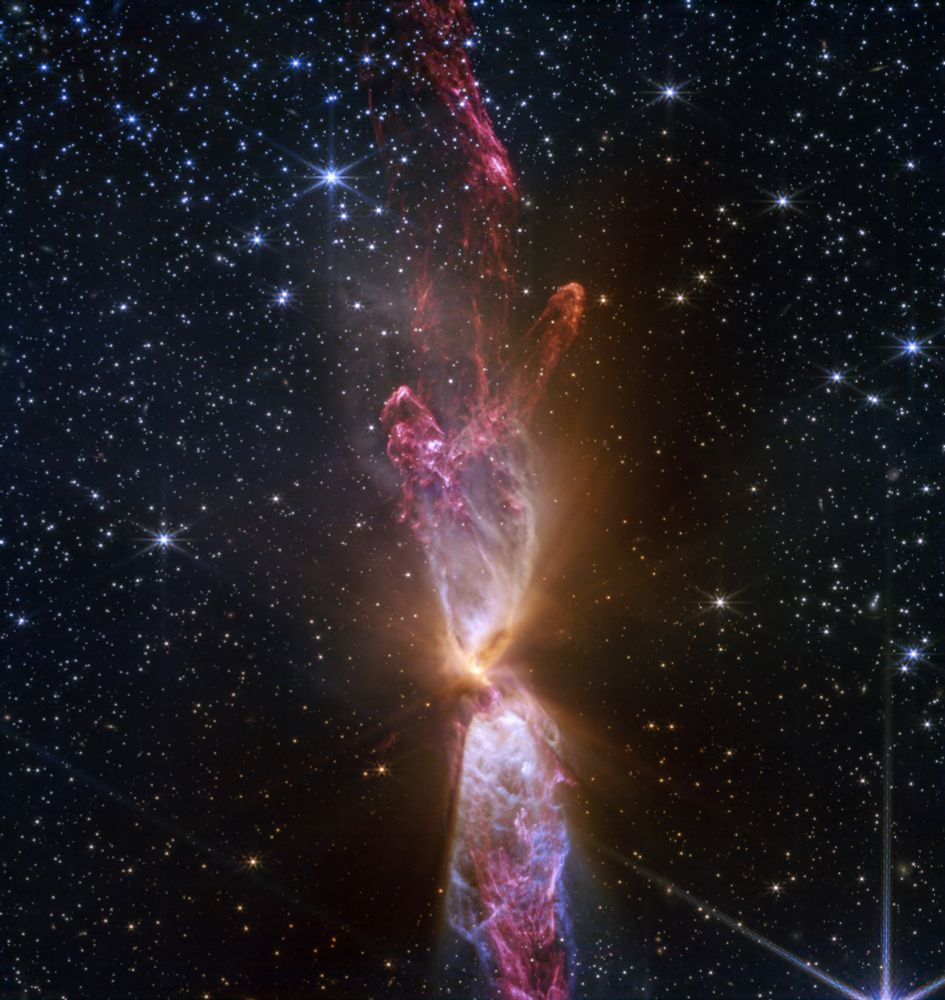
At the centre is a thin vertical cloud known as Lynds 483 (L483) that is roughly shaped like an hourglass with irregular edges. The lower lobe is slightly cut off. The top lobe is seen in full, petering out at the top.
New JWST image dropped: actively forming star system Lynds 483 (NIRCam image)
Credit:
NASA, ESA, CSA, STScI
esawebb.org/news/weic2503
07.03.2025 19:47 — 👍 2340 🔁 292 💬 26 📌 20

This is a cropped, close-up image of the planet Venus, taken by the Parker Solar Probe’s WISPR instrument. The image shows a crescent Venus against the black backdrop of space, with the edge of the planetary limb clearly defined. The crescent is illuminated by sunlight, transitioning from a bright, almost white glow at the top right edge to a subtle, golden yellow that dominates the majority of the illuminated area, before fading into the darkness of the planet's night side at the bottom left. The distinct variations in brightness and texture across the crescent suggest cloud formations or atmospheric layers. A bright, flaring light source is visible at the top right corner, likely the Sun, which contributes to the illumination of the crescent. The overall composition emphasizes the stark contrast between the luminous crescent and the surrounding darkness, highlighting the curvature and celestial context of Venus.
This is the clearest photo ever taken of Venus.
🔭 🧪
16.02.2025 17:14 — 👍 4662 🔁 836 💬 102 📌 114
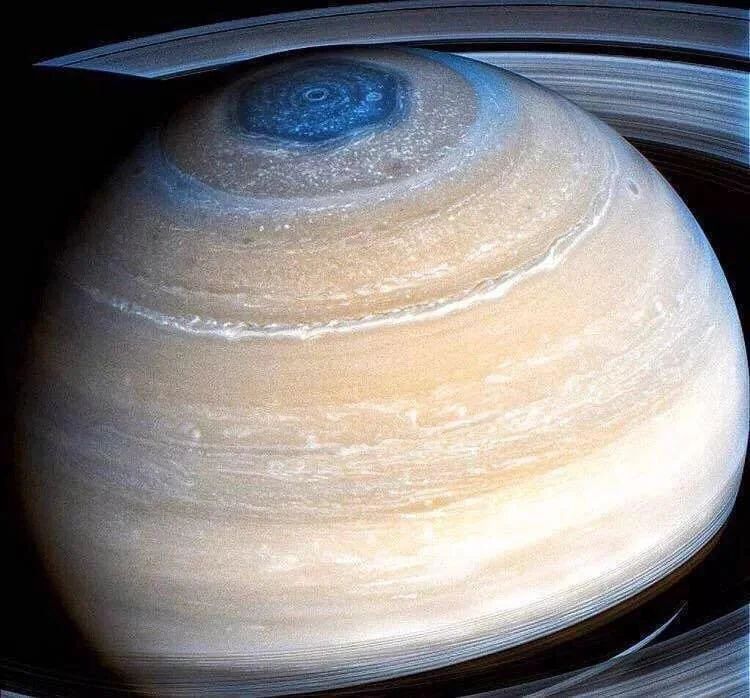
This is the closest image of Saturn ever captured by the Cassini spacecraft. It shows the planet in a majestic and serene light, with its rings in the foreground. The planet's golden hues are highlighted by the sunlight filtering through its upper atmosphere. A notable feature is the intriguing hexagonal storm at the north pole, a unique weather phenomenon in our solar system. The image provides an unparalleled, close-up perspective, inviting viewers to appreciate the intricate details of Saturn's cloud bands and the sheer vastness of its ring system. It is a stunning portrayal of the beauty and complexity of this gas giant, captured from a vantage point closer than any human-made probe has ventured before.
This is the closest photo of Saturn ever taken.
🔭 🧪
17.02.2025 19:00 — 👍 1096 🔁 163 💬 18 📌 20

A breathtaking view of Earth from space, showcasing its vibrant blue oceans and swirling white clouds. In the foreground, the rugged, cratered surface of the far side of the Moon is visible, providing a stark contrast to the lively appearance of our home planet.
The far side of the moon, illuminated by the sun, as it crosses between the DISCOVR spacecraft's camera and the Earth - one million miles away.
🔭 🧪
07.02.2025 15:45 — 👍 981 🔁 159 💬 29 📌 15

The JuliaCon Global 2025 Diversity, Equity, and Inclusion (DEI) Committee is excited to announce a Proprosal-A-Thon for writing your JuliaCon Global 2025 proposal! The call for proposals is out right now, and we are looking for both talks and posters for JuliaCon Global 2025. We will run the event during two days in different time zones Sunday January 26th at 4pm CET.
If you are curious about the process of writing and submitting a proposal (you don’t need an idea yet!), we encourage you to attend! The event will start with a 30-minute presentation on the process, followed by an hour of office hours where you can ask individual questions. This event is intended to help community members who are first-time presenters.
Submitting to JuliaCon Global 2025 for the first time, or know a student / young researcher who is interested?
Join us for our second Proposal-a-Thon at this link on Sunday 4PM CET / 10AM EST: app.gather.town/events/aONRc...
24.01.2025 03:51 — 👍 5 🔁 4 💬 0 📌 0

This Near-Infrared Camera (NIRCam) image shows the Bullet Cluster, a powerful astronomical event resulting from the collision of two galaxy clusters. The image features a bright, central core with a distinct pinkish hue, representing the hot gas. Surrounding this core are countless individual galaxies, seen as bright white and yellowish dots, scattered across the dark background of space. Extending outwards from the center are faint, blue streaks, indicative of the superheated gas that was pulled away during the collision. The overall scene conveys a sense of immense energy and cosmic dynamism.
Bullet cluster - JWST.
Processed by c.claude.
www.flickr.com/photos/27527...
🔭 🧪
05.02.2025 19:39 — 👍 1247 🔁 116 💬 7 📌 5
Tips and tricks for learning Japanese language through novels, manga, anime, podcasts, etc.
(JLPT N1. Translator. Live in Japan.)
Don't just study Japanese, use it!
勉強だけでなく日本語は、使えば使うほど上手になるんです。
🇯🇵 jtalkonline.com
☕️ https://ko-fi.com/G2G5AEBW
PhD, MSc, BEng. Solar Physicist, flare observations and modeling. Dabbles in Space Weather & related stuff. Professor at Mackenzie University (Brazil). Average guitar player. https://orcid.org/0000-0002-4819-1884
Astro | Helio | Space Weather | ML
Science Director, Space & Astronomy @CSIRO; OMO
Histórias da Grande Lisboa para todos os lisboetas. Impacto social e jornalismo comunitário. História. Mobilidade. Diversidade. A nossa política é a dos bancos de jardim.
The official account of Stockholm University. Here, we publish research findings and other news from SU, as well as updates on when our researchers appear in the media or participate in public debates. Mainly in English.
su.se/english
su.se
Changing the world since 1451 🌍 | #TeamUofG #WorldChangingGlasgow https://www.gla.ac.uk/
preCICE is an open-source coupling library for partitioned multi-physics simulations. Learn more on https://precice.org/
Account managed by @gercho.bsk.social
The global hub for investigative journalism, sharing resources, stories, events, and jobs.
Find #GIJN's regional feeds, here: http://gijn.org/follow-gijn/
Julia is a high-level, dynamic programming language built for technical computing.
Official Bluesky account of the Julia Language Project
#JuliaLang
Fortran programming language. Powering the world since 1956. Latest edition is Fortran 2023. The next one is Fortran 2028.
https://fortran-lang.org/
The nonprofit organization behind the Python programming language. For help with Python code: http://python.org/about/help/
On Mastodon: @ThePSF@fosstodon.org
James Webb - Everything That's Hot 🔥
jwstfeed.com