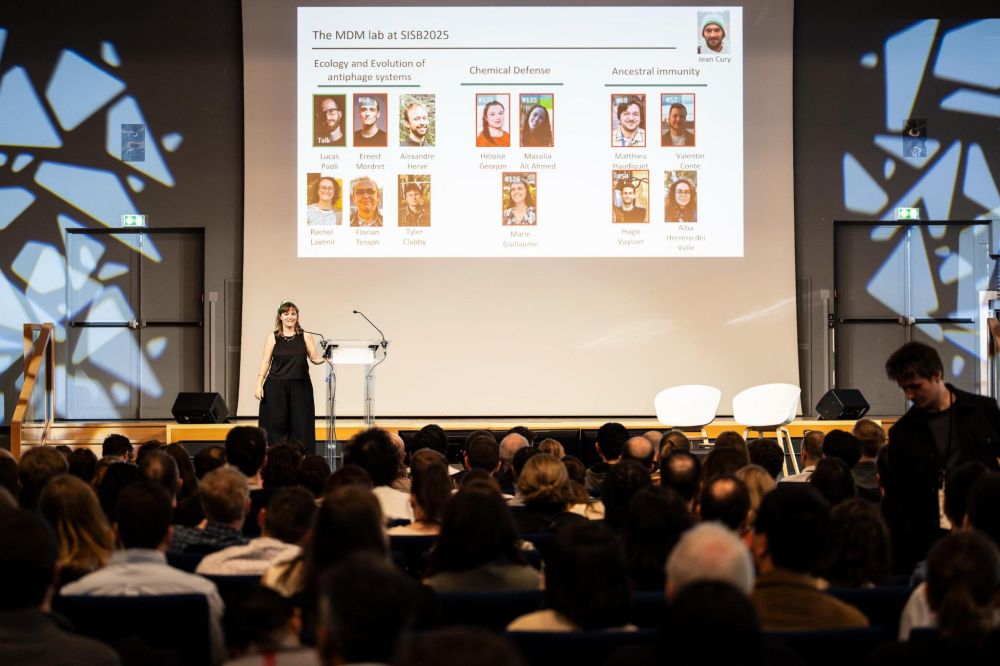
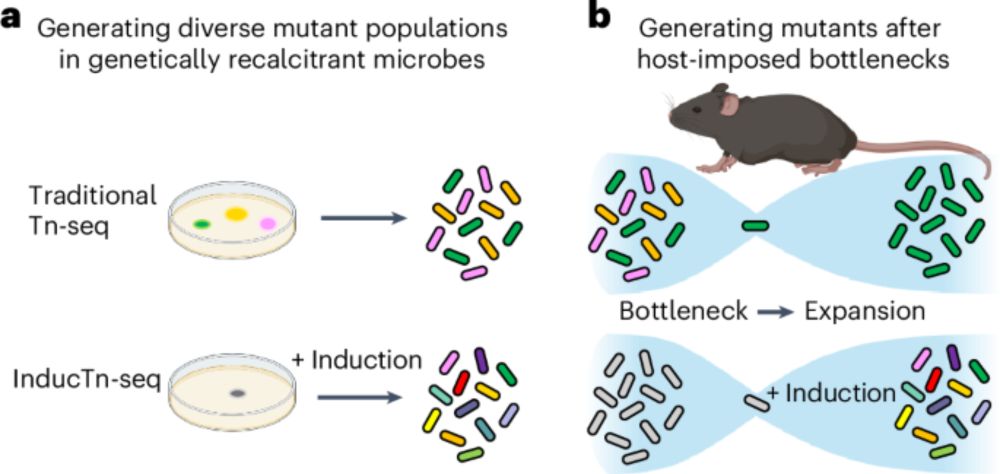
New post-doctoral research position in my phage-host interactions (Phi) laboratory in @otagomicroimmuno.bsky.social at @universityofotago.bsky.social New Zealand. The project is focused on defences against jumbo phages. Please share and if interested apply using the link in the comments.
04.03.2026 00:20 —
👍 48
🔁 47
💬 5
📌 1
Fantastic collaboration w/ @dbikard.bsky.social @audeber.bsky.social @rayanchikhi.bsky.social labs led by @jmouradesousa.bsky.social : We assessed the rates of variation of anti-phage systems in P4-like satellites and P2 helper phages. Quick conclusion: Huge variation! We focus on 4 key questions/5
03.03.2026 17:39 —
👍 41
🔁 18
💬 1
📌 1
Out now! In collaboration with Leifu Chang, we uncover the molecular and structural underpinnings of CRISPR-Cas12f-like RNA-guided transcription systems!
Links to the published articles:
tinyurl.com/55kpavet
tinyurl.com/sk6djwx3
Previous thread for the preprint:
bsky.app/profile/did:...
04.03.2026 20:28 —
👍 67
🔁 26
💬 0
📌 2
SISB2026
Abstract submission is now OPEN for the 2026 Symposium on the Immune System of Bacteria!
sisb2026.rockefeller.edu
🗓 May 5–7, 2026
📍 Rockefeller University, New York City
⏰ Abstract deadline: March 16, 2026
Attendance will be capped, be sure to register early and secure your spot.
See you in NYC!
11.02.2026 14:05 —
👍 20
🔁 12
💬 0
📌 2

Congratulations to Sonomi Yamaguchi for her paper at @nature.com. Sonomi discovered Clover defense and explained how nucleotide signals control each step of viral sensing, immune regulation, and viral restriction – named for her beautiful "four-leaf" structures 🍀
www.nature.com/articles/s41...
18.02.2026 17:11 —
👍 59
🔁 31
💬 0
📌 4

EMBL International PhD Programme - summer recruitment 2026! 👀
Research groups across EMBL are recruiting now! www.embl.org/about/info/e...
Don’t miss this opportunity to receive dedicated mentoring while doing interdisciplinary research.
19.02.2026 09:41 —
👍 12
🔁 13
💬 0
📌 1

Rewiring of oncogenic signaling in #DrugResistance is a moving target. In our new study, we used biophysical phosphoproteomics to investigate #BRAF mutant cancer, linking phosphorylation changes to protein function and #MolecularMechanisms through #Multi-Omics integration.
tinyurl.com/funsignaling
11.02.2026 13:57 —
👍 29
🔁 12
💬 1
📌 3
That's cool, and flattering 🙃 I hope they enjoy it
05.02.2026 16:08 —
👍 2
🔁 0
💬 1
📌 0
Two independent super-elegant studies from Maxwell & Laub labs find immune proteins that sense infection by binding to oligomeric phage protein rings (i.e phage portal), using them as a scaffold to assemble into their active immune effector form 🤯
Highly recommend read! 🤓📖l
05.02.2026 09:15 —
👍 18
🔁 7
💬 0
📌 0
A DNA damage-activated kinase controls bacterial immune pathway expression https://www.biorxiv.org/content/10.64898/2026.02.02.703251v1
04.02.2026 04:16 —
👍 11
🔁 7
💬 0
📌 0
A great example of the ongoing arms race between bacteria and phages. 🦠🛡️ The plot thickens on the NAD+ bacteria vs. phage battlefield.
See thread below from @ostermanilya.bsky.social ⤵️
Congrats to you and all involved 🥂 I wonder what's next? 🧐
29.01.2026 11:42 —
👍 4
🔁 0
💬 1
📌 0
Helaine& Kranzusch labs reveal a mechanism by which a prophage-encoded abortive infection protein defends the host from other phages using a tail tip triggered tRNA nuclease, while maintaining its own propagation abilities- by encoding a tail tip variant that does not trigger it.
👇🏽🧬✂️☠️🦠
29.01.2026 06:31 —
👍 12
🔁 3
💬 0
📌 0
Another cool finding of nucleotides activating antiphage defense 👇🏽
5′-phosphorylated deoxydinucleotides arising during host genome degradation activate the doughnut shaped ApeA oligomer, to cleave host
tRNAs and abort infection
✂️🧬➡️🍩✨➡️✂️☠️🦠
www.biorxiv.org/content/10.6...
27.01.2026 13:13 —
👍 25
🔁 7
💬 0
📌 0

Recruitment for the EMBL International PhD Programme is officially open! 🔊
At EMBL, we train young scientists to become skilled and creative future leaders in academia, industry and other sectors. Start your career in the life sciences with us!
🔎 Read more here:
tinyurl.com/4jdt2ra5
26.01.2026 08:50 —
👍 23
🔁 33
💬 1
📌 1
SISB2026
Check this out for the 2026 SISB (phage defense) meeting in NYC. Mark your calendar! (and note the Zoom option, if needed)
sisb2026.rockefeller.edu
01.12.2025 23:44 —
👍 35
🔁 19
💬 0
📌 5
A methylome-derived m6-dAMP trigger assembles a PUA-Cal-HAD immune filament that depletes dNTPs to abort phage infection
Bacteria must distinguish phage attack from normal homeostatic processes, yet the danger signals that trigger many defence systems remain unknown. Here, we show that a PUA-Calcineurin-CE-HAD module from Escherichia coli ECOR28 confers broad anti-phage protection by binding Dam-methylated deoxyadenosine monophosphate (m6-dAMP) generated during phage-induced chromosome degradation. Ligand binding converts a preassembled PUA-Calcineurin-CE hexamer loaded with six HAD phosphatases into a polymerising filament. The filament acts as a high-flux dNTP sink through a two-enzyme cascade: HAD first dephosphorylates dATP to dADP, and Calcineurin-CE then converts dADP to dAMP. dNTP collapse halts phage replication and enforces abortive infection. Multiple mobile-element DNA mimic proteins block filament assembly, revealing a direct phage counter-defence. More broadly, our findings extend a conserved, cross-kingdom paradigm of immune filament assembly to nucleotide-depletion antiviral defence and suggest modified-nucleotide sensing by related PUA-Calcineurin-CE modules as a widespread, underappreciated bacterial strategy. ### Competing Interest Statement The authors have declared no competing interest. NIHR Southampton Biomedical Research Centre, https://ror.org/01qqpzg67, Postdoctoral Bridging Fellowship F.L.N. is supported by a Wessex Health Partners (WHP) and National Institute for Health and Care Research Wessex Experimental Medicine Network (NIHR WEMN), Seed fund National Institutes of Health, GM145888, U24 GM129539) Maloris Foundation Memorial Sloan Kettering Cancer Center, P30-CA008748 Simons Foundation, SF349247 New York State Assembly
Preprint out: We characterise PUA-Cal-HAD, a widespread bacterial antiphage defence family. An infection cue switches a preassembled complex into an immune filament that drains dNTPs via a coupled two-enzyme cascade, and phage DNA mimics can block filament assembly (anti-polymerisation).
17.01.2026 14:52 —
👍 34
🔁 19
💬 1
📌 0

Intracellular competition shapes plasmid population dynamics
From populations of multicellular organisms to selfish genetic elements, conflicts between levels of biological organization are central to evolution. Plasmids are extrachromosomal, self-replicating g...
Hot off the press! Our latest paper led by @fernpizza.bsky.social, understanding how plasmids evolve inside cells. These small, self-replicating DNA circles live inside bacteria and carry antibiotic resistance genes, but also compete with one another to replicate. 1/
www.science.org/doi/10.1126/...
20.11.2025 21:42 —
👍 437
🔁 200
💬 11
📌 18

@sacrozhangt.bsky.social and I wrote a commentary on Jordi van Gestel and Carol Gross's latest paper, check it out!
www.pnas.org/doi/10.1073/...
Sadly, the Editors at PNAS rejected our initial introduction, which was a David Attenborough style voice over of the microbial Serengeti (included below)
13.11.2025 14:54 —
👍 75
🔁 19
💬 8
📌 2
Preprint: Bacteria sense virus-induced genome degradation via methylated mononucleotides
tinyurl.com/ch3damp
We show how molecular byproducts released during virus-induced cell exploitation are used as signals to trigger host immunity
Revealed by the amazing Ilya Osterman. See his thread below👇
06.11.2025 10:39 —
👍 61
🔁 19
💬 0
📌 1

Bacteria can sense when a virus starts shredding their genome — by detecting methylated mononucleotides.
Here’s the story of how we discovered the Metis defense system 👇
www.biorxiv.org/content/10.1...
06.11.2025 04:59 —
👍 132
🔁 49
💬 4
📌 12
Amazing Francois! Congrats! 🥂
04.09.2025 20:35 —
👍 1
🔁 0
💬 0
📌 0
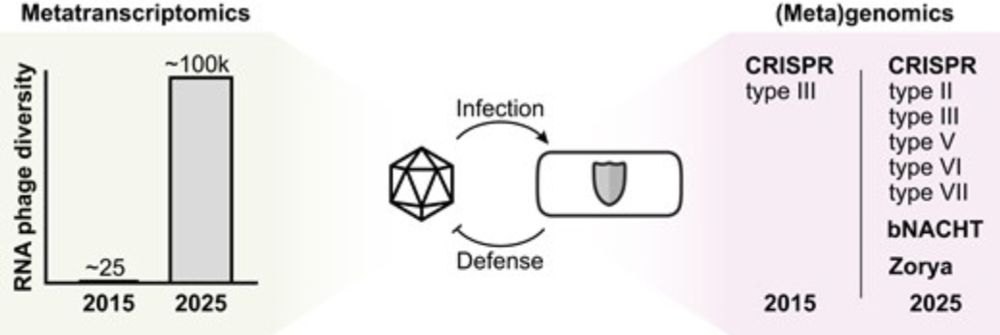
Advancing RNA phage biology through meta-omics
Abstract. Bacteriophages with RNA genomes are among the simplest biological entities on Earth. Since their discovery in the 1960s, they have been used as i
I'm happy to share the first publication from my lab @hoerlab.bsky.social, now out in @narjournal.bsky.social! I take a look at the biology of RNA phages, focusing on how meta-omics methods are discovering new RNA phage families and bacterial defense strategies.
#PhageSky
doi.org/10.1093/nar/...
23.04.2025 08:57 —
👍 57
🔁 26
💬 1
📌 0
The perfect conference. I was so lucky to attend! 🥰
16.04.2025 20:56 —
👍 2
🔁 0
💬 0
📌 0

Excited to share our paper published in @currentbiology.bsky.social that explores the consequences of having multiple genomes in a bacterial model system and it’s benefits in a multidrug environment ! www.cell.com/current-biol...
04.03.2025 17:12 —
👍 33
🔁 12
💬 4
📌 0