Tamil Nadu Archeology
www.thehindu.com/news/cities/...
@pacificflore.bsky.social
Medievalist. India past and today . Pacific Studies. Hokulea. Art. Museums. Archeology. Science. Biology. Environment.
Tamil Nadu Archeology
www.thehindu.com/news/cities/...

Excursion du 3 Mai 2025 archeographs.hypotheses.org/854
27.01.2026 12:29 — 👍 0 🔁 0 💬 0 📌 0
#Podcast Mathématiciennes de l'ombre, elles ont compté pour la NASA, à (ré)écouter via @franceculture.fr ! #ScienceCQFD
www.radiofrance.fr/francecultur...

Dr. Gladys West, the pioneering mathematician whose work laid the foundation for modern GPS technology, has died. She was 95.
19.01.2026 18:00 — 👍 27329 🔁 9653 💬 551 📌 506Une nouvelle fâcheuse, beaucoup moins grave qu’annoncée (comme d’habitude)
07.12.2025 18:36 — 👍 7 🔁 2 💬 0 📌 0
Several megaliths stood in a grassy field.
Carnac (🇫🇷) is the site of thousands of standing stones, constructed ~7,000-years-ago #StandingStoneSunday
Radiocarbon dates indicate people added to and changed the complex over a 300 year period, painting a picture of a dynamic #megalithic landscape
🆓 doi.org/10.15184/aqy...
🏺 #Archaeology
base-romane.fr
Iconographie et photothèque du CESCM, Centre Études Médiévales.

[30 oct. 2025] conférence de Thomas Herron cescm.hypotheses.org/31638
24.09.2025 17:09 — 👍 0 🔁 0 💬 0 📌 0
🧬 The MOOC “Human Population and Evolutionary Genetics” is open for registration!!
👉 bit.ly/4fw3Zje
💀🌍 Where do we come from? What was the migration history of our species? What role does the Neanderthal genome play in our genetic heritage? How has our species adapted to different environments?

Les côtes et leur évolution. Explication par un spécialiste.
theconversation.com/quest-ce-que...

French voice fears over Bayeux Tapestry move to UK
www.bbc.com/news/article...

Leeds IMC 2026 Call for Papers: When is a Landscape? The Landscape Consortium invites papers exploring medieval landscapes in and beyond time, their multiscalar and multitemporal constructions and interpretations, and their meanings within medieval or modern worlds. When is a landscape? Following the lead of Yannis Hamilakis’ work (2013) demonstrating that object and place are witnesses to coexistences of times, this session seeks to explore medieval landscapes as carriers of concurrent past, present and future places and meanings, and as bridges between multiple scales of studies and multiple times. We are particularly interested in creative, theoretic and interpretive research to understand how landscape can – and do – transcend temporal boundaries. Topics may include, but are certainly not limited to: • Multiscalar explorations of place and landscapes • Dynamic theories and interpretations • Multiple, concurrent times understood in landscapes and places • Microhistories or biographies of landscapes Papers are welcome from any area of the world and ‘medieval’ broadly conceived. Please send a 250-word abstract (plus key terms), short CV, and contact information to landscapeconsortium@gmail.com by 15 September. If you have any questions, please feel free to contact the organizers at the same email. The Landscape Consortium is dedicated to promotion of multidisciplinary research into the landscapes of the medieval world. The organizing directors are Drs Karl Christian Alvestad, Daniel Brown, Stefanie Schild, Johannes Waldschütz and Katherine Weikert.
When is a landscape? Join The Landscape Consortium @imc-leeds.bsky.social with this #imc2026 #cfp exploring multi-scalar research and interpretations of medieval landscapes. Full cfp in alt-text. TLC is Karl Alvestad, Daniel Brown, @jwfr.bsky.social and Stefanie Schild. Please share far and wide!
12.08.2025 16:17 — 👍 30 🔁 23 💬 1 📌 0Great to see this published by our committee member Chris (@ccooijmans.bsky.social) A Middle Dutch text with some conspicuously Scottish influences!
08.08.2025 08:12 — 👍 8 🔁 4 💬 0 📌 0
The image is of a poster with the following text on a dark blue background: CFP: Leeds International Medieval Congress (6-9 July 2026) Thematic Focus: ‘Temporalities’ The past decades have seen exciting developments in medieval liturgical scholarship, moving beyond analysis of texts to examining liturgical practices as diverse, lived, localised, and contested devotional frameworks. Perhaps nowhere is this more apparent than in the study of the Divine Office or Liturgy of the Hours: the cycle of daily prayers structured around the eight canonical hours (Matins, Lauds, Prime, Terce, Sext, None, Vespers, and Compline) central to the spiritual, intellectual, temporal and communal life of the medieval Christian world. This panel invites proposals for 15-20 minute papers on any aspect of Medieval Office Liturgy, especially those that address new perspectives, methodologies, or understudied sources. Topics may include (but are not limited to): ⁃ Office Manuscripts ⁃ Intersections with visual and material culture ⁃ Lay experiences of the Divine Office ⁃ Liturgical Reform ⁃ Performance Practices and/or Prescriptions ⁃ The Liturgy of the Hours in Medieval Literature ⁃ Temporality and the Canonical Hours ⁃ Saints lives, cults and offices Please send an abstract of up to 250 words and short biography including your affiliation(s) to Rhiannon Warren (rlow2@cam.ac.uk) by the 31st of August 2025
#CFP for #IMC2026 'New Approaches to Medieval Office Liturgy'. @imc-leeds.bsky.social
Please share widely and get in touch if you have any questions!
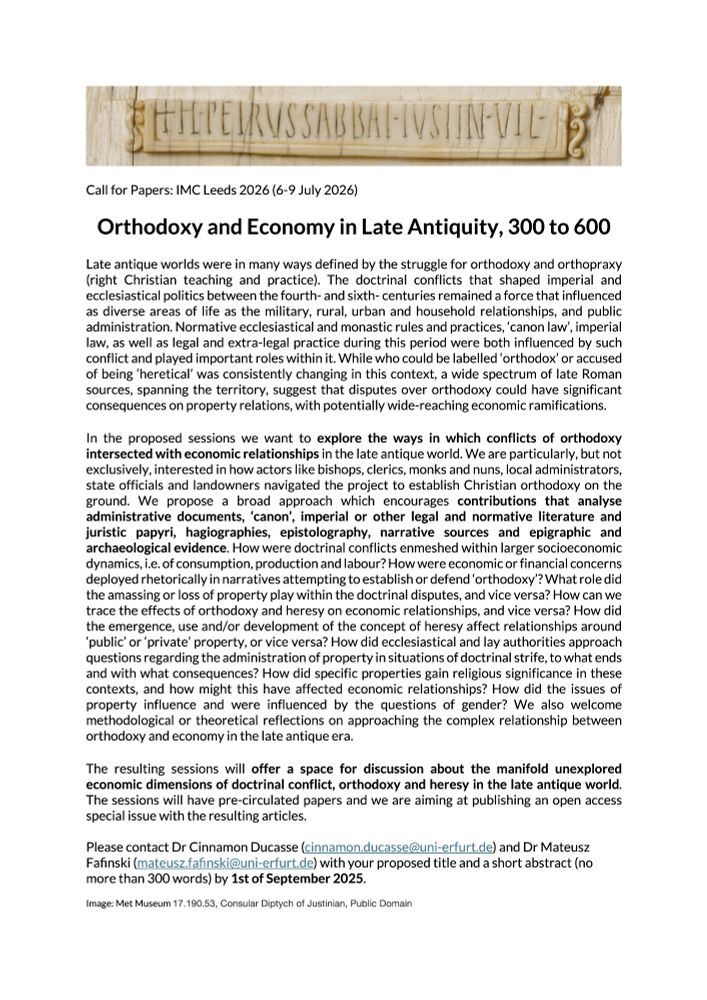
We are particularly, but not exclusively, interested in how actors like bishops, clerics, monks and nuns, local administrators, state officials and landowners navigated the project to establish Christian orthodoxy on the ground. We propose a broad approach which encourages contributions that analyse administrative documents, ‘canon’, imperial or other legal and normative literature and juristic papyri, hagiographies, epistolography, narrative sources and epigraphic and archaeological evidence. How were doctrinal conflicts enmeshed within larger socioeconomic dynamics, i.e. of consumption, production and labour? How were economic or financial concerns deployed rhetorically in narratives attempting to establish or defend ‘orthodoxy’? How did the emergence, use and/or development of the concept of heresy affect relationships around ‘public’ or ‘private’ property, or vice versa? How did ecclesiastical and lay authorities approach questions regarding the administration of property in situations of doctrinal strife, to what ends and with what consequences? How did specific properties gain religious significance in these contexts, and how might this have affected economic relationships? How did the issues of property influence and were influenced by the questions of gender? We also welcome methodological or theoretical reflections on approaching the complex relationship between orthodoxy and economy in the late antique era. The resulting sessions will offer a space for discussion about the manifold unexplored economic dimensions of doctrinal conflict, orthodoxy and heresy in the late antique world. The sessions will have pre-circulated papers and we are aiming at publishing an open access special issue with the resulting articles. Please contact Dr Cinnamon Ducasse (cinnamon.ducasse@uni-erfurt.de) and Dr Mateusz Fafinski (mateusz.fafinski@uni-erfurt.de) with your proposed title and a short abstract (no more than 300 words) by 1st of September 2025.
It is this time of the year again! We are organising @imc-leeds.bsky.social sessions on orthodoxy and economy in late antiquity for the #IMC2026! Have a look at our CfP and come and join us next year!
Do get in touch and please share widely!
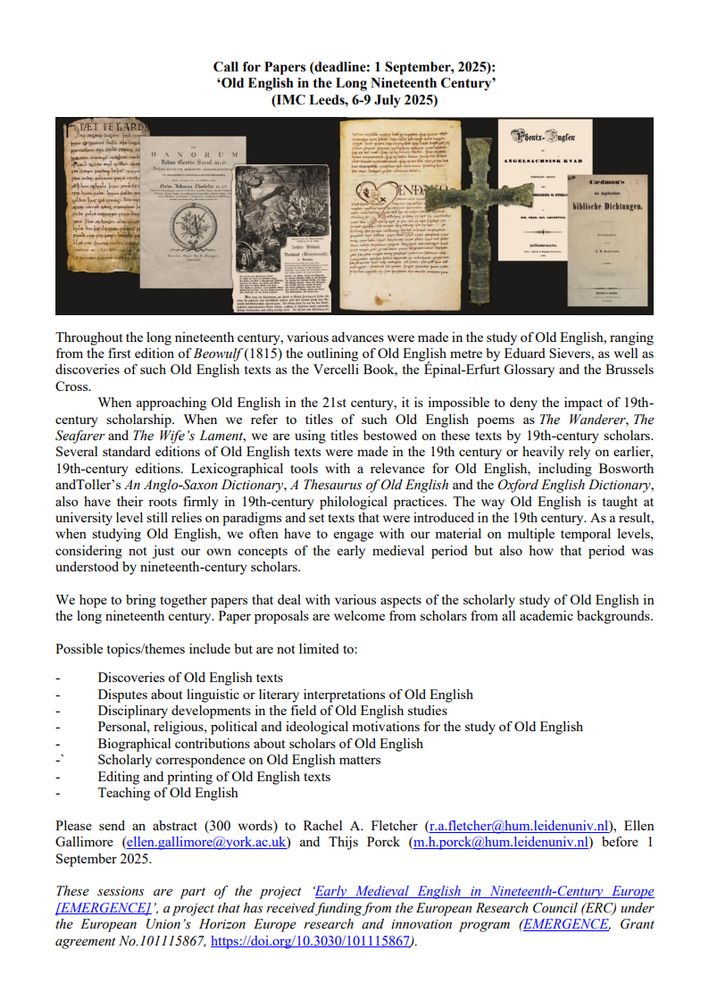
Call for papers for the 2026 Leeds IMC for "Old English in the Long 19th Century". Deadline 1 Sept. 2025. Description reads: Throughout the long 19th c., various advances were made in the study of Old English, ranging from the 1st edition of Beowulf (1815) the outlining of OE metre by Eduard Sievers, as well as discoveries of such OE texts as the Vercelli Book, the Épinal-Erfurt Glossary and the Brussels Cross. When approaching OE in the 21st c., it is impossible to deny the impact of 19th-c. scholarship. When we refer to titles of such OE poems as The Wanderer, The Seafarer and The Wife’s Lament, we are using titles bestowed on these texts by 19th-c. scholars. Several standard editions of OE texts were made in the 19th c. or heavily rely on earlier, 19th-c. editions. Lexicographical tools with a relevance for OE, including Bosworth and Toller’s An Anglo-Saxon Dictionary, A Thesaurus of Old English and the Oxford English Dictionary, also have their roots firmly in 19th-c. philological practices and how OE is taught still relies on paradigms and set texts from the 19th c. Thus, when studying OE, we often have to engage with material on multiple temporal levels, considering not just our own concepts of the early medieval period but also how that period was understood by 19th-c. scholars. Paper proposals are welcome from scholars from all academic backgrounds. Possible topics include but are not limited to: - Discoveries of OE texts - Disputes about linguistic or literary interpretations of OE - Disciplinary developments in the field of OE studies - Personal, religious, political and ideological motivations for the study of OE - Biographical contributions about scholars of OE - Scholarly correspondence on OE matters - Editing and printing of OE texts - Teaching of OE Please send an abstract (300 words) to Rachel A. Fletcher (r.a.fletcher@hum.leidenuniv.nl), Ellen Gallimore (ellen.gallimore@york.ac.uk) and Thijs Porck (m.h.porck@hum.leidenuniv.nl).
CFP for @imc-leeds.bsky.social for July 2026: "Old English in the Long Nineteenth Century". Please share widely! Deadline for abstracts 1 September 2025. #IMC2026
30.07.2025 11:05 — 👍 23 🔁 12 💬 1 📌 3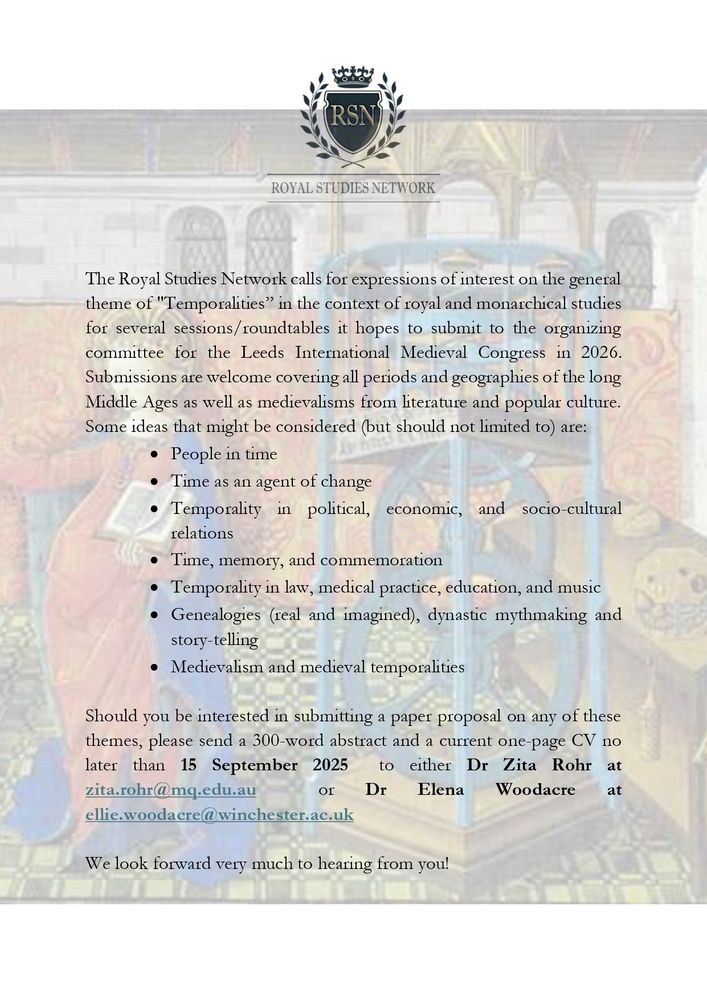
CfP related to Royal Studies for @imc-leeds.bsky.social 2026. Get your proposals in before the 25th September!
30.07.2025 12:45 — 👍 10 🔁 7 💬 0 📌 0
Call for papers for the 2026 Leeds IMC, please feel free to share widely
28.07.2025 15:59 — 👍 5 🔁 6 💬 0 📌 2
CFP: Leeds IMC 2026
The Society for Fourteenth-Century Studies invites papers on any aspect of the long 14thC across the Plantagenet estates.
📅 6–9 July 2026
📨 Title + abstract by 31 Aug 2025
✉️ Laura.Tompkins@hrp.org.uk & dgreen@harlaxton.ac.uk

Call for Papers (deadline: 1 September, 2025):
'Old English in the Long Nineteenth Century'
(IMC Leeds, 6-9 July 2026)
@imc-leeds.bsky.social

The Call for Papers for our strand on the Middle Ages in Modern Games for next year's @imc-leeds.bsky.social is now open with the conference theme of 'Temporalities'. Please circulate to any interested parties. Deadline 17 September. Text here: middleagesinmoderngames.net/announcement...
04.08.2025 14:00 — 👍 22 🔁 8 💬 0 📌 1
CfP @imc-leeds.bsky.social 2026:
New Studies in Old Norse Hagiography
Session Jointly Sponsored by the Norse Hagiography Network and the Viking Society for Northern Research
Deadline: August 24.
[Alt text in thread]

Working on early/high medieval trading places, exchange, contact? Check out our call for papers for #IMC2026 ! ⛵️
@imc-leeds.bsky.social @rmoudheden.bsky.social
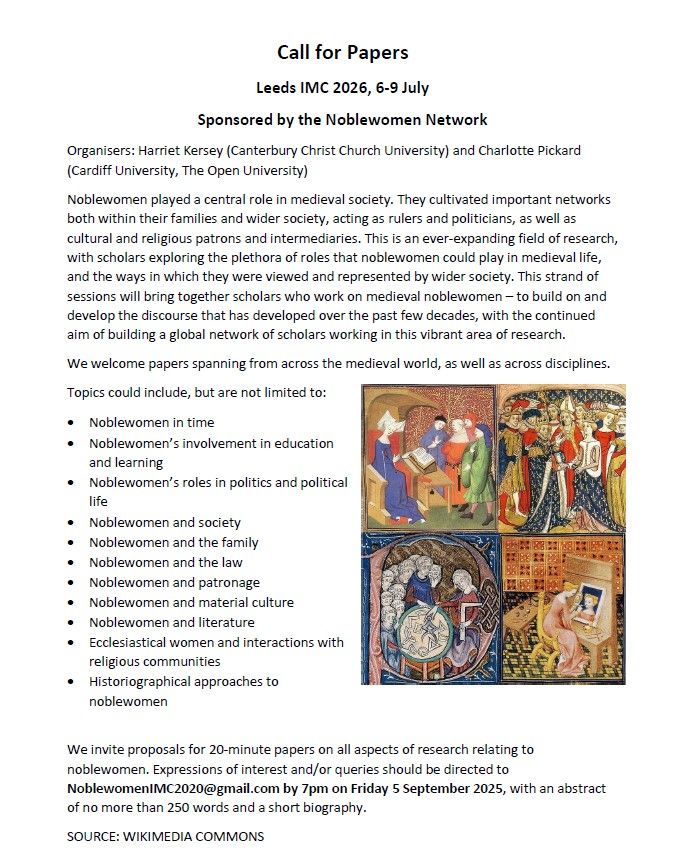
Noblewomen played a central role in medieval society. They cultivated important networks both within their families and wider society, acting as rulers and politicians, as well as cultural and religious patrons and intermediaries. This is an ever-expanding field of research, with scholars exploring the plethora of roles that noblewomen could play in medieval life, and the ways in which they were viewed and represented by wider society. This strand of sessions will bring together scholars who work on medieval noblewomen – to build on and develop the discourse that has developed over the past few decades, with the continued aim of building a global network of scholars working in this vibrant area of research. We welcome papers spanning from across the medieval world, as well as across disciplines. Topics could include, but are not limited to: Noblewomen in time; Noblewomen’s involvement in education and learning; Noblewomen’s roles in politics and political life; Noblewomen and society; Noblewomen and the family; Noblewomen and the law; Noblewomen and patronage; Noblewomen and material culture; Noblewomen and literature; Ecclesiastical women and interactions with religious communities; Historiographical approaches to noblewomen. We invite proposals for 20-minute papers on all aspects of research relating to noblewomen. Expressions of interest and/or queries should be directed to NoblewomenIMC2020@gmail.com by 7pm on Friday 5 September 2025, with an abstract of no more than 250 words and a short biography.
CfP: The Noblewomen Network @imc-leeds.bsky.social 2026. If you're working on medieval noblewomen, we'd love to hear from you! Please share widely.
Deadline for abstracts: 5 September.
#IMC2026
![Leeds IMC 2026 Call for Papers:
Things Transcending Time
This session, sponsored by the Haskins Society and the Centre for Medieval and Renaissance Research, University of Winchester, invites papers exploring objects and their relationships to, through, or against time.
Things never have one life but many, through birth, interference, additions, and even abandonment. This session seeks to understand the many ways that objects transcend time through creating it, holding or shaping it. This session also wishes to challenge the dominating hierarchy of textual studies for history (as a time and place, rather than a discipline) through objects who themselves shape or create history.
‘Object’ is broadly conceived for this session; for example, a manuscript is also an object when the research is its life as an object rather than the textual understanding of it.
Topics may include, but are certainly not limited to:
• Multiple or concurrent times understood or embedded in objects
• Objects’ authority and agency with and against time and history
• Microhistories or biographies of objects and their place(s) in time.
• Theoretical or methodological considerations of object-led histories
Papers are warmly invited from any academic field (art history, archaeology, history, etc.), and should be generally focussed on the Anglo-Norman worlds and their surrounds (broadly interpreted), ca 800-1300. Papers presented by ECRs in this session may be submitted for consideration to the Denis Bethell Prize from the Haskins Society.
Please send a 250-word abstract (including key terms) and short CV to Katherine Weikert (Katherine.weikert@winchester.ac.uk) by 15 September. Your subject line should read ‘Things Transcending Time [your surname]’, else it is liable to be missed and unread. If you have any questions, please contact Katherine Weikert.](https://cdn.bsky.app/img/feed_thumbnail/plain/did:plc:reyoejusyevgfe3jr6vl4los/bafkreihoubfcws5rg57rls2aifuh7sufnxputdevuvnhi2oymrt5gapkze@jpeg)
Leeds IMC 2026 Call for Papers: Things Transcending Time This session, sponsored by the Haskins Society and the Centre for Medieval and Renaissance Research, University of Winchester, invites papers exploring objects and their relationships to, through, or against time. Things never have one life but many, through birth, interference, additions, and even abandonment. This session seeks to understand the many ways that objects transcend time through creating it, holding or shaping it. This session also wishes to challenge the dominating hierarchy of textual studies for history (as a time and place, rather than a discipline) through objects who themselves shape or create history. ‘Object’ is broadly conceived for this session; for example, a manuscript is also an object when the research is its life as an object rather than the textual understanding of it. Topics may include, but are certainly not limited to: • Multiple or concurrent times understood or embedded in objects • Objects’ authority and agency with and against time and history • Microhistories or biographies of objects and their place(s) in time. • Theoretical or methodological considerations of object-led histories Papers are warmly invited from any academic field (art history, archaeology, history, etc.), and should be generally focussed on the Anglo-Norman worlds and their surrounds (broadly interpreted), ca 800-1300. Papers presented by ECRs in this session may be submitted for consideration to the Denis Bethell Prize from the Haskins Society. Please send a 250-word abstract (including key terms) and short CV to Katherine Weikert (Katherine.weikert@winchester.ac.uk) by 15 September. Your subject line should read ‘Things Transcending Time [your surname]’, else it is liable to be missed and unread. If you have any questions, please contact Katherine Weikert.
#cfp #imc2026 @imc-leeds.bsky.social! Please consider an abstract for 'Things Transcending Time,' sponsored by @haskinssociety.bsky.social and the Centre for Medieval and Renaissance Research, @uniwinchester.bsky.social, and organized by myself. Abstract below with full text in the alt.
04.08.2025 16:18 — 👍 28 🔁 19 💬 1 📌 3