

One of my favourite sides of politics/media.
02.03.2026 10:20 — 👍 13393 🔁 4255 💬 131 📌 174
One of my favourite sides of politics/media.
02.03.2026 10:20 — 👍 13393 🔁 4255 💬 131 📌 174
Leyendo esto que es bastante interesante:
¿Qué pasa cuando los científicos/as utilizan la inteligencia artificial para avanzar en sus teorías?
Artificial intelligence and illusions of understanding in scientific research
www.nature.com/articles/s41...
What this technology is going to do is not end higher education, but it is going to undo so much of the baseline work on accessibility by pushing overworked professors to take things back to offline modalities, in person timed exams, keeping tech out of the classroom, etc.
23.02.2026 15:46 — 👍 667 🔁 168 💬 22 📌 14
Happy birthday to one of my favourite haters, Charles Darwin
12.02.2026 16:31 — 👍 10354 🔁 3079 💬 162 📌 419Heraskevych’s choice to forfeit the medal chance instead of give up the memorial helmet is the biggest story in Ukraine today. Everyone is heartbroken but there is a unanimous consensus that this was what had to happen rather than to give up.
12.02.2026 13:41 — 👍 3058 🔁 937 💬 46 📌 61
"Model to Meaning" just received a super generous review in JASA.
Check it out! (I'm blushing 😊)
Reminder: You can get the paper copy from CRC, and the full **free** version will remain online forever at marginaleffects.com
www.tandfonline.com/doi/full/10....

It must be very hard to publish null results Publication practices in the social sciences act as a filter that favors statistically significant results over null findings. While the problem of selection on significance (SoS) is well-known in theory, it has been difficult to measure its scope empirically, and it has been challenging to determine how selection varies across contexts. In this article, we use large language models to extract granular and validated data on about 100,000 articles published in over 150 political science journals from 2010 to 2024. We show that fewer than 2% of articles that rely on statistical methods report null-only findings in their abstracts, while over 90% of papers highlight significant results. To put these findings in perspective, we develop and calibrate a simple model of publication bias. Across a range of plausible assumptions, we find that statistically significant results are estimated to be one to two orders of magnitude more likely to enter the published record than null results. Leveraging metadata extracted from individual articles, we show that the pattern of strong SoS holds across subfields, journals, methods, and time periods. However, a few factors such as pre-registration and randomized experiments correlate with greater acceptance of null results. We conclude by discussing implications for the field and the potential of our new dataset for investigating other questions about political science.
I have a new paper. We look at ~all stats articles in political science post-2010 & show that 94% have abstracts that claim to reject a null. Only 2% present only null results. This is hard to explain unless the research process has a filter that only lets rejections through.
11.02.2026 17:00 — 👍 642 🔁 223 💬 30 📌 51A few years ago, I was on a commission here in the Max Planck Society that tried to motivate the society to stop wasting millions of Euros on Microsoft licenses for bad calendar and email software. That and Elsevier subscriptions are just wasteful use of public funds imo. >
11.02.2026 07:44 — 👍 74 🔁 11 💬 6 📌 1This looks super awesome! Any chance it would work with AMD GPUs? Asking for a friend...
11.02.2026 16:02 — 👍 0 🔁 0 💬 1 📌 0
cuplyr version 0.1.0 is now out!
A GPU-accelerated dplyr backend for R, powered by RAPIDS cuDF.
Write familiar tidyverse code, execute on GPU. Lazy eval with AST optimization.
In my benchmarks 60x faster than dplyr on 50M rows.
github.com/bbtheo/cuplyr
#rstats #cuda #DataScience

I was going to ask someone to remind me of the magic "resize quarto figures interactively, then insert the figure size parameters back into the quarto document" plug-in; I managed to find it, so here it is again for anyone who didn't hear about it the first time: github.com/EmilHvitfeld...
02.02.2026 23:11 — 👍 20 🔁 4 💬 1 📌 1
Mean life satisfaction in the survey years 2010, 2015 and 2023, separately for female and male gender. In general, girls have lower scores but in 2023, they are drifting even further down

The city of Leipzig in Germany conducts large-scale school surveys of adolescents in secondary education schools. Following the regular surveys in 2010 and 2015, the 2020 survey had to be rescheduled to 2023 due to the COVID-19 pandemic. In this latest survey wave, the gender gap in general life satisfaction has significantly grown. While in 2010 and 2015 girls were somewhat less satisfied than boys (0.26 to 0.33 SD), in 2023 this gender gap had doubled (with girls 0.57 SD less satisfied). Why? Here, we probe various explanations, aiming to provide a template for researchers who are asking reverse causal questions (“What caused this?”). First, we find that the widening of the gender gap is much more pronounced among students with a migration background. This could plausibly be explained by a shift in the composition of the underlying population, with a strong increase of Syrian students, and a relative decrease of Vietnamese ones. Second, among students without a migration background, part of the increasing gender gap could potentially be attributed to survey mode: In 2023, for the first time, the survey was conducted on tablets—and unexpectedly, girls (but not boys) reported significantly lower satisfaction when surveyed on tablet rather than on paper. Third, beyond these two patterns, we still find significantly widening gender gaps in satisfaction with leisure time activities and relationships to friends. Thus, there may be a substantive increase in the gender gap in satisfaction in those two domains that is not readily attributable to changes in population and survey mode.
New preprint 🥳
The city of Leipzig conducts large-scale surveys of adolescents. In 2023, the gender gap in life satisfaction has significantly widened, with girls declining more steeply than boys. What's up with that?>
(work with @rmcelreath.bsky.social and @gregork.bsky.social)


New study shows Portugese researchers engage in questionable research practices (sometimes frequently), even though most admit these are problematic. QRPs studied are mainly related to integrity, but includes hypothesizing after results are known.
journals.plos.org/plosone/arti...
pulling this reflection on white silence/fear over here, too:
15.01.2026 16:41 — 👍 5008 🔁 2138 💬 106 📌 292
Globally, no single day in 2025 was cooler than its 1991-2020 average.
climate.copernicus.eu/global-clima...

Let me interrupt your sadscroll. I really like this song. It's nothing fancy, a familiar E minor progression (Em Bm A Em C) for the most part. But the voicing and layering is really satisfying somehow. www.youtube.com/watch?v=ys-7...
13.01.2026 13:55 — 👍 23 🔁 1 💬 2 📌 0

Can you guess what happened when South Africa unexpectedly banned alcohol sales nationwide for 5 weeks in 2020?
…
…
…
Injury-induced deaths, homicides, assaults, and reported rapes all fell sharply as a direct result.
Alcohol sucks.

Great work here by @sholtodavid.bsky.social
www.thetimes.com/article/3113...

So a CBS Evening News reporter actually did a pretty solid breakdown of the ICE murder video, talking to a former agent who details all the ways Ross messed up. And yet: It didn’t air on the actual show tonight. CBS did post it to YouTube—and it has nearly 800k views already youtu.be/6ywLEESFDu0?...
09.01.2026 07:03 — 👍 4114 🔁 2123 💬 109 📌 110
Don’t know who credit image to, but
07.01.2026 05:16 — 👍 930 🔁 140 💬 25 📌 11
"If you want to know who took all of your money, it's the people with all of the money."
I keep thinking about this post and how it's one of the best, most succinct messages Democrats could use in 2026 campaigns.

What a fantastic video: www.youtube.com/watch?v=MiUH...
Such a beautiful tale of persistence against all odds. The most important take for me is that science needs time! Oh, and very smart and well trained people in pursuit of mad ideas. #Slowscience
Yes! Sorry, you are right. Would love to have access to the data collected to see how the raw data looks like. Can't see anything in the paper about data availability.
02.01.2026 15:08 — 👍 0 🔁 0 💬 0 📌 0
This is the paper: docs.iza.org/dp18338.pdf
It seems a bit shaky at first glance (see results table, where the full model is p = .066). But would love to read experts comments assessing the paper!
This is everything good in the world
30.12.2025 03:11 — 👍 213 🔁 55 💬 3 📌 2
Book cover for Reproducible Code guide. The cover has a red background with a large yellow-bodied black-headed stag beetle.
Excited to launch the new improved Reproducible Code guide from @britishecologicalsociety.org @methodsinecoevol.bsky.social FREE online here! www.britishecologicalsociety.org//wp-content/... Amazing work by some very talented ECRs. We hope it’s useful!
16.12.2025 15:03 — 👍 315 🔁 198 💬 6 📌 9
Bar graph showing zonal mean surface air temperature anomalies for the period of November 2025. All latitude bands observed above average temperature anomalies.
Last month showed more unusual warmth across the #Arctic, where the extent, thickness, and volume of sea ice also recently set new record lows. Not ideal...
Plot shows zonal-mean temperature anomalies, where latitude = y-axis (not scaled by distance). GISTEMPv4 data using their 1951-1980 baseline.


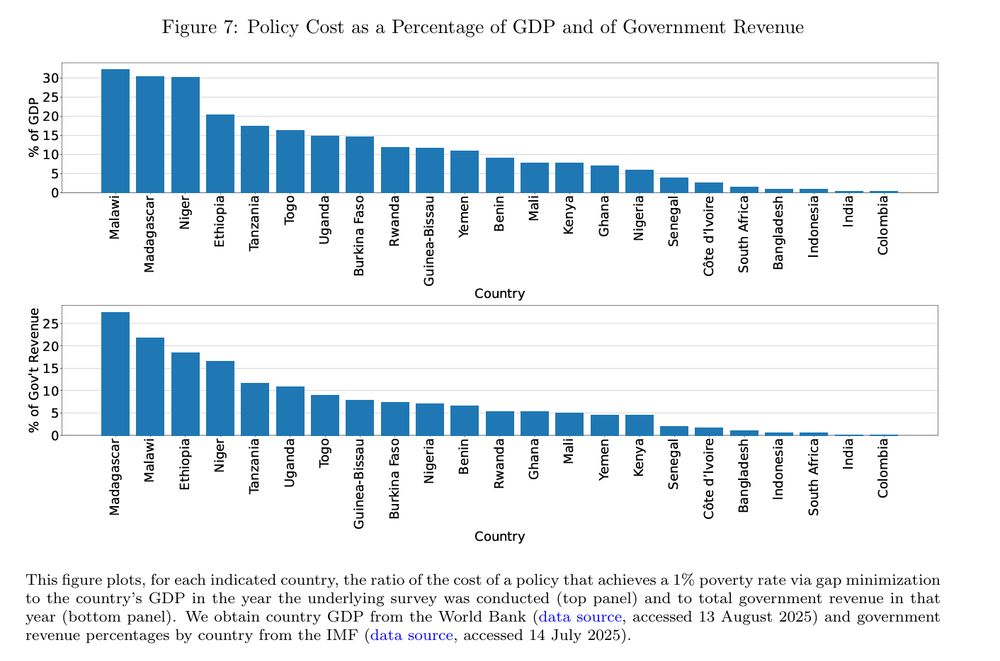
What would it cost to end extreme poverty?
"We estimate that reducing the poverty rate to 1% ... would cost $170B nominal per year."
"The results correspond to a cost of (approximately) ending extreme poverty of roughly 0.3% of global GDP."
First time I've come across Anna's Archive, and only because of this news about scraping and backing up Spotify metadata and music files.
It's an #opensource search engine for shadow libraries, aggregating records from Z-Library, Sci-Hub, LibGen, and others. 👀

Bias Detection Tool es una herramienta diseñada para identificar grupos de personas que pueden ser tratados injustamente por los sistemas de IA, utilizando métodos estadísticos de aprendizaje no supervisado como el clustering algorithmaudit.eu/technical-to...
#AIEthics
