

I can't* fathom why the top picture, and not the bottom picture, is the standard diagram for an autoencoder.
The whole idea of an autoencoder is that you complete a round trip and seek cycle consistency—why lay out the network linearly?
I can't* fathom why the top picture, and not the bottom picture, is the standard diagram for an autoencoder.
The whole idea of an autoencoder is that you complete a round trip and seek cycle consistency—why lay out the network linearly?
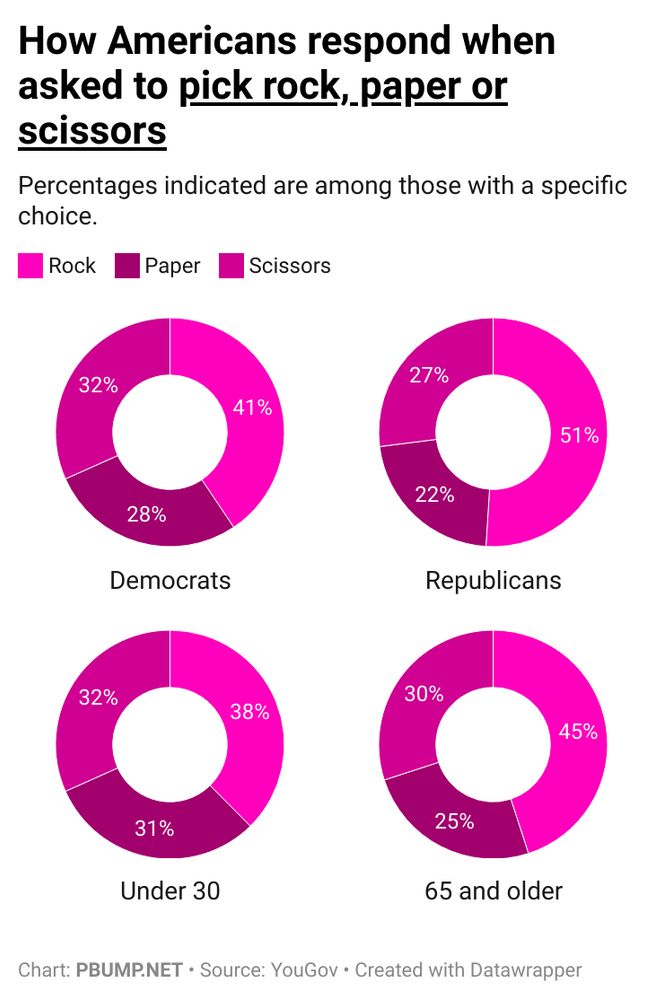
If you're playing rock, paper, scissors against a Republican, pick paper. www.pbump.net/o/how-to-win...
14.08.2025 18:33 — 👍 593 🔁 104 💬 52 📌 99
After 3 1/2 years of work my course on quantum computing is finally finished — the "Director's Cut" of Understanding Quantum Information and Computation is now available.
arxiv.org/abs/2507.11536
Jensen's inequality gives the difference between the average value of a convex function φ, and its value at the center, where both “average” and “center” are defined in terms of some distribution p_X.
When the function φ is flat, or the distribution is narrow, they agree.
Overfitting is among the conceptually most interesting problems in machine learning.
I am happy of several new phenomena we began to understand with Pierfrancesco Urbani.
Alert: mostly non-rigorous! (Celebrating Jorge Kurchan)
web.stanford.edu/~montanar/OT...
bsky.app/profile/stei...
26.04.2025 20:03 — 👍 2 🔁 1 💬 1 📌 0
We’re proud to share that 46 members have been elected as 2025 ASA Fellows! This honor recognizes contributions to research, education, industry, government, and service to ASA and the broader statistical community. Congrats to this year’s class of Fellows! www.amstat.org/news-listing...
22.04.2025 12:28 — 👍 12 🔁 1 💬 0 📌 3
#statsmeme
22.04.2025 06:42 — 👍 277 🔁 55 💬 1 📌 5
In the Notices of the AMS: "Selected Results from the Mathematical Conventions Survey." Is 0 a natural number? Does ⊂ mean subset or proper subset? Is f(x)=3 an increasing function? Is f(x)=3x+1 a linear function?
www.ams.org/journals/not...

Research briefing: A quantum microsatellite that has been developed and launched can perform space-to-ground quantum communication using portable ground stations.
https://go.nature.com/41Bzouc

oh cool news in the red there!
09.03.2025 19:37 — 👍 73 🔁 12 💬 2 📌 0
e^n = sum of n^k/k!, for k =0 to n. Since each summand is positive, the sum is lower bounded by its n-th term, which is n^n/n!. So e^n is greater than n^n/n!, and reorganizing the inequality gives the result.
You may have seen the handy inequality n! ≥ (n/e)ⁿ.
I didn't know its proof, at least not this short, beautiful one. It's so elegant.
Equality is also on the list…🤷🏻♂️
04.02.2025 04:01 — 👍 0 🔁 0 💬 0 📌 0
It’s by no means something they had to do! The American Physical Society has kept their DEI pages up. I think I might write them an email to thank them
www.aps.org/initiatives/...
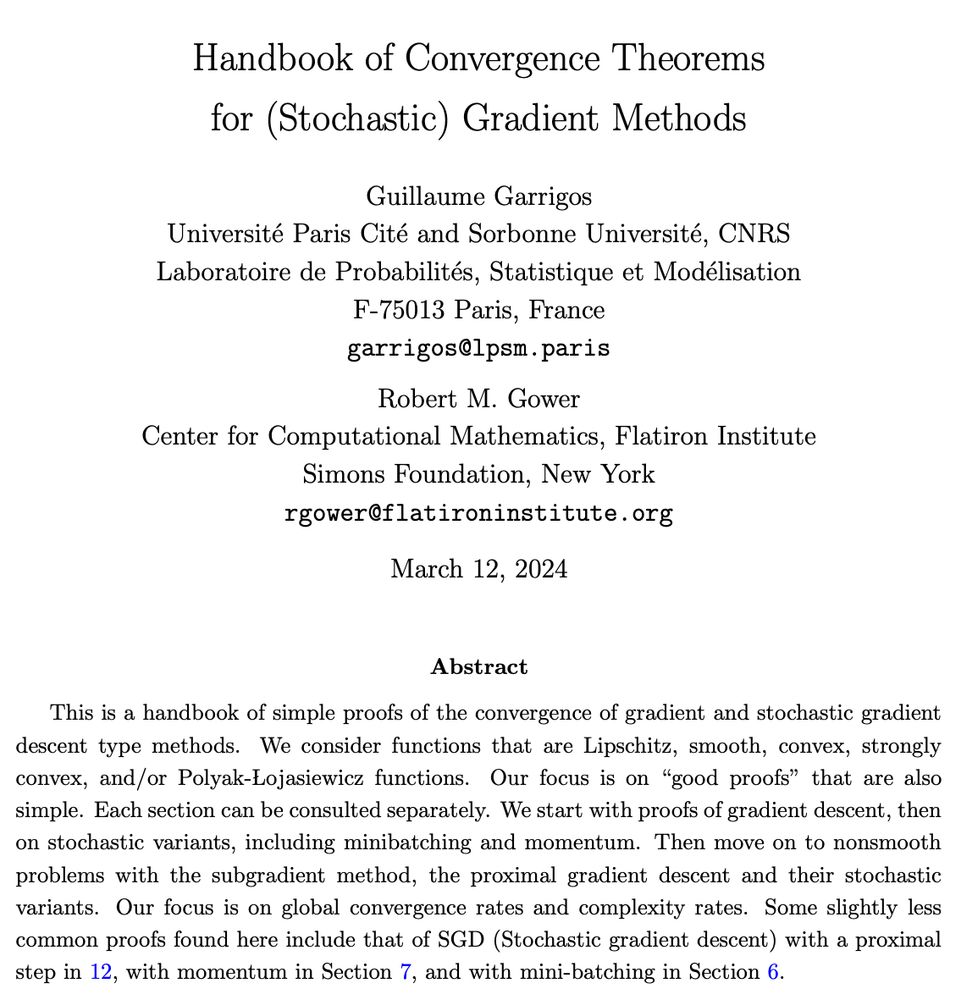
This review paper by @guillaume-garrigos.com on SGD-related algorithms is a fantastic resource, offering elegant, self-contained, and concise proofs in a single, accessible reference. arxiv.org/pdf/2301.11235
29.01.2025 16:15 — 👍 189 🔁 39 💬 1 📌 0I meant the final grade is a number rather than a letter. Anything in between 85-100, or 90-100, or 93-100, whatever, is an A, but 95 is not equal to 96, 97, 98, 99, 100. Granularity helps.
19.01.2025 17:17 — 👍 0 🔁 0 💬 0 📌 0Grading on a 0–100 scale partially mitigates the problem
19.01.2025 16:02 — 👍 0 🔁 0 💬 0 📌 0And waiting to be optimized after turning 35
15.01.2025 18:58 — 👍 0 🔁 0 💬 0 📌 0
Bravo to 1st-year undergraduate Tyler Yang at CMU, who was the first person to write up and make videos for all* 100 exercises in my "Quantum Computer Programming in 100 Easy Lessons" series! (www.youtube.com/watch?v=XtDJ...)
*more or less all
I still recall this one as my high school homework problem :)
07.01.2025 04:43 — 👍 1 🔁 0 💬 0 📌 0
Bar graph showing cs.CV, cs.LG, cs.CL, quant-ph, cs.RO are the top 5 categories and they have grown 27%, 23%, 43%, 16%, and 33% in 2024 over 2023. Other high-growth categories include cs.AI (48%), cs.CR (34%), cs.HC (56%), cs.SE (38%), cs.IR (31%) and cs.CY (48%). cs.CV had about 24000 submissions in 2024
ArXiv continues to grow. Here is the year-on-year comparison for the categories with 1000+ submissions. Overall, 17% growth in submissions from 2023 to 2024 (208,493 -> 244,031)
06.01.2025 04:21 — 👍 43 🔁 8 💬 1 📌 1Humans vs Ants: Problem-solving Skills
25.12.2024 17:12 — 👍 118 🔁 34 💬 9 📌 6The set of ways to learn linear algebra is convex
24.12.2024 17:57 — 👍 51 🔁 9 💬 1 📌 0
ALT 2025: list of accepted papers. Congratulations to the authors !
openreview.net/group?id=alg...
Is life fair? Short answer: no. Long answer: noooooooooo.
15.12.2024 23:09 — 👍 940 🔁 117 💬 18 📌 8
The slides of my NeurIPS lecture "From Diffusion Models to Schrödinger Bridges - Generative Modeling meets Optimal Transport" can be found here
drive.google.com/file/d/1eLa3...

In case you missed my awesome post doc Arthur da Cunha's Oral Presentation of our "Optimal Parallelization of Boosting" at #NeurIPS2024, I recorded a (slightly extended) version here.
youtu.be/BGZJMwhQc4U

If at NeurIPS on Friday, consider stopping by Eren Sasoglu's poster on 'Scaling laws for learning with real and surrogate data' arxiv.org/abs/2402.04376
Often training on a mixture of data from the target distribution and from a surrogate distribution yields better models than training on either.

I'm pleased to share that our recent paper with @2ptmvd has been accepted to the Philoshophical Transactions of the Royal Society. Here's the ‘Accepted Author Version’:
drive.google.com/file/d/1jdtr...
And here it is on arxiv without the fancy formatting:
arxiv.org/abs/2409.06219
1/3

How are Kernel Smoothing in statistics, Data-Adaptive Filters in image processing, and Attention in Machine Learning related?
My goal is not to argue who should get credit for what, but to show a progression of closely related ideas over time and across neighboring fields.
1/n

