The oldest UK Black-tailed Godwit will be 30 when (if?) it returns from Iceland at the end of the 2026 breeding season. It's a colour-ringed bird that is seen regulalrly, quite often by observers that were born several years after it was ringed.
06.03.2026 14:57 —
👍 1
🔁 0
💬 0
📌 0
For comparison, the longevity record for BTO (Ireland and UK) Common Ringed Plover is 21y 10m 12d (from ringing to latest report).
More longevity-records here:
wadertales.wordpress.com/2018/01/16/w...
@btobirds.bsky.social
#ornithology
06.03.2026 10:54 —
👍 16
🔁 3
💬 3
📌 1
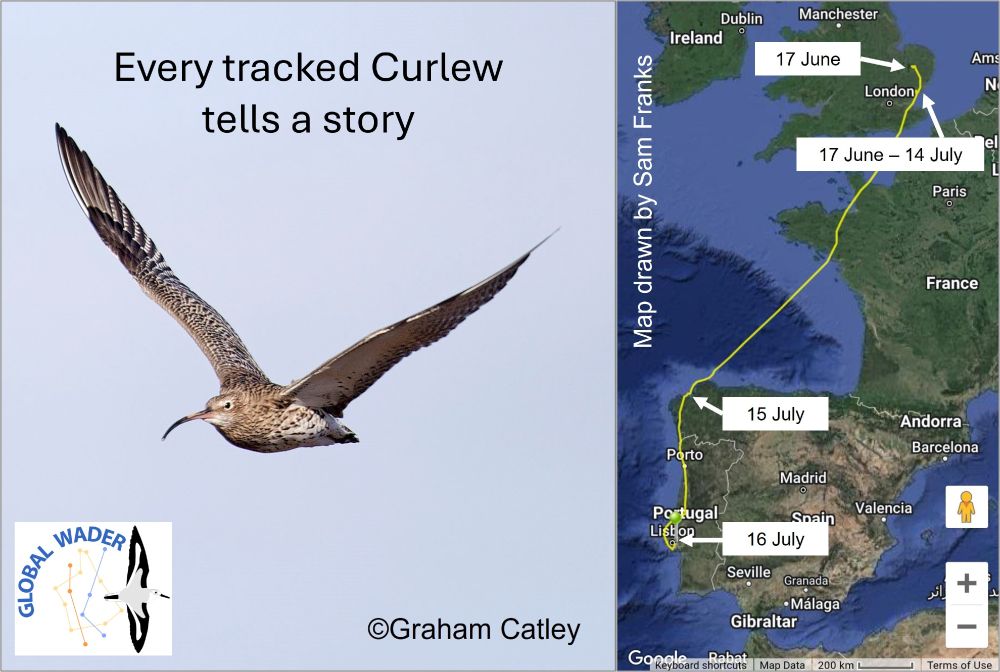
Do you have tracking data for waders?
You can help new "Global Relevance of Protected Areas" project:
www.globalwader.org/collaboratio...
To learn more about how shorebird tracking is aiding conservation, check out this blog:
wadertales.wordpress.com/2025/05/06/m...
#ConservationScience🌍
06.03.2026 10:09 —
👍 1
🔁 2
💬 0
📌 0

Hi Darren. Yes - waders do 'egg dump'. The different one in the picture is a dummy egg, used to increase clutch size in this study. Here's an Icelandic Ringed Plover nest with five real eggs. More in the blog.
06.03.2026 07:55 —
👍 0
🔁 0
💬 1
📌 0

Four eggs ✅
Five eggs ❌
Chicks from five-egg Ringed Plover nests are far less successful.
wadertales.wordpress.com/2026/03/06/f...
WaderTales blog #156
#ornithology
06.03.2026 07:18 —
👍 7
🔁 0
💬 2
📌 0

Redshank chick
Curlew v Forestry
Relevant WaderTales blogs.
Estonia
wadertales.wordpress.com/2022/03/16/k...
Iceland
wadertales.wordpress.com/2022/06/18/i...
Scottish peatlands
wadertales.wordpress.com/2020/06/19/t...
Recreating wader habitat
wadertales.wordpress.com/2025/08/16/p...
#ornithology
08.02.2026 09:14 —
👍 12
🔁 6
💬 1
📌 0

Greenshanks will soon be returning to Scottish breeding sites.
Unlike their cousins that breed in eastern Russia, they won't have flown far.
Research by Highland Ringing Group, supported with £ from @scottishbirding.bsky.social.
wadertales.wordpress.com/2020/03/23/m...
#BirdingScotland
11.02.2026 07:09 —
👍 30
🔁 8
💬 0
📌 0

Which Oystercatchers stay in Iceland, and deal with short days and much colder temperatures, and which ones cross the Atlantic?
wadertales.wordpress.com/2020/02/21/w... 🎂6️⃣
Thanks to colour-ring readers!
#ornithology
p.s. update from 2021
wadertales.wordpress.com/2021/02/02/o...
Verónica Méndez et al
21.02.2026 06:35 —
👍 14
🔁 4
💬 1
📌 0

We met up with LG-YE, one of the ProjectGodwit Black-tailed Godwits, in Portugal last week (not in photo 👇).
It will soon be back in the Nene or Welney Washes.
There were 50,000 godwits in the Tagus rice fields!
More here:
wadertales.wordpress.com/2020/03/04/b... 🎂6️⃣
#ornithology
04.03.2026 13:29 —
👍 15
🔁 1
💬 1
📌 0

Waders rely on networks of migrations sites.
Blog about important paper by Martin Beal (@amigodeaves.bsky.social) that combines ringing, colour-ringing and tracking data for Black-tailed Godwits.
wadertales.wordpress.com/2025/01/09/h...
Good to finally meet Martin last week!
#ConservationScience🌍
04.03.2026 06:33 —
👍 12
🔁 4
💬 1
📌 0

10 years ago, Mary Colwell started a 500 mile walk across Ireland & UK in support of Curlews.
"I liked something about the way Curlew lived in the world, sang to the world, and drifted through the world with a light touch."
Blog about her book:
wadertales.wordpress.com/2018/04/29/c...
#ornithology
03.03.2026 08:19 —
👍 23
🔁 5
💬 0
📌 0

Ireland's Curlew Crisis
WaderTales blog from 1 March 2019
wadertales.wordpress.com/2019/03/01/i...
Still a crisis, sadly.
#ornithology
01.03.2026 20:48 —
👍 12
🔁 5
💬 0
📌 0

Why do advances in timing of breeding occur more in short-distance migrants? Latest wadertales blog: wadertales.wordpress.com/2026/02/28/m...
on our new @ecol-evol.bsky.social paper about Icelandic waders: onlinelibrary.wiley.com/doi/full/10....
#ornithology
02.03.2026 08:26 —
👍 15
🔁 5
💬 0
📌 0
There is also a wadertales blog about this paper: wadertales.wordpress.com/2025/12/02/r...
02.03.2026 14:23 —
👍 5
🔁 3
💬 0
📌 0

Waders in a changing climate?
New WaderTales blog:
wadertales.wordpress.com/2026/02/28/m...
To coincide with paper published on Saturday:
onlinelibrary.wiley.com/doi/full/10....
#Iceland
#ConservationScience🌍
02.03.2026 07:10 —
👍 7
🔁 5
💬 0
📌 0
Ireland's Curlew Crisis
WaderTales blog from 1 March 2019
wadertales.wordpress.com/2019/03/01/i...
Still a crisis, sadly.
#ornithology
01.03.2026 20:48 —
👍 12
🔁 5
💬 0
📌 0

Why do chicks squeak?
Quirky blog from 1 March 2022:
wadertales.wordpress.com/2022/03/01/c... 🎂4️⃣
Research by Kristal Kostoglou and colleagues
#ornithology
01.03.2026 20:39 —
👍 8
🔁 1
💬 0
📌 0

Can all waders take advantage of Iceland's warmer springs?
Blog:
wadertales.wordpress.com/2026/02/28/m...
Paper by Verónica Méndez et al:
onlinelibrary.wiley.com/doi/full/10....
#climatechange
01.03.2026 07:46 —
👍 11
🔁 1
💬 1
📌 0

Latest Wadertales blog on why timing of breeding advances more in short-distance migrants: wadertales.wordpress.com/2026/02/28/m..., from neat new @ecol-evol.bsky.social paper led by Verónica Méndez using 16 years of data on Icelandic waders: onlinelibrary.wiley.com/doi/full/10....
#ornithology
28.02.2026 09:58 —
👍 12
🔁 9
💬 0
📌 0

It pays not to migrate too far!
Waders that winter close to Iceland have more flexibility to take advantage of warm conditions.
Blog:
wadertales.wordpress.com/2026/02/28/m...
Paper by Verónica Méndez et al:
onlinelibrary.wiley.com/doi/full/10....
#ornithology
28.02.2026 09:42 —
👍 21
🔁 4
💬 0
📌 1

Will this spring be wet enough for a Great Snipe?
Recent paper from Poland:
www.sciencedirect.com/science/arti...
Blog about these AMAZING high-flying migrants:
wadertales.wordpress.com/2021/06/30/f...
#ornithology
27.02.2026 07:27 —
👍 11
🔁 3
💬 0
📌 0

Composite image - a feeding flock of Icelandic Black-tailed Godwits and image of front page of new blog.
Social learning in Black-tailed Godwits - where to find food?
Summary of new paper in @asab.org journal by Josh Nightingale is summarised in this blog:
wadertales.wordpress.com/2026/02/05/l...
Paper:
www.sciencedirect.com/science/arti...
#ConservationScience🌍
05.02.2026 13:40 —
👍 13
🔁 8
💬 0
📌 0
Spring migration thread 👇
Focus on waders in the UK.
#birds
27.02.2026 07:10 —
👍 7
🔁 3
💬 0
📌 0

Are you ready for spring?
The first Oystercatchers are crossing the Atlantic, Black-tailed Godwits are heading north, Scottish Greenshanks are moving onto territories - and so much more!
Quick summary of wader migration:
wadertales.wordpress.com/2017/07/20/w...
#ornithology
26.02.2026 19:18 —
👍 24
🔁 6
💬 0
📌 1

Stone-curlews are returning to East Anglian pig fields.
What other habitats are important and how can they be created?
wadertales.wordpress.com/2021/02/26/g... 🎂5️⃣
Paper by Rob Hawkes et al
#ornithology
26.02.2026 06:54 —
👍 24
🔁 3
💬 0
📌 0

There are only about 100 Black-tailed Godwits breeding in England.
Many of these 'limosa' birds have been to Africa for the winter.
More here:
wadertales.wordpress.com/2020/03/04/b...
#ornithology
25.02.2026 19:17 —
👍 27
🔁 6
💬 0
📌 0

On this day six years ago, I was writing about Foxes and Curlew in East Anglia ... and sheep too:
wadertales.wordpress.com/2020/02/24/c...
Research by @natbzielonka.bsky.social and colleagues
#ornithology
24.02.2026 06:51 —
👍 7
🔁 3
💬 0
📌 0