
Excited to share my first PhD paper with @ashenhav.bsky.social
@shenhavlab.bsky.social
“Rejection-based choices discourage people from opting out of voting.”
www.nature.com/articles/s41...

@barbaraoberbauer.bsky.social
PhD student @cmdn-lab.bsky.social (PI: @sgluth.bsky.social) at the University of Hamburg modeling dietary and sustainable decision-making - ScieCom enthusiast - all about soccer, rowing, and books 📚 Github: https://github.com/barbaraoberbauer
Excited to share my first PhD paper with @ashenhav.bsky.social
@shenhavlab.bsky.social
“Rejection-based choices discourage people from opting out of voting.”
www.nature.com/articles/s41...
Is your lab doing code reviews? I'd like to hear about your experiences and practices!
In our teams, we'd like to establish internal peer-reviews of our research software. Our focus is on the correctness of our "one-off" analysis scripts underlying manuscripts. Because of that, the usual […]
I had such a great time on this episode! 🤩
I really enjoyed taking the explore-exploit trade-off beyond theory and discussing its relevance for athletes, coaches, and performance in real sport settings. 🏀🏌️♀️🏃♀️
Thanks so much for having me @danabrahamspsych.bsky.social

New episode of The Sport Psych Show! On this week's episode "Exploit or Explore: Decision Making in Sport" I speak with University of Hamburg PhD student Katja Rewitz. Katja's research focuses on human sensations and their influence on decision-making and performance behaviour
16.02.2026 16:04 — 👍 3 🔁 3 💬 0 📌 1
🎉 New paper in Nature Communications 🎉
rdcu.be/e24jT
Does our environment influence how likely we are to help others?

ME/CFS In der neuen Staffel MAITHINK X werden wir über ME/CFS sprechen. Dafür suchen wir Betroffene oder auch Angehörige von Betroffenen, die mit uns über ihren Alltag und Schwierigkeiten sprechen wollen. Schickt uns einfach eine DM. Dazu ein Bild von Mai Thi Nguyen-Kim, die auf den Text zeigt.
Wir zeichnen ganz bald die neue Staffel MAITHINK X für euch auf und wollen dieses Mal über das sehr wichtige Thema ME/CFS sprechen. Hier ein Aufruf, dem ihr gerne folgen könnt, wenn ihr das mögt. Oder markiert einfach Personen, von denen ihr wisst, dass sie etwas dazu zu sagen haben. Danke euch! 🙏
05.01.2026 13:16 — 👍 1322 🔁 776 💬 100 📌 22
Inspiring talk at our research colloquium yesterday! 🧠
Using very cool games (🦀🎰🐷🃏),
@sebraem.bsky.social showed when and how individuals flexibly adapt their learning across different environments.
We enjoyed a day packed of valuable discussions and delicious food!

article cover page and abstract
New article in Cognitive Psychology with @thorstenpachur.bsky.social and Veronika Zilker: “How sampling strategies shape experience-based risky choice.”
We present a computational framework for information search and choice in decisions from experience. 1/4
doi.org/10.1016/j.co...
A "Nutri-Score", but for the lab 😁
We uploaded a preprint with our thoughts on optimal lab technology for complex questions. We hope it's as much fun to read as was writing it:
Wolff, W., Gluth, S., & Keyser, J. (2025, December 6). Considerations for setting up an S-tier behavioral and brain […]

Very happy to see this out now in Psychology of Sport & Exercise 🤓
If you’re interested in how the explore–exploit framework helps us study decision-making in sports and exercise, check it out!
w/ @nicoschuck.bsky.social & @wanjawolff.bsky.social
www.sciencedirect.com/science/arti...

Excited to share that the main work of my PhD has been published!
We found that having control over pain makes expectations more precise, and changes pain perception. This is accompanied by activation changes in the PAG, SMA and ACC.
You can read the full version of the paper here: rdcu.be/eQy6X
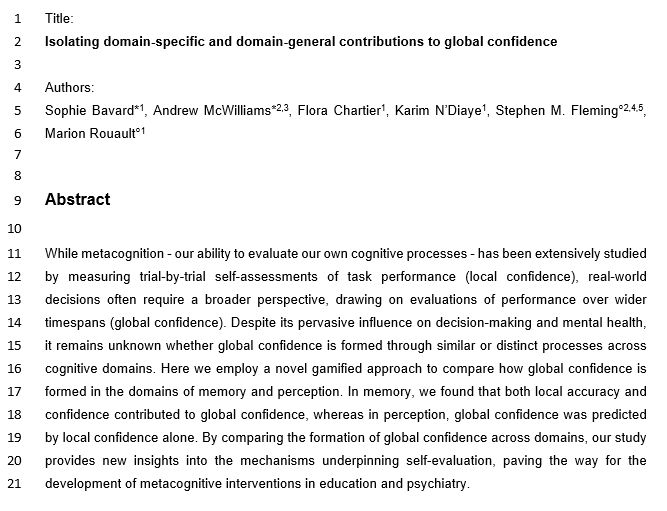
🚨 New preprint! 🚨
Very happy to share our latest work on metacognition with M. Rouault, A. McWilliams, F. Chartier, @kndiaye.bsky.social and @smfleming.bsky.social where we identify contributors to self-performance estimates across memory and perception domains 👇
osf.io/preprints/ps...
Feeling *gitty* about this fall with two exciting workshops on Version Control with Git for Scientists coming up @mpib-berlin.bsky.social and @rtg2660.bsky.social @uni-wuerzburg.de! ✨
Sounds interesting? Check out my website, where I share course materials: lennartwittkuhn.com 💫
#OpenScience #Git
Taken together, we provide novel insights into how attribute translations lead to behavior change and how behaviorally effective translations in the form of ratings differ from less effective numeric translations.
11.09.2025 05:30 — 👍 0 🔁 0 💬 0 📌 0
For all who use Bayesian hierarchical models, have a look at our new preprint, out now together with @linushof.bsky.social @nunobusch.bsky.social and @thorstenpachur.bsky.social
osf.io/preprints/ps...

In contrast, we found only response deliberation to increase for behaviorally less effective numeric translations (carbon emissions in kg).
08.09.2025 07:32 — 👍 1 🔁 1 💬 1 📌 0
Our modeling results suggest that a translation in form of an evaluative rating caused participants to make more ecological choices as a result of a shift in attribute weights in favor of the translated attribute, a decreased attentional bias on the attended option, and increased deliberation.
08.09.2025 07:32 — 👍 1 🔁 1 💬 1 📌 0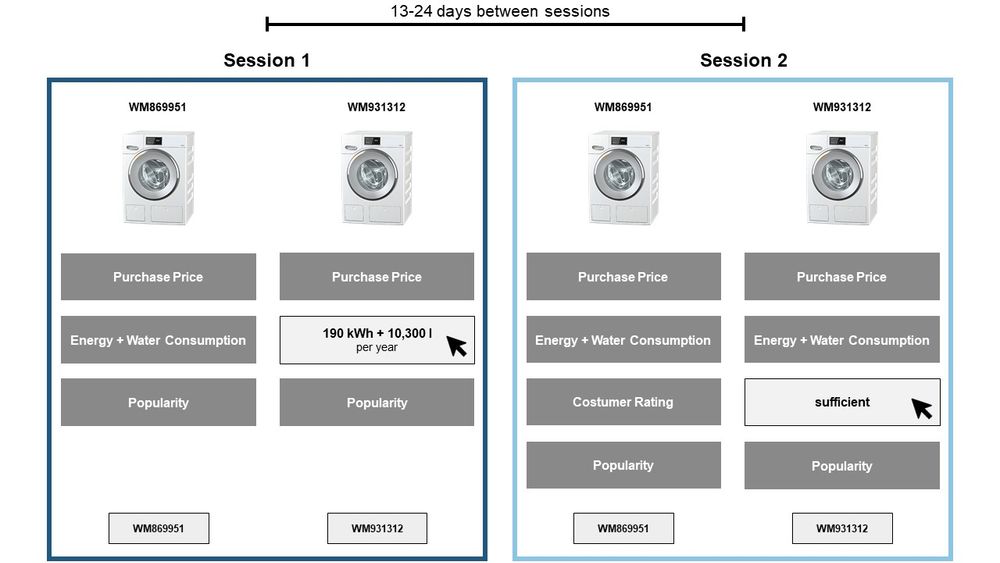
To fill this gap, we model the interplay of attention and evidence accumulation using the maaDDM for a pre-existing data set from an online process tracing study in which participants completed a consumer choice task w/ and w/o the translation of the items' energy and water consumption.
08.09.2025 07:32 — 👍 0 🔁 0 💬 1 📌 0Attribute translations promote behavior change by translating decision-relevant information into more meaningful units and have been widely adopted by policy makers (e.g., EU energy label). However, little is known about the computational mechanisms that underlie their effects on behavior.
08.09.2025 07:32 — 👍 1 🔁 1 💬 1 📌 0
Excited to share joint work with Ulf Hahnel and @sgluth.bsky.social on investigating how attribute translations - a widely implemented behavior intervention - lead to more ecological consumer choices. Main results are below, but check out our preprint 👇
www.researchsquare.com/article/rs-7...
Our modeling results suggest that a translation in form of an evaluative rating caused participants to make more ecological choices as a result of a shift in attribute weights in favor of the translated attribute, a decreased attentional bias on the attended option, and increased deliberation.
08.09.2025 07:24 — 👍 0 🔁 0 💬 0 📌 0
To fill this gap, we model the interplay of attention and evidence accumulation using the maaDDM for a pre-existing data set from an online process tracing study in which participants completed a consumer choice task w/ and w/o the translation of the items' energy and water consumption.
08.09.2025 07:24 — 👍 0 🔁 0 💬 1 📌 0Attribute translations promote behavior change by translating decision-relevant information into more meaningful units and have been widely adopted by policy makers (e.g., EU energy label). However, little is known about the computational mechanisms that underlie their effects on behavior.
08.09.2025 07:24 — 👍 0 🔁 0 💬 1 📌 0