Interestingly, this work achieves arbitrary-weight Dicke states in QAC^0_f, but only constant-weight Dicke states in QAC^0. Thus, a QAC^0 lower-bound against any ω(1)-weight Dicke state would separate QAC^0 and QAC^0_f, resolving a major open question in quantum complexity.
16.01.2026 03:47 — 👍 1 🔁 0 💬 0 📌 0
For architectures (e.g. trapped ions) with access to global FAN-OUT gates, we offer poly-ancillae QAC^0_f circuits for exact preparation of arbitrary-weight Dicke states.
16.01.2026 03:47 — 👍 0 🔁 0 💬 1 📌 0
For architectures (e.g. neutral atoms) with access to global CZ gates, we offer poly-ancillae QAC^0 circuits for exact preparation of constant-weight Dicke states. We also show that weight-1 Dicke states, i.e. W states, can be approximated to constant-error fidelity, using only *constant* ancillae.
16.01.2026 03:47 — 👍 0 🔁 0 💬 1 📌 0
We overcome the log-depth barrier by moving beyond the standard circuit model and leveraging global interactions. In particular, we consider the constant-depth QAC^0 circuit class (arbitrary 1-QB and global CZ gates) and the QAC^0_f circuit class (arbitrary 1-QB and global FAN-OUT gates).
16.01.2026 03:47 — 👍 0 🔁 0 💬 1 📌 0
However, in the standard circuit model (restricted to constant-width gates) there are logarithmic-depth lower-bounds for unitary Dicke state preparation. Thus, all previously known constant-depth protocols for exact Dicke state prep rely on measurement and adaptive feed-forward.
16.01.2026 03:47 — 👍 0 🔁 0 💬 1 📌 0

There is a large literature on low-depth Dicke state preparation (see table) due to their prevalence in quantum physics, metrology, communication, and computation. For example, Dicke states are a main quantum resource in the recent Decoded Quantum Interferometry (DQI) algorithm.
16.01.2026 03:47 — 👍 0 🔁 0 💬 1 📌 0

Constant-Depth Unitary Preparation of Dicke States
Dicke states serve as a critical resource in quantum metrology, communication, and computation. However, unitary preparation of Dicke states is limited to logarithmic depth in standard circuit models ...
Very excited to share a new paper with Malvika Joshi (@malvikaraj.bsky.social) on "Constant-Depth Unitary Preparation of Dicke States"! In this work, we offer the first unitary, constant-depth circuits for exact preparation of arbitrary-weight Dicke states.
arXiv: arxiv.org/abs/2601.10693
16.01.2026 03:47 — 👍 5 🔁 0 💬 1 📌 0

Excitingly, the depth-3 proof introduces novel techniques for proving quantum circuit lower-bounds. We introduce a new form of quantum restrictions to simplify the circuit. We also show these QAC^0 circuits are simulable via small AC^0 circuits, enabling application of the classical Switching Lemma!
17.12.2025 19:32 — 👍 7 🔁 0 💬 0 📌 0
Additionally, we prove the first depth-3 lower-bounds for QAC^0! Specifically, we show that depth-3 QAC^0 cannot compute exact Parity with unlimited ancillae nor exact Majority with super-polynomial ancillae.
17.12.2025 19:32 — 👍 3 🔁 0 💬 1 📌 0
Our work improves upon previously known depth-2 lower bounds against Parity for QAC^0 with unlimited ancillae.
First, we prove a new structural result (via entropy-based and Fourier-analytic arguments) showing that depth-2 QAC^0 circuits with unlimited ancillae have low influence.
17.12.2025 19:32 — 👍 2 🔁 0 💬 1 📌 0
Improved Lower Bounds for QAC0
In this work, we establish the strongest known lower bounds against QAC$^0$, while allowing its full power of polynomially many ancillae and gates. Our two main results show that:
(1) Depth 3 QAC$^0...
Very excited to share a new paper with Malvika Joshi, Avishay Tal, and John Wright on “Improved Lower Bounds for QAC^0”! In this work, we prove the strongest known lower-bounds to date for QAC^0 with the full power of polynomially many ancillae.
arXiv: arxiv.org/abs/2512.14643
17.12.2025 19:32 — 👍 18 🔁 3 💬 2 📌 0
QCOW
Department of Computer Science - People: Sergii Strelchuk - QCOW
Join us for the first Quantum Cambridge–Oxford–Warwick Colloquium (Quantum COW, if you insist...), 11–12 December 2025 at the University of Oxford.
This meeting focuses on Quantum Low-Depth Complexity, with talks, tutorials, and open discussions.
Details: qcow.cs.ox.ac.uk
20.11.2025 19:46 — 👍 18 🔁 1 💬 1 📌 0
YouTube video by Institute for Robust Quantum Simulation
Francisca Vasconcelos: “Methods for Reducing Ancilla-Overhead in Block Encodings”
I was very excited to present my first research project on quantum algorithms at QSim 2025! This work, joint with András Gilyén, develops new space-time and space-accuracy tradeoffs for manipulation of block encodings, helping reduce ancilla-overhead in quantum algorithms.
youtu.be/7AaZzzoSAic?...
23.09.2025 03:06 — 👍 5 🔁 0 💬 1 📌 0
Beyond cryptographic implications, our approach yields novel average‑case learning lower bounds for QAC⁰ and suggests a new path towards proving Parity ∉ QAC⁰, a longstanding open problem in quantum complexity.
19.08.2025 00:22 — 👍 6 🔁 0 💬 0 📌 0
Namely, by considering physically motivated models of computation—such as QAC⁰ and constant-depth circuits with mid-circuit measurements—we surpass prior constructions requiring Θ(log log n) depth.
19.08.2025 00:22 — 👍 5 🔁 0 💬 1 📌 0


I had a lot of fun giving my first philosophy (lightning) talk and catching up with quantum learning theory friends at Foundations of Quantum Computing 2025, in Edinburgh!
18.06.2025 18:10 — 👍 7 🔁 0 💬 1 📌 0

A Quadratic Speedup in Finding Nash Equilibria of Quantum Zero-Sum Games
Quantum 9, 1737 (2025).
https://doi.org/10.22331/q-2025-05-06-1737
Recent developments in domains such as non-local games, quantum interactive proofs, and quantum generative adversarial networks have renewed interest in quantum game theory and, specifically, quantum zero-sum games. Central to classical game theory is the efficient algorithmic computation of Nash equilibria, which represent optimal strategies for both players. In 2008, Jain and Watrous proposed the first classical algorithm for computing equilibria in quantum zero-sum games using the Matrix Multiplicative Weight Updates (MMWU) method to achieve a convergence rate of $\mathcal{O}(d/\epsilon^2)$ iterations to $\epsilon$-Nash equilibria in the $4^d$-dimensional spectraplex. In this work, we propose a hierarchy of quantum optimization algorithms that generalize MMWU via an extra-gradient mechanism. Notably, within this proposed hierarchy, we introduce the Optimistic Matrix Multiplicative Weights Update (OMMWU) algorithm and establish its average-iterate convergence complexity as $\mathcal{O}(d/\epsilon)$ iterations to $\epsilon$-Nash equilibria. This quadratic speed-up relative to Jain and Watrous' original algorithm sets a new benchmark for computing $\epsilon$-Nash equilibria in quantum zero-sum games.
Surfing the Ocean ERC seminar talk: QTML talk slides
06.05.2025 16:36 — 👍 1 🔁 1 💬 0 📌 0

"WE'VE ARRANGED A society based on science and technology, in which nobody understands anything about science technology. And this combustible mixture of ignorance and power, sooner or later, is going to blow up in our faces. Who is running the science and technology in a democracy if the people don't know anything about it?"
"Science is more than a body of knowledge, it's a way of thinking. A way of skeptically interrogating the universe with a fine understanding of human fallibility. If we are not able to ask skeptical questions, to interrogate those who tell us that something is true, to be skeptical of those in authority, then we're up for grabs for the next charlatan, political or religious, who comes ambling along."
I think a lot about what Carl Sagan said in one of his final interviews.
04.05.2025 06:21 — 👍 18526 🔁 6304 💬 247 📌 278
YouTube video by Erc Ocean
Surfing the OCEAN - Francisca Vasconcelos
Last week, I spoke at the Surfing the Ocean ERC seminar on faster classical algorithms for finding Nash equilibria of quantum zero-sum games. In particular, we achieve an O(1/\eps) convergence rate -- a quadratic speedup over the Jain-Watrous MMWU algorithm (2009).
www.youtube.com/watch?v=lw0J...
17.03.2025 17:37 — 👍 4 🔁 0 💬 0 📌 0

On behalf of Qubit x Qubit:
🚀 Calling all Quantum Computing and Cybersecurity Companies in NY!
We're seeking internship hosts in NY state to provide hands-on experience in quantum computing and cybersecurity!
📨 If you’re in NY state and are interested in more details, email us at eqci@the-cs.org.
08.02.2025 21:57 — 👍 2 🔁 0 💬 0 📌 0
Thanks Henry 😊
18.12.2024 20:52 — 👍 0 🔁 0 💬 0 📌 0
YouTube video by QTML Conference
Learning shallow quantum circuits with many-qubit gates - Francisca Vasconcelos
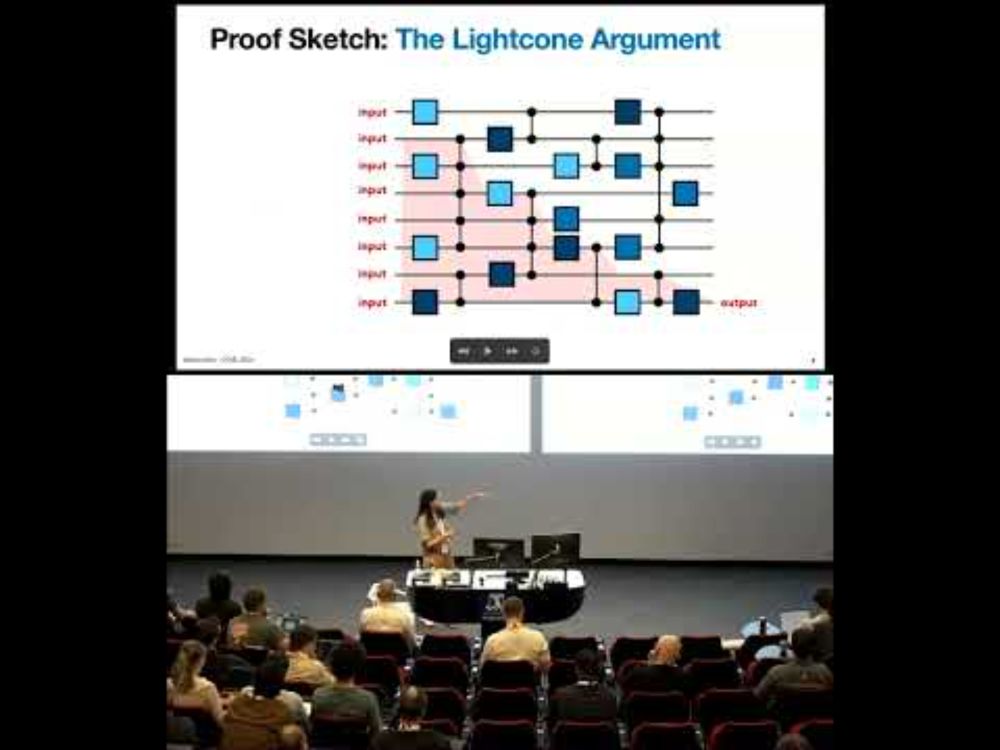
At QTML 2024, I spoke about recent work with Robert Huang on "Learning shallow quantum circuits with many-qubit gates" (a.k.a. efficient learning of QAC^0 unitaries). In this ~15min talk I discuss the project motivation, key results, and high-level proof ideas.
www.youtube.com/watch?v=iRiJ...
18.12.2024 18:16 — 👍 14 🔁 3 💬 1 📌 0
Very excited that our work was featured on @tomgur.bsky.social's 2024 advent calendar, alongside many great math/TCS talks from the year! 😊
12.12.2024 02:04 — 👍 9 🔁 1 💬 1 📌 0

Day two of #qtml2024 brings another bouquet of exciting talks, e.g, by Maria Schuld and Kristan Temme - and also my plenary talk and a small technical talk have been happening today. I like how the meeting is developing: Lots of solid, rigorous technical work.
26.11.2024 04:00 — 👍 26 🔁 1 💬 0 📌 0
PhD student in quantum information and complexity theory at The University of Texas at Austin. Previously EECS @ UC Berkeley.
Die Alexander von Humboldt-Stiftung fördert Wissenschaftskooperationen zwischen exzellenten ausländischen und deutschen Forschenden. https://www.humboldt-foundation.de
Quantum computer scientist @jkulinz.bsky.social, coin tossing enthusiast, armchair historian and aspiring subsistence farmer. Lived and worked in Switzerland, the UK, Germany, Australia and the US.
Team-webpage: www.jku.at/iicqc
Latest issue:
https://www.journals.uchicago.edu/toc/bjps/current
BJPS Review of Books:
https://www.thebsps.org/reviewofbooks/
BJPS Short Reads:
https://www.thebsps.org/short-reads/
Podcast:
https://podcasters.spotify.com/pod/show/bjps
Quantum Information PhD student at Scuola Normale Superiore of Pisa (Italy)
Senior Lecturer #USydCompSci at the University of Sydney. Postdocs IBM Research and Stanford; PhD at Columbia. Converts ☕ into puns: sometimes theorems. He/him.
Illuminating math and science. Supported by the Simons Foundation. 2022 Pulitzer Prize in Explanatory Reporting. www.quantamagazine.org
Computer science staff writer @quantamagazine.bsky.social, ex-physicist. More about me at benbrubaker.com. Banner art by Nico Roper — find more of their work at nicoroper.com. [Obligatory disclaimer about views being my own.]
Chief Scientist at Quantinuum, ex Oxford Professor, author of Picturing Quantum Processes & Quantum in Pictures. Also, composer/musician at Black Tish, inventor of Quantum Guitar, playing duets with orchestral organ.
✨ Sharing stories of women in mathematics in all walks of life #hermathsstory
🔗 https://hermathsstory.eu
Theoretical physicist (quantum information + quantum thermodynamics) at QuICS, author of Quantum Steampunk: The Physics of Yesterday's Tomorrow
Physics, philosophy, complexity. @jhuartssciences.bsky.social & @sfiscience.bsky.social. Host, #MindscapePodcast. Married to @jenlucpiquant.bsky.social.
Latest books: The Biggest Ideas in the Universe.
https://preposterousuniverse.com/
PhD student in quantum information @freieuniversitaet.bsky.social
Lecturer-Researcher, Chaire d'Excellence AMU-A*MIDEX, Marseille, France. Editor at Quantum Journal.
https://ravikunjwal.com/
Assistant Professor at NYU Courant Institute School | Postdoc at MIT | PhD at CMU | Theoretical Computer Science | Quantum Information
Freelance science writer covering technology, math, computer science- https://lakshmichandrasekaran.contently.com/. Words in @quantamagazine.bsky.social, @sciencenews.bsky.social & others.
Please subscribe to my blog here: https://scieye.wordpress.com/
Prof in Quantum Information Theory at NUS and CQT, an information theorist at the quantum frontier, ETH Zurich alumnus, opinions my own