
Trophic Interactions Are Key to Understanding the Effects of Global Change on the Distribution and Functional Role of the Brown Bear
🔗 buff.ly/h0P8Ho6

@pablomlucas.bsky.social
ORCID: 0000-0003-4517-9748 Postdoc @ Univ. of Seville | 🐾 Conservation Biology | Biogeography | 🌍 Macroecology | Large mammals 🐻🐺 🐐| Studying global change effects on biodiversity 🌡️🌱
Trophic Interactions Are Key to Understanding the Effects of Global Change on the Distribution and Functional Role of the Brown Bear
🔗 buff.ly/h0P8Ho6
@unisevilla.bsky.social @csic.es @mncn-csic.bsky.social @ebdonana.bsky.social @csicdivulga.bsky.social @eloyrevilla.bsky.social @laura-pollock.bsky.social
09.06.2025 09:59 — 👍 0 🔁 0 💬 0 📌 0
1⃣6⃣🔑 KEY MESSAGES:
1⃣ Ecological networks help improve biodiversity & #speciesdistributionmodels under #climate & #land-use change.
2⃣ Global change reshapes #foodwebs, affecting #ecosystem structure & function.
3⃣ We need better data on species #interactions.

1⃣5⃣Brown bears have a wide potential distribution in Europe, but future #climatechange and land-use changes—through abiotic and biotic factors—will affect each subpopulation differently.
09.06.2025 09:59 — 👍 0 🔁 0 💬 1 📌 0
1⃣4⃣The inclusion of biotic interactions considerably improved our understanding of brown bear distribution at large (continental) scales compared with Bayesian models including only abiotic factors (climate and land use)
09.06.2025 09:59 — 👍 1 🔁 0 💬 1 📌 0
1⃣3⃣Bear diet depends of climate and land use variables, for example subpopulations located in areas with higher temperatures eat more plants, which means that bears have different roles in the ecosystems
09.06.2025 09:59 — 👍 0 🔁 0 💬 1 📌 0
1⃣2⃣🚨 RESULTS🚨 What brown bear eats?
09.06.2025 09:59 — 👍 0 🔁 0 💬 1 📌 0
1⃣1⃣ We fitted three models explaining the distribution of brown bear (Using the historical range data and the current data): 1) A model with only abiotic variables 2) A model only biotic variables 3) A model combining abiotic and biotic variables
09.06.2025 09:59 — 👍 0 🔁 0 💬 1 📌 0
🔟And the #biotic variables
09.06.2025 09:59 — 👍 0 🔁 0 💬 1 📌 0
9⃣ Using all wild species in the brown bear diet, we created #biotic variables based on the energy each species provides. We combined this with #habitat #models for each #diet species using
@gbif.es @gbif.org , #climate, and #landuse data

8⃣… and (2) high-resolution occurrences of brown bears from all European and Turkish subpopulations. We built a database with over 3 million 🐻 occurrences from more than 3,000 individuals, covering a broad environmental range.”
09.06.2025 09:59 — 👍 0 🔁 0 💬 1 📌 0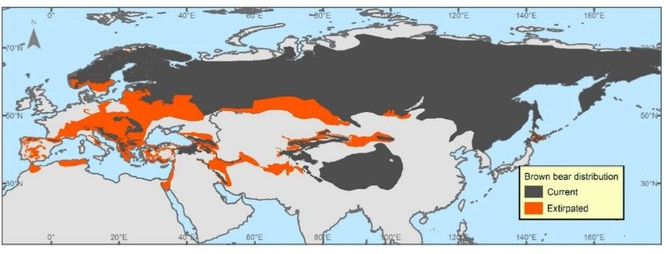
7⃣We combined distribution data for brown bears by using (1) range-scale data from the Eurasian range, complemented with historical range info from historical sources. Avilable at zenodo.org/records/1537...
09.06.2025 09:59 — 👍 0 🔁 0 💬 1 📌 0
6⃣ To fill the biotic‑interaction gap, we reviewed 47 studies on the 🐻 brown bear’s diet🍏🌿🐜🦌🫎 across Europe and built a detailed trophic database — a #foodweb with >1,300 quantitative, empirical links, available at zenodo.org/records/1536...
09.06.2025 09:59 — 👍 0 🔁 0 💬 1 📌 0
5⃣ …and from a #conservation perspective, the brown bear is a keystone species in some of the most important protected areas of the continent: #CordilleraCantábrica #Pyrenees #Alps #Carpathians #Apennines #Pindus #Balkans #Finland #Baltic #Scandinavia #Natura2000 #Türkiye #Tatra
09.06.2025 09:59 — 👍 0 🔁 0 💬 1 📌 0
4⃣ To address this, we focused on the #brownbear in #Europe and #Türkiye — a well-studied species and region. From an #ecosystem perspective, the brown bear is a top #predator and an #omnivorous generalist, key to ecosystems and with several subpopulations at #extinction risk e.g. #Cantabrian
09.06.2025 09:59 — 👍 0 🔁 0 💬 1 📌 03⃣ However, when studying species distributions at large scales, we usually focus on abiotic variables such as climate and land use. This is partly due to the limited data on biotic interactions at broad scales — a gap known as the Eltonian shortfall. annualreviews.org/doi/abs/10.1...
09.06.2025 09:59 — 👍 0 🔁 0 💬 1 📌 0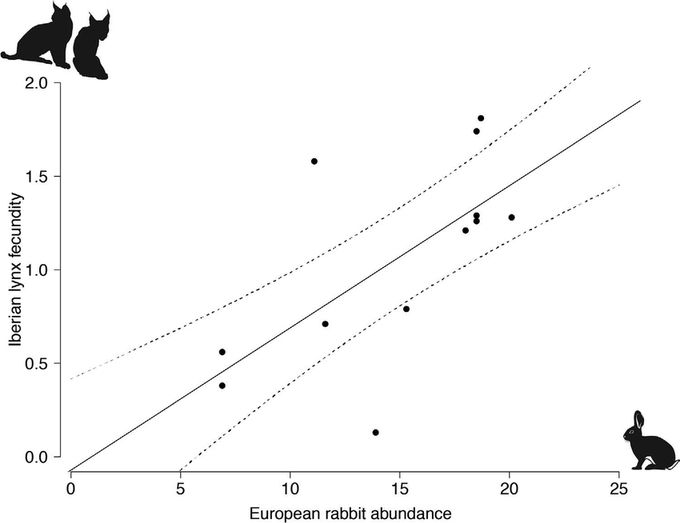
2⃣ Hutchinson proposed that species distributions are shaped by a complex set of abiotic and biotic factors. For example, the #IberianLynx 😺 depends on rabbit 🐰abundance (Monterroso et al. 2016).
09.06.2025 09:59 — 👍 0 🔁 0 💬 1 📌 0
📢PAPER ALERT!!🚨🚨
Our article “Trophic interactions are key to understanding how global change shapes the distribution and ecological role of the brown bear” 🐻is now online in
@globalchangebio.bsky.social #Climate #Ecology #Biodiversity #bear #SDM #carnivores
onlinelibrary.wiley.com/doi/10.1111/...

New paper! led by Ruben Bernardo-Madrid "A general rule on the organization of biodiversity in Earth’s biogeographical regions" in NEE @natureportfolio.nature.com
Read it here: doi.org/10.1038/s415...