Graph of award probability of R35 and R01 from NIH factbook as a function of review rank percentile. As is apparent, 2025 is a significant departure, with lower award probabilities at all scores <40 and significant departures from norm, where even being in the top 10% is no longer a nearly certain indicator of success.
Data source: https://report.nih.gov/nihdatabook/report/302
The data is in: the NIH goalposts have shifted.
What were once almost certain fundable scores have become coin flips and what used to be likely grants have become aspirational, leading to fewer awards.
Another manifestation of how HHS policies have led to fewer awards and less science.
07.03.2026 01:59 —
👍 663
🔁 405
💬 19
📌 59

A fun (AI-enhanced) image of 12187 ABR waveforms. We used these data from our own lab and several others to train ABRA (PMID: 38948763) and are still using it to train next-gen machine learning models for cochlear studies. Stay tuned (no pun intended) for more!
19.02.2026 01:09 —
👍 2
🔁 3
💬 0
📌 0

Hey #ARO2026, today we have a poster on an interesting participant who hears sounds when her eyes move! Board #134 1/
10.02.2026 13:51 —
👍 13
🔁 3
💬 2
📌 1

Bluesky Map
Interactive map of 3.4 million Bluesky users, visualised by their follower pattern.
I made a map of 3.4 million Bluesky users - see if you can find yourself!
bluesky-map.theo.io
I've seen some similar projects, but IMO this seems to better capture some of the fine-grained detail
08.02.2026 22:59 —
👍 7207
🔁 2161
💬 659
📌 4581

"How much of the brain's learned algorithms depend on the fact it is a brain?" arxiv.org/abs/2601.02063 The brain is a neural network, but also a biological organ (unlike artificial neural networks). How much does this matter to cognition?
25.01.2026 09:09 —
👍 38
🔁 8
💬 0
📌 1
Bye bye 2025, a divisive year,
with many divisors: 3, 5, 9, 15, 25, 27, 45, 75, 81, 135, 225, 405, 675.
Happy 2026 = 2*1013
Just two primes
Cheers!
31.12.2025 16:32 —
👍 22
🔁 6
💬 1
📌 0
YouTube video by CNRS
Stéphane Mallat, bâtisseur de ponts mathématiques et informatiques | Talents CNRS
Du format de compression d’images JPEG 2000 aux fondements mathématiques de l’IA, Stéphane Mallat a façonné des outils devenus incontournables. Pour ses travaux exceptionnels, il reçoit la médaille d'or 2025 du CNRS. #TalentsCNRS 🏅
Son portrait vidéo 👉 youtu.be/m3zNvnGSjjk
17.12.2025 18:55 —
👍 59
🔁 22
💬 1
📌 1
left: inner ear; center: transverse section of the cochlear duct; right: section showing the cochlear duct spiraling around the modiolus/spiral ganglion
31.10.2025 23:17 —
👍 0
🔁 0
💬 0
📌 0

pumpkin carving representing the inner ear. left: inner ear, center: transverse section of the cochlear duct, right: spiral canal, modiolus and sprial ganglion
Each year amazed by the incredible carving work of Purdue Audiology student Isabella Huddleston 🤩🤩 via x.com/HeinzLab_Pur... #Halloween 🎃👻
31.10.2025 23:14 —
👍 3
🔁 0
💬 1
📌 0

Really interesting work by Bakhurin and colleagues challenging the reward prediction error hypothesis of dopamine:
www.nature.com/articles/s41...
I love this figure which both echoes and undermines the famous figure from Schultz et al. (1997).
14.10.2025 11:05 —
👍 141
🔁 52
💬 3
📌 6

Arousal as a universal embedding for spatiotemporal brain dynamics - Nature
Reframing of arousal as a latent dynamical system can reconstruct multidimensional measurements of large-scale spatiotemporal brain dynamics on the timescale of seconds in mice.
Super proud of this collaboration with rockstar Ryan Raut - born out of playing in the sandbox in our last year of grad school! Multi-scale brain activity can be predicted from a simple measure of arousal like pupil diameter. Out with linear causality, in with dynamic systems to explain neurobiology
24.09.2025 21:52 —
👍 85
🔁 25
💬 3
📌 4
Congratulations Prof. Mallat! 👏
11.09.2025 16:14 —
👍 0
🔁 0
💬 0
📌 0
I had the chance to have Stephane Mallat as a teacher. His course connected important ideas in statistical signal processing/machine learning with mathematical concepts. It was very inspiring I know him as a great mentor. His book 'a wavelet tour on signal processing' is a classic IMO :)
11.09.2025 16:13 —
👍 1
🔁 0
💬 1
📌 0
I love this experience-sampling study on the absolute pitch of earworms! It's a really nicely done study conducted in everyday settings. The link to this paper (open access) is provided below. It is also featured in a podcast (tinyurl.com/4ydrw5zp) by the Psychonomic Society. Congrats!
08.08.2025 16:48 —
👍 23
🔁 7
💬 1
📌 0

🔵 Proud to share our new preprint 🔵
We compared humans and deep neural networks on sound localization 👂📍
Humans robustly localized OOD sounds even without primary interaural cues (ITD & ILD)
Models localized well only in-training distribution sounds, failing on OOD regime
Link & full story 🧵👇
09.08.2025 11:04 —
👍 37
🔁 12
💬 4
📌 4
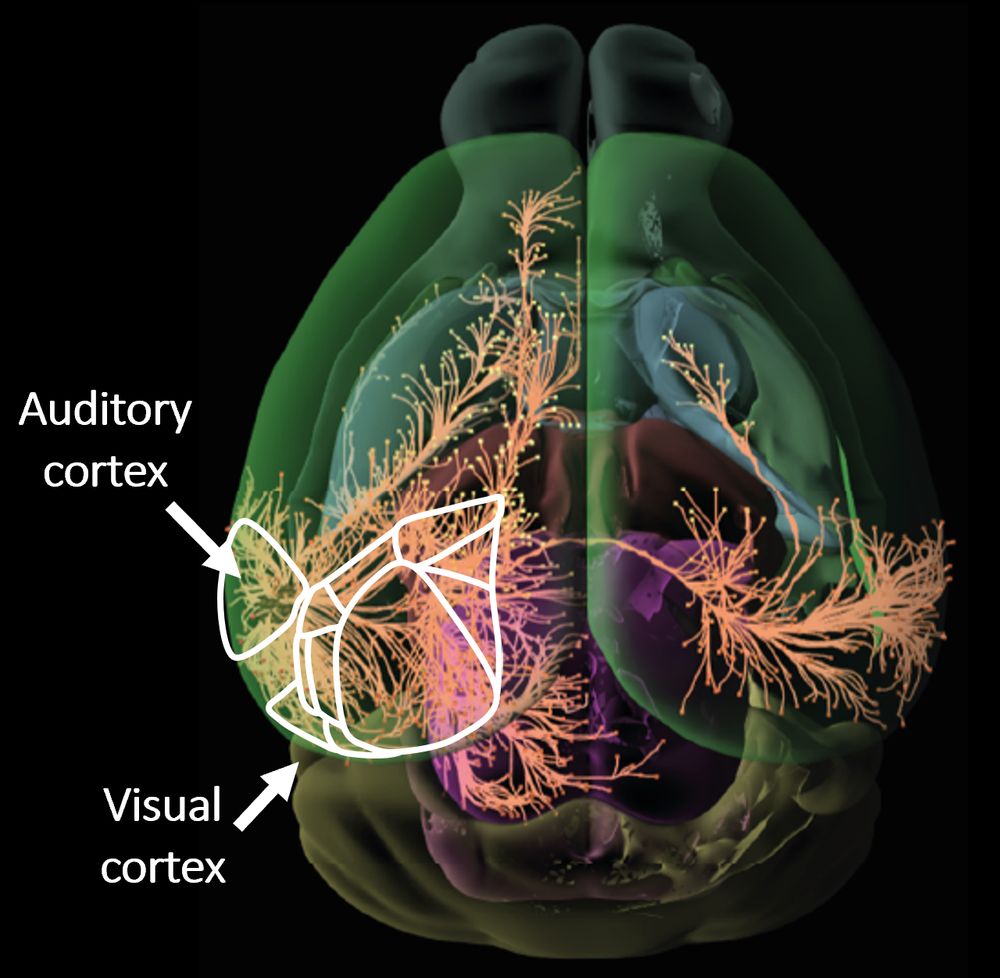
1/N What are the organizational principles underlying crossmodal cortical connections?
We address this in this new preprint, led by @alexegeaweiss.bsky.social & @bturner-bridger.bsky.social in collab w/ @petrznam.bsky.social @crick.ac.uk
www.biorxiv.org/content/10.1...
01.08.2025 10:09 —
👍 91
🔁 33
💬 1
📌 5
A major NIH grant to study ways to restore hearing was terminated by the Trump administration bc it was awarded through a DEI initiative—to a researcher who qualified bc of his own hearing loss www.cnn.com/2025/07/29/h... @manorlaboratory.bsky.social
29.07.2025 12:45 —
👍 127
🔁 78
💬 3
📌 13
👏
02.07.2025 22:19 —
👍 1
🔁 0
💬 0
📌 0
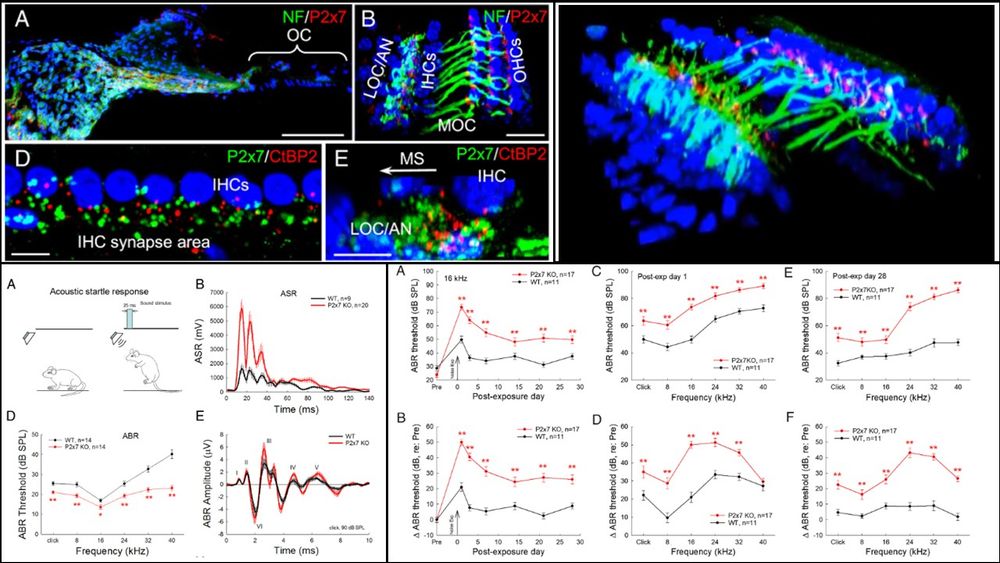
Howdy! Today's paper spotlight comes from Chun Liang and was published in June. This paper shows that knocking out the ATP gated receptor P2X7 enhances hearing sensitivity but makes noise induced cochlea damage much worse! Adds info to those mysterious type II fibres 🔍 www.pnas.org/doi/10.1073/...
02.07.2025 07:43 —
👍 6
🔁 2
💬 0
📌 0
Delighted to have our newest paper out in #Jneurosci ! We looked at how much a single cell contributes to an auditory-evoked EEG signal. Big thanks to my co-authors Ira Kraemer, Christine Köppl, Catherine Carr and Richard Kempter (all not in Bsky). Here’s how: (1/13)
bsky.app/profile/sfnj...
28.06.2025 14:18 —
👍 21
🔁 6
💬 3
📌 0
Does anyone else find it perpetually annoying that what most folks would consider neural "computation" is Marr's "algorithmic" level, while his *computational* level is really just "what's the goal of this thing anyway?" AKA function.
26.06.2025 02:53 —
👍 60
🔁 7
💬 13
📌 3
This is just the beginning of this line of research. And other teams have developed different approaches to unravel the mechanisms of cochlear amplification. The field is moving fast! Definitely an exciting time for research on cochlear mechanics.
16.06.2025 10:47 —
👍 1
🔁 0
💬 0
📌 0
This could however explain several observations, including the orientation of collagen fibers in the tectorial membrane (stained in blue in the picture below), which conveys the velocity gradient in this hypothesis. bsky.app/profile/audi...
16.06.2025 10:47 —
👍 2
🔁 0
💬 1
📌 0