
Spannendes Projekt an unserem Lehrstuhl!🙌 Erprobung von KI-gestütztem Therapie-Training in Virtual Reality 🗣️👓
www.uni-wuerzburg.de/aktuelles/ei...
@sabrinagado.bsky.social @isabelneumann.bsky.social @Daniel Gromer
Spannendes Projekt an unserem Lehrstuhl!🙌 Erprobung von KI-gestütztem Therapie-Training in Virtual Reality 🗣️👓
www.uni-wuerzburg.de/aktuelles/ei...
@sabrinagado.bsky.social @isabelneumann.bsky.social @Daniel Gromer
And what a performance! 👏🏻😮💨💯
Congratulations, Dr. Lingelbach 🙌🏻🤩
11 days left to apply!💼⏰ Spread the word 📣
20.10.2025 08:52 — 👍 4 🔁 7 💬 0 📌 0
Also a big shoutout to me co-organizer @isabelneumann.bsky.social!
#teamworkmakesthedreamwork 🤝

With an amazing keynote by @michaelgaebler.com #wuertual25 comes to an end. A huge thank you to all participants for sharing your research and perspectives and for contributing to the amazing atmosphere! #tbc
10.10.2025 15:51 — 👍 19 🔁 3 💬 1 📌 0
#wuertual25 just started!
Looking forward to an interesting and inspiring 3 days ahead 🚀

🚨 Come work with us! A 3-year postdoc position is available in my group, focusing on gaze interactions in real and virtual environments. The job ad is only in German, since a certain level of German proficiency is required. Please share widely! @biodgps-dgpa.bsky.social
04.09.2025 11:55 — 👍 17 🔁 15 💬 1 📌 1
I might be biased, but what an inspiring #VR symposium at #PuG25 🤩
This field still develops so fast 🚀as showcased by the integration of neurophysiology, multi-user settings and clinical application.
Thanks to @martandreatta.bsky.social, @leonkroczek.bsky.social, @michaelgaebler.com and Marius Rubo!
You can find our pre-reg here: osf.io/e4rbd
But, of course, we now learned a lot about this new paradigm and we might recommend adjusting some things for similar studies. If you’re interested, we could have a call to discuss this 😊
@jannateigeler.bsky.social opening PuG2025 symposia 🚀 presenting our gaze-based approach-avoidance task #AAT 👀
Turns out it’s actually hard to transfer traditional AAT paradigms to #eye-tracking. Attention is likely influenced by additional factors like salience and arousal🔥
Excited about all #PUG25 @biodgps-dgpa.bsky.social posts coming in!
Check out our symposium "The Best of Both Worlds? Bridging Behavior and Physiology Using Immersive #VirtualReality"
🗓️Friday 14:30-16:00
@sabrinagado.bsky.social
@michaelgaebler.com
Marius Rubo
@martandreatta.bsky.social
Happy to share that this study is now published in JEP:HPP 🎉
psycnet.apa.org/doi/10.1037/...

🚨 New study reveals that when used to summarize scientific research, generative AI is nearly five times less accurate than humans.
Many haven't realized, but Gen AI's accuracy problem is worse than initially thought.
Our social conditioning #VR study is now published in Behavior Research Methods: doi.org/10.3758/s134...
More exiting projects with this paradigm soon to come #staytuned 😊
Finally it’s my turn to say: #phdone 🙌🏻🎓
Thanks @gamerlab.bsky.social and @rtg2660.bsky.social for giving me this opportunity! It was a blast 🎊
Only few days left to apply for a PhD position in my group @biodgps-dgpa.bsky.social
07.04.2025 07:19 — 👍 5 🔁 7 💬 0 📌 0We are also thrilled to announce our keynote speakers: Rachel McDonnell (Trinity College Dublin) and @michaelgaebler.com (MPI Leipzig) 🎉
26.02.2025 16:09 — 👍 1 🔁 1 💬 0 📌 0
🗓️Save the date!
The Wuertual Reality XR-Meeting is back! 🙌🏻
From Oct 8-10, 2025, Würzburg will be the place-to-be to present, discuss, and try out the latest psychological VR, AR, and XR research. Stay tuned for more information! 🚀
A starter pack I found missing 👓🖥️🌍🧠🩺
Immersive technologies - #VR, #AR, #XR, #spatialcomputing, #CG - for research (e.g., psychology, neuroscience) & medicine (diagnostics, therapy).
go.bsky.app/E9bhHvQ
Please let me know if you wanna be added - especially undergrad, grad, predoc researchers!

In addition, we provided further evidence for a cardiovascular hyperarousal 🫀↗️ in social anxiety, which was not limited to social situations and not modulated by the pressure to adhere to social norms.
06.11.2024 16:47 — 👍 1 🔁 0 💬 0 📌 0Instead, we could show that social anxiety affects social exploration behavior not in a way of general avoidance 🚫, but rather in nuanced adaptations 🌈 depending on the concrete situation, perceived control, likelihood of interaction and associated socio-evaluative threat.
06.11.2024 16:46 — 👍 0 🔁 0 💬 1 📌 0
We expected socially anxious participants to show avoidance of potentially crowded spaces 🚷, reduced visual attention on other people 👀, and heightened physiological arousal in social situations 🫀.
06.11.2024 16:45 — 👍 0 🔁 0 💬 1 📌 0
Our pre-screened participants with varying trait social anxiety scores went for a walk on a freely chosen route 👣 and then had a staged social interaction with a confederate 👥.
We recorded the chosen route 📍, gaze behavior 👀, and autonomic responses 🫀.
🎉 Very proud to share my first published PhD paper 🎊
With @gamerlab.bsky.social, @jannateigeler.bsky.social and the amazing bachelor students Kaja Kümpel and Madita Schindler, we investigated how trait social anxiety influences social attention in naturalistic situations 🌳🏡
doi.org/10.1080/1061...

Next up: two further posters of the lab #2024SPR - @sabrinagado.bsky.social presenting a meta-analysis on the influence of social anxiety on subjective, physiological and hormonal measures 👇
25.10.2024 14:56 — 👍 10 🔁 2 💬 1 📌 0These results imply that social attention is less automatic and reflexive than previously assumed and can be suppressed by executive control to efficiently maintain goal-directed behavior 🤝
28.09.2024 11:25 — 👍 2 🔁 0 💬 0 📌 0
Overall, participants were more likely to look at the CSpos 🎯. Their first saccade was hereby mostly driven towards the social CSpos.
28.09.2024 11:22 — 👍 0 🔁 0 💬 1 📌 0
In Experiment 2, we included an attentional competition phase, during which participants were confronted with simultaneous presentations of social and non-social CSpos and CSneg.
28.09.2024 11:20 — 👍 0 🔁 0 💬 1 📌 0
It turned out: Participants could adapt their looking behavior and avoided looking towards punished stimuli – social or not 👏.
Nevertheless ☝️, they were still faster in looking towards social stimuli.
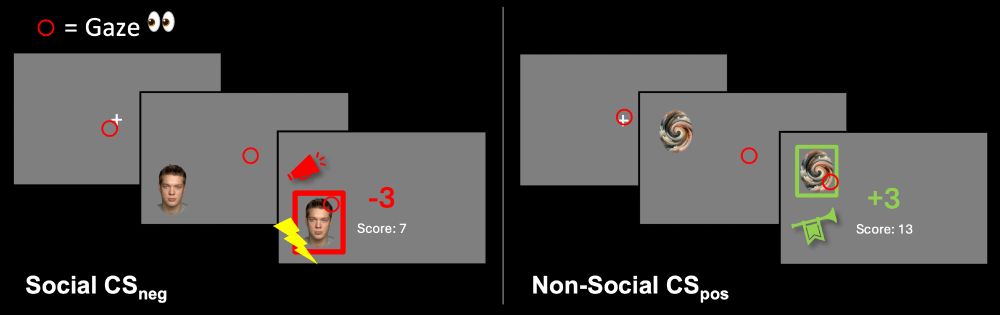
We presented social (faces) and non-social (fractals) stimuli serving as CSpos or CSneg. If participants looked at the CSpos, they were rewarded with points 🏆. However, if they looked at the CSneg, they received an aversive electrical stimulation⚡ (Experiment 1) or lost points ❌ (Experiment 2).
28.09.2024 11:01 — 👍 0 🔁 0 💬 1 📌 0