#FontsonFriday
28.11.2025 08:02 — 👍 2 🔁 0 💬 0 📌 0
@cryptandclerestory.bsky.social
An early-twenties church-crawler hoping to document his travels, and find new places of interest. All pictures my own unless stated otherwise. Interested in: rambling, nature, heritage, horticulture, and birdwatching.
#FontsonFriday
28.11.2025 08:02 — 👍 2 🔁 0 💬 0 📌 0
St. Mary, Bucklebury
#AdoorableThursday
Dated 1150-1170 in the Decorated Norman style with several carved faces, chevrons, pellets, rosette and interestingly a Celtic symbol as well.
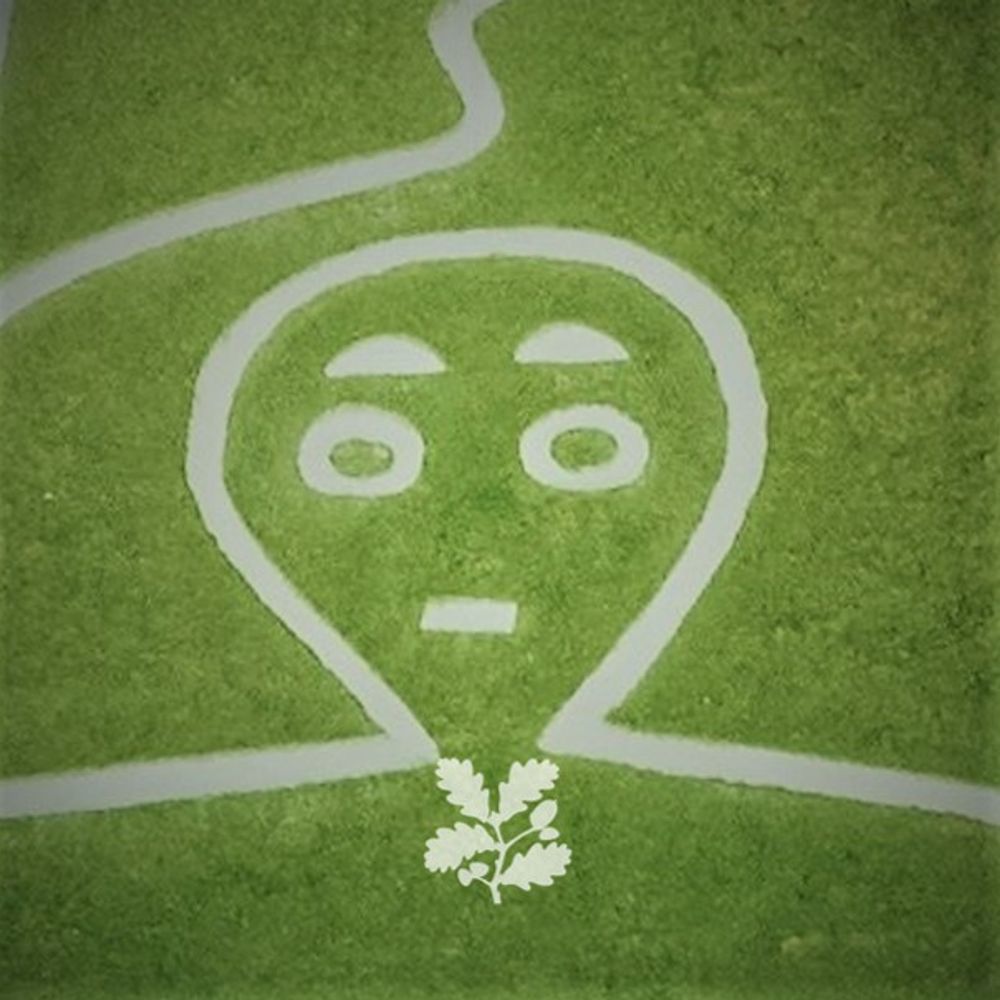
Above the headstone is a face surrounded by a beaded band surmounted by a carved orb and Maltese cross.


I read that the banded old parish chest, hollowed from a single piece of wood, supposedly came from Reading Abbey who previously owned the manor of Bucklebury.
#Woodensday


St. Mary's church, Bucklebury
#TilesonTuesday


The west tower dates to around 1450 and displays classic medieval features: diagonal buttresses, a coped parapet, carved gargoyles, and four obelisks capped with ball finials and weathervanes. Its two-stage design also includes a newel turret and striking carved symbols.
#MedievalMonday


St. Mary, Bucklebury, Berkshire.
#SteepleSaturday
Created from flint, tile, rubble and Ferricrete, the church showcases mainly 12th- and 15th-century work, with 19th-century additions. The roof is tiled, with separate covers for nave and aisle, and dormer windows on the nave’s south side.
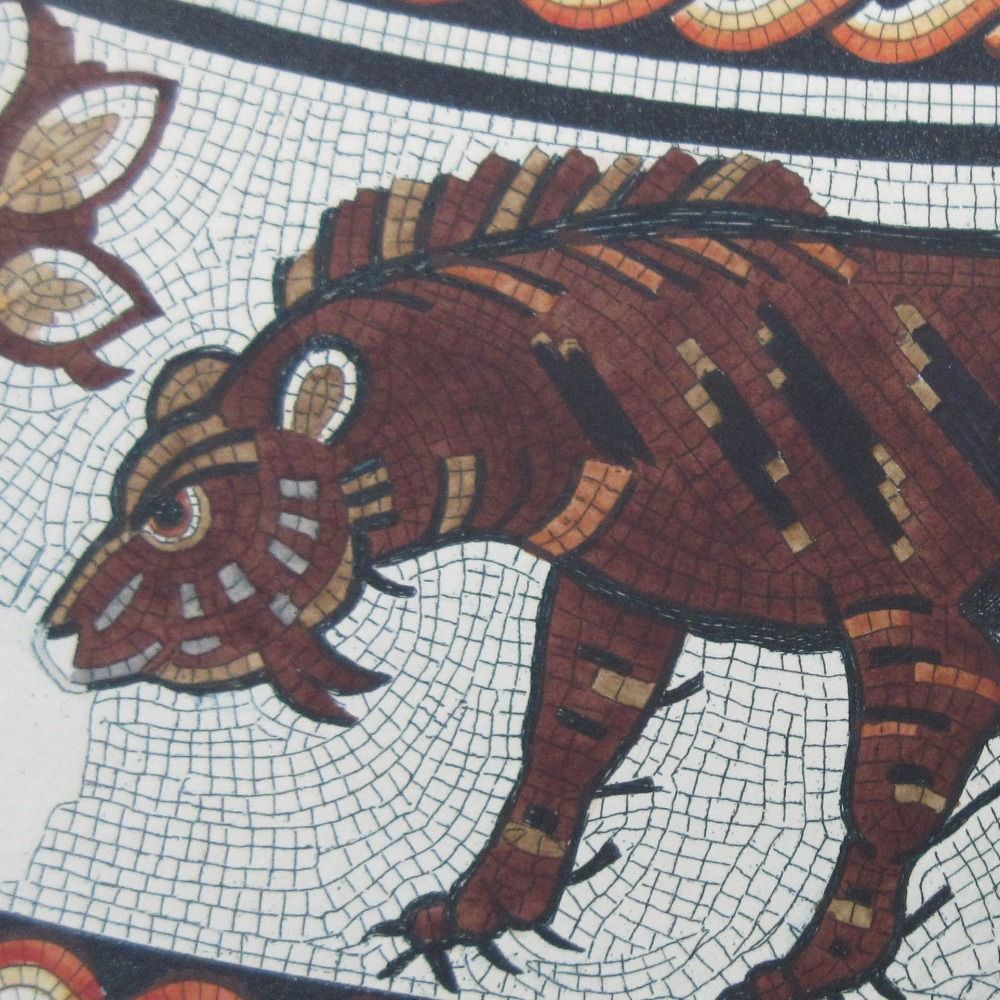
#MosaicMonday
24.11.2025 20:13 — 👍 4 🔁 0 💬 1 📌 0
Watts Cemetery features peaceful cloisters, an Italian-style well, all creating a serene setting. The grave of famed writer Aldous Huxley lies here alongside memorials to George and Mary Watts.
24.11.2025 20:07 — 👍 1 🔁 0 💬 0 📌 0


Over 70 villagers helped build Watts Chapel, learning pottery and terracotta modeling in evening classes led by Mary Watts. They crafted many of the symbolic tiles seen on the chapel and in surrounding graves, showcasing community craftsmanship central to the Arts and Crafts ethos.
#MemorialsMonday

There are trees of life rising behind and beside the mensa, intertwined with symbols of the Trinity, light, love and hope. The effect turns the altar into a focus for consolation in bereavement, echoing Mary’s dedication to the memory of all who rest nearby and to the comfort of those who mourn them
24.11.2025 20:07 — 👍 1 🔁 0 💬 1 📌 0
At the East, the altar forms the spiritual and visual climax of the chapel, framed by dense symbolism and glowing colour. G F Watts contributed a version of his painting The All‑Pervading for above the altar only a few months before his death adding his own symbolist vision to Mary's scheme.
24.11.2025 20:07 — 👍 2 🔁 0 💬 1 📌 0

The design features symbolic zones of seraphim, angels, a golden girdle, and trees of life, blending Christian and Celtic imagery alongside references to multiple faiths. This creates a visual meditation on life, death, and renewal, distinct from typical Victorian decoration.
#MosaicsMonday
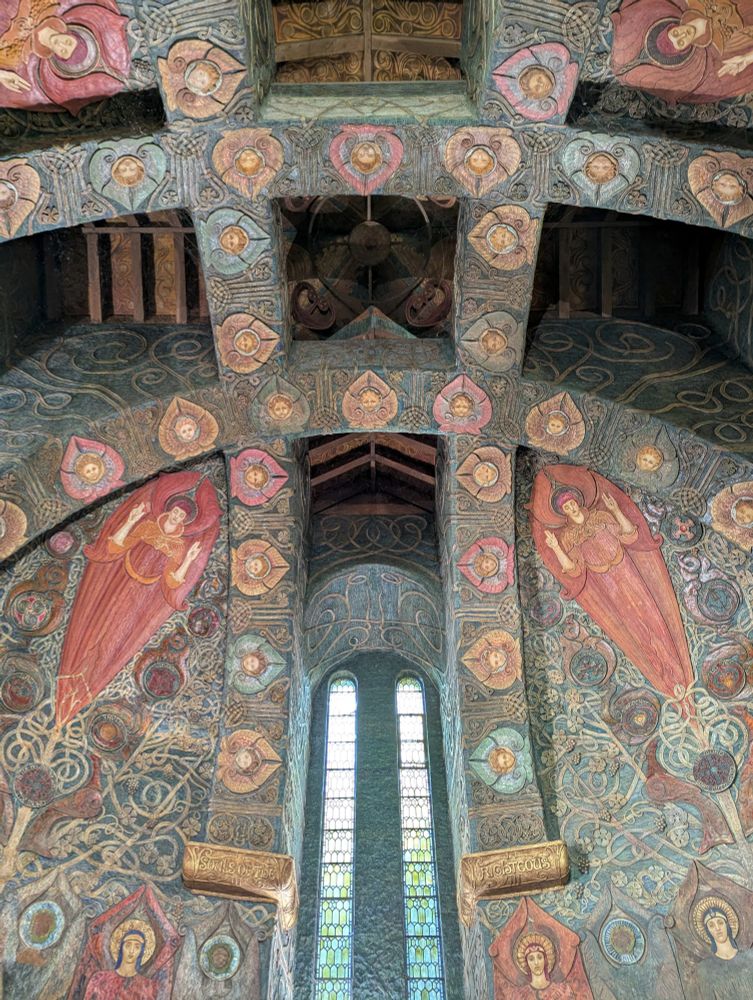

Inside, Mary Watts created one of England's most experimental decorative schemes using painted gesso reliefs, low-relief modeling, and gilding instead of traditional fresco. Villagers, taught by Mary, built up textured panels painted in rich reds, blues, and greens with gold leaf.
#MosaicsMonday


The terracotta-clad chapel fuses Arts and Crafts ideals with Celtic interlace, stylised foliage, and symbolic creatures—motifs inspired by ancient traditions that Mary Watts studied and reinterpreted to promote craftsmanship and spiritual expression.
24.11.2025 20:07 — 👍 1 🔁 0 💬 1 📌 0
Watts Chapel was designed and built by Mary Watts (1895-1904) as a joint memorial to her and G.F. Watts, reflecting their partnership and both were prominent artists. The chapel’s near-circular cruciform design and symbolic terracotta surface express Mary’s artistic vision and both their ideals.
24.11.2025 20:07 — 👍 4 🔁 0 💬 1 📌 0
#MonumentsMonday #MomentoMoriMonday
When from the dust of death I rise,
To take my mansion in the skies,
This all my hope, this all my plea
That Jesus lived and died for me
The church was locked but NCT notes: "There... [is] an early 14th century font, Royal Coat of Arms, two medieval piscinas and the pulpit with its fine medieval woodwork. There are also traces of red wall painting on the south arcade arches and round one of the windows."
23.11.2025 15:43 — 👍 0 🔁 0 💬 1 📌 0

The tower features a chamfered plinth and buttresses flanking elegant lancet windows. A string course with gargoyles runs beneath its embattled ashlar parapet, which is topped by crocketed pinnacles. Above, a recessed octagonal spire.
#SundayStonework #StainedGlassSunday


Look for the original Norman herringbone masonry in the north wall—this distinctive zigzag stonework has survived nearly nine centuries as a key architectural feature.
A number of other churches in South Yorkshire have also retained their Herringbone.
#SundayStonework

St Helen’s, Marr, Doncaster built in rubble limestone dates from the 12th century, with its tower added and the building remodelled between the 13th and early 14th centuries. Later, the 15th century brought the south porch, parapet, and spire.
#SteepleSaturday
 25.10.2025 16:33 — 👍 0 🔁 0 💬 0 📌 0

Set in the north chancel wall, a 14C tomb canopy houses a worn slab carved with a foliated cross. Believed to*possibly* be that of Ralph de Chasteleyn, founder of St. Andrew's, it recalls his 1336 death in a feud that once divided Kingham and neighbouring Churchill.
#momentomorimonday

The 13C circular font on a moulded plinth is the church's oldest fitting.
#FontsonFriday

On the chancel's north wall, a brass to Katherine James (d.1588) within the Easter Sepulchre depicts her kneeling with three children. The image, devotional and domestic, bridges Tudor piety and tenderness through finely incised detail on burnished brass.
#momentomorimonday

In the chancel, richly patterned encaustic tiles from the mid-1800s create a glowing floor beneath the altar. Their intricate designs - geometric, floral, and symbolic & reflect the Gothic revival's rediscovery of colour, form, and meaning in sacred decoration.
#TilesonTuesday

A fine monument by R. Physick of London commemorates Lt. Col. Henry Samuel Davies (d.1851). A mourning soldier rests wearily against his sarcophagus - an evocative sculptural study of dignity, service, and loss that contrasts powerfully with the serenity of its chancel setting.
#momentomorimonday

The chancel glows with 19C tastes. Its 1843 east window lights painted panels of saints, while angels above carry the instruments of Christ's passion. Carved sedilia and a piscina complete a composition uniting Victorian piety with enduring Gothic elegance.
#stainedglasssunday

The nave roof dates to 1774 containing seven low-pitched bays with carved wall-posts and gilded wooden bosses.
The striking spikey poppyhead pews have traceried bench ends of pale composition stone and were carved in the 1850s by local stonemason John Jackson.

The tower dating from the mid-14C with a 15C embattled parapet is crowned by crocketed pinnacles and diagonal buttresses. It has trefoil-headed belfry windows, projecting stairs turret, and Tudor-arched doorway.
25.10.2025 16:33 — 👍 0 🔁 0 💬 1 📌 0
Henry Lockwood's 1850s restoration of St Andrew's Church, Kingham, brought new vision. He combined and retained medieval, Tudor, 17th century, and Georgian features whilst reimagining the structure in Decorated Gothic style uniting past and Victorian present.
#SteepleSaturday