
Love dinosaurs? Come chat with past AMNH REU intern Jean at his poster # 539 on the second floor of Hall 3 today! #SVP2025 #2025SVP #dinosaurs #bonehistology
15.11.2025 13:27 — 👍 12 🔁 2 💬 0 📌 0
@paleozoek.bsky.social
Vertebrate paleobiologist, Gerstner Scholar at the American Museum of Natural History, UW Biology alumn, associate editor @ JVP 🖥️ : https://zoekulik.wixsite.com/paleo I study the evolution of mammalian biology from extinct stem mammal fossils 🦴🩻🪚🔬👀
Love dinosaurs? Come chat with past AMNH REU intern Jean at his poster # 539 on the second floor of Hall 3 today! #SVP2025 #2025SVP #dinosaurs #bonehistology
15.11.2025 13:27 — 👍 12 🔁 2 💬 0 📌 0
An evening chase erupts above the forests of Late Jurassic China between two gliding mammal-like animals. The sun sets between them, highlighting the leaves of the ginkgo tree they have leapt from. The mammals are darkly coloured, reflecting data from palaeocolour studies suggesting dark brown hues across most or all of their bodies.
The reality of being a freelancer is that you end up working a lot of evenings and nights, something #mammals have been doing since the Mesozoic. Here's new #paleoart of two #Jurassic gliding Mammaliaformes, Arboroharamiya, starting their day as the sun sets 160 million years ago. #sciart #fossil
04.11.2025 21:19 — 👍 237 🔁 69 💬 5 📌 2
🚨New paper alert!🚨
🧪⚒️
Terrestrial gigantism evolved through divergent pathways, with dinosaurs favoring cortical reinforcement while mammals adopted flexible trabecular expansion strategies
www.sciencedirect.com/science/arti...
This is so cool! Do you think the signal in bone density is strong enough to infer each type of ecology or shifts in phases for extinct animals? 👀
22.10.2025 22:44 — 👍 0 🔁 0 💬 1 📌 0
🚨 New 🦎 🚨
Breugnathair (“Bree-ack na-haird”) elgolensis is the oldest and most complete squamate from the Middle Jurassic of Scotland. Its Gaelic name means ‘false snake of Elgol’, referencing the snake-like teeth and jaws but lizard-like body and limb proportions.

A cut surface of a permineralized fossil femur embedded in clear epoxy
A permineralized #Dimetrodon femur ready for #ThinSectionThursday #Paleohistology
24.04.2025 14:19 — 👍 40 🔁 7 💬 0 📌 0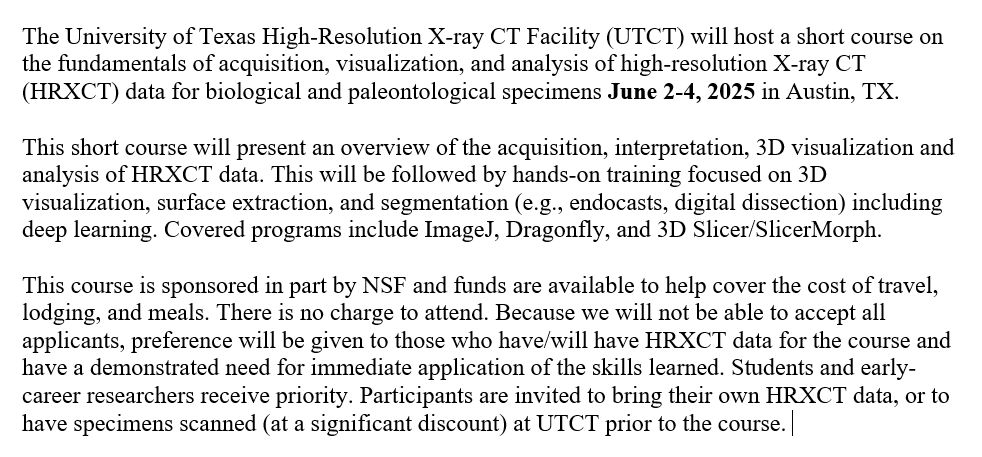
Text that reads: The University of Texas High-Resolution X-ray CT Facility (UTCT) will host a short course on the fundamentals of acquisition, visualization, and analysis of high-resolution X-ray CT (HRXCT) data for biological and paleontological specimens June 2-4, 2025 in Austin, TX. This short course will present an overview of the acquisition, interpretation, 3D visualization and analysis of HRXCT data. This will be followed by hands-on training focused on 3D visualization, surface extraction, and segmentation (e.g., endocasts, digital dissection) including deep learning. Covered programs include ImageJ, Dragonfly, and 3D Slicer/SlicerMorph. This course is sponsored in part by NSF and funds are available to help cover the cost of travel, lodging, and meals. There is no charge to attend. Because we will not be able to accept all applicants, preference will be given to those who have/will have HRXCT data for the course and have a demonstrated need for immediate application of the skills learned. Students and early-career researchers receive priority. Participants are invited to bring their own HRXCT data, or to have specimens scanned (at a significant discount) at UTCT prior to the course.
Every year UTCT teaches NSF sponsored short courses on high-resolution X-ray CT, taught by UTCT staff (including me!). Applications for the 2025 courses are now open! See below for the biological/paleontological course info, & we also have a geological one. If you'd like to apply, send me a DM 🩻☢️🦴
04.04.2025 17:52 — 👍 15 🔁 25 💬 0 📌 0Agreed! 😊
28.03.2025 16:40 — 👍 0 🔁 0 💬 0 📌 0
I am installing the life size 3D printed dicynodont skeleton on display in the Field Museum Grainger Science Hub. Grey bones represent real fossils from the bonebed, blue bones are resized or reflected bones.

The fossil dicynodont skull in a plaster cradle custom made for the display. In the background are shin bones that I thin sectioned to tell us information on how old these animals were when they died around 240 million years ago

Augmented reality of a dicynodont skeleton in Stanley Field Hall.

A reconstruction of Dolichuranus in the river beds of what is now Tanzania some 240 million years ago. Image credit to Mark Witton who is thanked for this artistic reconstruction.
Happy #FossilFriday
A few weeks ago we opened the first exhibit I helped design based on my work on bone histology and taphonomy of a #dicynodont bonebed from Tanzania!
If you are passing by the #FieldMuseum, go check out the #GraingerScienceHub
Huge thanks to @markwitton.bsky.social for 🎨🖼️
New pub alert! 🚨 and the final installment of papers from my dissertation!
Really happy to share this work on Triassic cynodonts that reveals surprising growth differences, helping to reshape our understanding of stem mammal evolution #ThinSectionThursday #Paleontology #Cynodonts #Triassic

CT scan of fossilized femur with 1 mm scale bar
Why do bone histologists use the middle of bones when examining growth patterns? Because mid-shaft record the longest history of growth, seen in this tiny femur where the joint ends are made of spongy bone and only the middle shows growth marks.
07.02.2025 21:17 — 👍 27 🔁 8 💬 0 📌 0
If you don't know about the @burkemuseum.bsky.social DIG Field School, it's a great time to learn about this PD program for K-12 educators and classrooms www.burkemuseum.org/education/ed...
Sign up for a Microfossil Workshop by Jan 3! and the DIG Field School applications open soon! #paleo #K12STEM

New paper alert! This was a fun study examining intraskeletal growth patterns in leopard geckos using fluorescent labeling. Labels administered in ovo are still present up to 4 years post-hatching! doi.org/10.1111/joa....
27.11.2024 16:26 — 👍 7 🔁 3 💬 1 📌 1
Our 2025 #REU applications are now open! Come learn with us next summer at the #AMNH! More information can be found www.amnh.org/research/ric...
09.12.2024 20:57 — 👍 33 🔁 32 💬 1 📌 0
🚨New Diamond 💎 Open Access Journal in Paleontology 🦴🐚!🚨
Send us your manuscripts 📜 and publish fully open access 🔓 entirely for free!
#openacess #paleontology #free #palaeontology #diamond #open
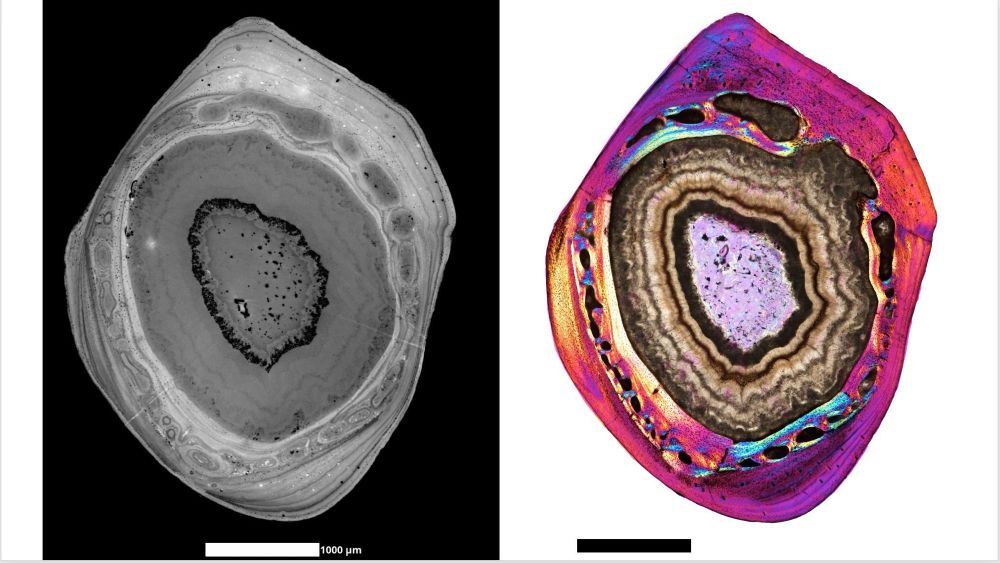
The left image is a grey value CT scan of a fossil bone thin section. The right image is the same fossil bone viewed under cross-polarized light microscopy with brightly colored pink, purple, blue, and yellow colors indicating bone mineral fiber orientations. The inside of the bone’s marrow cavity is infilled with brown crystals that look like a geode.
Happy #ThinSectionThursday
Here is a side by side comparison of virtual histology from synchrotron tomography on the left and “traditional” histology from optical microscopy on the right. It’s sometimes hard to tell what’s a growth mark in virtual histology but with this, we can can train our 👀

Job alert! Two Full-time Assistant Teaching Professor positions in our Department (UW Biology). Come join us! Please share: apply.interfolio.com/147513
22.11.2024 16:18 — 👍 9 🔁 7 💬 0 📌 0
A late night #ThinSectionThursday
Resisting that “we’ll pick it up in the new year” mentality with cool collaborations that have data that looks this good
Happy to help! And spread the word that JVP needs submissions to fill volumes. It’s unclear when or if the journal will move to an online format that frees us up from this type of constraint.
20.11.2024 18:37 — 👍 1 🔁 0 💬 0 📌 0I’m a JVP editor & we talked about this at the publications meeting at SVP. The journal had a backlog but as of today, the pace of finishing volumes is dependent on copy flow. I don’t know what caused the backlog, but JVP now needs submissions to fill volumes so the long lead times should be over.
20.11.2024 12:00 — 👍 1 🔁 0 💬 1 📌 0Please add me too!
17.11.2024 23:10 — 👍 1 🔁 0 💬 1 📌 0
A picture of a computer screen showing a live feed of the inside of a CT scan machine chamber with lenses and a shiny detector. In the middle of the image is a toothpick with a tiny fossil glued to it.

An image of a CT scan showing gray and black colors that correspond to microscopic cellular and vascular spaces inside fossil bone Some of the cellular spaces have been colored red in the upper right corner.
Paleobluesky has risen!
So happy to be here and share a sneak peak of some micro-CT scans. Check out the 3D histology of some truly tiny Mesozoic mammal fossils 🤩 🐭🐹🐿️
#fossilfriday #fossil #zeissxradia #amnh #watchthisspace
Come work with us! We are hiring a new #curator in invertebrate paleontology! careers.amnh.org/postings/4301 #academicjobs #tenuretrack #AMNH
14.11.2024 19:56 — 👍 71 🔁 65 💬 1 📌 1
#ThinSectionThursday brought to you by this stunning watercolor painting by Leonie Schön. Check out her histology artwork!
lamellipodiumart.com

I’m new to this online paleo community and am looking forward to getting connected. If you’re going to #2024SVP next week, stop by my talk on Wed. at 8am in the mammalian life history evolution symposium for a deep dive into 3D bone histology from some of the earliest non-mammalian synapsids!
25.10.2024 02:29 — 👍 3 🔁 0 💬 0 📌 0