List of articles in the october 2025 issue of regulation & governance.
The last issue of 2025 is out (vol 19, issue 4). Thanks to all the authors contributing to this issue and to our stellar community of reviewers who make the journal possible and our work as editors easier. 🙏
lnkd.in/gcD_gHky
30.10.2025 14:24 — 👍 1 🔁 0 💬 0 📌 0

My latest work with Professor Bo Wen about the governance legitimacy of Financial Action Task Force on @reggovjournal.bsky.social!
Key takeaway: lower-capacity regions convert the SAME compliance into WORSE effectiveness, exposing inequalities. Developing regions need incentive-based aid from FATF!
22.10.2025 13:51 — 👍 2 🔁 1 💬 1 📌 0

Corporate Power in a Multistakeholder World: Venue Hopping and the Multilevel Politics of Ultra‐Processed Food
The regulation of business is increasingly characterized by “soft” governance regimes that blur the boundaries of public and private authority, as signaled by the rapid proliferation of multistakehol...
new article in @reggovjournal.bsky.social that examines how corporations engage in 'venue hopping' as a means to advance agendas in multiple spaces and at multiple levels
This riffs off Baumgartner and Jones' notion of venue shopping, but adapts it for an increasingly multistakeholder world
13.10.2025 11:41 — 👍 16 🔁 10 💬 2 📌 2

🚨New publication out in @reggovjournal.bsky.social
@danielk24.bsky.social & I show that the support for green subsidies by unions & business interest groups in the 🇺🇸 & in 🇩🇪 goes hand in hand with the support for eco-social policies.
Open access here: doi.org/10.1111/rego...
A summary below 👇
07.10.2025 08:49 — 👍 16 🔁 9 💬 1 📌 0

After 7 yrs of work, the special issue "China in Compliance" is out with @reggovjournal.bsky.social. The focus is to unpack how #compliance works in globalizing China. #Cambodia #Kyrgyzstan #Tajikistan #Fiji #Vanuatu #Singapore #Taiwan #Ethiopia #Hungary
onlinelibrary.wiley.com/doi/toc/10.1...
26.09.2025 12:27 — 👍 9 🔁 2 💬 0 📌 1

New 📝 out in @reggovjournal.bsky.social
1. Governments are taking a more active role in education and training
2. Linking technical issues to politically salient debates, such as climate change and digitalization, helps open the door to new public policies
onlinelibrary.wiley.com/doi/10.1111/...
24.09.2025 10:19 — 👍 35 🔁 13 💬 4 📌 2

Screenshot of new article in regulation & governance that includes information on authors and article title, as well as abstract, as copied below.
ABSTRACT
Drawing on recent cases of digital technology adoption in China, this paper investigates changes in the digital reach of the Chinese state. We focus first on state capacity, a key dimension of state reach, and show that the adoption of digital technologies by central and local governments has increased coercive, administrative, and extractive capacity. We also examine the state's intrusiveness and show that digitalizing governance and regulatory processes has enabled new forms of power abuse, leading to resource waste and resistance among citizens. We contend that broader societal debate on the practices and outcomes of digital governance is essential to addressing these challenges. While digitalization poses unique challenges to regulators and societies worldwide, China's advanced experience offers important lessons.
New #earlyview #openaccess article.
The Expanding Digital Reach of the Chinese State: Digital Governance in China
by Genia Kostka, Anton Bogs
onlinelibrary.wiley.com/doi/10.1111/...
22.09.2025 16:13 — 👍 1 🔁 1 💬 0 📌 0
In this new study, Kenneth Nelson and I find that higher social assistance - which raises the income floor for the most disadvantaged - can strengthen public support for ambitious but regressive climate measures like fossil fuel taxes.
Open access @reggovjournal.bsky.social: doi.org/10.1111/rego...
09.09.2025 15:44 — 👍 11 🔁 4 💬 0 📌 0

screenshot of new article, with title, author and abstract information. abstract below.
ABSTRACT
When pandemics threaten, governments are expected to protect citizens. Trustworthiness and trust are central to meeting public expectations. Motivational posturing theory differentiates resistant and dismissive defiance during the COVID-19 pandemic. While trust is central to responding to resistant defiance, it is less relevant for dismissive defiance. Dismissive defiance is associated with distrust, conceptualized as losing hope that trust norms will restore trust. Using multiple linear regression and path analysis of Australian survey data, pathways are identified to resistant defiance and dismissive defiance. Hypotheses are confirmed, but with some unexpected insights. Trust in government and medical experts dampens both resistant and dismissive defiance. Intervening variables on the resistant defiance pathway include disagreement with government COVID decisions and vaccine hesitancy. On the dismissive defiance pathway, intervening variables include poor information seeking on COVID and poor adherence to COVID-safe behaviors. Resistant and dismissive defiance, while related, require different approaches to trust building.
#Earlyview #Openaccess
"Trust Norms, Distrust, and Worst-Case Defiance in the COVID-19 Pandemic"
by Valerie Braithwaite
See abstract 👇
onlinelibrary.wiley.com/doi/10.1111/...
04.09.2025 14:46 — 👍 1 🔁 0 💬 0 📌 0

🚨 New OA article with Scherwin M. Bajka in @reggovjournal.bsky.social:
“Subjective Technology Risk and Education Preferences: VET as a Safe Haven or Dead End?” (link in last post)
When people fear job loss from new tech, do they prefer vocational training over academic tracks? Short answer: yes.
13.08.2025 08:31 — 👍 8 🔁 2 💬 1 📌 0

Screenshot of the first paragraphs of first editorial in regulation & governance
Regulation and governance have become popular phenomena for social scientists to study and for good reason. Although redistributive, distributive and developmental policies still abound, the expanding part of governance is regulation. Indeed, few projects are more central to the social sciences than the study of regulation and regulatory governance. Regulation and the significant issues raised by it have become central to the work of social scientists from many disciplines – political science, economics, law, sociology, psychology, anthropology, history and others. Furthermore, the strong interest of other professional and scholarly communities, such as physicians, nutritionists, biologists, ecologists, geologists, pharmacists and chemists, makes regulatory issues even more central to scientists and practitioners who are perplexed by the demands for better, fairer, more efficient, and more participatory systems of governance.
We have established this journal to serve the needs of these varied professional and scholarly communities. We aim to provide a leading interdisciplinary platform for the study of regulation and its implications for governance. We seek to bridge and solidify discussions among a variety of relevant disciplines, serving the development of core theoretical and empirical insights in the study of regulation.
In this editorial introduction, we introduce the new journal first by offering an avowedly brief history of how interest in regulation has grown across the social science disciplines in the course of the last century. We then argue that the most recent buildup of that wave of research interest has coincided with a shift in political studies from an interest in government to governance. Finally, we distinguish regulation from governance and set out broadly, yet clearly, the intellectual agenda and vision for Regulation & Governance.
As we approach our 20th anniversary, we look back at an early contribution to Regulation & Governance, including this first editorial by the John Braithwaite, Cary Coglianese & David Levi-Faur that asked:
'Can regulation and governance make a difference?'
onlinelibrary.wiley.com/doi/10.1111/...
02.09.2025 14:53 — 👍 5 🔁 2 💬 0 📌 0

Screenshot of article title, authors and abstract.
ABSTRACT
In this article, we show how the study of compliance provides significant insights into the political and social tensions that shape Chinese business conduct in Kyrgyzstan's extractive industry and beyond. Drawing on interviews and analysis of legal documents, we first examine disputes between Chinese mining companies and Kyrgyz state institutions. These disputes demonstrate how the mundane workings of government bureaucracy foster a legal environment in which compliance is indeterminate. We argue that this indeterminacy—defined here as a social setting in which an action is neither predictably compliant nor noncompliant—provides a useful framework for analyzing interactions between mining companies and the state. We then move on to discuss how the establishment of international arbitration courts in Kyrgyzstan can be seen as an attempt to create new forms of compliance beyond this indeterminacy. We argue that looking at compliance through the lens of indeterminacy and examining ways of overcoming or managing it challenge the binary of compliance vs. noncompliance that continues to dominate social science literature on the subject. Finally, we maintain that the indeterminacy of compliance and the creation of new institutions both emerge from a legal environment that is shaped by broader political debate.
#Earlyview #Openaccess
Mining for Norms: International Extractivism, Chinese Business, and the Indeterminacy of Compliance in Kyrgyzstan
by Asel Doolotkeldieva & Till Mostowlansky
onlinelibrary.wiley.com/doi/10.1111/...
02.09.2025 14:50 — 👍 1 🔁 1 💬 0 📌 0

ABSTRACT
Chinese investments in Tajikistan have significantly increased since the early 2010s. In rural Tajikistan, Chinese companies make up the majority of foreign investors. However, Tajikistan's rural landscape is no easy terrain for foreigners. It is characterized by legal complexity, namely weak regulatory capacity, as well various elites' unofficial requirements. What does compliance mean in such a setting, and how do Chinese companies navigate this environment? Engaging with the literature on compliance and legal geography scholarship, this article examines these questions through the lens of a Chinese agribusiness operating in Tajikistan's cotton economy. I focus on environmental law and the governance of cotton procurement and illuminate a stark contrast: compliance with state law can be claimed relatively easily, but also questioned. On the contrary, compliance with elites' informal requirements is indispensable and requires adaptation. In this context, Chinese companies adjust and comply with laws and norms in locally specific ways.
#Earlyview #Openaccess
'Which and Whose Rules Rule? Chinese Agribusinesses and the Challenge of Compliance in Rural Tajikistan'
by @irnahofman.bsky.social
Abstract below 👇
#RevGov #Compliance #Agribusiness
onlinelibrary.wiley.com/doi/10.1111/...
28.05.2025 13:49 — 👍 2 🔁 0 💬 0 📌 1
ABSTRACT
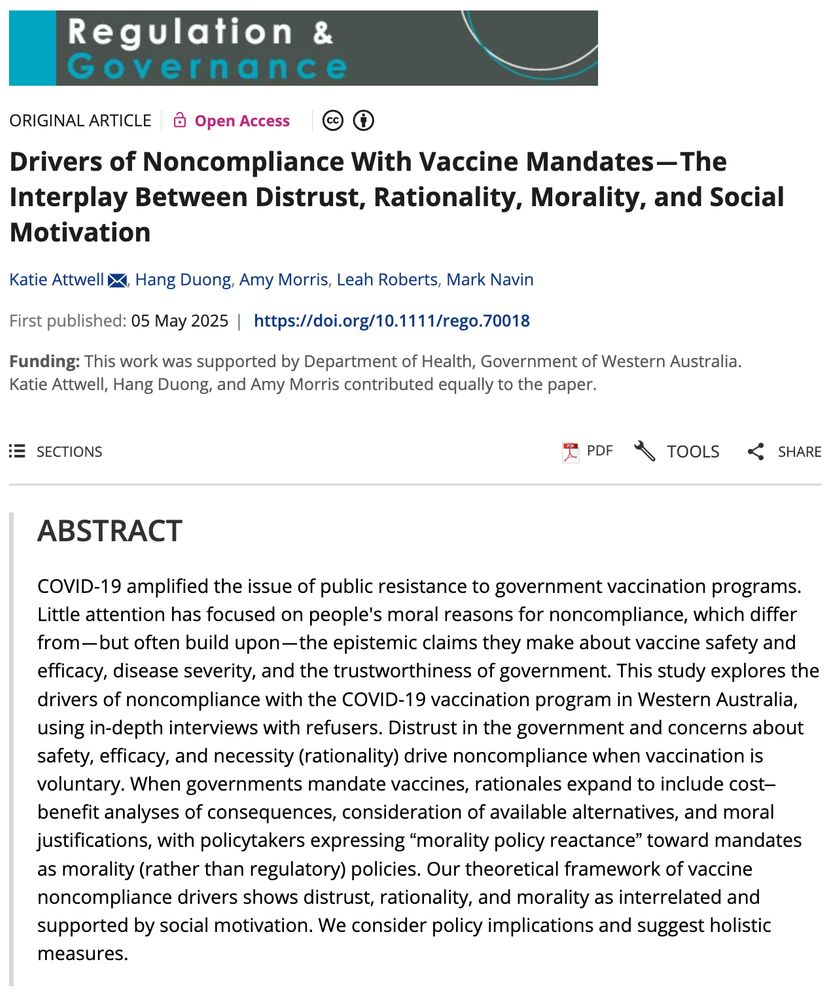
COVID-19 amplified the issue of public resistance to government vaccination programs. Little attention has focused on people's moral reasons for noncompliance, which differ from—but often build upon—the epistemic claims they make about vaccine safety and efficacy, disease severity, and the trustworthiness of government. This study explores the drivers of noncompliance with the COVID-19 vaccination program in Western Australia, using in-depth interviews with refusers. Distrust in the government and concerns about safety, efficacy, and necessity (rationality) drive noncompliance when vaccination is voluntary. When governments mandate vaccines, rationales expand to include cost–benefit analyses of consequences, consideration of available alternatives, and moral justifications, with policytakers expressing “morality policy reactance” toward mandates as morality (rather than regulatory) policies. Our theoretical framework of vaccine noncompliance drivers shows distrust, rationality, and morality as interrelated and supported by social motivation. We consider policy implications and suggest holistic measures.
#Earlyview #Openaccess
'Drivers of Noncompliance With Vaccine Mandates—The Interplay Between Distrust, Rationality, Morality, and Social Motivation'
by: Katie Attwell, Hang Duong, Amy Morris, Leah Roberts, Mark Navin
Abstract below 👇
#RegGov #Vaccines
onlinelibrary.wiley.com/doi/10.1111/...
28.05.2025 13:39 — 👍 2 🔁 0 💬 0 📌 0

ABSTRACT
We perform bibliometric analysis on documents for 255 Regulatory Impact Analyzes (RIAs) prepared by the US Environmental Protection Agency (EPA) from 1980 through 2024. Using a series of automated information extraction methods, we extract references from these documents and match them to bibliographic records. We then build a database of relevant articles (whether cited in an RIA or not) and fit a two-stage regression model that predicts whether, and how many times, a reference is used in RIAs as a function of journal prestige, professional popularity, article accessibility, EPA funding, and involvement of EPA employees as co-authors. By considering cited and uncited articles related to similar scientific concepts, we can observe systematic differences in what types of research products get used in policy analysis. Academic popularity, open access status, and EPA authorship and sponsorship all predict more likely and more frequent article use. Articles in prestigious journals are no more likely to be referenced, but once referenced in the corpus are then referenced more frequently.
#Earlyview #Openaccess
'The Drivers of Science Referenced in US EPA Regulatory Impact Analyses: Open Access, Professional Popularity, and Agency Involvement'
By: Tyler A. Scott, Sojeong Kim, Liza Wood
See abstract below 👇
#RegulatoryScience #RegGov
onlinelibrary.wiley.com/doi/10.1111/...
27.05.2025 15:19 — 👍 1 🔁 0 💬 0 📌 1

ABSTRACT
In conventional understandings of compliance, lawyers and compliance officers internalize compliance within corporations. Complicating this model, this article argues that compliance professionals may occupy a Janus-faced role between informality and formality. We use the case of “legal brokers” of Chinese investment in Cambodia as our empirical testing ground. Based on qualitative fieldwork conducted in Cambodia from 2019 to 2022, we find that legal brokers between Chinese investors and Cambodian counterparties are a vital feature of the market converting illicit into lawful capital. Our findings have implications for not just compliance professionals but also market entry, sustainable development, anti-bribery, and rule of law. By drawing on theoretical literature including relational contract and guanxixue (the study of guanxi or “social ties”), we scale up our findings to conclude that a focus on legal brokers reveals a social reality that may be more emblematic for most of the world than the existing model.
#Openaccess #Earlyview
'Legal Brokers of Chinese Investment in Cambodia: Compliance Between Contract and Culture'
by: @matthewserie.bsky.social, Molly Bodurtha, Sokphea Young
See abstract below 👇
#RegGov #Compliance #investment
onlinelibrary.wiley.com/doi/10.1111/...
27.05.2025 14:56 — 👍 2 🔁 0 💬 0 📌 2

Call for papers! Submit to the special issue of Regulation & Governance on 'Regulating the Invisible: Efforts to Map and Control Corruption.' Deadline: June 1, 2025. Email abstracts to ampippidi@luiss.it. Be part of the solution! #AntiCorruption #Research #Policy #GSDEC @nkechiazinge.bsky.social
28.04.2025 10:04 — 👍 2 🔁 1 💬 0 📌 0

ABSTRACT
Recent literature calls for scholars to bridge the divide that has emerged between criminology and regulation and governance. In the current work, we propose that criminological opportunity theories provide one fruitful pathway to that end. Specifically, we introduce the notion of regulatory guardianship based on the concepts of guardians, guardian capability, and guardian willingness to intervene, and connect them to the regulation and governance literature. We demonstrate the utility of this perspective as the building blocks for improving theoretical understanding of the effectiveness of a broad range of parties engaged in compliance work in specific regulatory environments. Considering new empirical insights into regulatory guardianship in the design of future legislation and systems of oversight and accountability may also improve governance implementation and effectiveness.
#Earlyview #openaccess
'Reengaging Criminology in Regulation and Governance: A Synergistic Research Agenda on Regulatory Guardianship'
By Carole Gibbs, Fiona Chan, Rachel Boratto, Tyler Hug
See abstract below 👇
#reggov #guardianship #criminology
onlinelibrary.wiley.com/doi/full/10....
28.04.2025 16:13 — 👍 1 🔁 0 💬 0 📌 0

ABSTRACT
Assigning the preparation of decisions to specialized committees composed of member state representatives is a widespread response to the ‘governor's dilemma’, that is, the tension between competence and control, in international organizations (IOs). We theorize a causal mechanism referring to self-selection and agenda-setting effects and show how the resulting division of labor among IO bodies produces organizational influence beyond current accounts of committee governance. We demonstrate why specialized committees develop a distinct rationale of accommodating expertise with member state preferences, even if composed of member state representatives, and why agreed committee proposals are difficult to overcome by final decision-making bodies. We argue that the organization of IO decision processes constitutes an important source of IO autonomy beyond the activities of IO administrations and independent from socialization or predispositions of individual committee members. Empirically, we show that IO committees meet the theoretically derived prerequisites for activating the causal mechanism and trace how committee influence according to the mechanism has shaped an important IO decision.
#Earlyaccess #Openaccess
'Specialized Committees of International Organizations an Important Source of Organizational Autonomy'
by Michael Giesen, Thomas Gehring, Simon Linder, Thomas Rixen
See abstract 👇
#Reggov #IO #Autonomy
onlinelibrary.wiley.com/doi/full/10....
10.04.2025 14:38 — 👍 2 🔁 1 💬 0 📌 0

Green Transitions: Rethinking Political Economy in the Context of Climate Change
Basak Kus, Gregory Jackson
Pages: 287-302 First Published: 07 April 2025
From a cultural to a distributive issue: Public climate action as a new field for comparative political economy
Hanna Schwander, Jonas Fischer
Pages: 303-328 First Published: 20 August 2024
Tackling toxins: Case studies of industrial pollutants and implications for climate policy
Tim Bartley, Malcolm Fairbrother
Pages: 329-348 First Published: 10 September 2024
Financialization and an emerging “green investor state”: Examining China's use of state-backed funds for green transition
Kasper Ingeman Beck, Mathias Larsen
Pages: 349-369 First Published: 21 August 2024
Historical Foundations of Green Developmental Policies: Divergent Trajectories in United States and France
Ritwick Ghosh, Stephanie Barral, Fanny Guillet
Pages: 370-382 First Published: 08 October 2024
Picking Losers: Climate Change and Managed Decline in the European Union
Timur Ergen, Luuk Schmitz
Pages: 383-398 First Published: 06 March 2025
Climate Politics in Latin America: The Cases of Chile and Mexico
Isik D. Özel
Pages: 399-421 First Published: 05 March 2025
Digitalization and the green transition: Different challenges, same policy responses?
Marius R. Busemeyer, Sophia Stutzmann, Tobias Tober
Pages: 422-447 First Published: 03 September 2024
Decarbonization under geoeconomic distress? Energy shocks, carbon lock-ins, and Germany's pathway toward net zero
Milan Babić, Daniel Mertens
Pages: 448-468 First Published: 19 September 2024
Fossil Capital in the Caribbean: The Toxic Role of “Regulatory Havens” in Climate Change
Jose Atiles, David Whyte
Pages: 469-481 First Published: 12 February 2025
The Development of Carbon Markets in Upper-Middle-Income Countries
Pieter E. Stek, Renato Lima-de-Oliveira, Thessa Vasudhevan
Pages: 482-495 First Published: 05 March 2025
The Rise of Investor-Driven Climate Governance: From Myth to Insti…
Volume 19, issue 2 is now out. 📖
See the table of contents 👇
Issue includes a special issue on 'Greening the Economy: Toward a New Political Economy'
Other articles on #lobbying #implementation #intermediaries #procurement
onlinelibrary.wiley.com/toc/17485991...
08.04.2025 13:08 — 👍 7 🔁 4 💬 0 📌 1

Special Issue: Greening the Economy: Toward a New Political Economy: Regulation & Governance: Vol 19, No 2
Click on the title to browse this issue
Read more articles and comments in the entire special issue 'Greening the Economy: Toward a New Political Economy' in the latest issue of the journal.
onlinelibrary.wiley.com/toc/17485991...
08.04.2025 12:59 — 👍 1 🔁 1 💬 0 📌 0
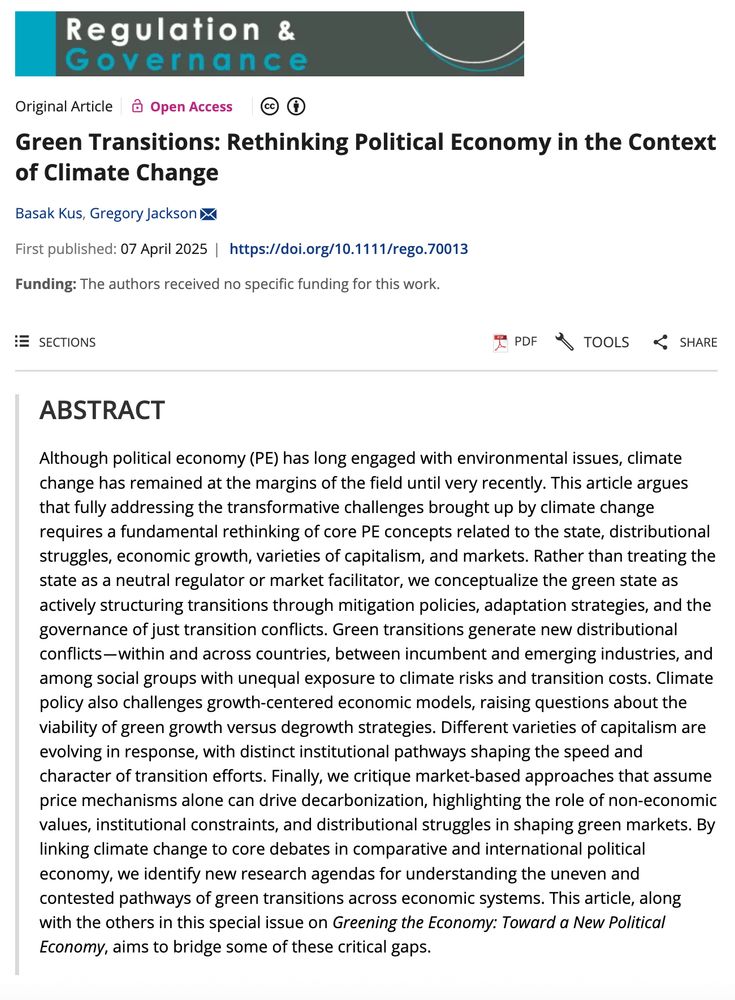
ABSTRACT
Although political economy (PE) has long engaged with environmental issues, climate change has remained at the margins of the field until very recently. This article argues that fully addressing the transformative challenges brought up by climate change requires a fundamental rethinking of core PE concepts related to the state, distributional struggles, economic growth, varieties of capitalism, and markets. Rather than treating the state as a neutral regulator or market facilitator, we conceptualize the green state as actively structuring transitions through mitigation policies, adaptation strategies, and the governance of just transition conflicts. Green transitions generate new distributional conflicts—within and across countries, between incumbent and emerging industries, and among social groups with unequal exposure to climate risks and transition costs. Climate policy also challenges growth-centered economic models, raising questions about the viability of green growth versus degrowth strategies. Different varieties of capitalism are evolving in response, with distinct institutional pathways shaping the speed and character of transition efforts. Finally, we critique market-based approaches that assume price mechanisms alone can drive decarbonization, highlighting the role of non-economic values, institutional constraints, and distributional struggles in shaping green markets. By linking climate change to core debates in comparative and international political economy, we identify new research agendas for understanding the uneven and contested pathways of green transitions across economic systems. This article, along with the others in this special issue on Greening the Economy: Toward a New Political Economy, aims to bridge some of these critical gaps.
#Specialissue #Greentransitions #Politicaleconomy
'Green Transitions: Rethinking Political Economy in the Context of Climate Change'
by @basakkus.bsky.social & Gregory Jackson
See special issue introduction 👇
onlinelibrary.wiley.com/doi/full/10....
08.04.2025 12:56 — 👍 7 🔁 3 💬 1 📌 1

ABSTRACT
New governance models increasingly employ self-regulation tools like pledges and nudges to achieve regulatory compliance. These approaches premise that voluntary compliance emerges from intrinsic motivation to cooperate rather than coercive measures. Central to their success is trust—both in government institutions and among citizens. However, rising societal polarization raises critical questions about the continued effectiveness of self-regulatory approaches. This paper examines how ideological extremity, a key dimension of polarization, affects cooperation in self-regulatory contexts. We theorize that ideological extremity erodes trust in government and interpersonal trust, thereby diminishing cooperative behavior and threatening self-regulation's viability. Furthermore, we propose that extremity transforms authority dynamics, with ideological orientation and partisan alignment increasingly determining cooperation levels. Using data from the European Social Survey (ESS) and World Value Survey (WVS), we find robust evidence that ideological extremity undermines cooperation through distinct mechanisms across the ideological spectrum. While our data has limitations, our findings have important implications for policymakers implementing self-regulation tools in polarized societies. The results suggest the need to carefully consider how ideological dynamics shape the effectiveness of voluntary compliance mechanisms.
#Earlyview #Openaccess
'Polarization and Voluntary Compliance: The Impact of Ideological Extremity on the Effectiveness of Self-Regulation'
by Libby Maman, @yuval-feldman.bsky.social, Tom Tyler
See abstract 👇
#trust #selfregulation #polarization #reggov
onlinelibrary.wiley.com/doi/full/10....
07.04.2025 17:48 — 👍 1 🔁 0 💬 0 📌 0

ABSTRACT
Given the ongoing climate crisis, the frequency and severity of natural disasters are increasing. These events result in enormous reconstruction costs, pose a high burden on state budgets, and potentially drive homeowners into private insolvency. One policy instrument for collectively covering such costs is a compulsory insurance scheme for natural hazards. As the impact of natural disasters is uneven, introducing mandatory insurance regulation has a range of social and financial implications. While some European countries have introduced compulsory schemes, others have adopted different policy responses. Taking this variation as the main puzzle, I consider what factors can explain the introduction of compulsory insurance for natural hazards. Building on public risk and quiet politics literature, I identify several factors and test these against three empirical cases: Germany, Austria, and Switzerland. This analysis finds that focusing events are necessary for policy change, but the position and power of interest groups, as well as exogenous shocks within the EU context, were also crucial to explaining the introduction, rejection, and even termination of compulsory insurance schemes for natural hazards.
#Earlyview #Openaccess
'Taking Eco-Social Risks Seriously: Explaining the Introduction of Compulsory Insurance for Natural Hazards'
by @anneparth.bsky.social
#risk #naturalhazards #insurance #quietpolitics
onlinelibrary.wiley.com/doi/full/10....
03.04.2025 11:54 — 👍 2 🔁 1 💬 0 📌 0

ABSTRACT
This paper proposes a transdisciplinary approach to design future degrowth-oriented industrial policies in pursuing a well-being economy in the case of a specific growth model. Specifically, we show that the case of the Visegrad countries (Czechia, Hungary, Poland and Slovakia, V4s) is a clarion call for the degrowth literature to be much more modest and self-critical. It addresses the puzzling question of whether the future degrowth policies of the V4s are influenced by their unique industrialization path, which has historically relied on foreign capital. It proposes a transdisciplinary framework (based on political economy and ecological economics) to root degrowth-compatible industrial policies for the degrowth transition. It then analyzes the V4s' capital-dependent growth models historically to improve degrowth-oriented industrial policy research. It concludes with implications for future study on degrowth-oriented industrial policy, based on V4s' experience anticipated to remain in a wayward FDI-dependent mode, to make the well-being economy-seeking endeavor more scientifically sound.
#Earlyview
'Well-Being Economy in the Visegrad Countries: Lessons for Degrowth-Oriented Industrial Policy'
By Oliver Kovacs & Endre Domonkos
#RegGov #degrowth
onlinelibrary.wiley.com/doi/full/10....
18.03.2025 13:06 — 👍 1 🔁 0 💬 0 📌 0
An explorer in interdisciplinary research in economics and policy-oriented social problems.
Lecturer in Public Policy at Edinburgh Uni researching corporate power and planetary health - currently global plastics treaty | ‘most improved PhD student’ 2017-18 | part-time Kieran Tierney Ultra
prof interested in political economy, business and politics, democracy, populism, capitalism, Corporate Social Responsibility (+ irresponsibility).
Post Doc @goetheuni | prev. @MZESUniMannheim & @PolEconReforms | Interested in Political Economy, Political Conflict, Welfare States & Comparative Methods
https://www.goethe-university-frankfurt.de/135512626/Benedikt_Bender?locale=en
Sicilian. Fellow at @LSESocialPolicy. Labour market protection, family policy, knowledge econ. Ogni tanto leggo, scrivo, faccio cose, vedo gente.
Associate Professor in Sociology and Researcher at SOFI, Stockholm University. Social class, social policy, inequality, politics, climate change, networks, work
Assistant professor of Political Science at the University of California, Irvine | researching and teaching IPE, financial politics, global inequality | fan of plants, birds, snacks, sci-fi, quilting | she/her
Rural Central Asia | Tajikistan | Global China | Critical agrarian studies | Everyday geopolitics | Ethnography | Labour | Cotton | Running |
@unileiden.bsky.social https://www.geog.ox.ac.uk/staff/ihofman.html
Global tax politics, economic sociology, political economy, equality. Department of Sociology, Maynooth University, Ireland
Senior researcher @mpifg.bsky.social, studying private wealth, finance & the state in the climate crisis. #privatewealth | #impinv | #greenfinance | #strandedassets
Comparative political economy @unikonstanz.bsky.social • European integration, technological change, green transition, welfare state, Bayesian statistics.
https://tobiastober.github.io
Our aim is to provide a European perspective on public policy. Join us!
Committee: @johannahornung.bsky.social, @kariningold.bsky.social,
@jo-kuenzler.bsky.social & Vilém Novotný
Website: https://ecpr.eu/Group/public-policy
Behavioral & Empirical Analysis of Regulation, Compliance & Ethics. PI @ERC_Research Voluntary Compliance Lab https://www.voluntary-compliance-lab.org/
Political Science Postdoc at GSI LMU München. Interested in social policies, social inequalities and climate crisis
Law Prof @ umich (formerly Ohio State), ABA AdLaw Section past chair, YaleJREG blogger, #adlaw nerd, dad of four
https://michigan.law.umich.edu/faculty-and-scholarship/our-faculty/christopher-j-walker
Edward B. Shils Professor of Law and Political Science; Director, Penn Program on Regulation, University of Pennsylvania. carycoglianese.net
Leverhulme Early Career Fellow @ University of Edinburgh | interested in corporate power in policymaking, regulatory governance, sustainable food systems 🌿 | 🇨🇭🇩🇪 in 🇬🇧
Senior Lecturer in European Health Policy at University of Edinburgh. Research on regulatory management, impact assessment, Better Regulation, fiscal governance, and the intersection of the above with (EU) health policy.