Congrats Jackie! So well deserved. I can’t wait to see what you do over the next few years!
09.12.2025 04:16 — 👍 1 🔁 0 💬 0 📌 0
But did NZ consider the cost of transporting all those pixels all the way there?
28.11.2025 12:03 — 👍 5 🔁 2 💬 0 📌 0
Still time to apply to work on #symbioses #mosses #cyanobacteria! Join us in #Copenhagen! @voltcenter.bsky.social
17.11.2025 06:35 — 👍 7 🔁 6 💬 0 📌 0

A table showing profit margins of major publishers. A snippet of text related to this table is below.
1. The four-fold drain
1.1 Money
Currently, academic publishing is dominated by profit-oriented, multinational companies for
whom scientific knowledge is a commodity to be sold back to the academic community who
created it. The dominant four are Elsevier, Springer Nature, Wiley and Taylor & Francis,
which collectively generated over US$7.1 billion in revenue from journal publishing in 2024
alone, and over US$12 billion in profits between 2019 and 2024 (Table 1A). Their profit
margins have always been over 30% in the last five years, and for the largest publisher
(Elsevier) always over 37%.
Against many comparators, across many sectors, scientific publishing is one of the most
consistently profitable industries (Table S1). These financial arrangements make a substantial
difference to science budgets. In 2024, 46% of Elsevier revenues and 53% of Taylor &
Francis revenues were generated in North America, meaning that North American
researchers were charged over US$2.27 billion by just two for-profit publishers. The
Canadian research councils and the US National Science Foundation were allocated US$9.3
billion in that year.

A figure detailing the drain on researcher time.
1. The four-fold drain
1.2 Time
The number of papers published each year is growing faster than the scientific workforce,
with the number of papers per researcher almost doubling between 1996 and 2022 (Figure
1A). This reflects the fact that publishers’ commercial desire to publish (sell) more material
has aligned well with the competitive prestige culture in which publications help secure jobs,
grants, promotions, and awards. To the extent that this growth is driven by a pressure for
profit, rather than scholarly imperatives, it distorts the way researchers spend their time.
The publishing system depends on unpaid reviewer labour, estimated to be over 130 million
unpaid hours annually in 2020 alone (9). Researchers have complained about the demands of
peer-review for decades, but the scale of the problem is now worse, with editors reporting
widespread difficulties recruiting reviewers. The growth in publications involves not only the
authors’ time, but that of academic editors and reviewers who are dealing with so many
review demands.
Even more seriously, the imperative to produce ever more articles reshapes the nature of
scientific inquiry. Evidence across multiple fields shows that more papers result in
‘ossification’, not new ideas (10). It may seem paradoxical that more papers can slow
progress until one considers how it affects researchers’ time. While rewards remain tied to
volume, prestige, and impact of publications, researchers will be nudged away from riskier,
local, interdisciplinary, and long-term work. The result is a treadmill of constant activity with
limited progress whereas core scholarly practices – such as reading, reflecting and engaging
with others’ contributions – is de-prioritized. What looks like productivity often masks
intellectual exhaustion built on a demoralizing, narrowing scientific vision.

A table of profit margins across industries. The section of text related to this table is below:
1. The four-fold drain
1.1 Money
Currently, academic publishing is dominated by profit-oriented, multinational companies for
whom scientific knowledge is a commodity to be sold back to the academic community who
created it. The dominant four are Elsevier, Springer Nature, Wiley and Taylor & Francis,
which collectively generated over US$7.1 billion in revenue from journal publishing in 2024
alone, and over US$12 billion in profits between 2019 and 2024 (Table 1A). Their profit
margins have always been over 30% in the last five years, and for the largest publisher
(Elsevier) always over 37%.
Against many comparators, across many sectors, scientific publishing is one of the most
consistently profitable industries (Table S1). These financial arrangements make a substantial
difference to science budgets. In 2024, 46% of Elsevier revenues and 53% of Taylor &
Francis revenues were generated in North America, meaning that North American
researchers were charged over US$2.27 billion by just two for-profit publishers. The
Canadian research councils and the US National Science Foundation were allocated US$9.3
billion in that year.

The costs of inaction are plain: wasted public funds, lost researcher time, compromised
scientific integrity and eroded public trust. Today, the system rewards commercial publishers
first, and science second. Without bold action from the funders we risk continuing to pour
resources into a system that prioritizes profit over the advancement of scientific knowledge.
We wrote the Strain on scientific publishing to highlight the problems of time & trust. With a fantastic group of co-authors, we present The Drain of Scientific Publishing:
a 🧵 1/n
Drain: arxiv.org/abs/2511.04820
Strain: direct.mit.edu/qss/article/...
Oligopoly: direct.mit.edu/qss/article/...
11.11.2025 11:52 — 👍 608 🔁 435 💬 8 📌 62
this is a nightmare and i love it
06.11.2025 23:29 — 👍 4 🔁 1 💬 0 📌 0

Small stream with clear water green macrophytes growing in it. The stream run through a tussock grassland with mountains on either side.
Pretty nice day for exploring field sites in Arthur’s Pass National Park 👩🔬This summer we’re kicking off some new work using a braided river spring complex to figure out how (if?) invasive plants affect stream energy
04.11.2025 09:10 — 👍 33 🔁 4 💬 0 📌 0
a century of glaciers melting 🧪🌐
03.11.2025 17:21 — 👍 1040 🔁 613 💬 51 📌 58

We are organising a session on #Nitrogen biogeochemistry - links to other elements and biodiversity at #BIOGEOMON 2026 in Umeå! Join us! @benhoulton.bsky.social
09.10.2025 06:31 — 👍 4 🔁 3 💬 0 📌 1
Surely though there’s a worthwhile point to be made about the environmental cost of ‘foods’ relative to their nutritional value? Depressingly wasteful that precious land, fertilises, water, GHGs go into products that don’t actually help feed humanity, just designed to meet (& create) cravings
09.10.2025 08:01 — 👍 1 🔁 0 💬 0 📌 0
So true re the immeasurable role that department administrators play in our student experience (both directly and indirectly) - and so sadly apparently universal that our corporate unis don’t seem to think twice about axing the people in these roles as expendable / optimisable / digitalisable 😕
08.10.2025 10:23 — 👍 2 🔁 0 💬 1 📌 0

Screenshot from sigma Aldrich website, listing 15N labelled potassium nitrate. And also listing ‘15N labelled potassium nitrite’ as its synonym.
🤔 not super inspiring really. Usually I like my chemically suppliers to be able to differentiate between chemical compounds. Now I’m doubting myself. Has nitrite really just been a synonym for nitrate all along, missing oxygen be damned????
07.10.2025 09:27 — 👍 2 🔁 0 💬 0 📌 0
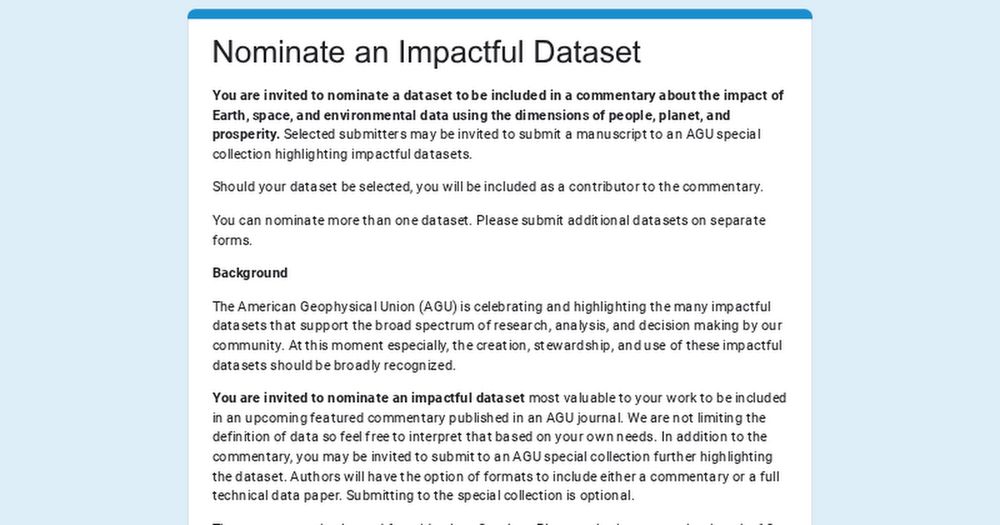
Nominate an Impactful Dataset
You are invited to nominate a dataset to be included in a commentary about the impact of Earth, space, and environmental data using the dimensions of people, planet, and prosperity. Selected submitter...
⭐️Nominate an Impactful Dataset
@agu.org invites you to nominate an impactful dataset!
📊Submissions will be considered for inclusion in an upcoming featured commentary published in AGU Advances.
Submit nominations by 20 October.
docs.google.com/forms/d/e/1F...
@agubiogeosciences.bsky.social
05.10.2025 18:32 — 👍 5 🔁 7 💬 0 📌 1
Noted 🤣
03.10.2025 09:54 — 👍 0 🔁 0 💬 0 📌 0

One submission said leaders’ salaries could not be “justified by the quality of executive decision-making, nor by the scope of executive duties. The core business of a university – teaching and research – is co-ordinated virtually entirely by ordinary non-executive staff”.
Report on Australian Higher Education finds:
🔹️ Council members have no lived experience of universities
🔹️ Council members have COIs with consultancy firms
🔹️ Council meetings are closed affairs that lack transparency
🔹️ Leaders' exorbitant salaries could not be justified
27.09.2025 21:27 — 👍 52 🔁 25 💬 3 📌 6
Yeah me too! And then a colleague was like ‘you should come to BIOGEOMON’ and I looked at the programme and it looks potentially great so now I don’t know what to do…
27.09.2025 11:23 — 👍 1 🔁 0 💬 1 📌 0
Science conferences next year: should I go to ASLO-SIL aquatic sciences in Montreal or BIOGEOMON in Umea??
Timing for the latter is much better with my teaching calendar, so really the question is: BIOGEOMON - as great as I imagine it to be? (I’ve never been to one)
26.09.2025 22:56 — 👍 2 🔁 0 💬 1 📌 0
Yeah my students use it for things like coding, clarifying new concepts, generating templates for a new writing types (eg recs). All sounds fine, but also nothing that I as an old person manage w existing tools in the same amt of time. Hard to see much ‘revolution’, just Web 2.0 (3.0)?
17.09.2025 20:49 — 👍 0 🔁 0 💬 0 📌 0

Two-panel illustration showing sparse trees in a Cretaceous landscape (bottom) and densely forested Paleocene landscape.
With the extinction of dinosaurs, dense, closed-canopy forests could proliferate, leading to shifts in fluvial structure and accumulation of organics. This represented a profound change in the landscape, illustrated here by the incomparable Julius Csotonyi.
15.09.2025 16:17 — 👍 85 🔁 26 💬 1 📌 3

Graphic with journal statistics.
Today we celebrate the 20th anniversary AGU’s JGR: Biogeosciences!🎉
For two decades, the journal has published original research, methods, and data articles on the biogeosciences of the Earth system.
🔗 Learn how to submit: buff.ly/RcwG5Ty
#AGUPubs @jgrbiogeo.bsky.social
12.09.2025 14:04 — 👍 12 🔁 9 💬 1 📌 1
So the funding for this new PRO - is this for hiring ppl, infrastructure, carrying out research, or all three? Ie, is this skewing the funding system even more (making new teams to vie for even less research $), or ‘just’ cutting contestable research $ to redistribute ppl & resources & signage?
06.08.2025 06:20 — 👍 1 🔁 0 💬 0 📌 0
The mesh-swathed object we’re contemplating in the pic is a fire pit we excavated & repurposed as an anchor / POM-excluder for our pumps, which were pummelled by waves and tonnes of storm-mobilised wrack all night long.
Some of the most physically challenging field work I’ve ever done. Worth it?
06.08.2025 03:51 — 👍 0 🔁 0 💬 0 📌 0

Two scientists wearing waterproof outdoor gear standing on the shore holding a large metal object. The sea behind them has small choppy waves and the beach is covered in green seaweed wrack.
New work out in GRL: greenhouse gas emissions across human-modified land-to-ocean aquatic continuums. We show how storms shift aquatic emission magnitude & pattern. This arose from (completely unplanned!) estuary sampling during a winter storm.
agupubs.onlinelibrary.wiley.com/doi/10.1029/...
06.08.2025 03:45 — 👍 11 🔁 2 💬 1 📌 0

Today was spent exploring new potential alpine river study sites with Helen, Angus, & Saskia. Back and brimming with so many exciting ideas 🤗👩🔬
(Now just to figure out how to make these ideas happen…)
05.08.2025 11:05 — 👍 2 🔁 0 💬 1 📌 0

Special Collection Call for Papers!
Changing biogeochemical cycles along the land-to-ocean aquatic continuum
Now open for submissions in Earth's Future, Geophysical Research Letters, Global Biogeochemical Cycles, JAMES, JGR: Biogeosciences, or JGR: Oceans.
📢Call for Papers!📢
A new #AGUPubs special collection seeks submissions that advance our understanding of human-altered nutrient and carbon cycles along the land-to-ocean continuum.
🔗 Learn how to submit: buff.ly/ZgVTHsm
#AOGS2025 #Geoscience #SDGs #Nutrients #Biogeochemistry
29.07.2025 11:01 — 👍 5 🔁 2 💬 0 📌 0
https://agnes-riviere.github.io
Earth researcher: critical zone, hydrology, hydrogeophysics, geothermal and water uses modeling, global changes
https://agnes-riviere.github.io/GWSBound
New Zealand's weather service. Helping Kiwis be ready, whatever the weather.
Critical thinking, published every fortnight.
Read the LRB: https://lrb.co.uk
Listen: https://podcasts.apple.com/gb/podcast/the-lrb-podcast/id510327102
Subscribe: https://mylrb.co.uk/TWQU0725
Professor, University of Auckland: urban ecology, conservation, invasive species. Mum to 2 teenagers. Nature fan. She/her. Aotearoa - New Zealand.
UOA profile: https://profiles.auckland.ac.nz/mc-stanley
Aquatic ecologist at U. Cologne; interested in adaptations of aquatic organisms to environmental change; underwater rugby player; born at 332 ppm
I watch volcanoes explode in the deep sea and wonder how life continues to survive such drama. Scientist, Ocean Explorer, & Storyteller
Ecosystem ecologist researches nitrogen cycling in pristine ecosystems. Focus on moss-cyanobacteria associations and nitrogen fixation.
Aquatic Invasive Species with Illinois-Indiana Sea Grant | #GreatLakes | Come for the #ecology & #scicomm, get reeled in by the fish puns
https://iiseagrant.org/about/our-team/katie-oreilly/
Aotearoa published daily → thespinoff.co.nz • Unofficial Account
Food and science (but not food science). Views my own.
Science writer & professor in Aotearoa New Zealand: Antarctica, climate, nukes. Tangata tiriti. Latest book, End Times, by @thwupbooks.bsky.social ❄🇦🇶🐧 🌈.
Now writing book about the (melting) Antarctic Ice Sheet
She/her or they/them/ia
Science integrity consultant and crowdfunded volunteer, PhD.
Ex-Stanford University. Maddox Prize/Einstein F Award winner
NL/USA/SFO.
#ImageForensics
@MicrobiomDigest on X.
Blog: ScienceIntegrityDigest.com
Support me: https://www.patreon.com/elisabethbik
Data Scientist | Smithsonian Institution (remote - Australia). Love all things biodiversity, ecology, coral reefs, mesophotic, stable isotopes
Alum | University of Queensland, Coral CoE, Johns Hopkins
Hiker, brewer, mango farmer
Statistician (she/her) | #rstats | Posts primarily about statistical ecology and fisheries (and pet chickens)
Statistical Data Artist & Scientist at Australian National University 🇳🇿 Interested in mixed models, experimental design, plant breeding 🌱, bioinfo 🧬, data vis 📊, statistical practice, ML/AI 👩🏻💻 Dabbles in UI, UX, front-end & #rstats 📦 dev
emitanaka.org
Professor of Statistics, Monash University, Australia. FAA, FASSA. Interested in #forecasting, #rstats, #statistics. he/him http://robjhyndman.com
The Global Lake Ecological Observatory Network conducts innovative science to understand, predict and communicate the role and response of lakes in a changing global environment.