Eduardo Flores's Avatar

Eduardo Flores

@metalwolf1.bsky.social

An irrational scientist trying to figure it out. Whatever "it" really is. All tweets are my own.

33 Followers  |  68 Following  |  10 Posts  |  Joined: 31.01.2025
Posts Following

Posts by Eduardo Flores (@metalwolf1.bsky.social)

Preview
Short activation domains control chromatin association of transcription factors Single-molecule tracking of transcription factors in living cells revealed how mutations that make short activation domains stronger increased the fraction of transcription factor molecules bound to c...

I'm super excited that our paper was published last month! We find that very short activation domains can control the fraction of transcription factor molecules bound to chromatin. Vinson added some very nice extra experiments in the revised version! elifesciences.org/articles/105...

26.02.2026 16:43 β€” πŸ‘ 4    πŸ” 2    πŸ’¬ 0    πŸ“Œ 0
Post image

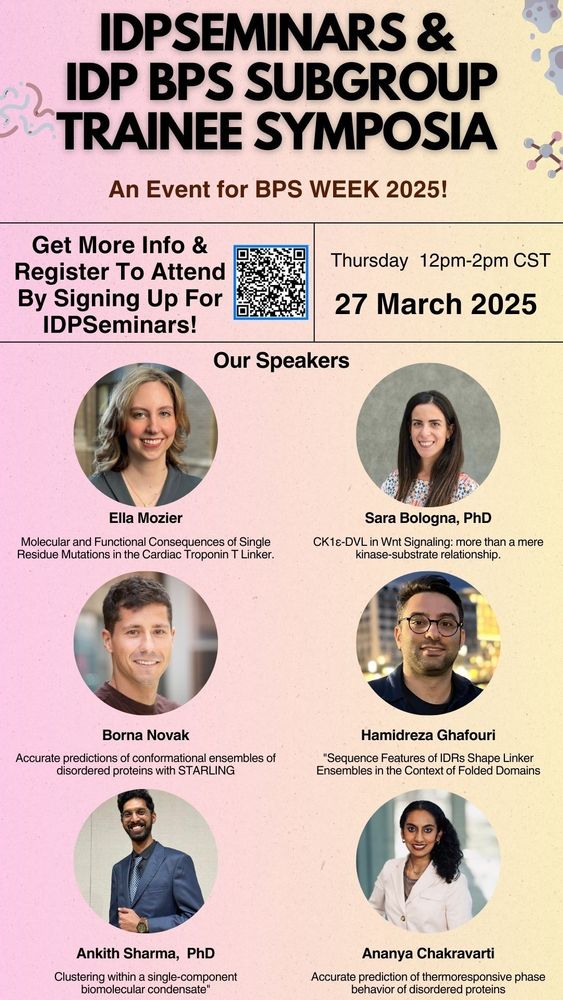
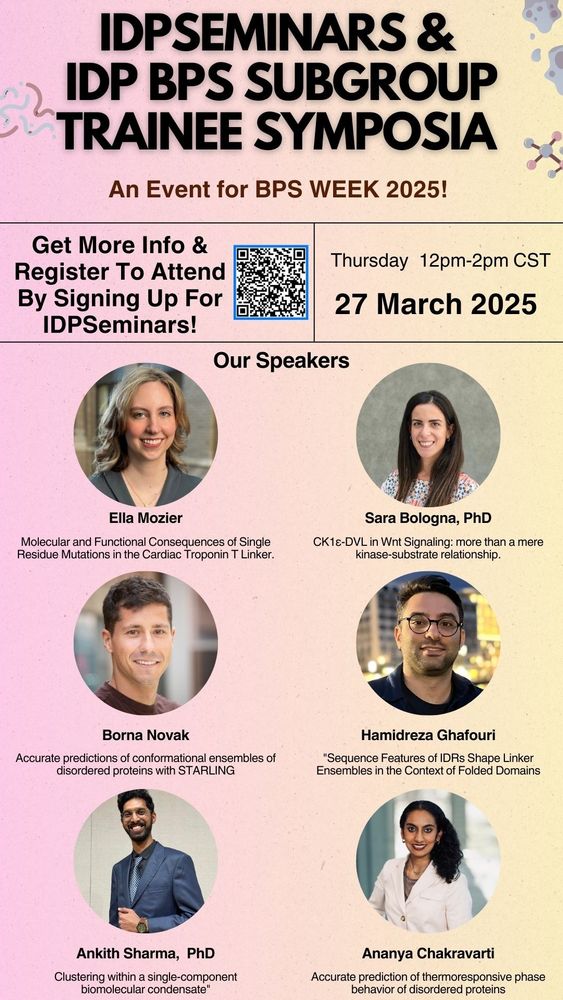
Announcing the joint @idpseminars.bsky.social / BPS IDP Subgroup Trainee Symposium Speakers! Join us on Mar 27, 12–2pm CST for 6 exciting talks focused on Intrinsically Disordered Proteins as part of #BophysicsWeek2025 with the @biophysicalsoc.bsky.social Sign up now using the QR code below!

17.03.2025 15:37 β€” πŸ‘ 8    πŸ” 3    πŸ’¬ 0    πŸ“Œ 1
Post image

Announcing the joint @idpseminars.bsky.social / BPS IDP Subgroup Trainee Symposium Speakers!

Join us on Mar 27, 12–2pm CST for 6 exciting talks focused on Intrinsically Disordered Proteins as part of #BophysicsWeek2025 with the @biophysicalsoc.bsky.social Sign up now using the QR code below!

17.03.2025 15:38 β€” πŸ‘ 16    πŸ” 8    πŸ’¬ 0    πŸ“Œ 1
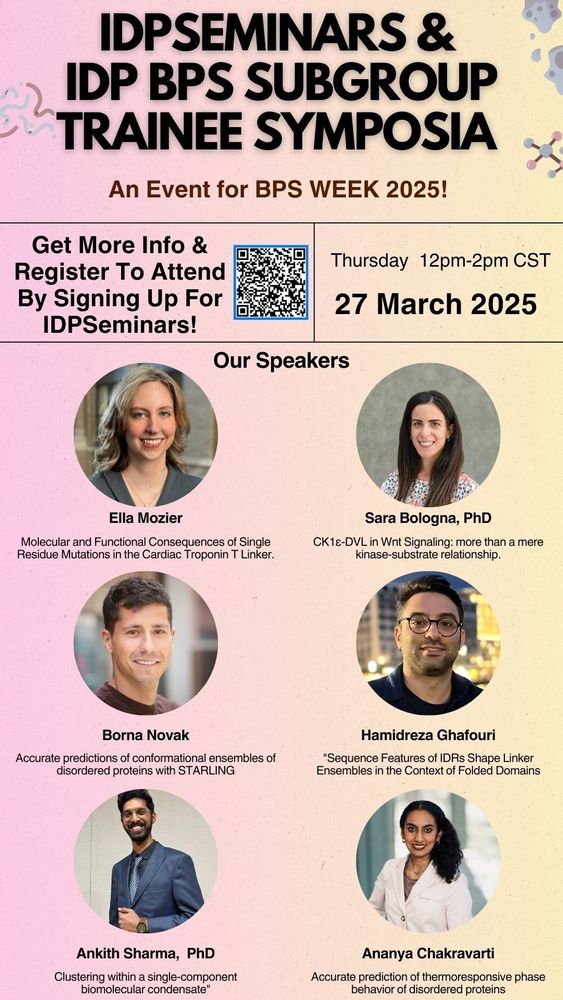
IDPSeminars/BPS IDP Subgroup symposium. March 27th 2025 at noon central time. Speakers are Ella Mozier, Sara Bologna, Borna Novak, Hamidreza Ghafouri, Ankith Sharma and Ananya Chakravarti!

IDPSeminars/BPS IDP Subgroup symposium. March 27th 2025 at noon central time. Speakers are Ella Mozier, Sara Bologna, Borna Novak, Hamidreza Ghafouri, Ankith Sharma and Ananya Chakravarti!

Announcing the joint IDPSeminars / BPS IDP Subgroup Trainee Symposium Speakers!

Join us on Mar 27, 12–2pm CST for 6 exciting talks focused on Intrinsically Disordered Proteins as part of #BophysicsWeek2025 with the @biophysicalsoc.bsky.social

Sign up now at docs.google.com/forms/d/1L_K...

17.03.2025 16:14 β€” πŸ‘ 20    πŸ” 10    πŸ’¬ 0    πŸ“Œ 4
Preview
STI1 domain dynamically engages transient helices in disordered regions to drive self-association and phase separation of yeast ubiquilin Dsk2 Ubiquitin-binding shuttle proteins are important components of stress-induced biomolecular condensates in cells. Yeast Dsk2 scaffolds proteasome-containing condensates via multivalent interactions wit...

#preprint Postdoc Nirbhik Acharya used NMR to find three transient helices within intrinsically-disordered regions of shuttle protein Dsk2 -- these interact with STI1. The STI1 is important for phase separation and proteasome condensates in yeast. Comments welcome!
www.biorxiv.org/content/10.1...

18.03.2025 00:40 β€” πŸ‘ 15    πŸ” 8    πŸ’¬ 1    πŸ“Œ 1
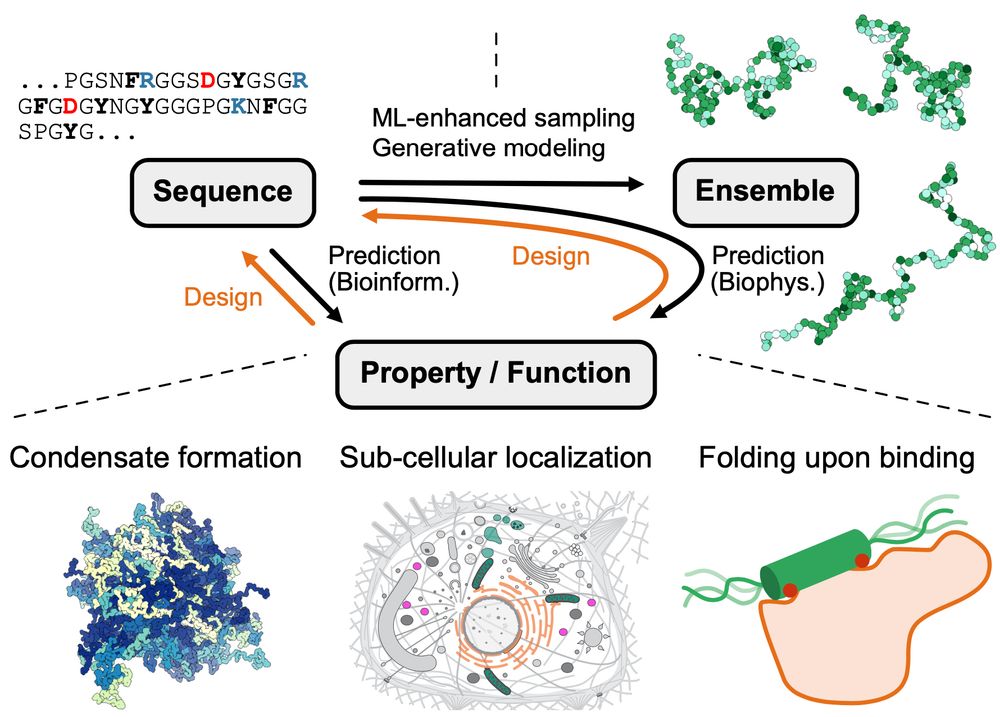
Figure from the paper illustrating sequence–ensemble–function relationships for disordered proteins. ML prediction (black) and design (orange) approaches are highlighted on the connecting arrows. Prediction of properties/functions from sequence (or vice versa, design) can include biophysics approaches via structural ensembles, or bioinformatics approaches via other hetero- geneous sources. The lower panels show examples of properties and functions of IDRs for predictions or design targets. ML, machine learning; IDRs, intrinsically disordered proteins and regions.

Figure from the paper illustrating sequence–ensemble–function relationships for disordered proteins. ML prediction (black) and design (orange) approaches are highlighted on the connecting arrows. Prediction of properties/functions from sequence (or vice versa, design) can include biophysics approaches via structural ensembles, or bioinformatics approaches via other hetero- geneous sources. The lower panels show examples of properties and functions of IDRs for predictions or design targets. ML, machine learning; IDRs, intrinsically disordered proteins and regions.

Our review on machine learning methods to study sequence–ensemble–function relationships in disordered proteins is now out in COSB

authors.elsevier.com/sd/article/S...
Led by @sobuelow.bsky.social and Giulio Tesei

12.03.2025 21:37 β€” πŸ‘ 91    πŸ” 27    πŸ’¬ 0    πŸ“Œ 1

Now published in JCIM! Thanks to reviewers and our editor for pushing us to (hopefully) clarify a few things and ensure it's clear what PENGUIN is trying to do (and what it's NOT trying to do).

Also, in case you were unsure, graphic design is our passion.

pubs.acs.org/doi/full/10....

05.03.2025 14:50 β€” πŸ‘ 35    πŸ” 9    πŸ’¬ 1    πŸ“Œ 1
Preview
Short activation domains control chromatin association of transcription factors Transcription factors regulate gene expression with DNA-binding domains (DBDs) and activation domains. It is generally assumed that DBDs are solely responsible for interacting with DNA and chromatin. ...

Happy new year! Our new preprint is live! We use single molecule imaging in live cells to show that activation domains can control how transcription factors bind to chromatin. SMT 1 TF Dogma 0 www.biorxiv.org/content/10.1...

10.01.2025 17:07 β€” πŸ‘ 10    πŸ” 4    πŸ’¬ 0    πŸ“Œ 0
Preview
Correlating Disordered Activation Domain Ensembles with Gene Expression Levels Transcription factor proteins bind to specific DNA promoter sequences and initiate gene transcription. These proteins often contain intrinsically disordered activation domains (ADs) that regulate their transcriptional activity. Like other disordered protein regions, ADs do not have a fixed three-dimensional structure and instead exist in an ensemble of conformations. Disordered ensembles contain sequence-encoded structural preferences which are often linked to their function. We hypothesize this link exists between the structural preferences of AD ensembles and their ability to induce gene expression.

Online now! Correlating Disordered Activation Domain Ensembles with Gene Expression Levels. Eduardo Flores, Aleah R. Camacho, Estefania Cuevas-Zepeda, Mary B. McCoy, Feng Yu, Max V. Staller, and Shahar Sukenik. ow.ly/Ttgo50UAiLE

06.01.2025 18:19 β€” πŸ‘ 2    πŸ” 2    πŸ’¬ 0    πŸ“Œ 0
Preview
Correlating disordered activation domain ensembles with gene expression levels Transcription factor proteins bind to specific DNA promoter sequences and initiate gene transcription. These proteins often contain intrinsically disordered activation domains (ADs) that regulate thei...

πŸ”¬ Funded by @NIH, this work contributes to the growing knowledge on intrinsically disordered proteins and their role in gene expression. Read more here:
www.cell.com/biophysrepor...

26.02.2025 07:03 β€” πŸ‘ 0    πŸ” 0    πŸ’¬ 0    πŸ“Œ 0
Post image

HIF-1Ξ± ensemble dimensions change less under osmotic stress than with specific mutations. In contrast, CITED2 shows significant ensemble changes under stress. This suggests cellular environments might naturally regulate AD function through changes in ensemble dimensions.

26.02.2025 07:03 β€” πŸ‘ 0    πŸ” 0    πŸ’¬ 1    πŸ“Œ 0
Post image

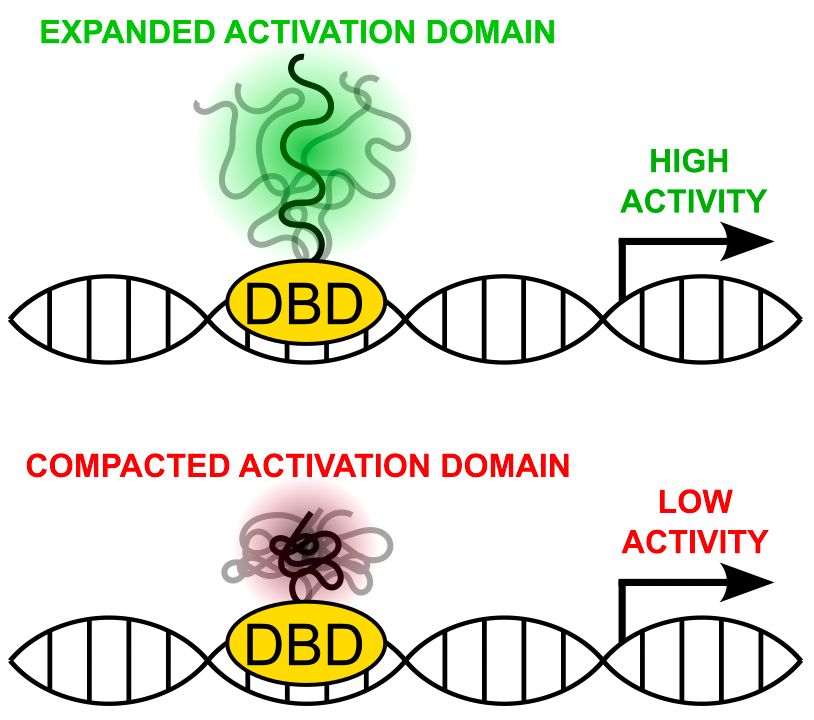
Mutations expanding the HIF-1Ξ± ensemble correlated with higher activity, while compaction correlated with reduced activity. For CITED2, ensemble size didn’t impact activity. Our findings suggest that ensemble dimensions may influence transcriptional activity in some ADs.

26.02.2025 07:03 β€” πŸ‘ 0    πŸ” 0    πŸ’¬ 1    πŸ“Œ 0
Post image

We studied two activation domains from HIF-1Ξ± and CITED2, using live-cell FRET microscopy to measure changes in their ensemble dimensions.

26.02.2025 07:03 β€” πŸ‘ 0    πŸ” 0    πŸ’¬ 1    πŸ“Œ 0
Post image

πŸ“’ Excited to share our research with @shaharsu.bsky.social & @mvstaller.bsky.social on how activation domain (AD) structure affects gene expression! 🧬 TLDR: HIF-1Ξ± & CITED2 ADs suggest ensemble dimensions may regulate transcription in unique ways.
www.cell.com/biophysrepor...
🧡 Highlights:

26.02.2025 07:03 β€” πŸ‘ 10    πŸ” 3    πŸ’¬ 1    πŸ“Œ 0
mvstaller.bsky.social

I’m grateful to Max Staller (@mvstaller.bsky.social) for his insights, discussions, and for providing the activity data for our correlations. Deep thanks to (blueskyless?) Aleah Camacho, Estefania Cuevas-Zepeda, Mary McCoy, and Feng Yu for their contributions throughout the project!

26.02.2025 06:54 β€” πŸ‘ 0    πŸ” 0    πŸ’¬ 0    πŸ“Œ 0
Preview
Correlating disordered activation domain ensembles with gene expression levels Transcription factor proteins bind to specific DNA promoter sequences and initiate gene transcription. These proteins often contain intrinsically disordered activation domains (ADs) that regulate thei...

πŸ”¬ Funded by
@NIH, this work contributes to the growing knowledge on intrinsically disordered proteins and their role in gene expression. Read more here:
www.cell.com/biophysrepor...

26.02.2025 06:54 β€” πŸ‘ 0    πŸ” 0    πŸ’¬ 1    πŸ“Œ 0
Post image

HIF-1Ξ± ensemble dimensions change less under osmotic stress than with specific mutations. In contrast, CITED2 shows significant ensemble changes under stress. This suggests cellular environments might naturally regulate AD function through changes in ensemble dimensions.

26.02.2025 06:54 β€” πŸ‘ 0    πŸ” 0    πŸ’¬ 1    πŸ“Œ 0
Post image

Mutations expanding the HIF-1Ξ± ensemble correlated with higher activity, while compaction correlated with reduced activity. For CITED2, ensemble size didn’t impact activity. Our findings suggest that ensemble dimensions may influence transcriptional activity in some ADs.

26.02.2025 06:54 β€” πŸ‘ 0    πŸ” 0    πŸ’¬ 1    πŸ“Œ 0
Post image

We studied two activation domains from HIF-1Ξ± and CITED2, using live-cell FRET microscopy to measure changes in their ensemble dimensions.

26.02.2025 06:54 β€” πŸ‘ 0    πŸ” 0    πŸ’¬ 1    πŸ“Œ 0