This work is now out in Nature Communications! 🎉
Computational signatures of uncertainty are reflected in motor cortex excitatory neurochemistry: www.nature.com/articles/s41467-025-64702-6
Huge thanks to our amazing team! @beckyneuro.bsky.social @campsydept.bsky.social @camneuro.bsky.social
05.11.2025 13:26 —
👍 21
🔁 9
💬 1
📌 0
This work challenges deficit-oriented narratives around perception in autism and highlights shared strengths of implicit perceptual cohesion across neurodiversity.
13.11.2025 12:26 —
👍 0
🔁 0
💬 0
📌 0
In this large-scale (n = 470) pre-registered online behavioural study involving two different tasks - no significant group differences emerged.
13.11.2025 12:26 —
👍 0
🔁 0
💬 1
📌 0
@plos.org
13.11.2025 12:17 —
👍 0
🔁 0
💬 0
📌 0
This one was featured in the @natcomms.nature.com editors highlights page - a lovely recognition of the quality and importance of this work. Well done team!
13.11.2025 12:14 —
👍 1
🔁 1
💬 0
📌 0
This opens exciting avenues: for example, exploring whether similar neurochemical-computational links exist in value-based or affective learning settings (where anxiety might play a stronger role).
13.11.2025 12:14 —
👍 0
🔁 0
💬 1
📌 0
Even though uncertainty processing is tightly linked to anxiety, we found these computational signatures were not simply explained by trait anxiety. However, individuals higher in trait anxiety were faster after the reversal of the task-structure suggesting they adapted more quickly to change.
13.11.2025 12:14 —
👍 0
🔁 0
💬 1
📌 0
In the context of a motor learning task, we show that the way people update beliefs under uncertainty maps onto excitatory neurochemistry in motor cortex. Higher M1 Glx was tied to stronger prediction-error updates and lower inferred volatility.
13.11.2025 12:14 —
👍 0
🔁 0
💬 1
📌 0
Suggests a mechanism by which postnatal maternal anxiety could shape early sensitivity to environmental unpredictability.
For anyone interested in developmental neurocognition, early risk for anxiety, and prediction-error processing, this opens up a compelling pathway.
13.11.2025 12:01 —
👍 1
🔁 0
💬 0
📌 0
Key findings:
Prediction-error responses localised to infant mPFC and only evident when controlling for infant attention via gaze.
The strength of these responses scaled with maternal trait anxiety – infants whose mothers were more anxious showed greater activation to unexpected stimuli.
13.11.2025 12:01 —
👍 0
🔁 0
💬 1
📌 0
Just found Brónagh on BlueSky - go give her some love
@bronaghm.bsky.social
13.11.2025 11:54 —
👍 1
🔁 0
💬 0
📌 0
Suggests that when studying anxiety and learning, we should consider both sources of uncertainty (noise + volatility), not just volatility alone.
Great advance for computational psychiatry and understanding how anxiety influences adaptation in changing environments.
13.11.2025 11:51 —
👍 0
🔁 0
💬 0
📌 0
Key take-aways:
Noise and volatility interact in shaping learning behaviour and modelled learning rates.
Anxious traits modulated how people responded especially when noise was high and volatility low: more lose-shift, less adjustment.
13.11.2025 11:51 —
👍 0
🔁 0
💬 1
📌 0
I've been pretty absent from social media for a while, mostly for my own sanity. But my lab have had a run of amazing outputs lately, and it feels like the right moment to shake off the cobwebs and share what they've all been up to. I'm genuinely so proud of this team. Separate posts to follow!
13.11.2025 11:45 —
👍 6
🔁 0
💬 0
📌 1

Effort choices are sensitive to prior learning
Motivated behaviour relies on both learning and effort-based decision-making, yet these processes are often studied in isolation. We developed a novel paradigm combining probabilistic associative lear...
My first post into the bsky void, the first preprint of my PhD! A novel task to bridge learning and effort decision-making.
Of course, we find that effort choice is sensitive to prior learning, but this integration of beliefs into action is affected by anhedonia.
doi.org/10.1101/2025...
01.08.2025 10:00 —
👍 14
🔁 6
💬 1
📌 0

Long overdue update prompted by submitting my hardbound thesis: I successfully defended my PhD earlier this year and have started a postdoc with @beckyneuro.bsky.social! Excited for more adventures in uncertainty with an amazing team.
16.10.2025 11:54 —
👍 98
🔁 3
💬 5
📌 0

Anne Willis, Head of MRC Toxicology Unit, with quote on Cambridge Blue background: ‘Half the workforce in Biomedical Sciences are women, who make an enormous contribution to the subject area. However, women still face challenges in their career progression. It is essential that women are fully represented at all levels, and especially in strategic leadership positions where their contributions have the potential to motivate and, I hope, inspire others'

Sandra Fulton, School of Biological Sciences, Director of Education (Natural Sciences and Psychological and Behavioural Sciences), smiling, wearing glasses, with blue scarf, with quote on Cambridge Blue background: ‘I think it is important for women to be involved in education strategy/leadership to bring a broad perspective to the roles, to ensure that strategic development takes into account the particular challenges faced by women in undertaking research and teaching and to encompass a range of learning styles and teaching delivery in our deliberations.'

Catherine Lindon, Pharmacology, Biomolecular Science MPhil Lead, smiling, with quote on Cambridge Blue background: ‘It’s important for women to be involved in education strategy/ leadership positions – to ensure the diversity of leadership that gives rise to creative decision-making and enhanced educational experience and outcomes for all students, regardless of gender.'

Heike Laman, Head of Department of Pathology, with quote on Cambridge Blue background: ‘When we spoke to people in Pathology about career progression in science, they highlighted the challenges of advancing in academic science and the scarcity of women in senior leadership roles. I believe it’s essential for the next generation of scientists to see and experience women in leadership—not only to raise aspirations but also to redefine expectations of what effective leadership looks like and who can embody it. My hope is that by seeing more women in these roles, future scientists will be able to imagine themselves there too.'
Read our final reflections from our inspiring Women in Leadership positions across the School of Biological Sciences this International Women’s Day (and make sure to check out our other posts!)
#IWD2025 #InternationalWomensDay
08.03.2025 16:14 —
👍 5
🔁 3
💬 0
📌 0

Mekayla Storer, Cambridge Stem Cell Institute, Reproduction, Development and Lifelong Health Research Theme Lead and Developmental Biology MPhil Lead, smiling, with quote on Cambridge Blue background: ‘Diverse leadership teams lead to better decision-making and overall success. Women bring unique perspectives and experiences to the table, pushing boundaries and driving innovation’.

Amy Milton, Psychology, Neuroscience, Psychology and Behaviour Research Theme Lead, in a red coat with quote on Cambridge Blue background: ‘We stand the best chance of making progress in solving complex problems, like understanding mental health conditions, by bringing in to the conversation people with different backgrounds, perspectives and approaches. I’ve been proud to contribute to this as an Research Theme Lead, and I look forward to continuing this work on promoting equity as Co-Chair of the Culture & Inclusion Steering Committee.'
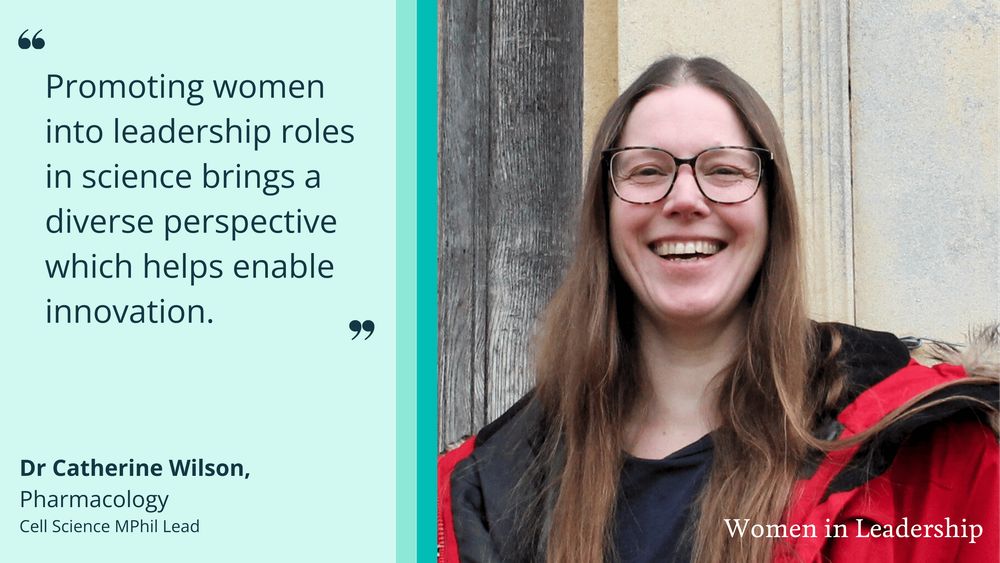
Catherine Wilson, Pharmacology, Cell Science MPhil Lead, in a red coat with quote on Cambridge Blue background: ‘Promoting women into leadership roles in science brings a diverse perspective which helps enable innovation.'

Amanda Sferruzzi-Perri, Physiology, Development and Neuroscience, Reproduction, Development, and Lifelong Health Research Theme Lead and Reproduction and Embryogenesis MPhil Lead smiling, in a red scarf with quote on Cambridge Blue background: ‘It is important to have women in leadership positions as they bring diverse perspectives, unique management styles, and valuable strengths, especially in balancing work and family responsibilities. They also serve as powerful role models for the next generation, demonstrating that career success and family life can go hand in hand’
We are continuing to celebrate the Women in Leadership across the School of Biological Sciences who are contributing to our excellent research and education.
Here are some more inspiring quotes from our amazing leaders!
#IWD2025 #InternationalWomensDay
08.03.2025 13:01 —
👍 6
🔁 1
💬 0
📌 1

Kate Baker, Genetics, Infection and Immunity Research Theme Lead, smiling, wearing glasses, in a black shirt, with quote on Cambridge Blue background: 'True progress happens when leadership reflects the communities it impacts. Fairness isn’t about idealism – it’s smart strategy.'

Lida Derevnina, Plant Sciences, Crop Science MPhil Lead, smiling, in a plant laboratory with quote on Cambridge Blue background: 'The most powerful educational systems are built by diverse voices that challenge traditional boundaries. As women step into leadership roles, we're not just filling seats—we're fundamentally reshaping how we nurture future thinkers and leaders. Where I once saw few role models, I now see possibility. For the next generation, these leadership roles will be normal, expected, and simply the way the world should work. We are reimagining learning, potential, and success, one leadership position at a time.'

Rebecca Lawson, Psychology, Acting Deputy Head of School for Research Strategy, smiling, in a black shirt with quote on Cambridge Blue background: "Scientific progress thrives on diversity, and the inclusion of women in research strategy and leadership is not just about equity—it’s about excellence. A diverse research leadership enriches the way we approach problems, challenge assumptions, and translate discoveries into meaningful change. At Cambridge, we recognise that the future of biological sciences depends on fostering leadership that reflects the full breadth of talent in our community"

Laura Itzhaki, Pharmacology, Head of the Department of Pharmacology, smiling, in a black shirt with quote on Cambridge Blue background: "I have found being Head of Department great fun and rewarding. It has been exciting and empowering to see what can be done. Often women don't see themselves in leadership positions, but I'm sure they'd be pleasantly surprised if they tried, and the more diverse the leadership the better for everyone."
Happy International Women’s Day!
Today we are celebrating the Women in Leadership across the School of Biological Sciences driving Research and Education Strategy.
Read their reflections on the importance of involving women in leadership teams.
#IWD2025 #InternationalWomensDay
08.03.2025 09:12 —
👍 16
🔁 5
💬 0
📌 3

Neurochemical markers of uncertainty processing in humans
How individuals process and respond to uncertainty has important implications for cognition and mental health. Here we use computational phenotyping to examine individualised 'uncertainty fingerprints...
New preprint alert! How do we process uncertainty, and how do neurometabolites shape this?🧠Here we combine computational modeling + 7T MRS to answer these questions: www.biorxiv.org/content/10.1...
With Peter Thestrup Waade, Chris Mathys, Frederike Petzchner, @beckyneuro.bsky.social & others! 🧵(1/4)
20.02.2025 15:33 —
👍 16
🔁 10
💬 1
📌 1
Lived Experience Academy brings a new approach to research - Durham University
Our new project, the Lived Experience Academy, is putting people with #livedexperience at the top of the research hierarchy for the first time. www.durham.ac.uk/news-events/... @nihr.bsky.social @durham-university.bsky.social @northumbriauni.bsky.social @gatesheadcouncil.bsky.social
20.11.2024 12:46 —
👍 3
🔁 2
💬 0
📌 0
Hello everyone! The Computational Psychiatry journal is now on Bluesky... Please follow for updates about articles, special issues, and #CPsy job and conference announcements. Our Co-Eds-in-Chief are here too: @xiaosigu.bsky.social and @drrickadams.bsky.social
14.11.2024 12:28 —
👍 4
🔁 1
💬 0
📌 1
Major funding awarded to support the next generation of researchers
The School of Biological Sciences has received one of the BBSRC Doctoral Landscape Awards announced by UK Research and Innovation (UKRI) to support our Cambridge Biosciences Doctoral Training
Great news that the Cambridge Biosciences Doctoral Training Partnership will be funded by one of UKRI BBSRC's new Doctoral Landscape Awards, offering PhD training across the breadth of BBSRC Strategic and Discovery Bioscience. Applications to start in October 2025 are now open!
15.11.2024 15:04 —
👍 3
🔁 3
💬 1
📌 0
👋
14.11.2024 16:27 —
👍 1
🔁 0
💬 1
📌 0