Cool approach to use expert-elicited tree attractiveness scores. Would be could to match them with field-derived data in the future.
21.01.2026 17:05 —
👍 1
🔁 1
💬 0
📌 0
Common FIT designs contain an upper and a lower container. They may be adjusted for #bee research by removal of the upper container: we caught very few insects and not a single bee in it, which is surprising given the results for other arthropod groups, mostly in forest research.
🐝 #monitoring #JKI
21.01.2026 15:02 —
👍 0
🔁 0
💬 0
📌 0
Seeing the actual numbers plotted takes the shock and disbelief to the next level...
@wbrazelton.bsky.social
21.01.2026 14:27 —
👍 1
🔁 1
💬 0
📌 0
Bee communities caught with FITs mirrored communities expexted from the literature and from known preferences of specialized bees. They proved as a valid, standardizable and reliable tool for monitoring bees.
21.01.2026 13:51 —
👍 1
🔁 0
💬 1
📌 0
In an inital pilot study, we then focussed on flight interception traps (often called window traps) as a promising, standardizable method for monitoring bees in trees. We tested FITs in different tree species at their peak bloom, particularly focussing on the methodological aspects of this method.
21.01.2026 13:44 —
👍 0
🔁 0
💬 1
📌 0
Happy to share our latest publication with you. 🧵
Trees are often overlooked as relevant bee forage ressources. Realising that there is relatively little known about bees in flowering tree canopies, we searched for data and methodologies to tackle this gap.
@jki-research.bsky.social
21.01.2026 13:36 —
👍 16
🔁 5
💬 1
📌 0

🥁 Wer wird Vogel des Jahres 2026? Das digitale Wahllokal hat ab sofort für euch geöffnet und jetzt kommt es auf deine Stimme an. 💌 Waldohreule, Schleiereule, Amsel, Zwergtaucher oder Rebhuhn – Wer wird dieses Jahr an die Spitze flattern? 👉 Jetzt abstimmen auf www.vogeldesjahres.de
02.09.2025 08:10 —
👍 227
🔁 63
💬 26
📌 71

‘Almost unimaginable’: these ants are different species but share a mother
Ant queens of one species clone ants of another to create hybrid workers that do their bidding.
woah this is genuinely, utterly WILD
Ant queens of one species produce males of another species, so she can then mate with them and produce hybrid workers!
This is so gloriously weird I can't quite compute it 🤯🧪🐜
www.nature.com/articles/d41...
03.09.2025 22:09 —
👍 890
🔁 340
💬 19
📌 83
Pike & Rittschof pointing out that "only ∼13% of resource competition studies evaluated fitness effects of A. mellifera on wild bees" and call it a research gap. Not surprising! It's a real challenge to look at fitness, particularly for rare species, which might be the most vulnerable.
25.08.2025 13:14 —
👍 3
🔁 0
💬 0
📌 0
This is hot!!
doi.org/10.1016/j.uc...
One of the puzzle pieces to predict future urban bee community composition...
25.08.2025 09:44 —
👍 4
🔁 0
💬 1
📌 0

Honey bee (Apis mellifera L.) and wild bee resource competition: how big is this problem?
Abstract. The Western honey bee (Apis mellifera L.) has been managed by humans for centuries for honey, wax, and most recently, crop pollination. The deep
Honey bee (Apis mellifera L.) and wild bee resource competition: how big is this problem?
Spoiler: not a very big problem.
Pike & Rittschof 2025
doi.org/10.1093/icb/...
#apidologie #beeresearch #beescience #science #biology #environment #beekeeping #bees
18.06.2025 04:35 —
👍 2
🔁 2
💬 0
📌 1
Interesting study by the @isaacslab.bsky.social showing the need for drift-reducing agricultural application techniques in order to mitigate risks for pollinators academic.oup.com/ee/article/5...
20.08.2025 12:42 —
👍 8
🔁 2
💬 1
📌 0
@habitecture.bsky.social
20.08.2025 10:56 —
👍 1
🔁 0
💬 0
📌 0
Great to read this synthesis on how effective promotion measurements for urban pollinators really are! They work! Sadly, there is no data on perennial plantings yet - watch this space.
20.08.2025 10:55 —
👍 5
🔁 0
💬 1
📌 0
I'd like to see our opinion paper to be a starting point for a wider discussion before monitoring methodology is written in stone.
09.07.2025 17:50 —
👍 3
🔁 1
💬 0
📌 0

Some of the survey sites are located in intensively managed agricultural areas. Just in these locations, the field margins show an unexpectedly diverse flora during the course of the year (note the difference between end of March and beginning of May 2025). At this site, located in the Salzland district of Saxony-Anhalt, the halictid bee (Lasioglossum xanthopus) visits flowers of field bugloss (Lycopsis arvensis), among others.
Photo: Dr Severin Polreich/JKI

Researchers at the JKI Institute for Bee Protection collect pan-trap samples. The spectrum of bee species and other flower-visiting insects is determined using DNA metabarcoding later on.
Photo: Dr Severin Polreich/JKI

Hedges are important landscape elements, providing not only food but also nesting opportunities and sun-exposed surface for warming up and resting (here on field maple, Acer campestre), which may also have a positive effect on the pollination activity of bees in the cooler spring.
Photo: Dr Severin Polreich/JKI
Researchers at our Institute for #Bee Protection are currently collecting data on the occurrence of honeybees and wild bees in agricultural landscapes. Systematic data collection over several years will provide a robust reference for future interval monitoring. #WorldBeeDay
www.julius-kuehn.de/en/bs
20.05.2025 10:06 —
👍 6
🔁 3
💬 1
📌 0
Great to have you here @jki-research.bsky.social
10.05.2025 20:46 —
👍 2
🔁 0
💬 0
📌 0


Ok, so I know all bees are incredible creatures, and it's a brave human who ranks them. But surely this blue carpenter bee would be near the top?
This is Xylocopa tumida and she is gorgeous. 1/3
01.03.2025 16:52 —
👍 787
🔁 158
💬 13
📌 13
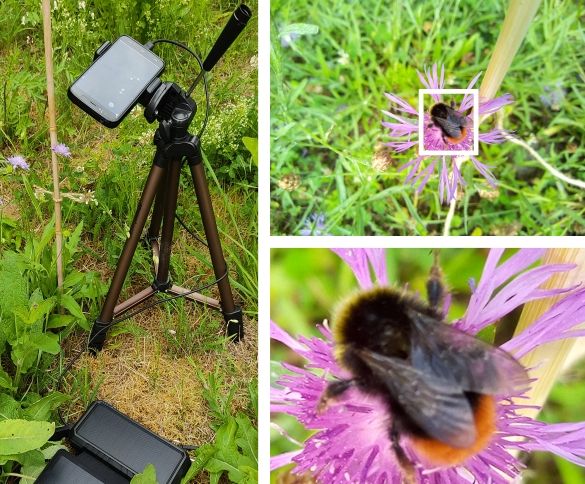
2025 starts with a methodology publication by Ștefan et al. on Utilising affordable smartphones and open-source time-lapse photography for pollinator image collection and annotation - Happy new year!
doi.org/10.26786/192...
10.01.2025 16:22 —
👍 30
🔁 15
💬 1
📌 3

Cover Artenfocus

Titel Wildbienen-Artikel
Kürzlich ist ein Wildbienen-Artikel erschienen 🐝🐝
Autor*innen: Thomas Fechtler, Hanna Gardein (Julius-Kühn-Institut), Felix Kirsch @thuenen.de, Friederike Grau & Annika Haß @funcagroeco.bsky.social @unigoettingen.bsky.social & Fionn Pape.
▶️ www.researchgate.net/publication/...
22.01.2025 08:12 —
👍 45
🔁 11
💬 1
📌 0

Elon Musk and the right’s war on Wikipedia
The world's richest man has joined a growing chorus of right-wing voices attacking Wikipedia as part of an intensifying campaign against free and open access information.
The world's richest man has joined a growing chorus of right-wing voices attacking Wikipedia as part of an intensifying campaign against free and open access information. Why do they hate it so much?
02.01.2025 23:43 —
👍 5158
🔁 1626
💬 324
📌 220

A Biting Buzz
Bees transfer vibrations better and increase pollen rewards when they grasp flowers with their mandibles.
A biting buzz: Thanks to Sigma Xi and New Scientist for covering our work on how #bees bite flowers to transmit vibrations to flowers during buzz pollination! www.americanscientist.org/article/a-bi...
18.01.2025 06:59 —
👍 20
🔁 4
💬 0
📌 0

Crop diversification for pollinator conservation - Landscape Ecology
Context Intensive agriculture drives insect decline impacting insect-mediated ecosystem services that support production. Crop diversification shows promise in increasing crop productivity and enhanci...
New study: #CropDiversification can help pollinators without taking land out of agricultural production, but only some #pollinator species may benefit. We highlight mechanisms on the spatial
and temporal #diversity of crops. Led by Thijs Fijen @w-u-r.bsky.social
14.01.2025 11:57 —
👍 39
🔁 16
💬 2
📌 0