
Huge thanks to everyone involved in this project Berta Casas, Alba Cervera-Lierta, @qzoeholmes.bsky.social and Adrián Pérez-Salinas.
09.02.2026 13:28 — 👍 0 🔁 0 💬 0 📌 0Huge thanks to everyone involved in this project Berta Casas, Alba Cervera-Lierta, @qzoeholmes.bsky.social and Adrián Pérez-Salinas.
09.02.2026 13:28 — 👍 0 🔁 0 💬 0 📌 0
We validate this theorem by simulating the training of the anisotropic XY model and the generalized Ising Hamiltonian. We test the iterative strategy for 16 qubits with a real shot-noise model, and we find that the iterative training is successful provided we remain away from a gap closing.
09.02.2026 13:28 — 👍 1 🔁 0 💬 1 📌 0
We provide a rigorous theoretical foundation for this approach. We lower-bound the variance at each iteration of the problem, and show that it doesn’t vanish exponentially provided that we remain away from gap closings.
09.02.2026 13:28 — 👍 1 🔁 0 💬 1 📌 0
We demonstrate that solving a sequence of discretely deformed Hamiltonians facilitates tracking the ground-state manifold towards the target system even when scaling up the system size.
09.02.2026 13:28 — 👍 0 🔁 0 💬 1 📌 0
Preparing approximate ground states has never been hotter 🔥, nor cooler🥶
scirate.com/arxiv/2602.0...
In short: we combine warm-started variational quantum circuits with adiabatic principles to show how iterative training strategies can be useful to prepare approximate ground states.

Thanks to all my collaborators Hela Mhiri, Sacha Lerch, @quantummanuel.bsky.social, @thipchotibut.bsky.social, Supanut Thanasilp, @qzoeholmes.bsky.social
13.02.2025 14:49 — 👍 5 🔁 0 💬 0 📌 0We therefore conclude that while warm-starting strategies offer some hope for sidestepping the barren plateau phenomenon, for this hope to be realized, we will likely need increasingly clever initialization strategies.
13.02.2025 14:49 — 👍 4 🔁 0 💬 1 📌 0Finally, we show that for some circuits, having BP when looking at the whole landscape also means having BP in some of the order-1 regions. This, combined with our numerical analysis, suggests that warm-starting strategies will need to increase precision as the number of qubits increases.
13.02.2025 14:49 — 👍 2 🔁 0 💬 1 📌 0
We also reproduce results for previously studied circuits, particularly around the identity, for HVA, HEA, and tensor product ansatz. We use these results to analyze the effect of global/local observables and the impact of correlating parameters.
13.02.2025 14:49 — 👍 4 🔁 0 💬 1 📌 0
We use this bound to study different circuits and points on the landscape. In particular, we present a corollary that characterizes the size of the region around the minima. We also focus on studying the region around zero for time-correlated circuits, such as the correlated UCC or HVA circuits.
13.02.2025 14:49 — 👍 4 🔁 0 💬 1 📌 0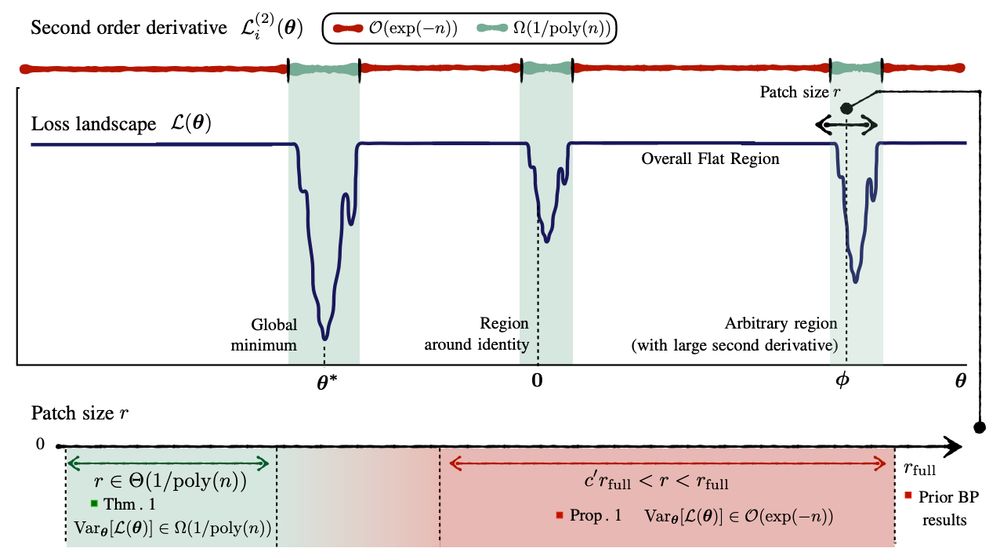
We analytically prove a generic lower bound on the variance of a loss function. It can be applied around any point on the landscape and for a wide range of circuits. Around any point with substantial curvature, we can prove that there exists a substantial region with (non-exp small) gradients.
13.02.2025 14:49 — 👍 4 🔁 0 💬 1 📌 0
New paper on arXiv 🔥
We present a bound that unifies all the previous guarantees of small regions with substantial gradients in BP landscapes. This allows us to study new architectures, parameter correlations, and points on the landscape that could not be analyzed before.
scirate.com/arxiv/2502.0...
Special thanks to my co-authors Marc Drudis, Supanut Thanasilp and @qzoeholmes.bsky.social
24.01.2025 11:37 — 👍 3 🔁 0 💬 0 📌 0
However this does not mean that it is not possible to train. To do so the ‘only thing’ we require is a path with substantial gradients. These fertile valleys between barren regions can theoretically exist, but to what extent is unknown. We provide a toy example of this.
24.01.2025 11:37 — 👍 1 🔁 0 💬 1 📌 0
A final limitation of our analysis is that the adiabatic minimum need not be the global minimum of the loss. It is possible for the best minimum to jump from the initialization region to another. We show an example in which this seems to happen.
24.01.2025 11:37 — 👍 1 🔁 0 💬 1 📌 0An adiabatic minimum is the one that a marble dropped in the initial minima would follow if the landscape were slowly modified with time. We show that the scheme will converge to this minimum if the time step is small enough for the minimum to be within the above region.
24.01.2025 11:37 — 👍 1 🔁 0 💬 1 📌 0
Focusing on an iterative variational method for quantum dynamics as an ideal playground for studying warm starts, we can analytically guarantee substantial gradients and approximate convexity around the initializations at each (small) time-step.
24.01.2025 11:37 — 👍 1 🔁 0 💬 1 📌 0Barren plateaus are fundamentally a statement about the landscape "on average". However, there may be small regions with substantial gradients and good solutions. This has motivated the study of warm starts whereby the algorithm is cleverly initialized closer to a minimum.
24.01.2025 11:37 — 👍 1 🔁 0 💬 1 📌 0
Is a barren plateau landscape trainable? If we start close to the actual solution, then probably yes!?
Here we study variational quantum simulation to explore whether warm starts can be a possible solution to exponential concentration

Our paper titled Variational Quantum Simulation: A Case Study for Understanding Warm Starts has been published in PRX Quantum 🚀
Short explanation 🧵 or you can find the whole paper here: journals.aps.org/prxquantum/a...
Nature cools things easily but getting a quantum computer to do it is hard!
Give us an approx ground state, we present an algorithm that approximates imaginary time evolution to:
- Cool that state by an amount proportional to its energy fluctuations
- Increase its fidelity with the ground state
Thanks to all my collaborators for making this possible Pavel Sekatski, Paolo Andrea Erdman, Paolo Abiuso, John Calsamiglia ( @giq-bcn.bsky.social ), and Martí Perarnau-Llobet
05.12.2024 09:36 — 👍 1 🔁 0 💬 0 📌 0With this work we try to provide new insights into the potential and limits of many-body metrology.
05.12.2024 09:36 — 👍 0 🔁 0 💬 1 📌 0We also analyze the transient regime from the dynamical metrology to the steady – state via different processes, and characterize tradeoffs between equilibration times and measurement precision.
05.12.2024 09:36 — 👍 0 🔁 0 💬 1 📌 0
Starting from a product state, we present bounds for the Quantum Fisher Information and find physically relevant interactions that approach such bounds.
We study this for the dynamical regime and for the Gibbs and time-averaged dephased state.

New paper on arXiv🔥
How can many-body interactions boost quantum sensing to its limits?
We show how to add controlled interactions in many-body probes to reach the highest precision limits in quantum metrology -- both for dynamical and steady states.
scirate.com/arxiv/2412.0...
#quantum
New paper out!! We study quantum-enhanced classical simulation. Check out @quantummanuel.bsky.social 's post or find the paper here scirate.com/arxiv/2411.1...
#quantum
Would really appreciate it! Thanks.
01.12.2024 11:58 — 👍 2 🔁 0 💬 1 📌 0Hey!! Could you add me please?
26.11.2024 09:45 — 👍 1 🔁 0 💬 0 📌 0Thanks!!
22.11.2024 07:15 — 👍 0 🔁 0 💬 0 📌 0