Cenozoic evolution of wet season (months when ΔTT > 0) a mean land rainfall averaged over South Asian region (70°E–110°E; 5°N–30°N); accumulated upper tropospheric temperature gradient (ΔTT); atmospheric CO2 levels (right y-axis). The TP area above 3.5 km elevation in the 70°E–105°E, 25°N–45°N domain is shown in the pink shade with the right y-axis. b Mean column-integrated moisture in 40°E–160°E, 15°S–30°N domain (left y-axis); vertical velocity at 500 hPa (ω500) averaged over 70°E–110°E, 5°N–30°N; relative SST (tropical mean subtracted) in the northern Neotethys/Indian Ocean (40°E–120°E, 5°N–30°N); and tropical (30°S–30°N) mean surface temperature (right y-axis). The correlation between rainfall and the variables are mentioned in parenthesis. The Y-axis colors and labels are matched to their respective curves. c Normalized Mass Accumulation Rate (MAR) from combined Mekong, Pearl, and Red river fans, and Indus river fan. MAR values are normalized by their own standard deviation. The minimum and maximum ranges are shaded around the curves. The timeline of the different geological stages is shown along the top x-axis, while the geological stages, epochs, and periods of the Cenozoic era are indicated along the bottom x-axis.
#WeekendReading: Abhik et al. on the evolution of the Asian summer #monsoon through the Cenozoic era. It's mostly models (s.h., numerical experiments), but still offers an interesting set of hypotheses. 🧪🌊
Link: www.nature.com/articles/s41...
06.03.2026 08:05 —
👍 1
🔁 1
💬 0
📌 0
And the #AQUA2026 second circular is here: aqua.org.au/wp-content/u...
05.03.2026 22:09 —
👍 1
🔁 1
💬 0
📌 0

Line graph time series of global atmospheric methane abundance for each month from 1984 to 2025. There is a long-term increasing trend in additional to a seasonal cycle and decadal variability. November 2025 methane abundance is currently 1946 ppb.
🚨 Methane is at about record high levels in its latest update for November 2025 (1945.85 ppb).
November 2024's global methane abundance was 1940.0 ppb.
Note there is a seasonal cycle. Data available from gml.noaa.gov/ccgg/trends_...
06.03.2026 00:45 —
👍 77
🔁 22
💬 2
📌 4

Atmospheric CO2 concentration graphed from 1957 to present, showing a continuous increase to current 429 parts per million. The annual natural cycle of slight ups and downs can also be seen. Measurements are taken hourly at the top of Mauna Loa, Hawaii
The latest update from the Mauna Loa CO2 observatory, shows current #carbondioxide concentrations continue to accelerate upward. The latest reading? 429.1 parts per million. Pre-industrial concentrations were under 280 ppm.
#climatechange
#climate
06.03.2026 05:15 —
👍 54
🔁 29
💬 5
📌 5

AQUA 2026 – Australasian Quaternary Association (AQUA)
We're hosting the Australasian Quaternary Association conference here in Sydney in July.
Registration and abstracts deadlines are coming soon.
I'm planning to lead a Wombeyan Caves pre-conference fieldtrip, maybe more tbd.
Details below:
aqua.org.au/conference/a...
05.03.2026 21:32 —
👍 5
🔁 3
💬 1
📌 0

We need to change how we publish science! New article with @camthomas.bsky.social : “Diamond is the new Green: why Green OA is not sustainable long-term.” About 15 min, perfect for a weekend reading with a coffee: @sedimentologika.bsky.social 💎 doi.org/10.57035/jou...
05.03.2026 23:06 —
👍 6
🔁 5
💬 0
📌 1
In case anyone else needs one (yes you do), a portion of the proceeds go to support the Earth Science Women's Network
05.03.2026 18:51 —
👍 8
🔁 6
💬 1
📌 0


🪸Our new paper led by Lily Böhringer is out: Benthic megafauna from @awi.de #HAUSGARTEN Observatory in the #Arctic #DeepSea went through significant changes. From 2002-2021, selected taxa populations declined ranging from 28% for crinoids to 93% for soft corals.
www.sciencedirect.com/science/arti...
05.03.2026 12:37 —
👍 10
🔁 5
💬 0
📌 0
Remember! Applied and Environmental Microbiology solicits minireviews. And they are free to publish!
There's 2 more I want to write. Time in my career to summarize and rant.
05.03.2026 16:25 —
👍 11
🔁 5
💬 0
📌 0
We're searching for a new colleague in the Département de
@geographieudem.bsky.social! The department is looking for an Associate or Full Professor of Ocean and Climate Science.
fas.umontreal.ca/public/FAS/f...
05.03.2026 17:27 —
👍 3
🔁 2
💬 0
📌 1

The war in Iran shows us another cost of our fossil-fuel economy
our reliance on fossil fuels makes us less safe
On The Climate Brink, my latest post is on what the war in Iran tells us about the hidden costs of fossil fuels
05.03.2026 17:29 —
👍 18
🔁 9
💬 0
📌 0

Pterocoma pennata, a comatulid ("feather star") from the Jurassic of Germany

Ginkgoites huttoni, a ginkgo from the Jurassic of England.

Cymatophlebia longialata, a dragonfly from the Jurassic of Germany

Pterodactylus antiquus, a pterosaur from the Jurassic of Germany.
Look at all these beautiful flattened Jurassic friends! ⛏️🤓 All from the Paläontologisches Museum München public exhibit -names in alt-text #fossil #paleontology #paleobotany
05.03.2026 17:33 —
👍 92
🔁 25
💬 2
📌 1

The U.S. Scientific Ocean Drilling Coordination Office (SODCO) is now on LinkedIn! Follow for updates on professional opportunities, such as jobs, workshops, and fellowships: www.linkedin.com/company/us-scientific-ocean-drilling-coordination-office
05.03.2026 17:47 —
👍 2
🔁 1
💬 0
📌 0

Santé des femmes, le grand oubli
En santé aussi, les femmes sont victimes des inégalités de genre. Alors que la recherche s’est intéressée tardivement aux spécificités du corps féminin face à la maladie, les essais sur les médicaments commencent à peine à se féminiser.
05.03.2026 16:03 —
👍 12
🔁 5
💬 0
📌 0

a Optimal temperature (Topt), b denaturation temperature (Td), and e phase transition temperature (Tp) patterns as a function of the MAT at the site from which the 78 esterases originated along the North–South latitudinal transect. c Topt, d Td, and f Tp patterns of 150 esterases from 56 TARA ocean locations as a function of the MAT at the site. Topt, Td, and Tp of esterases are determined by measuring the initial hydrolysis rate of 4-nitrophenyl-propionate, the CD ellipticity changes (in millidegrees, mdeg; θ) at 220 nm at different temperatures at a rate of 0.5 °C per min, and performing Constraint Network Analysis (CNA), respectively. Topt and Td values are plotted as mean (n = 3) and related SD are reported in Supplementary Data S3 and S4. Tp values are presented as the mean of five independent MD simulations analysed with CNA and related SEM. The linear regressions are performed using a two-sided test in R; R2, degrees of freedom, F and p-values are reported in each graph. Significant regressions are reported as blue lines, while non-significant in grey. The blue/grey zone represents the confidence value of 95%. In the case of esterases from the TARA ocean dataset, piecewise regressions were run, and the breakpoints (flexus) where the slope of the regressions significantly changed are indicated with dashed lines on the MAT axis. Red boxes in panels c, d and f indicate the MAT range covered by the Irish Sea–Red Sea transect in panels a, b and e.
When we talk about thresholds, it's important to remember that biology, notably microbiology, doesn't respond linearly. Some have plasticity, some don't; that means that ecosystems (notably marine) can shift very fast as the microbiome alters it's respose. 🧪🌊
Link: www.nature.com/articles/s41...
05.03.2026 15:05 —
👍 7
🔁 2
💬 2
📌 0
🚨Replay dispo ici
▶️https://anneedesgeosciences.cnrs.fr/actualite/evenement/webinairesgeosciences2025-2026/
05.03.2026 15:15 —
👍 1
🔁 1
💬 0
📌 0

Ces maladies qui touchent davantage les femmes
À l’approche de la Journée internationale des droits des femmes, CNRS Le Journal revient sur ces maladies plus fréquentes, voire plus sévères, chez les femmes que chez les hommes : Alzheimer, maladies auto-immunes, mais aussi certains cancers. Pourquoi ? Les chercheurs sont sur la piste de ...
05.03.2026 14:45 —
👍 10
🔁 6
💬 0
📌 0

⏰ Candidatures jusqu'au 30 avril 2026
🏆 Prix du Collège de France pour les jeunes #chercheuses et jeunes #chercheurs !
🏆 Thème 2026 : « Sciences #mathématiques pour la #planète »
🏆 Dotation : 20 000 € et conférence publique au Collège de France
👉 https://tinyurl.com/y53xsb6m
05.03.2026 14:30 —
👍 7
🔁 7
💬 0
📌 0
👆🏻
With implications for ⚒️
and #PaleoSky
05.03.2026 14:33 —
👍 1
🔁 0
💬 0
📌 0
YouTube video by Ocean Devotion
30-minute beach sunrise, peaceful wave sounds for meditation
And here’s the link to the full version. #OceanDevotion
05.03.2026 12:09 —
👍 16
🔁 3
💬 0
📌 0
Good morning! Today’s sunrise: 30 minutes in 30 seconds.
I’m uploading the 30-minute version to YouTube and will put the link below so you can give yourself a nice long meditation today.
#OceanDevotion
05.03.2026 11:48 —
👍 106
🔁 16
💬 7
📌 0

Image description: A laptop in the background. Text reads: ''How to get a European postdoctoral grant,' scheduled for Wednesday, 11 March 2026 at 17:00 CET. Includes a 'REGISTER NOW' button and the EGU logo."
Interested in getting a European postdoctoral #grant, but hesitant to apply? This #webinar is for you!
Together with Sílvia Poblador and Elsa Abs, they will share the best application tips!
💻: How to get a European postdoctoral grant
🕔: Wednesday, 11 Mars 2026 @17:00 CET
🔗 : egu.eu/6WAGBT
05.03.2026 11:45 —
👍 2
🔁 3
💬 0
📌 0
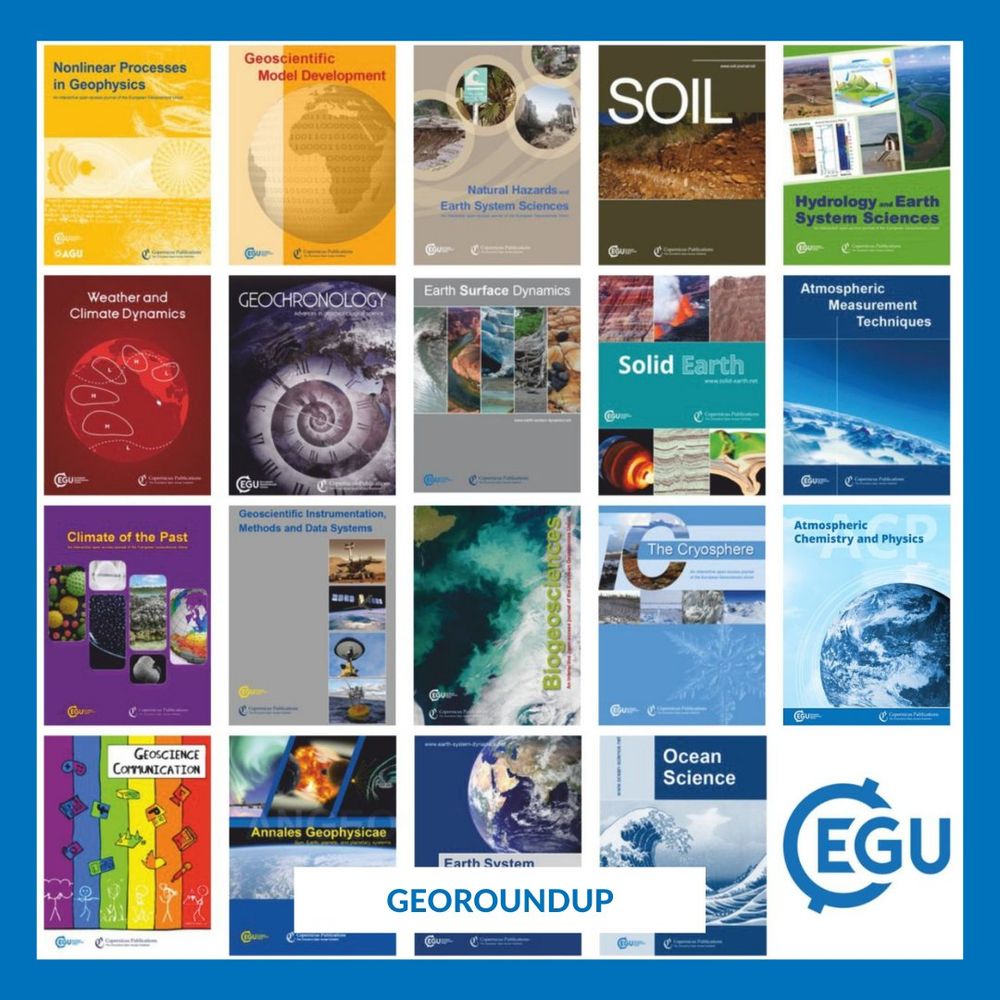
Image description: A collage of book covers and scientific posters related to various geosciences topics. With text reading: "GeoRoundup".
Wondering about what brilliant science we have published during February with the #EGUjournals? Check out the latest GeoRoundup, with all the #OpenAccess highlights on the #EGUblogs!
👉Discover more here: egu.eu/44S4PR
05.03.2026 12:25 —
👍 3
🔁 1
💬 0
📌 0
Really dig this tool. Not just recommendations, but carefully researched discussions of the strengths and drawback of tech from common to obscure.
05.03.2026 14:08 —
👍 17
🔁 6
💬 1
📌 0
On parlera #climat et de lunes-océans 🙄 !
Ca vous inspire ? Venez à l'espace des sciences de #Morlaix du 7 au 9 mars !
05.03.2026 12:55 —
👍 1
🔁 1
💬 0
📌 0