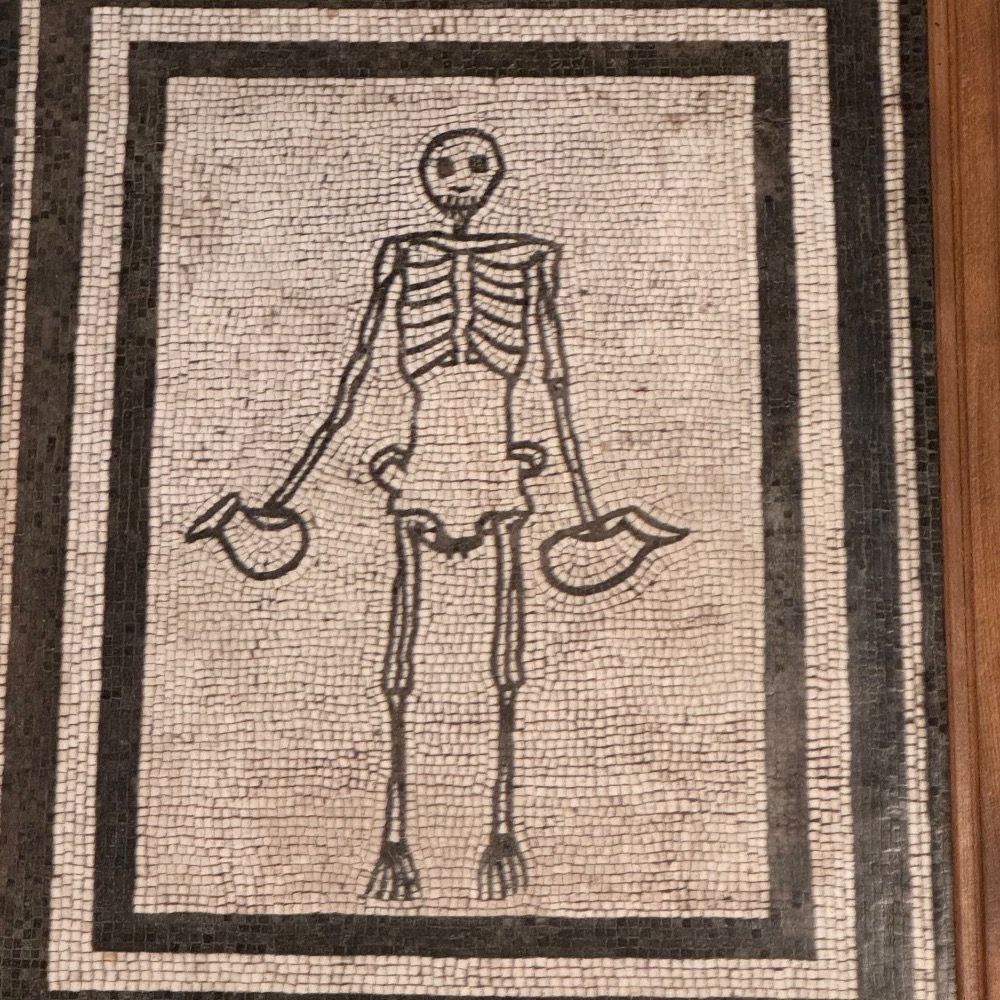
Le numéro de décembre de la lettre de l'OCIM est consacré aux restes humains. Y'a entre autre un article de mes collègues : "Ouvrir les données, ouvrir les bocaux. Les collections d’anatomie pathologique de Sorbonne Université" par Rémi Gaillard et Éloïse Quétel.
#OCIM #Musee #SorbonneUniversité
04.12.2025 19:23 — 👍 0 🔁 1 💬 0 📌 0

Programme de la journée Openalex du 2 décembre 2025
Plus de 330 participant·es pour cette première demi-journée consacrée à #OpenAlex durant laquelle @univlorraine.bsky.social @rennesuniv.bsky.social @epfllibrary.bsky.social @ethz.ch @universitedeliege.bsky.social et @sorbonne-universite.fr ont présenté leurs retours d'expérience #scienceouverte
02.12.2025 12:35 — 👍 14 🔁 6 💬 2 📌 1

Slides »» OpenAlex au service de l'évaluation de la recherche : l'idéal d'ouverture à l'épreuve de la qualité des données enpc.hal.science/hal-05363827 | Merci aux organisateurs du Séminaire Science Ouverte - Evaluation de la recherche et outils alternatifs @univ-spn.bsky.social
23.11.2025 17:58 — 👍 8 🔁 7 💬 0 📌 0

🚀 Munin Conference 2025 is LIVE at UiT! 🌟 Exciting discussions on making scholarly metadata openly available underway. Join the conversation! 📝📊 #Munin2025 #OpenScience #ScholarlyPublishing #Tromsø #Norway
18.11.2025 09:10 — 👍 18 🔁 5 💬 0 📌 1

Gentle request that @altmetric.com and @linkedin.com resume contact to be able to track academic LinkedIn activity on AltMetric.
More and more scientific discourse is happening on BlueSky (tracked) and LinkedIn (not tracked).
@linkedin.com let AltMetric use your API and include you! NOW!
14.11.2025 11:42 — 👍 26 🔁 8 💬 1 📌 0
Comment devient-on un·e chercheur·se très cité·e ? Réponse avec Lauranne Chaignon aujourd'hui dans TMN !
#VeilleESR
14.11.2025 09:39 — 👍 4 🔁 3 💬 0 📌 0

Highly Cited Researchers: Anatomy of a list
Abstract. The list of Highly Cited Researchers (HCR) published each year by Clarivate occupies a special place in the academic landscape, due to its use in the Shanghai rankings. This article looks at...
"It's tiiime!!!", comme le dit si bien Mariah Carey. C'est aujourd'hui que parait la liste 2025 des chercheurs très cités de Clarivate !
Êtes-vous prêts ? Avez-vous révisé l'histoire de cette liste ?
Si vous avez besoin d'une antisèche, c'est ici que cela se passe : direct.mit.edu/qss/article/...
12.11.2025 07:39 — 👍 4 🔁 3 💬 0 📌 1
This is a great thread. But three points.
1. Agree: profit in publishing is the central issue, but it needed the APC to go into overdrive. The mistake of the 2010s OA movement was to shift culture around access and not profit. This damanged sci publishing bc APCs incentivize quantity over quality
11.11.2025 17:28 — 👍 15 🔁 6 💬 3 📌 0

A table showing profit margins of major publishers. A snippet of text related to this table is below.
1. The four-fold drain
1.1 Money
Currently, academic publishing is dominated by profit-oriented, multinational companies for
whom scientific knowledge is a commodity to be sold back to the academic community who
created it. The dominant four are Elsevier, Springer Nature, Wiley and Taylor & Francis,
which collectively generated over US$7.1 billion in revenue from journal publishing in 2024
alone, and over US$12 billion in profits between 2019 and 2024 (Table 1A). Their profit
margins have always been over 30% in the last five years, and for the largest publisher
(Elsevier) always over 37%.
Against many comparators, across many sectors, scientific publishing is one of the most
consistently profitable industries (Table S1). These financial arrangements make a substantial
difference to science budgets. In 2024, 46% of Elsevier revenues and 53% of Taylor &
Francis revenues were generated in North America, meaning that North American
researchers were charged over US$2.27 billion by just two for-profit publishers. The
Canadian research councils and the US National Science Foundation were allocated US$9.3
billion in that year.

A figure detailing the drain on researcher time.
1. The four-fold drain
1.2 Time
The number of papers published each year is growing faster than the scientific workforce,
with the number of papers per researcher almost doubling between 1996 and 2022 (Figure
1A). This reflects the fact that publishers’ commercial desire to publish (sell) more material
has aligned well with the competitive prestige culture in which publications help secure jobs,
grants, promotions, and awards. To the extent that this growth is driven by a pressure for
profit, rather than scholarly imperatives, it distorts the way researchers spend their time.
The publishing system depends on unpaid reviewer labour, estimated to be over 130 million
unpaid hours annually in 2020 alone (9). Researchers have complained about the demands of
peer-review for decades, but the scale of the problem is now worse, with editors reporting
widespread difficulties recruiting reviewers. The growth in publications involves not only the
authors’ time, but that of academic editors and reviewers who are dealing with so many
review demands.
Even more seriously, the imperative to produce ever more articles reshapes the nature of
scientific inquiry. Evidence across multiple fields shows that more papers result in
‘ossification’, not new ideas (10). It may seem paradoxical that more papers can slow
progress until one considers how it affects researchers’ time. While rewards remain tied to
volume, prestige, and impact of publications, researchers will be nudged away from riskier,
local, interdisciplinary, and long-term work. The result is a treadmill of constant activity with
limited progress whereas core scholarly practices – such as reading, reflecting and engaging
with others’ contributions – is de-prioritized. What looks like productivity often masks
intellectual exhaustion built on a demoralizing, narrowing scientific vision.

A table of profit margins across industries. The section of text related to this table is below:
1. The four-fold drain
1.1 Money
Currently, academic publishing is dominated by profit-oriented, multinational companies for
whom scientific knowledge is a commodity to be sold back to the academic community who
created it. The dominant four are Elsevier, Springer Nature, Wiley and Taylor & Francis,
which collectively generated over US$7.1 billion in revenue from journal publishing in 2024
alone, and over US$12 billion in profits between 2019 and 2024 (Table 1A). Their profit
margins have always been over 30% in the last five years, and for the largest publisher
(Elsevier) always over 37%.
Against many comparators, across many sectors, scientific publishing is one of the most
consistently profitable industries (Table S1). These financial arrangements make a substantial
difference to science budgets. In 2024, 46% of Elsevier revenues and 53% of Taylor &
Francis revenues were generated in North America, meaning that North American
researchers were charged over US$2.27 billion by just two for-profit publishers. The
Canadian research councils and the US National Science Foundation were allocated US$9.3
billion in that year.

The costs of inaction are plain: wasted public funds, lost researcher time, compromised
scientific integrity and eroded public trust. Today, the system rewards commercial publishers
first, and science second. Without bold action from the funders we risk continuing to pour
resources into a system that prioritizes profit over the advancement of scientific knowledge.
We wrote the Strain on scientific publishing to highlight the problems of time & trust. With a fantastic group of co-authors, we present The Drain of Scientific Publishing:
a 🧵 1/n
Drain: arxiv.org/abs/2511.04820
Strain: direct.mit.edu/qss/article/...
Oligopoly: direct.mit.edu/qss/article/...
11.11.2025 11:52 — 👍 609 🔁 435 💬 8 📌 62

Google Scholar Is Doomed
Academia built entire careers on a free Google service with zero guarantees. What could go wrong?
"My bold prediction? Scholar gets the axe within 5 years. Google will announce it with 12 months' notice, Bluesky will have a collective meltdown, universities will scramble for alternatives, and research workflows will be in chaos for years."
hannahshelley.neocities.org/blog/2025_08...
30.10.2025 08:09 — 👍 3 🔁 5 💬 0 📌 0
Google Scholar Is Doomed
Academia built entire careers on a free Google service with zero guarantees. What could go wrong?
"Google has a proven track record of killing academic tools, Scholar generates 0 revenue in a company obsessed with billion-dollar priorities, AI is disrupting traditional research discovery, academia has built critical infrastructure around a free commercial service with 0 guarantees."
30.10.2025 08:09 — 👍 3 🔁 3 💬 1 📌 0

News & Views: Market Sizing Update 2025 – Has OA recovered its mojo?
Overview
L'OA repart à la hausse sur le marché de l'édition scientifique (+6,9% en 2024) : près de 50 % des articles sont publiés en OA, pour 20 % en valeur financière (prévision à 25% en 2027). L’APC moyen augmente, la part de l'hybride aussi.
#OpenAccess
www.deltathink.com/news-views-m...
29.10.2025 13:49 — 👍 2 🔁 3 💬 0 📌 0

Together, universities can take back control of their data
A single university can do little to demand accountability from rankings companies, but together institutions can demand reciprocal transparency, nego...
The secret life of university data?
In this article, I argue that universities must work together to demand transparency and openness in how their data are transformed and used, and ensure university data serve the public mission, not private interests.
www.universityworldnews.com/post.php?sto...
23.10.2025 08:51 — 👍 17 🔁 5 💬 0 📌 2

Journals and publishers crack down on research from open health data sets
PLOS, Frontiers, and others announce policies trying to stem the tide of suspect research
Durcissement de la validation des manuscrits basés sur des jeux de données ouverts : explosion des taux de rejet chez PLOS et Frontiers, renforcement de la formation des éditeurs chez Springer #effetdebord
www.science.org/content/arti...
13.10.2025 07:09 — 👍 0 🔁 1 💬 0 📌 0
L'un-e d'entre vous aurait accès à l'article de Télérama sur Laszlo de Simone?
08.10.2025 09:06 — 👍 0 🔁 1 💬 1 📌 0

Is there a relationship between the metadata publishers submit to Crossref and the submission systems they use? 🤔
We (w/ @msphelps.bsky.social) analyzed 153 publishers and 4 major systems to find out.
👉 doi.org/10.31222/osf...
#OpenScience #Crossref #OpenMetadata #BarcelonaDeclaration
07.10.2025 08:18 — 👍 16 🔁 6 💬 0 📌 1
salut, je peux te l'envoyer par mail, si tu veux
06.10.2025 14:49 — 👍 0 🔁 0 💬 1 📌 0