A Perspective on Unintentional Fragments and Their Impact on the Dark Metabolome, Untargeted Profiling, Molecular Networking, Public Data, and Repository Scale Analysis
In/postsource fragments (ISFs) arise during electrospray ionization or ion transfer in mass spectrometry when molecular bonds break, generating ions that can complicate data interpretation. Although ISFs have been recognized for decades, their contribution to untargeted metabolomics─particularly in the context of the so-called “dark matter” (unannotated MS or MS/MS spectra) and the “dark metabolome” (unannotated molecules)─remains unsettled. This ongoing debate reflects a central tension: while some caution against overinterpreting unidentified signals lacking biological evidence, others argue that dismissing them too quickly risks overlooking genuine molecular discoveries. These discussions also raise a deeper question: what exactly should be considered part of the metabolome? As metabolomics advances toward large-scale data mining and high-throughput computational analysis, resolving these conceptual and methodological ambiguities has become essential. In this perspective, we propose a refined definition of the “dark metabolome” and present a systematic overview of ISFs and related ion forms, including adducts and multimers. We examine their impact on metabolite annotation, experimental design, statistical analysis, computational workflows, and repository-scale data mining. Finally, we provide practical recommendations─including a set of dos and do nots for researchers and reviewers─and discuss the broader implications of ISFs for how the field explores unknown molecular space. By embracing a more nuanced understanding of ISFs, metabolomics can achieve greater rigor, reduce misinterpretation, and unlock new opportunities for discovery.
The existence of unintentional fragmentation (often referred to as in-source fragments) in untargeted #metabolomics data can cause uncertainty among newcomers to the field and skepticism among data consumers such as medical experts or biologists.
pubs.acs.org/doi/10.1021/...
03.12.2025 15:29 —
👍 19
🔁 6
💬 1
📌 1


A very interesting symposium on multiomics (including metabolomics!) and ecology is ongoing today in Seoul. @egaquerel.bsky.social is presenting his works on N-acyl nicotines in Nicotiana spp.
02.12.2025 01:09 —
👍 0
🔁 0
💬 0
📌 0

A new workhorse has arrived! Our lab installed a Waters Xevo G3 Q/ToF today. Looking forward to play with it for observing metabolites!!
29.10.2025 08:28 —
👍 5
🔁 0
💬 0
📌 0
I have been elected as a Board of Director member of @metsoc.bsky.social. From tomorrow, I will serve for the society for 2 years. Super excited!
30.09.2025 10:32 —
👍 4
🔁 0
💬 0
📌 0

Lipidomics
This Scientific Data Collection welcomes descriptions of any technique relevant to lipidomics research, including mass spectrometry, NMR, theoretical studies, ...
Dear all of my colleagues working on lipidomics,
As an editorial board member of Scientific Data, I am serving as the collection (Lipidomics)’s Guest Editor and eager to read your submission.
Learn more about the collection and how to contribute: go.nature.com/4mxI9yu
16.09.2025 05:40 —
👍 2
🔁 0
💬 0
📌 0
We are looking for a 3-year postdoc to work with Daniel Probst, Justin van der Hooft and myself on an exciting project involving federated learning and integrative omics for discovery of new antibiotics from natural products.
Apply here: www.wur.nl/en/vacancy/p...
Please share!
08.09.2025 09:07 —
👍 31
🔁 32
💬 1
📌 3
Method papers shoud do so, as you know :)
08.09.2025 15:34 —
👍 0
🔁 0
💬 1
📌 0
We mainly wrote this protocol regarding the drug metabolism studies but actually the methodology itself can be appiled to mutiple different domains relevant to biotransformation. For example, our lab is using this method for phenotyping biotransformation of xenobiotics by human symbiotic bacteria.
08.09.2025 14:55 —
👍 2
🔁 0
💬 2
📌 0
It is always great to see students' achievement. Two PhD students in my lab, Kyungha and Yukyung, won the PhD student fellowship from the Ministry of Education of Korea. Each will be funded 50m KRW (about 36000USD) for 2 years. Congratulations!
28.08.2025 08:10 —
👍 3
🔁 0
💬 0
📌 0
I met David Beale working at CSiRO, Austrailia today at Korean Society for Mass Spec meeting today and let him know about this initiative. He has worked on experimental metabolomics for years so he would have many valuable data to contribute.
27.08.2025 15:22 —
👍 1
🔁 0
💬 1
📌 0

Interested in a co-authorship?
We’re building a tool for repository-scale untargeted #metabolomics and #exposomics of #environmental data. To make it the best it can be, we’re looking for people willing to share high-resolution LC-MS/MS (DDA) data from #water, #soil, #sediment, and related samples.
26.08.2025 19:51 —
👍 16
🔁 13
💬 3
📌 1
timsMetabo?
27.08.2025 00:09 —
👍 1
🔁 0
💬 0
📌 0
2025 Board Of Directors Election – Metabolomics Society
I run for this year's @metsoc.bsky.social Board of Director election. Please see my and other candidates' statement of purpose and vote for the society!
metabolomicssociety.org/board-commit...
22.08.2025 00:47 —
👍 2
🔁 0
💬 0
📌 0
Redirecting
My lab is known as a mass spectromerryblab, but we (sometimes) do NMR metabolomics. In this article published in J Pharm Biomed Anal today, we evaluated the applicability of 1H NMR metabomics for quality control of East Asian Traditional Medicine formulation products.
doi.org/10.1016/j.jp...
06.08.2025 03:15 —
👍 4
🔁 1
💬 0
📌 0
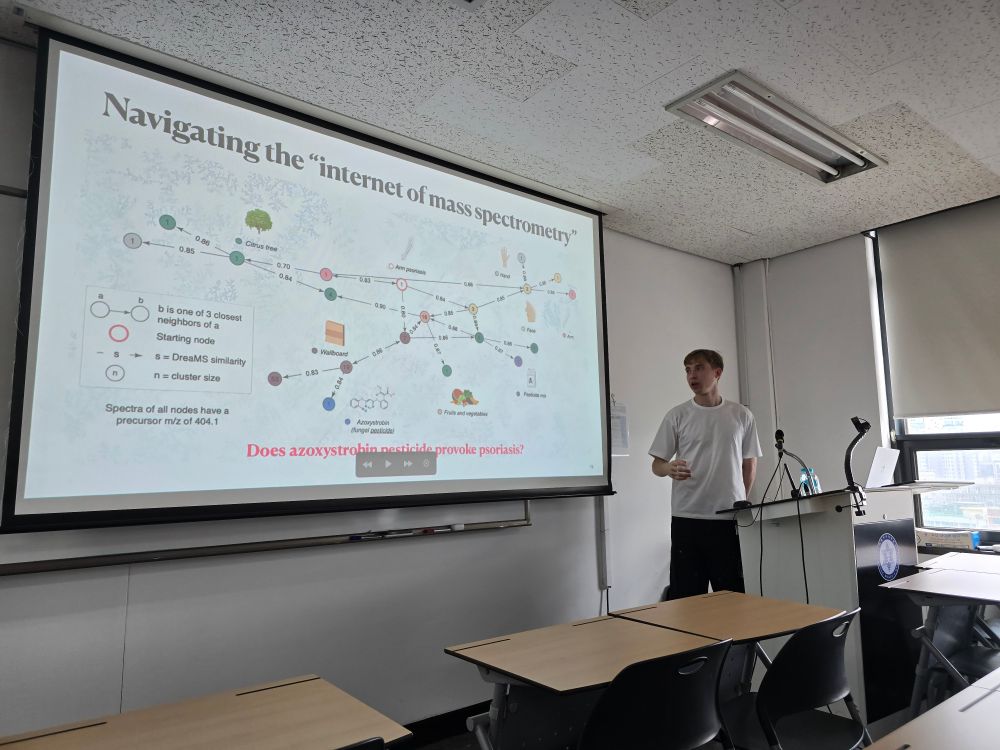
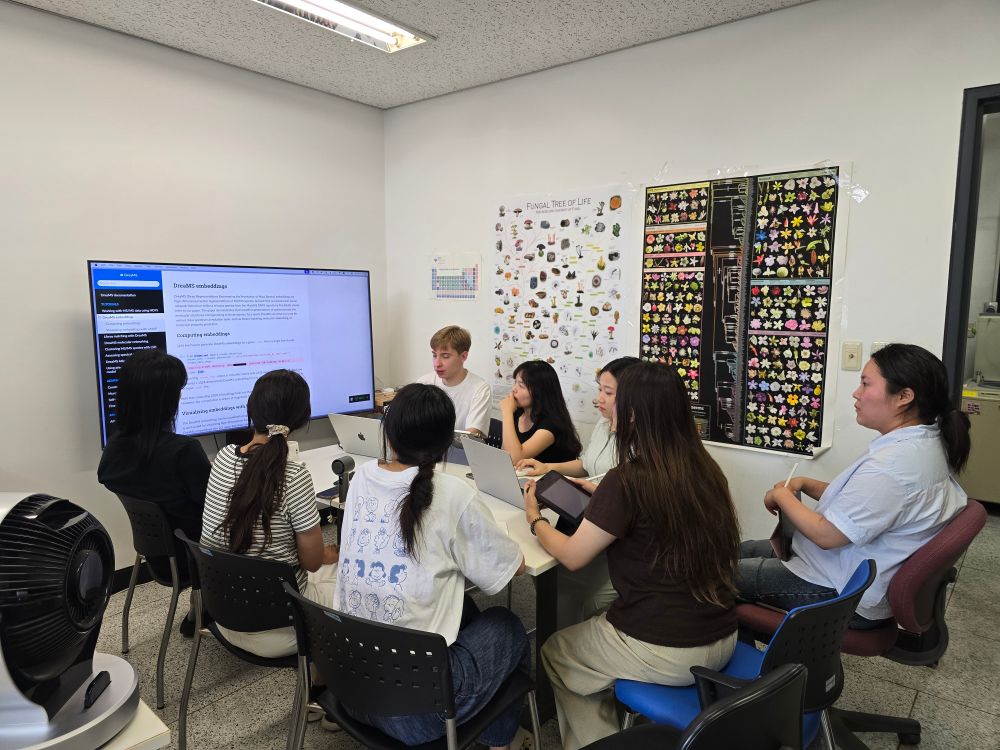
Yesterday @roman-bushuiev.bsky.social visited our lab. He gave a seminar talk about his recent work on DreaMS (www.nature.com/articles/s41...), and provided a hands-on training to my lab members. Looking forward to what we will discover using this awesome tool!
01.08.2025 08:37 —
👍 12
🔁 3
💬 1
📌 0
I guess that it intended downloading the list and getting the information via API; but I am not sure.
09.07.2025 05:28 —
👍 1
🔁 0
💬 1
📌 0

We just crossed the 800,000 files mark in Pan-ReDU. That's 800,000 public #metabolomics raw data files with harmonized metadata that can be re-analyzed to learn about new molecules and bio-distributions. 🎉 redu.gnps2.org
09.07.2025 00:55 —
👍 16
🔁 6
💬 0
📌 0
Folddisco finds similar (dis)continuous 3D motifs in large protein structure databases. Its efficient index enables fast uncharacterized active site annotation, protein conformational state analysis and PPI interface comparison. 1/9🧶🧬
📄 www.biorxiv.org/content/10.1...
🌐 search.foldseek.com/folddisco
07.07.2025 08:21 —
👍 153
🔁 70
💬 8
📌 3
Sounds useful and I love the naming 🤣
07.07.2025 10:50 —
👍 2
🔁 0
💬 0
📌 0
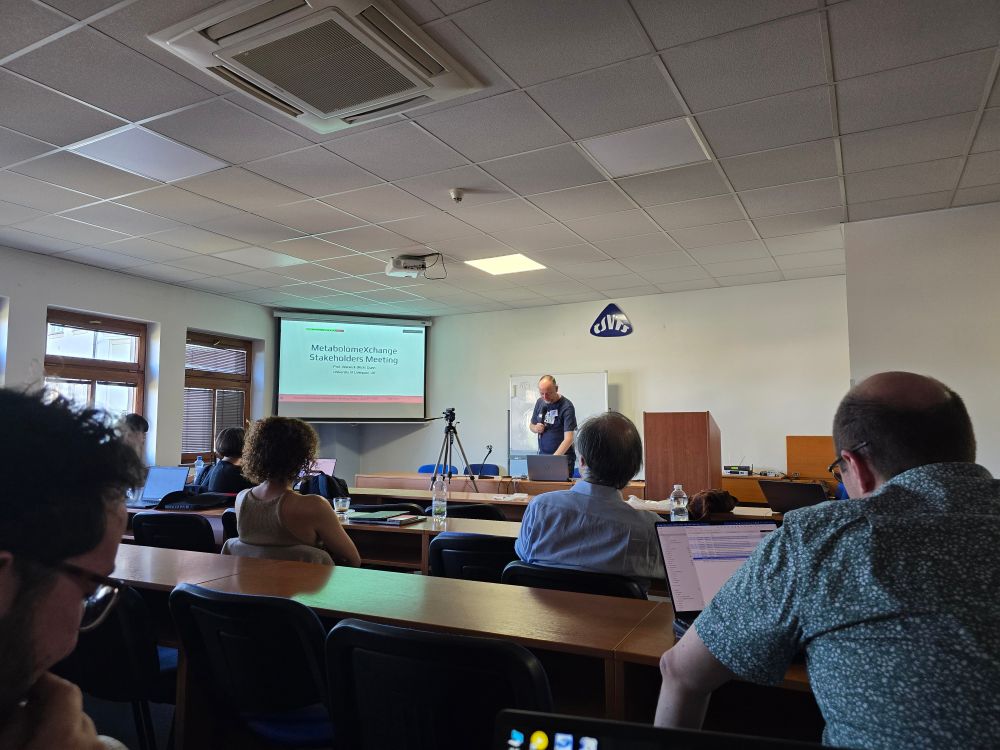
Participated in the MetabolomeXchange stakeholder meeting, one day before #metabolomics2025. So many valuable discussions!
21.06.2025 21:11 —
👍 9
🔁 2
💬 0
📌 0
Finally! See you soon 😎
18.06.2025 14:50 —
👍 2
🔁 0
💬 0
📌 0

Flying to Prague for #Metabolomics2024, the MetabolomeXchange meeting, and some other things. See you soon dear Metabolomics folks!
18.06.2025 00:52 —
👍 8
🔁 0
💬 1
📌 0

Microcrystal Electron Diffraction-Guided Discovery of Fungal Metabolites
Nature remains a vast repository of complex and functional metabolites whose structural characterization continues to drive innovations in pharmaceuticals, agrochemicals, and materials science. The cr...
There's been a rich connection between electron diffraction and the nature of the chemical bond over the years. Here, we've shown how you can leverage electron diffraction to discover and characterize novel natural products.
@caltechcce.bsky.social @uclacb.bsky.social
pubs.acs.org/doi/10.1021/...
03.06.2025 22:06 —
👍 13
🔁 4
💬 0
📌 0

How can physics contribute to understanding the evolution of complexity? Although great results have been produced over the last decades, some recent "theories" appear to ignore key ideas from evolutionary theory and are seriously flawed. Check this paper in PNAS www.pnas.org/doi/abs/10.1...
31.05.2025 15:55 —
👍 74
🔁 27
💬 3
📌 3