One week left, send your abstracts!
01.03.2026 10:00 —
👍 8
🔁 7
💬 0
📌 0
At 50:12, casual, "hard drive music", black magic (2026)
27.02.2026 13:08 —
👍 3
🔁 1
💬 2
📌 0

https://royalsocietypublishing.org/rsif/article/23/234/20250687/479613/Alerting-and-orienting-attention-in-anti-predator
Figure S1. The default alerting behaviour of sentinel vigilance is monitoring the surroundings via head
rotations. Alerting entails the agent hypothesis that a predator may or may not be present, whereas
orienting is initiated when the agent has a sufficiently low uncertainty belief that a predator is present,
i.e., acute risk increases. In a scenario with high background and low acute predation risk, we
experimentally induced a shift to high acute risk, using a pre-recorded hawk call (diagonal arrows,
upper right quadrant). In accordance with our hypothesis, this produced a behavioural shift from high
to low head rotation frequency, and a shift in the neurocognitive model to a belief that a predator is
present along with a reduction in simulated head rotation frequency. Our model provides a feasible
interpretation of the underlying neurocognition that distinguishes two identical observational scenarios
(low head rotation frequency under low and high acute risk).
In a field experiment and its simulation, we manipulated perceived acute predation risk and measured head rotation frequency. Our model provides a neurocognitive interpretation that distinguishes two identical observational scenarios (low head rotation freq. under low vs. high acute predation risk).
02.02.2026 10:15 —
👍 2
🔁 0
💬 0
📌 1
scrub-jays overcome visual limitations kind of like we do:
- rotate your head to see behind you
- move your eyes for narrow focus
- change your elevation to see over obstructions
how do these relate to habitat-specific predation strategies?
royalsocietypublishing.org/rsif/article...
🧪🌎🪶 #corvids
02.02.2026 10:15 —
👍 12
🔁 3
💬 1
📌 0

The Importance of Biological Theory - Biological Theory
Biological Theory -
I am happy to share this article, entitled "The importance of Biological Theory". It is my inaugural editorial as the new Editor-in-Chief of @biologicaltheory.bsky.social . In these complex and challenging times, theory is more important now than ever. Enjoy!
doi.org/10.1007/s137...
30.01.2026 13:40 —
👍 82
🔁 40
💬 1
📌 2
🫥
28.01.2026 17:18 —
👍 1
🔁 0
💬 0
📌 0

Simulation examples. Scenarios A–D above correspond to agent behaviour sequences in rows A–D below. The sequences indicate 12 time steps, one per box, which proceed horizontally (i.e. the leftmost box is t1, the rightmost box is t12). In the lower rows, beak direction is depicted with a triangle such that head rotations are visible (e.g. in row B, there is a head rotation each time step). The circular area connected to the triangle represents a top view of the scrub-jay head (filled circle with unfilled sectors). Circles with two unfilled sectors show the default foveal position bilaterally, and circles with four unfilled sectors show further foveation during a fixed head position. Unfilled row squares indicate that the scrub-jay has high uncertainty about whether a hawk is present due to lack of sensory evidence (no hawk shape is visible and no hawk call is audible). Filled row squares that progress from dark (orange) to light (yellow) represent the strength of the belief that a hawk is present, beginning with low uncertainty during three time steps when the hawk shape is visible and an increasing belief that the hawk is no longer present once the shape is no longer visible. Upper half: the filled circle indicates the scrub-jay’s proximal surroundings. In the top left (A), a single hawk suggests low background predation risk, which elicits a head rotation every two time steps (row A). (Dotted lines indicate possible but not actual approaches.) Three hawks are shown in B, indicating high background predation risk, which elicits a head rotation every time step (row B). Rectangular cover in C presents a skewed distribution of possible hawk approaches. This leads to a head rotation pattern that proportionately increases the time monitoring exposed areas (row C). In the upper right (D), two actual hawk approaches are shown (solid lines extended by dotted lines). The dark orange solid segment corresponds to the dark orange boxes in row D, when the hawk shape is visible.
Paper out today on @royalsocietypublishing.org:
"Alerting and orienting attention in anti-predator vigilance: neurocognitive modelling and behavioural evidence"
royalsocietypublishing.org/rsif/article...
🧪🌎🪶 #corvids #OpenAccess
21.01.2026 09:18 —
👍 18
🔁 9
💬 0
📌 2
Simulation examples. Scenarios A–D above correspond to agent behaviour sequences in rows A–D below. The sequences indicate 12 time steps, one per box, which proceed horizontally (i.e. the leftmost box is t1, the rightmost box is t12). In the lower rows, beak direction is depicted with a triangle such that head rotations are visible (e.g. in row B, there is a head rotation each time step). The circular area connected to the triangle represents a top view of the scrub-jay head (filled circle with unfilled sectors). Circles with two unfilled sectors show the default foveal position bilaterally, and circles with four unfilled sectors show further foveation during a fixed head position. Unfilled row squares indicate that the scrub-jay has high uncertainty about whether a hawk is present due to lack of sensory evidence (no hawk shape is visible and no hawk call is audible). Filled row squares that progress from dark (orange) to light (yellow) represent the strength of the belief that a hawk is present, beginning with low uncertainty during three time steps when the hawk shape is visible and an increasing belief that the hawk is no longer present once the shape is no longer visible. Upper half: the filled circle indicates the scrub-jay’s proximal surroundings. In the top left (A), a single hawk suggests low background predation risk, which elicits a head rotation every two time steps (row A). (Dotted lines indicate possible but not actual approaches.) Three hawks are shown in B, indicating high background predation risk, which elicits a head rotation every time step (row B). Rectangular cover in C presents a skewed distribution of possible hawk approaches. This leads to a head rotation pattern that proportionately increases the time monitoring exposed areas (row C). In the upper right (D), two actual hawk approaches are shown (solid lines extended by dotted lines). The dark orange solid segment corresponds to the dark orange boxes in row D, when the hawk shape is visible.
Paper out today on @royalsocietypublishing.org:
"Alerting and orienting attention in anti-predator vigilance: neurocognitive modelling and behavioural evidence"
royalsocietypublishing.org/rsif/article...
🧪🌎🪶 #corvids #OpenAccess
21.01.2026 09:18 —
👍 18
🔁 9
💬 0
📌 2

#Communiqué 🗞️ L'@academiesciences.bsky.social et le CNRS signent un accord de coédition pour développer un modèle de publication scientifique en libre accès et gratuit. ✍️
👉 www.cnrs.fr/fr/presse/la...
04.12.2025 15:04 —
👍 60
🔁 29
💬 1
📌 3
We are pouring our heart into this conference to keep it high quality, supportive, and accessible (no registration fee!). Do consider it for your #philsci content broadly conceived. I also can't wait to see Bucharest in September.
02.12.2025 10:09 —
👍 32
🔁 14
💬 1
📌 1
later that evening...
Santa Severa (outside Rome, west coast) #medievalsky #caturday
06.12.2025 09:16 —
👍 11
🔁 2
💬 0
📌 0
Assistant/Associate/Full Professor in Information, Culture & Society - School of Information Science
Duties & Responsibilities
Our School of Information Sciences is running four searches, and we can hire more than four candidates. Here’s the first link, for a job that might appeal to people working in history of information, history of science, or digital humanities. +
06.11.2025 16:58 —
👍 100
🔁 71
💬 4
📌 8

Black and white photograph of women of Nation of Islam, dressed in all white with white head coverings. Ethel Sharrieff in Chicago in the front. Photograph by Gordon Parks; 1963.

Black and white photograph of a large group of men, sanitation workers in Memphis in 1968, protesting with “I Am A Man” printed on their signs. Photograph by Ernest C. Withers.
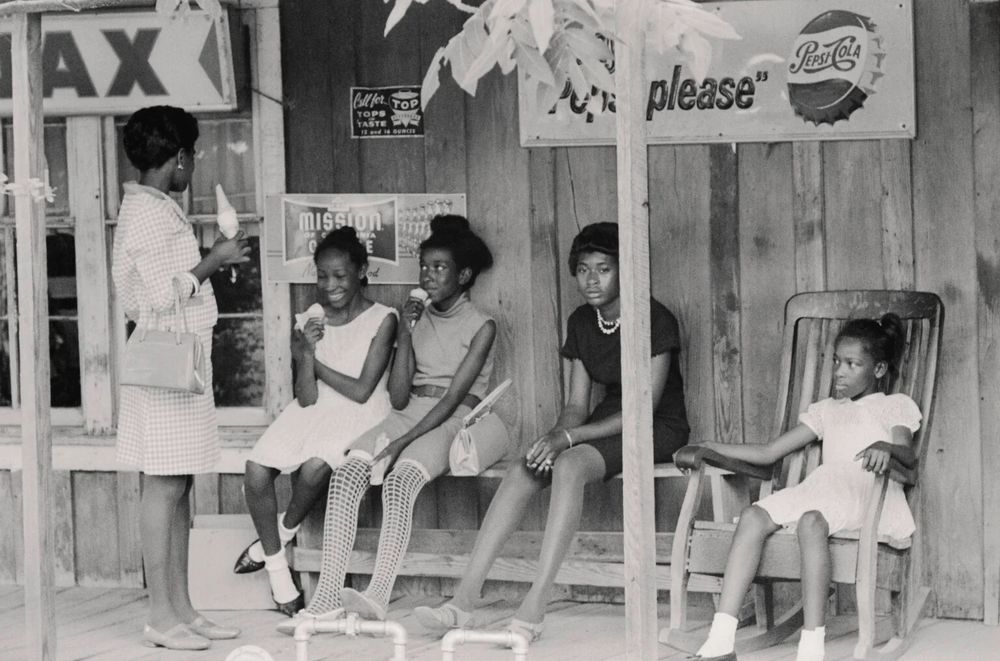
Black and white photograph. “Black-owned Grocery Store, Sunday, Mileston, Mississippi, 1968.” Photograph by Doris A. Derby.
“First-of-Its-Kind Exhibition Explores Photography’s Role in the ‘Black Arts Movement’” petapixel.com/2025/11/30/f...
01.12.2025 18:23 —
👍 23
🔁 16
💬 2
📌 0
was hoping you'd post this one...have this on 10", vaguely recall picking it up at a live show of theirs, maybe in Westwood (?), likely heard about it on KXLU!
29.11.2025 08:05 —
👍 4
🔁 0
💬 0
📌 0
Panic! At the oven window! It's regarding the pumpkin pie filling height! Relative to the crust edge height! Oh wait it's levelled out now! Sorry for the false alarm it's my first go and it was convex for a minute and I'd never seen that happen before!
27.11.2025 17:15 —
👍 6
🔁 0
💬 0
📌 0

An installation view of a museum gallery shows a large-scale Guerilla Girls collage that features Ingres's "Grand Odalisque" wearing a gorilla mask.
“Art should look like the rest of our culture,” says Frida Kahlo of the Guerilla Girls. Otherwise, “it’s not really history of art, it’s a history of power.”
I have a look at the timely Guerilla Girls show the Getty for Art Insider for @kcrw.com:
email.kcrw.com/guerrilla-gi...
26.11.2025 01:50 —
👍 51
🔁 11
💬 1
📌 1
Events | Event Calendar | Discover The KLI
The Konrad Lorenz Institute provides a stimulating and creative environment for fellows, visiting scholars, students, and external faculty.
The call for applications for 2026 European Advanced School in Philosophy of Life Sciences is now open! Deadline 15 Jan 2026, theme will be “philosophy of biology for a healthy planet”, all info here: www.kli.ac.at/en/events/ev... graduate students &early postdocs, do consider joining us! #philsci
20.11.2025 08:46 —
👍 33
🔁 19
💬 0
📌 1

sign in a Viennese venue: "RUHE"
16.11.2025 14:49 —
👍 3
🔁 0
💬 1
📌 0

Louis Auzoux's 1830 medical education mannequin, in ancient Antinous pose, 1.80m.
Montpellier. Louis Auzoux's 1830 medical education mannequin, 1.80m in ancient Antinous pose. Divides vertically: flayed display (r), moveable complete dissection (l), down to skeleton w 130 numbered pieces, 1700 detailed objects. more (🇫🇷): collections.umontpellier.fr/component/k2... (my 📷) #histSTM
15.11.2025 09:15 —
👍 8
🔁 1
💬 0
📌 0
Louis Auzoux's 1830 medical education mannequin, in ancient Antinous pose, 1.80m.
Montpellier. Louis Auzoux's 1830 medical education mannequin, 1.80m in ancient Antinous pose. Divides vertically: flayed display (r), moveable complete dissection (l), down to skeleton w 130 numbered pieces, 1700 detailed objects. more (🇫🇷): collections.umontpellier.fr/component/k2... (my 📷) #histSTM
15.11.2025 09:15 —
👍 8
🔁 1
💬 0
📌 0
YouTube video by PharcydeVEVO
The Pharcyde - Drop (Official Music Video)
caught them live a few times, always epic, but once right after this was 🤯 when they faked backwards moves on stage
14.11.2025 18:18 —
👍 1
🔁 0
💬 0
📌 0
Behavioral data can be very detailed but are usually aggregated and normalized in ways that smother the dynamics. Ben wrote a continuous-time Markov model to improve on this, and also wrote simulations for exploring and validating pipelines. All the code is here: github.com/BenKawam/ASN...
12.11.2025 12:05 —
👍 54
🔁 18
💬 1
📌 0

Each dyad (a, b) moves through four discrete states over time, represented by coloured circles. The dyad remains in a given state for a certain duration, or "holding time", before transitioning to a new state according to state-specific transition probabilities, indicated by arrows showing all possible (non-zero) transitions. Paintings by Sofia M. Pereira & Judith von Nordheim.
New paper!
We propose a framework to empirically study animal social relationships by modelling social network (SN) data as time-series—that is, without the need to aggregate them over time.
www.biorxiv.org/content/10.1...
12.11.2025 11:54 —
👍 92
🔁 37
💬 1
📌 2
06.11.2025 19:56 —
👍 183
🔁 41
💬 2
📌 1
💯 (had to for game 3!)
28.10.2025 20:39 —
👍 2
🔁 0
💬 0
📌 0
Angeleno out here 'across the pond' 😵
28.10.2025 20:35 —
👍 2
🔁 0
💬 1
📌 0
t̶h̶e̶ ̶d̶i̶n̶n̶e̶r̶ ̶t̶h̶i̶n̶g̶ sleep
(time zone thing)
28.10.2025 20:24 —
👍 2
🔁 0
💬 1
📌 0