BOLD signal changes can oppose oxygen metabolism across the human cortex, Nature Neuroscience
fMRI signals “up,” but neural metabolism might be going “down.”
In our @natneuro.nature.com paper, we demonstrate that about 40% of voxels with robust BOLD responses exhibit opposite oxygen metabolism, revealing two distinct hemodynamic modes.
rdcu.be/eUPO8
funds @erc.europa.eu
#neuroskyence 🧵:
16.12.2025 15:43 —
👍 176
🔁 80
💬 4
📌 8

8️⃣ FOCA vs. conventional FC
FOCA provides a much more robust view of negative coupling.
It is far more stable to GSR, captures greater inter-individual variability, shows stronger neonate–adult developmental effects, and predicts brain age markedly better than conventional FC.(11/12)
20.11.2025 11:27 —
👍 0
🔁 0
💬 1
📌 0

7️⃣ Neonatal functional topography matters
The spatial alignment of functional topography encodes brain development at birth and predicts neurodevelopmental outcomes at 18 months.(10/12)
20.11.2025 11:27 —
👍 1
🔁 0
💬 1
📌 0

6️⃣ Why neonatal organization looks “adult-inverted”
Negative topographies show the largest developmental shifts: DAN’s strongest negative couplings move from motor cortex (neonates) to TPJ/precuneus (adults), while positive patterns stay stable. The visual network shows similar changes.(9/12)
20.11.2025 11:27 —
👍 0
🔁 0
💬 1
📌 0

5️⃣ Neonatal organization is "adult-inverted"
Higher-order networks show strong positive coupling, and the visual system couples positively with the DMN rather than with somatomotor regions—the reverse of the adult patterns. (8/12)
20.11.2025 11:27 —
👍 0
🔁 0
💬 1
📌 0

4️⃣ Hierarchical organization
FOCA revealed a clear architecture:
• Primary systems → mainly positive coupling
• Higher-order systems → mainly negative coupling
These patterns are strongly predicted by aerobic glycolysis. (7/12)
20.11.2025 11:27 —
👍 0
🔁 0
💬 1
📌 0

3️⃣ FOCA matrix
We quantified these relations via spatial correlations between individualized network topographies(defined as FOCA).
The resulting FOCA matrix showed high cross-subject consistency and strong within-subject stability. (6/12)
20.11.2025 11:27 —
👍 0
🔁 0
💬 1
📌 0

2️⃣ Positive vs. negative topographic pairs
Visual inspection revealed widespread coupling patterns:
• Positive (convergent): FP ↔ DAN
• Negative (divergent): Default-Anterolateral ↔ CO/Action-mode (5/12)
20.11.2025 11:27 —
👍 0
🔁 0
💬 1
📌 0

1️⃣ Individualized spatial topography
We generated whole-brain spatial topographies for 20 functional networks—including the recently proposed action-mode and somato-cognitive-action networks.(4/12)
20.11.2025 11:27 —
👍 0
🔁 0
💬 1
📌 0
To answer these, we introduce Functional Topography Covariance Analysis (FOCA), leveraging MSC dense-sampling, HCP adults, and dHCP neonates to map individualized network topographic interactions and their developmental origins.(3/12)
20.11.2025 11:27 —
👍 1
🔁 0
💬 1
📌 0
1️⃣ How is this Yin–Yang interaction organized in the brain?
2️⃣ Do newborns follow the same rules as adults?
3️⃣ From birth to adulthood, which force dominates?
4️⃣ And can negative connectivity be measured reliably, beyond global-signal artifacts? (2/12)
20.11.2025 11:27 —
👍 0
🔁 0
💬 1
📌 0
In Eastern philosophy, Yin-Yang describes how opposite forces interact.
Interestingly, human brain networks shows a similar balance—Yin (negative coupling) and Yang (positive coupling), such as DMN vs. Action-mode network.
But many questions remain👇(1/12)
20.11.2025 11:27 —
👍 0
🔁 0
💬 1
📌 0

🚨 New preprint out!
www.biorxiv.org/content/10.1...
We introduce a framework that maps convergent (positive) and divergent (negative) spatial topographies of individualized brain networks—and reveals how these network interactions invert in newborns and reorganize across development.
Thread 🧵 ⬇️
20.11.2025 11:27 —
👍 1
🔁 0
💬 1
📌 0
5️⃣ Neonatal organization is "adult-inverted"
Higher-order networks show strong positive coupling, and the visual system couples positively with the DMN rather than with somatomotor regions—the reverse of the adult patterns. (8/12)
20.11.2025 07:19 —
👍 0
🔁 0
💬 0
📌 0
3️⃣ FOCA matrix
We quantified these relations via spatial correlations between individualized network topographies(defined as FOCA).
The resulting FOCA matrix showed high cross-subject consistency and strong within-subject stability. (6/12)
20.11.2025 07:19 —
👍 0
🔁 0
💬 0
📌 0
1️⃣ Individualized spatial topography
We generated whole-brain spatial topographies for 20 functional networks—including the recently proposed action-mode and somato-cognitive-action networks.(4/12)
20.11.2025 07:19 —
👍 0
🔁 0
💬 0
📌 0

🚨 New Preprint 🚨
Targeting intracranial electrical stimulation (ES) to network regions defined within individuals causes network-level effects
By Cyr et al.
***
Q: Can we use individualized network maps from precision fMRI to modulate a targeted network via intracranial ES?
A: Yes!
🧵:
05.08.2025 15:31 —
👍 79
🔁 37
💬 1
📌 6
I still get chills
Meet Mike
*30+ years severe depression
*first hospitalized @ 13y
*20 meds
*3 rounds of ECT
*2 near-fatal suicide attempts
Mike felt joy for the first time in decades after we turned on his new brain pacemaker or PACE
see videos, read paper, follow thread
doi.org/10.31234/osf...
10.08.2025 18:22 —
👍 390
🔁 136
💬 17
📌 34

1/11 Excited to share our @Naturestudy led by @leonooi.bsky.social @csabaorban.bsky.social @shaoshiz.bsky.social
AI performance is known to scale with logarithm of sample size (Kaplan 2020), but in many domains, sample size can be # participants or # measurements...
doi.org/10.1038/s415...
17.07.2025 01:36 —
👍 172
🔁 82
💬 3
📌 16
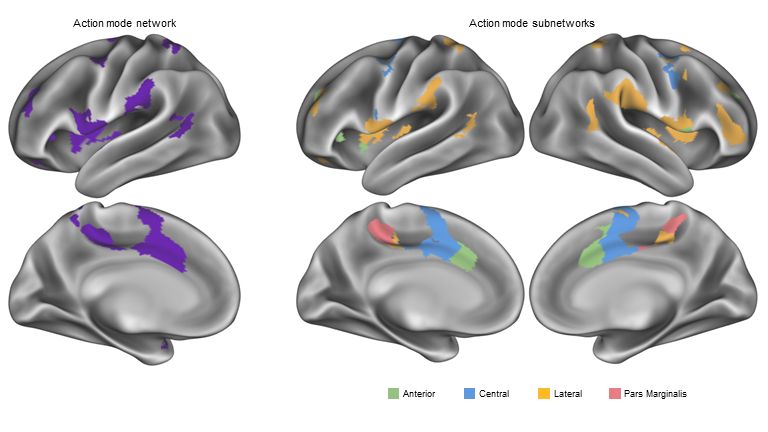
We have argued that the brain’s Action Mode Network controls functions required for goal-directed behavior. www.nature.com/articles/s41...
Now, in new work, we show that AMN contains distinct subnetworks for making decisions, implementing actions, and processing feedback. doi.org/10.1073/pnas...
10.07.2025 19:52 —
👍 81
🔁 34
💬 5
📌 4

How does the human brain coordinate hierarchical cortical development? Our work in Nature Neuroscience identifies a role for thalamocortical structural connectivity in the expression of hierarchical periods of cortical plasticity & environmental receptivity in youth 🧵 www.nature.com/articles/s41...
08.07.2025 00:00 —
👍 122
🔁 44
💬 4
📌 8
Alert! ... for the child development world!
@fluxsociety.bsky.social @fitngin.bsky.social
The Healthy Brain and Child Development (HBCD) Study has released its first data wave - it’s massive.
Check here:
docs.hbcdstudy.org
and here:
nbdc-datahub.org
Here’s why it matters 🧠🍼
29.06.2025 02:18 —
👍 159
🔁 79
💬 1
📌 4

Alert!!!!
“An Action Networks Model for Pain”
We propose a new model for chronic pain — and highlight two functionally connected cortical networks that could revolutionize how we treat it.
👉 thread below 🧵
osf.io/preprints/ps...
26.06.2025 13:28 —
👍 91
🔁 42
💬 2
📌 7

👏
White matter microstructure and macrostructure brain charts across the human lifespan | bioRxiv www.biorxiv.org/content/10.1...
12.05.2025 06:23 —
👍 6
🔁 3
💬 0
📌 0

It turns out the brain🧠is silently🤫working when your arm is in a cast. 🩼 🚧
Plastic changes occur, and revert again when the cast is removed … not just in cortex.
12.04.2025 17:59 —
👍 30
🔁 11
💬 2
📌 1

Probably the most insightful and most important paper on physiomarkers of subthalamic DBS in a long while. Bravo @julianneumann.bsky.social @tsbinns.com and team!!
Out at @natcomms.nature.com:
www.nature.com/articles/s41...
16.04.2025 00:50 —
👍 40
🔁 18
💬 0
📌 0

It's shocking how little is known about the brainstem red nucleus. In our new paper “The human brainstem’s red nucleus was upgraded to support goal-directed action” out now in @naturecomms.bsky.social we show that current thinking on the red nucleus is in need of a serious upgrade. rdcu.be/ehbOy
10.04.2025 15:45 —
👍 67
🔁 32
💬 1
📌 5