
Picture in the background of an adult Goldspotted oak borer on a green leaf. Text reads, “February 23-27, 2026. National Invasive Species Awareness Week. Sign up for a free webinar from the North America Invasive Species Management Association (NISAW.org)!”. At the bottom is are two small white circles with a white leaf inside, next to a text that says, “UC Integrated Pest Management: University of California, Agriculture & Natural Resources”.
This week (February 23-27, 2026) is National Invasive Species Awareness Week (NISAW), an event dedicated to raising awareness about invasive species, the threats they pose, and how we can slow their spread. Visit NISAW.org to sign up for a free webinar!
23.02.2026 18:10 —
👍 0
🔁 0
💬 0
📌 0

Picture in the background of University Arboretum landscape along Putah Creek, with redbud in bloom. Text reads, “UC IPM Has a New Logo. The University of California Agriculture and Natural Resources (UC ANR) recently launched new logos for UC ANR statewide programs. While the UC IPM may have a new look, rest assured the content you have come to trust from UC IPM will remain the same! Old UC IPM Logo” Picture of old UC Integrated Pest Management logo with a green leaf symbol inside a blue figure the shape of the California state. Text reads, “New UC IPM program logo”. Picture of new UC Integrated Pest Management logo with a green leaf symbol inside two blue circles.
Have you seen our new logo? Read more on what this logo change means for UC IPM: ucanr.edu/blog/pests-u...
10.02.2026 17:09 —
👍 2
🔁 0
💬 0
📌 0

Picture in the background of a red tomato with circular discoloration surrounded by green leaves with scattered brown spots. Text says, “Free IPM webinar: Diseases and Disorders of Vegetable Gardens”; February 19th from 12pm to 1pm.” UC Integrated Pest Management logo with a white leaf symbol inside two white circles.
Tune into the next webinar on February 19th, where we’ll be joined by UCCE IPM Advisor MacKenzie Patton, who'll be discussing how to identify and manage diseases and disorders of vegetable gardens. Link to register in the bio!
09.02.2026 22:10 —
👍 0
🔁 1
💬 0
📌 0

Picture in the background of pampas grass. Text says “When ornamental plants become invasive”.

Picture in the background of fountain grass in a landscaped setting. Text says “Some ornamental plants are invasive to California. Invasive plants can grow uncontrollably, become established, shade out and replace native plants, and damage local the ecosystem. Visit California Invasive Plant Council’s (Cal-IPC) Don’t Plant a Pest Website for region-based alternatives for invasive plants sold in nurseries. Swipe right for some examples.

Pictures of big periwinkle, calla Lilly, pampas grass, Douglas iris, bush anemone, and giant wildly. Text says “Invasive plants to avoid: big periwinkle (Vinca major), Calla lily (Zantedeschia aethiopica), Pampas grass (Cortaderia selloana). Instead consider: Douglas iris (Iris douglasiana), Bush anemone (Carpinteria californica), Giant wildrye (Olympus condensates).
Learn more about how ornamental plants can be invasive, what you can do, and resources you can use when planning your landscape design, in this week’s UC IPM blog: ucanr.edu/blog/pests-u...
23.01.2026 00:14 —
👍 1
🔁 2
💬 0
📌 0

Picture of mushrooms on a lawn in the background. Text says, “Have you seen mushrooms in your lawn lately?”

Picture of mushrooms on a lawn in the background. Text says, “Tips for managing lawn mushrooms: Remove organic debris, Improve drainage, Reduce irrigation, Aerate your soil, Increase sunlight on your lawn. What not to do: Don't mow mushrooms, Don't let the mushrooms mature, Don't use fungicides, Don't eat them!"
With the winter rains you might have also seen mushrooms popping up on your lawn! Want to know how to manage them? Visit the UC IPM blog to learn more: ucanr.edu/blog/pests-u...
15.01.2026 16:22 —
👍 0
🔁 1
💬 0
📌 0

Green background with beetles crawling around. Text says, “Top Pests of 2025: Wrapped Edition”.

Green background with beetles crawling around. Picture of an aphid on a stem. Text says, “Forget Spotify Wrapped – can you guess which pests received the most hits on UC IPM’s Pests Notes page this year? Here are the top ten pests that made your year: (1) carpet beetles, (2) fungus gnats, (3) whiteflies, (4) springtails, (5) thrips, (6) spider mites, (7) aphids, (8) scales, (9) clothes moths, (10) peach leaf curl. Visit the UC IPM blog to learn more about each of these pests!”
UC IPM brings you Top Pests of 2025: Wrapped Edition! These ten pests received the highest hits from our Pest Notes publication series last year. Can you guess which ones? Visit the UC IPM blog to learn more: ucanr.edu/blog/pests-u...
09.01.2026 16:58 —
👍 2
🔁 2
💬 0
📌 0

A photo of a chicken running across a grassy lawn. The text says, “Free IPM Webinar: Pests of Backyard Chickens on January 15th from 12pm-1pm."
Join us for our first webinar of the year! On January 15th, we'll be joined by Dr. Amy Murillo from UC Riverside as she discusses identification, prevention, and management of common ectoparasites found in backyard chicken flocks. Register here: ucanr.zoom.us/webinar/regi...
08.01.2026 20:30 —
👍 0
🔁 1
💬 0
📌 0

Light blue background with white snowflakes and a nutria rodent wearing a Santa hat. Text says, “Wishing you a happy holiday…”

Light blue background with white snowflakes. Text says, “Thank you for joining us this year to learn about pest management around the home and garden. This year, we’ve connected with you in various ways that we hope will continue in 2026: Monthly webinar series and invasive species webinar mini-series. New webinars planned in 2026! Published four issues of our Home and Garden Pest Newsletter. Website updates (new look coming soon)! Our many resources - Pest Notes fact sheets, Plant Problem Diagnostic Tool, Pesticide Active Ingredient Database, and Seasonal landscape IPM Checklist. Through social media on Facebook, Instagram, or BlueSky. Follow us @ucipmurban! We hope you all enjoy a safe, happy, and pest-free holiday! And if you do find some pests, we’ve got you covered."
As we reflect on this past year, we’d like to express our gratitude to all of you for joining us to learn about pest management around the home and garden! To stay connected with us in 2026, visit our website: ipm.ucanr.edu
-The UC IPM Urban and Community Team
22.12.2025 17:34 —
👍 1
🔁 0
💬 0
📌 0

Brown and lighter brown chickens in backyard. Text says, "Free IPM Webinar: Pests of Backyard Chickens on January 15th from 12pm-1pm."
On January 15, 2026, join Dr. Amy Murillo from UC Riverside as she discusses identification, prevention, and management of common ectoparasites found in backyard chicken flocks. Register at: ucanr.zoom.us/webinar/regi...
19.12.2025 17:19 —
👍 1
🔁 1
💬 0
📌 0

A photo in the background of many orange fruit with leaves. The text says, “Don’t give pests this holiday season”.

A photo of an adult Mediterranean fruit fly and Asian citrus psyllid. The text says, “Citrus Fruit & Invasive Pests: It’s citrus season and a time of giving! While we’re all in the spirit of sharing, it’s a great time to remember that harmful invasive pests can move to new areas on citrus fruit. There are several quarantines in California aimed at slowing the spread of these pests, including invasive fruit flies and Asian citrus psyllid (ACP), which can infect your citrus trees with citrus greening disease, or Huanglongbing (HLB).”

A photo in the background of Asian citrus psyllid. The text says, “Prevent the Spread of Invasive Pests: Do not move citrus fruit or plant material off the property where it was grown. Monitor your citrus trees for signs of invasive fruit fly damage or ACP. Report suspected fruit fly infestations or ACP to the California Department of Food and Agriculture (CDFA). Allow authorized CDFA workers access to your property to inspect fruit, set traps, or conduct eradication activities. Dispose of unused homegrown fruits and vegetables by double-bagging, sealing them, and placing them in the trash--not your green waste or compost bin.”
Protect your citrus trees and help prevent the spread of invasive pests this holiday season! Visit the UC IPM blog to read more: ucanr.edu/blog/pests-u...
18.12.2025 17:00 —
👍 0
🔁 0
💬 0
📌 0

Text over a background image of an urban garden filled with colorful flowers and tall, green shrubs. The text says "IPM Webinars 2026, full 2026 webinar schedule coming soon. Jan 15: Pests of Backyard Chickens. Feb 19: Diseases and Disorders in Vegetable Gardens. Mar 19: The Secret Life of Biopesticides."
Want to learn something new on your lunch break? Join UC IPM every month from 12:00 to 1:00pm. Get answers to your pest questions and learn about pest identification, prevention, and management around the home, garden, and landscape! ucanr.edu/site/urban-c... 🐞🌿
#integratedpestmanagement #webinars
10.12.2025 18:15 —
👍 2
🔁 2
💬 0
📌 0

A photo of two spotted lanternfly insects, one adult and one immature, crawling on a light brown tree branch. The adult spotted lanternfly is large, triangular-shaped insect with long black legs and black-spotted grey wings folded over its back. The immature spotted lanternfly is a small red, black, and white spotted insect that is somewhat flat and oval-shaped. Below the photo, there is text that says "Free IPM webinar: How Invasive Pests Are Managed in California, December 3, 11:00 am to 12:00 pm."
Managing invasive species is no easy feat, and many collaborative efforts are taking place in California. Join us on December 3 for a peek behind the scenes to learn what state agencies are doing to protect our state from these harmful pests. 🪲 ucanr.zoom.us/webinar/regi...
#invasivespecies #IPM
24.11.2025 22:54 —
👍 0
🔁 1
💬 0
📌 1

A flyer with text and an image of a large brown rodent with orange teeth and white whiskers sitting on its hind legs next to a body of water. The text says "UC IPM Home and Garden Pest Newsletter, November 2025. In this newsletter: Management of Urban Rats and Mice, Rodenticides: Further Restrictions in 2025, Invasive Pest Spotlight: Nutria."
Check out the latest issue of the Home and Garden Pest Newsletter from UC IPM! 🐀 ipm.ucanr.edu/home-and-lan...
#integratedpestmanagement #rodents #pestmanagement
21.11.2025 20:29 —
👍 0
🔁 0
💬 0
📌 0

An image of several brown ants walking in a line on the brown, craggy surface of a tree. Beneath the photo is text that says “Free IPM Webinar: Autumnal Antagonists: Pests During Fall in California. November 20, 12:00 to 1:00 PM.”
Days are getting shorter, and pests may be getting bolder! Cooler days and more moisture during fall can change household pest behavior. Learn about seasonal ant invasions, fall-swarming termites, and more on November 20. 🍁🐜 Register at ucanr.zoom.us/webinar/regi...
#fall #pestmanagement #autumn
13.11.2025 15:29 —
👍 0
🔁 1
💬 0
📌 0

A photo of a dead, swollen aphid exoskeleton next to a cartoon of a halloween mummy. The text says "Mummies!! What types of mummies might haunt your garden?"

A photo of several dead, brown, swollen and hollow aphids on a green leaf. The text says "Insect mummies are the hollowed-out exoskeletons (hardened outer shells of insect bodies) of aphids and other pest insects left behind after they have been attacked by parasitoids (small, parasitic wasps or flies)."

A photo of a brown, shriveled peach fruit still attached to a branch on the tree. The text says "Fruit and nut mummies are old, dried-out fruits and nuts that remain attached to trees due to diseases or environmental damage. These mummies can harbor pathogens and insect pests."
When you think of a mummy, you probably imagine the scary kind inspired by the ancient Egyptian ritual of preserving the bodies of the dead. ☠️ When we talk about mummies at UC IPM, we mean something completely different! Read more on our blog: ucanr.edu/blog/pests-u...
#halloween #ipm #gardening
30.10.2025 17:58 —
👍 2
🔁 1
💬 0
📌 0
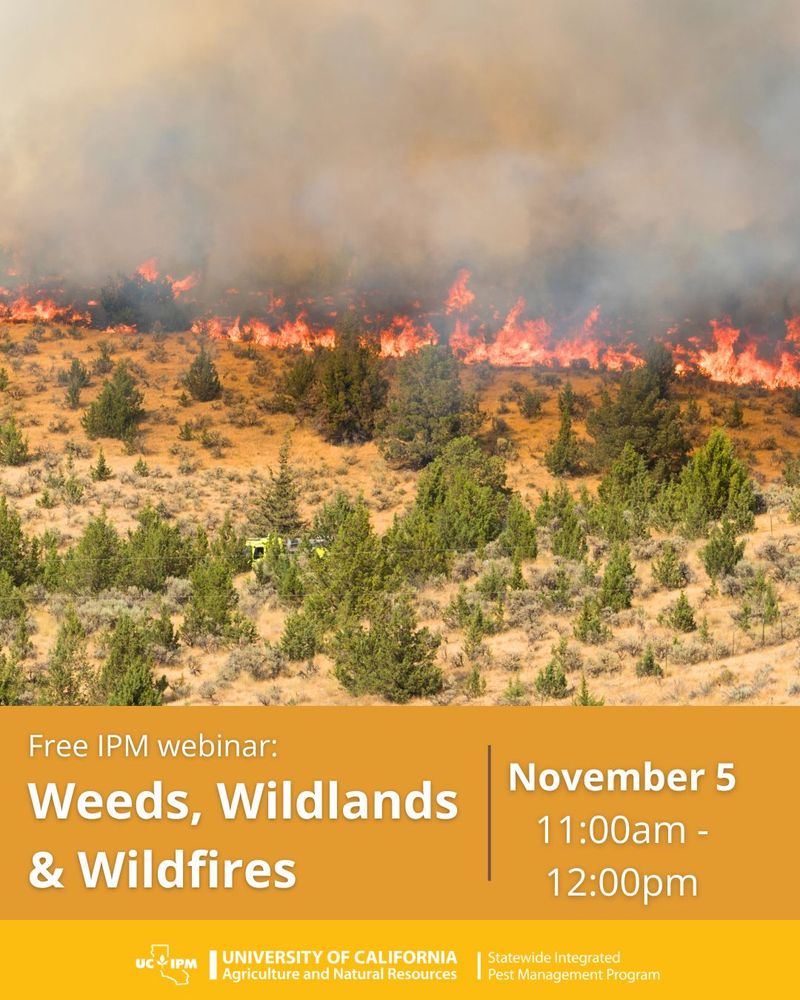
A photo of a wildfire sweeping across a natural landscape dotted with trees and shrubs. Below the image, there is text that says “Free IPM webinar: Weeds, Wildlands & Wildfires, November 5 11:00am to 12:00pm.”
Invasive plants cause a multitude of problems in California’s wildlands. They reduce biodiversity, impact outdoor recreation, and increase the risk of wildfires. On November 5, join us to learn more about these impacts. 🌲 Register: link.ucanr.edu/invasivewebi...
#invasiveplants #invasivespecies
27.10.2025 23:10 —
👍 1
🔁 2
💬 1
📌 0

A small black bug with red markings on a dark green plant stalk, with text that says "What's this bug?"
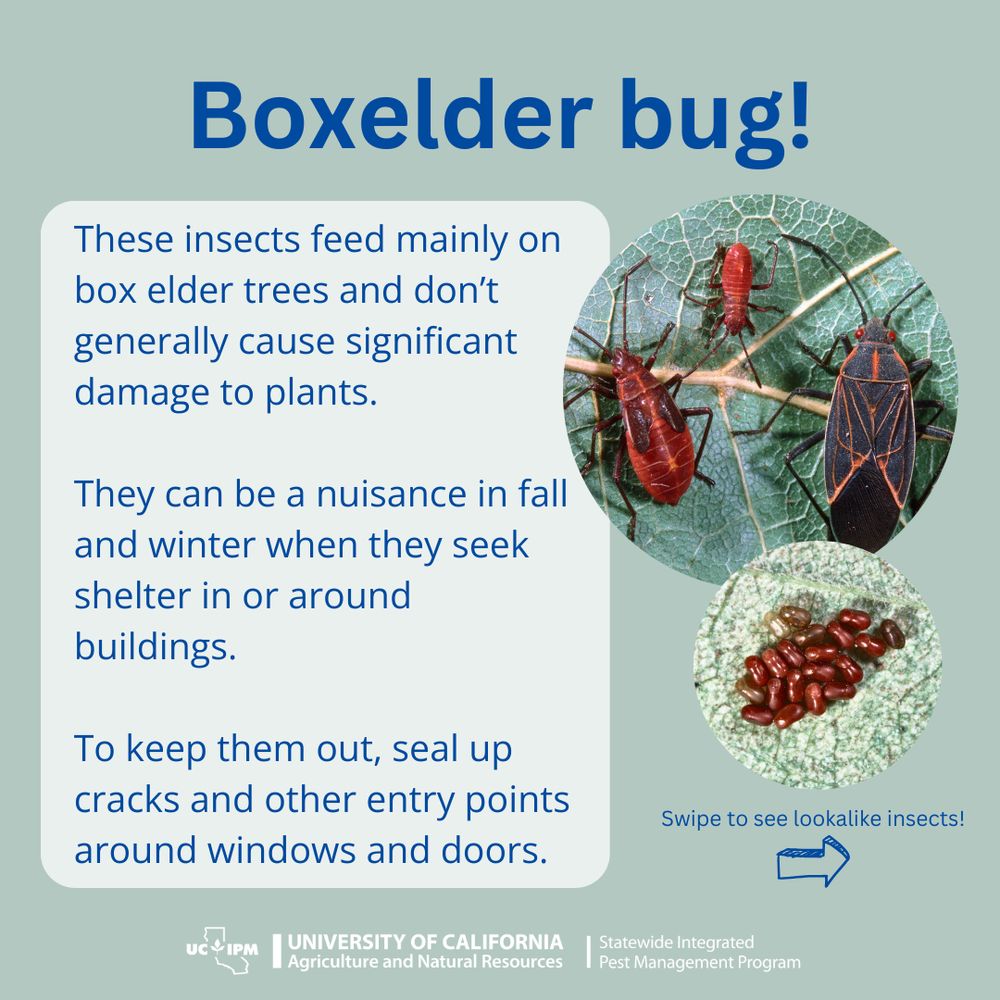
Two photos of insects, one of three life stages of black and red boxelder bugs and one of red boxelder bug eggs on a leaf. Text next to the photos says "Boxelder bug! These insects feed mainly on box elder trees and don’t generally cause significant damage to plants. They can be a nuisance in fall and winter when they seek shelter in or around buildings. To keep them out, seal up cracks and other entry points around windows and doors. Swipe to see lookalike insects!"

Text that says "Boxelder bug lookalikes" above two photos of insects with text next to each photo. The first photo is of a medium-sized black bug with orange markings around the edge of its back on a green plant stem, next to text that says "squash bugs feed con cucurbits like squash, pumpkins, and melons. Their feeding can cause plants to wilt and fruit to rot." The second photo is of two black insects with bright orange markings on a brown plant stem, next to text that says "milkweed bugs mainly eat milkweed plants." Text at the bottom says "see more lookalikes on our blog!"
Have you seen this bug? We’ll give you a hint: they are most likely to be on or near their preferred food source, box elder trees. 🪲🌳 Visit the UC IPM blog for more information about this insect and common lookalikes: ucanr.edu/blog/pests-u...
#boxelderbug #pestmanagement #ipm
23.10.2025 17:38 —
👍 0
🔁 1
💬 0
📌 0
Bats / Home and Landscape / UC Statewide IPM Program (UC IPM)
Oh my goodness! Sorry I didn't see this sooner. I hope the bat has departed! Here's UC IPM's webpage with info about excluding (and chasing out) bats. ipm.ucanr.edu/home-and-lan...
14.10.2025 16:38 —
👍 0
🔁 0
💬 0
📌 1

A photo of a large insect with grey, spotted wings, red eyes, and black legs above an illustration of a campfire. There is also text that says "don't let tree pests hitch a ride on your firewood. Buy it where you burn it."
October is National Firewood Month! Harmful pests like the spotted lanternfly can hitchhike on firewood. Help keep our forests safe: buy it where you burn it. 🪲🌲🏕️
To register for free webinars from the Don’t Move Firewood organization, visit www.dontmovefirewood.org/firewood-mon...
#firewoodmonth
09.10.2025 16:39 —
👍 1
🔁 2
💬 0
📌 0

An image of a beautifully landscaped yard with several shrubs and two small trees covered with bright pink flowers. Below the image, there is text that says “Free IPM Webinar: Tree and Shrub Pests, October 16 12:00 - 1:00pm.”
Do your trees or shrubs look unhealthy? In our next webinar on October 16, horticulture expert Chris Shogren will cover common pests of landscape trees and shrubs, their management, and proper plant care. 🌳🪲🍄
To register, visit: ucanr.zoom.us/webinar/regi...
#pestmanagement #gardening
06.10.2025 18:46 —
👍 2
🔁 2
💬 0
📌 0

A text box over a background image of fallen leaves in hues of orange, yellow and brown. The text says: IPM Tips for Fall. Clean up fallen fruit and leaves to avoid harboring pests. Keep mosquitoes away by removing clutter that could collect standing water before the rainy season. Prevent root rot by not overwatering plants and improving drainage. Create a fire safe landscape by removing weeds and dead plants. Thin out thick vegetation and prune dead material from trees and shrubs. Apply a preventative spray for peach leaf curl once or more during late fall through bud break if leaf curl has been a problem on nectarine or peach.
Fall is officially here! 🍁 It's time to prepare for garden and landscape pest problems that could come with the changing season. UC IPM's Seasonal Landscape IPM Checklist is a monthly guide to help you avoid common pests of landscape plants: ipm.ucanr.edu/home-and-lan...
#garden #pestmanagement
26.09.2025 17:16 —
👍 0
🔁 1
💬 0
📌 0

A photo of a tall tree with hills covered by mist in the background, and text that says "Free IPM webinar: The Growing Threat to Our Trees, October 1 11:00am - 12:00pm."
California’s forests and urban landscapes face growing threats from invasive tree pests, which have already killed hundreds of thousands of trees across the state. Join us on October 1 to learn about these pests and the damage they cause. Register at ucanr.zoom.us/webinar/regi...
🪲🌲
#invasivespecies
22.09.2025 20:47 —
👍 1
🔁 2
💬 0
📌 0

A close-up image of blackberries in the background, and three images in the foreground: an insect-damaged cherry with a hole in it, a cut-open cherry with a tiny, white maggot in it, and a small, pale brown fly with red eyes and a dark spot on the tip of each wing. The text says “Maggots in your berries? They might be spotted wing drosophila. Damaged fruit: this fly infests soft-skinned fruit like cherries, strawberries, and blackberries. Look for prematurely rotting fruit and a small hole where eggs were laid. Maggots: Check for immature spotted wing drosophila: tiny, white worm-like maggots that develop inside fruit. Spots on wings: Adults are light brown, have red eyes, and are less than 1/8 inch long. Look for a black spot on the tip of each wing.”
Are tiny maggots coming out of your homegrown berries? They might be spotted wing drosophila. These flies can ruin your harvest by infesting fruit before it ripens. Learn how to protect your berry patch from this pest on our blog ucanr.edu/blog/pests-u...
#ipm #garden #gardening #pest
10.09.2025 17:42 —
👍 1
🔁 0
💬 0
📌 0

A photo of a grey and brown coyote walking down a paved street, with text that says "Free IPM webinar: When Wildlife Become Pests, September 18 12:00 - 1:00pm"
Don’t miss our next webinar on September 18! Learn about problems caused by wildlife commonly found in urban areas. Our speaker will also discuss the beneficial ecosystem services wildlife provide and how to live harmoniously with our wild animal neighbors.🦨 Register at ucanr.zoom.us/webinar/regi...
08.09.2025 17:28 —
👍 0
🔁 2
💬 0
📌 0

A photo of a light brown rodent with dark brown and white stripes on its face and back sitting on a stump, with text that says "What you need to know about plague in California."

A landscape photo of a lake with evergreen trees surrounding it and text that says "A South Lake Tahoe resident recently tested positive for plague. Plague is a rare but serious disease that can be transmitted to humans and pets, including cats and dogs. Plague is usually transmitted through the bites of fleas that have fed on infected wild rodents like squirrels and chipmunks. Symptoms include fever, nausea, weakness, and swollen lymph nodes. Do not feed wild rodents, and keep pets away from them. If you become sick after being in an area where plague is known to occur, consult a doctor and let them know you may have been exposed to plague. If your cat or dog becomes sick after being in contact with rodents, consult a veterinarian."
A South Lake Tahoe resident recently tested positive for plague, a rare but serious disease that can be transmitted to humans and pets. It's usually transmitted through the bites of fleas that have fed on infected wild rodents.
For more information, visit www.cdph.ca.gov/Programs/CID...
🧪🐿️
04.09.2025 15:26 —
👍 1
🔁 2
💬 0
📌 0

An image of a yellow and black-striped wasp on a wooden table with text that says "Yellowjackets crashing your picnic? Swipe right for facts and tips."

An image of a yellow and black-striped wasp sitting on small, yellow flowers with text that says " Yellowjacket Facts: Often nest in the ground in large colonies. Eat pest insects. Scavenge human food. May sting if provoked while foraging."

An image of a bright yellow, plastic wasp trap filled with dead wasps and text that says "Yellowjacket tips: Avoid nests, look for wasps coming and going from one spot. Stay calm if one lands on or near you. Don't swat or run! Keep food and trash covered, and clean up spills. Hang traps to reduce numbers."
Late summer is prime time for yellowjackets. You may have seen these wasps buzzing around your picnic table. Learn more about yellowjackets and how to manage them on our blog: ucanr.edu/blog/pests-u...
🪲🧪🥪
29.08.2025 01:13 —
👍 0
🔁 0
💬 0
📌 0

An image of small, yellow-brown mussels on a white background, with text that says "Free IPM webinar: Protect CA's Waters from Invasive Species, September 3 11:00 to 12:00."
Invasive species like golden mussels are threatening California’s lakes and rivers by impeding water delivery systems, damaging recreation areas and harming wetland ecosystems. Join us on September 3 to learn more and find out what you can do to help! 🌊🧪🐟
Register at link.ucanr.edu/aquaticinvas...
26.08.2025 22:29 —
👍 0
🔁 0
💬 0
📌 0

A photo of a clear blue lake, a rocky shoreline with pine trees, and snow-capped mountains in the distance. Text that says: "Free IPM webinar: Protect CA's Waters from Invasive Species, September 3 11:00 - 12:00"
The spread of invasive species in California’s waterways has wide-ranging consequences, from impeding water delivery systems to damaging recreation areas and wetland ecosystems. Join us on September 3 to learn what you can do to help protect our waters. Register at link.ucanr.edu/aquaticinvas...
🐟🧪🌊
22.08.2025 23:07 —
👍 2
🔁 2
💬 0
📌 0

An image of a dark brown insect with text that says: "Just a Kiss? You don't want a kiss from this insect!"
Kissing bugs are seasonal, summertime pests of sparsely-inhabited rural and suburban areas. They are parasites that feed on the blood of many animals, including humans. On warm summer and fall evenings, they may enter homes to look for their next meal. Read more here: link.ucanr.edu/kissingbugblog
🪲
21.08.2025 21:37 —
👍 0
🔁 0
💬 0
📌 0

Image of text with a photo of a green, spiky, succulent plant. Text says: UC IPM Home & Garden Pest Newsletter, August 2025. In this newsletter: Aloe and Agave Pests. Just a Kiss? Kissing Bugs in Summer. Invasive Pest Spotlight: Golden Mussel.
Check out the latest issue of the Home and Garden Pest Newsletter from UC IPM! To view and subscribe to our newsletter, visit: ipm.ucanr.edu/home-and-lan... 🌱🧪🪲🍓
#hortfeed #plants #horticulture #pests
15.08.2025 20:33 —
👍 2
🔁 3
💬 0
📌 0
