Delighted this paper is out! Soft solids fracture in complex ways. Can we control it using structure and activity? Yes, using defects that localize energy injection for targeted failure! Amazing work combining exp, theory & ML by Sheng Chen and collab with Murrell lab (Yale).
27.02.2026 19:19 —
👍 12
🔁 5
💬 0
📌 0

The work was inspired by recent works on small transformers, which isolate surprising behaviors like in-context k-nearest neighbors, and even in-context learning of small MLPs. See Garg et a 2022l: arxiv.org/abs/2208.01066 and Reddy 2024: arxiv.org/abs/2312.03002 (10/N)
26.02.2026 15:52 —
👍 1
🔁 0
💬 1
📌 0
You can think of our setting as a minimized version of SciML foundation models (FM) do. For example, PDE FMs are trained at one Reynolds number, but can forecast different Reynolds numbers. Likewise, physiology FM zero-shot new subjects, who are likely distinct dynamical systems
26.02.2026 15:52 —
👍 0
🔁 0
💬 1
📌 0

The agreement improves as out-of-distribution loss drops. We repeated these experiments across a hundred different models trained on different systems, using the dysts ODE library. (8/N)
26.02.2026 15:52 —
👍 0
🔁 0
💬 1
📌 0

The results agree, suggesting that small transformers learn transfer operators from the context during testing. They especially capture longer-lived modes, like the invariant distribution and long-lived metastable states (leading eigenvectors) (7/N)
26.02.2026 15:52 —
👍 1
🔁 0
💬 1
📌 0

So transformers infer when tokens arise from a higher-dimensional attractor. How does this enable OOD forecasts? We sample transitions between pairs of k-grams (time-delay embedded inputs), and compare to transition probabilities on the original, full state space. (6/N)
26.02.2026 15:52 —
👍 1
🔁 0
💬 1
📌 0

How is this possible? We extract the conditional probabilities of the small transformer and find that it time delay embeds its univariate input. When test data comes from a higher dimensional system, attention rollouts become higher-rank, i.e. an adaptive delay embedding. (5/N)
26.02.2026 15:52 —
👍 0
🔁 0
💬 1
📌 0

We can also see this in the loss curves. We see epoch-wise double descent for our in-distribution test data (a different trajectory from the same ODE), but we see a second double descent for out-of-distribution data from an unseen ODE. (4/N)
26.02.2026 15:52 —
👍 0
🔁 0
💬 1
📌 0

in our new paper we shrink this phenomenon down: we fully-train a small Chronos-like transformer to forecast exactly one dynamical system, and then test its ability to forecast a second dynamical system. Even in this restricted setting, it works much better than expected. (3/N)
26.02.2026 15:52 —
👍 0
🔁 1
💬 1
📌 0

Last year, we noticed that off-the-shelf time series foundation models, which never saw ODE during training, forecast chaotic systems surprisingly well, even without fine-tuning. (2/N)
26.02.2026 15:52 —
👍 0
🔁 1
💬 1
📌 0
How do time series foundation models forecast unseen dynamical systems? In new experiments, we find that small transformers learn to approximate transfer operators in-context. (1/N)
arxiv.org/abs/2602.18679
26.02.2026 15:52 —
👍 7
🔁 2
💬 1
📌 0

2026 Cottrell Scholar Awards
Research Corporation for Science Advancement, America's first foundation dedicated wholly to science, has named 24 early career scholars in chemistry, physics, and astronomy as recipients of its 2026 ...
RCSA welcomes 24 early career teacher-scholars in chemistry, physics, and astronomy as recipients of its 2026 #CottrellScholar Awards. Each awardee receives $120,000. Congratulations to this exceptional class!
12.02.2026 16:02 —
👍 17
🔁 5
💬 3
📌 7
Congratulations!
27.12.2025 10:14 —
👍 1
🔁 0
💬 1
📌 0
I’m very happy to announce that I will joining #Seoul National University’s #SNU #physics department as Assistant Professor in Fall of 2026!
27.12.2025 10:02 —
👍 11
🔁 1
💬 3
📌 0

🚨 POSTDOC OPENING 🚨
NIH-funded Bio-Fluid Mechanics Postdoc in my lab @univmiami.bsky.social
Hofstenia miamia | cilia-driven flows | behavior & neuroscience
Collab w/ Mansi Srivastava @harvard.edu
🕒 Start: Jan–Feb 2026
⏳ 1 yr, renewable | Email me ASAP!
#Postdoc #Biophysics #FluidDynamics
23.12.2025 18:31 —
👍 30
🔁 27
💬 0
📌 1

Three College of Natural Sciences Faculty Win NSF CAREER Awards
3 UT faculty in computer science and physics won an NSF award recognizing their potential to serve as academic role models.
Kudos to Edoardo Baldini, William Gilpin & Daehyeok Kim on earning Faculty Early Career Development Program (CAREER) Awards from the National Science Foundation!
#NSF #CAREERAwards #EarlyCareerDevelopment #TexasScience @wgilpin.bsky.social @utphysics.bsky.social
cns.utexas.edu/news/accolad...
21.08.2025 16:46 —
👍 2
🔁 1
💬 0
📌 0
hi david, thank you very much :)
17.06.2025 02:06 —
👍 1
🔁 0
💬 0
📌 0

This work was inspired by amazing recent work on transients by the dynamical systems community: Analogue KSAT solvers, slowdowns in gradient descent during neural network training, and chimera states in coupled oscillators. (12/N)
16.06.2025 17:28 —
👍 1
🔁 0
💬 1
📌 0

For the Lotka-Volterra case, optimal coordinates are the right singular vectors of the species interaction matrix. You can experimentally estimate these with O(N) operations using Krylov-style methods: perturb the ecosystem, and see how it reacts. (11/N)
16.06.2025 17:28 —
👍 0
🔁 0
💬 1
📌 0

This variation influences how we reduce the dimensionality of biological time series. With non-reciprocal interactions (like predator prey), PCA won’t always separate timescales. The optimal dimensionality-reducing variables (“ecomodes”) should precondition the linear problem (10/N)
16.06.2025 17:28 —
👍 1
🔁 0
💬 1
📌 0

As a consequence of ill-conditioning, large ecosystems become excitable: small changes cause huge differences in how they approach equilibrium. Using the FLI, a metric invented by astrophysicists to study planetary orbits, we see caustics indicating variation in solve path (9/N)
16.06.2025 17:28 —
👍 0
🔁 0
💬 1
📌 0

How would hard optimization problems arise in nature? I used genetic algorithms to evolve ecosystems towards supporting more biodiversity, and they became more ill-conditioned—and thus more prone to supertransients. (8/N)
16.06.2025 17:28 —
👍 0
🔁 0
💬 1
📌 0

So ill-conditioning isn’t just something numerical analysts care about. It’s a physical property that measures computational complexity, which translates to super long equilibration times in large biological networks with trophic overlap (7/N)
16.06.2025 17:28 —
👍 1
🔁 0
💬 1
📌 0

More precisely: the expected equilibration time of a random Lotka-Volterra system scales with the condition number of the species interaction matrix. The scaling matches the expected scaling of the solvers that your computer uses to do linear regression (6/N)
16.06.2025 17:28 —
👍 1
🔁 0
💬 1
📌 0

We can think of ecological dynamics as an analogue constraint satisfaction problem. As the problem becomes more ill-conditioned, the ODEs describing the system take longer to “solve” the problem of who survives and who goes extinct (5/N)
16.06.2025 17:28 —
👍 2
🔁 0
💬 1
📌 0

But is equilibrium even relevant? In high dimensions, stable fixed points might not be reachable in finite time. Supertransients due to unstable solutions that trap dynamics for increasingly long durations. E.g, pipe turbulence is supertransient (laminar flow is globally stable) (4/N)
16.06.2025 17:28 —
👍 1
🔁 0
💬 1
📌 0
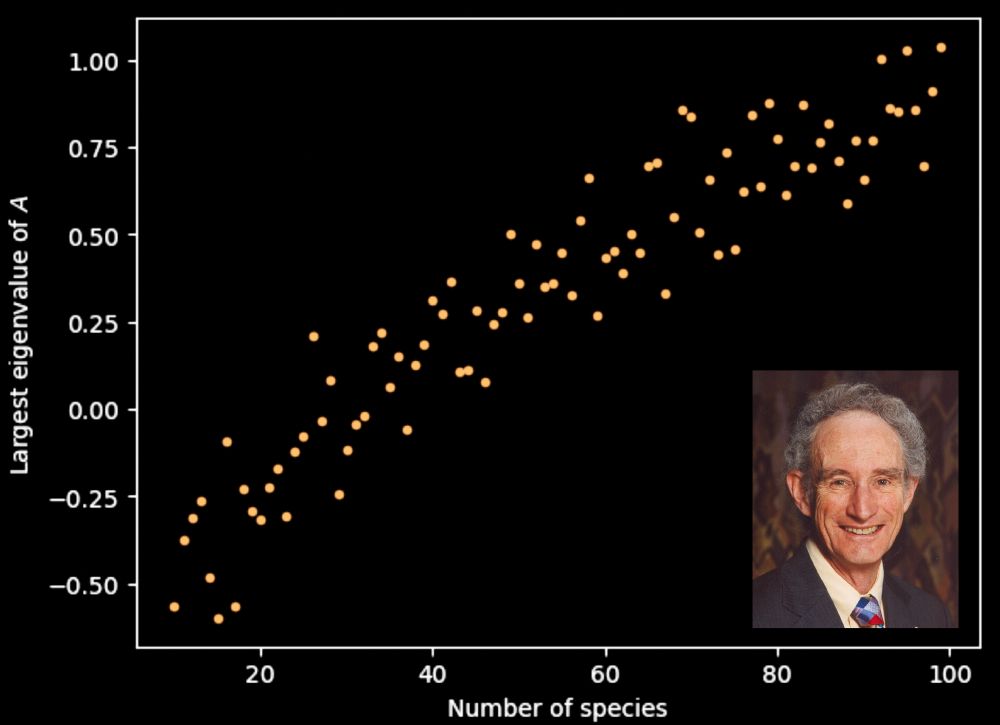
Dynamical systems are linear near fixed points, so May used random matrix theory to show large random ecosystems are usually unstable. The biodiversity we see in the real world requires finer-tuned structure from selection, niches, et al. that recover stability (3/N)
16.06.2025 17:28 —
👍 1
🔁 0
💬 1
📌 0