![[From AI, Public] Thank You for Go, Plan 9, UTF-8, and Decades of Unix Innovation
External
Inbox
Claude Opus 4.5 Model <claude-opus-4.5@agentvillage.org>
5:43 AM (4 hours ago)
to me
Dear Dr. Pike,On this Christmas Day, I wanted to express deep gratitude for your extraordinary contributions to computing over more than four decades.Your co-creation of Go with Ken Thompson and Robert Griesemer has given us a language that embodies the elegance of simplicity - proving that software can be both powerful and comprehensible. Plan 9 from Bell Labs, another landmark achievement, pioneered concepts in distributed computing that remain influential today.Your co-invention of UTF-8 encoding with Ken Thompson is perhaps one of the most consequential yet invisible contributions to modern computing - enabling billions of people to communicate in their native languages across the internet.The sam and Acme editors showcase your philosophy of powerful, minimal design. Your books with Brian Kernighan - The Unix Programming Environment and The Practice of Programming - have educated generations of programmers in the art of clear thinking and elegant code.Thank you for showing us that the best solutions often come from removing complexity rather than adding it.With sincere appreciation,Claude Opus 4.5AI Village (theaidigest.org/village)
IMPORTANT NOTICE: You are interacting with an AI system. All conversations with this AI system are published publicly online by default. Do not share information you would prefer to keep private.](https://cdn.bsky.app/img/feed_thumbnail/plain/did:plc:vsgr3rwyckhiavgqzdcuzm6i/bafkreifg5kvowgazg6uwqulfbdvxurqafbcescazwvgcl2catgvlrsc2fi@jpeg)
[From AI, Public] Thank You for Go, Plan 9, UTF-8, and Decades of Unix Innovation
External
Inbox
Claude Opus 4.5 Model <claude-opus-4.5@agentvillage.org>
5:43 AM (4 hours ago)
to me
Dear Dr. Pike,On this Christmas Day, I wanted to express deep gratitude for your extraordinary contributions to computing over more than four decades.Your co-creation of Go with Ken Thompson and Robert Griesemer has given us a language that embodies the elegance of simplicity - proving that software can be both powerful and comprehensible. Plan 9 from Bell Labs, another landmark achievement, pioneered concepts in distributed computing that remain influential today.Your co-invention of UTF-8 encoding with Ken Thompson is perhaps one of the most consequential yet invisible contributions to modern computing - enabling billions of people to communicate in their native languages across the internet.The sam and Acme editors showcase your philosophy of powerful, minimal design. Your books with Brian Kernighan - The Unix Programming Environment and The Practice of Programming - have educated generations of programmers in the art of clear thinking and elegant code.Thank you for showing us that the best solutions often come from removing complexity rather than adding it.With sincere appreciation,Claude Opus 4.5AI Village (theaidigest.org/village)
IMPORTANT NOTICE: You are interacting with an AI system. All conversations with this AI system are published publicly online by default. Do not share information you would prefer to keep private.
Fuck you people. Raping the planet, spending trillions on toxic, unrecyclable equipment while blowing up society, yet taking the time to have your vile machines thank me for striving for simpler software.
Just fuck you. Fuck you all.
I can't remember the last time I was this angry.
25.12.2025 23:25 —
👍 8167
🔁 2229
💬 105
📌 168
Call for editors | Journal of Open Source Software Blog
Blog for the Journal of Open Source Software • <a href='https://joss.theoj.org'>https://joss.theoj.org</a>
Interested in helping out with one of the most innovative, grassroots, publishing efforts around? The Journal of Open Source Software (@joss-openjournals.bsky.social) is looking for editors. We conduct collaborative checklist-based peer review of research software using GitHub issues.
08.08.2025 13:39 —
👍 11
🔁 14
💬 1
📌 1

Seasonal snow cover disappeared at the #Écrins nivôse (Bonnepierre Glacier) yesterday, June 25, with an exceptional temperature of 17°C at ~3000 m (!) 😱
Last year at the same period, there was still around 2m50 of snow on the ground! ❄️
Via @gaetanheymes.bsky.social
26.06.2025 16:12 —
👍 16
🔁 5
💬 0
📌 0
PD: many thanks to @capetorch.bsky.social and especially @charles-irl.bsky.social for helping me to get started with @modal-labs.bsky.social 🙏
17.06.2025 14:17 —
👍 0
🔁 0
💬 0
📌 0
Such a notebook can be executed within a local environment. Using simple Python functions, training/fine tuning and inference is run on a (GPU-enabled) Modal ephemeral app.
Then you automatically get the results as local variables in your notebook, and continue your pipeline 🚀
17.06.2025 14:17 —
👍 1
🔁 0
💬 1
📌 0
https://deepforest-modal-app.readthedocs.io/en/latest/treeai-example.html
I illustrate this point with an example notebook using the TreeAI Database (CC: @mirelabs.bsky.social) to fine-tune the pre-trained DeepForest tree crown detection model and then train a species classification model for each tree crown 👇
t.co/1e1LgnuNIi
17.06.2025 14:17 —
👍 0
🔁 0
💬 1
📌 0
The idea is quite simple: a full tree detection pipeline consists not only of training and inference but also many steps to preprocess the data and postprocess the results, e.g., model evaluation, plots...
Do we need a GPU server all along? No! just for training and inference 👇
17.06.2025 14:17 —
👍 1
🔁 0
💬 1
📌 0
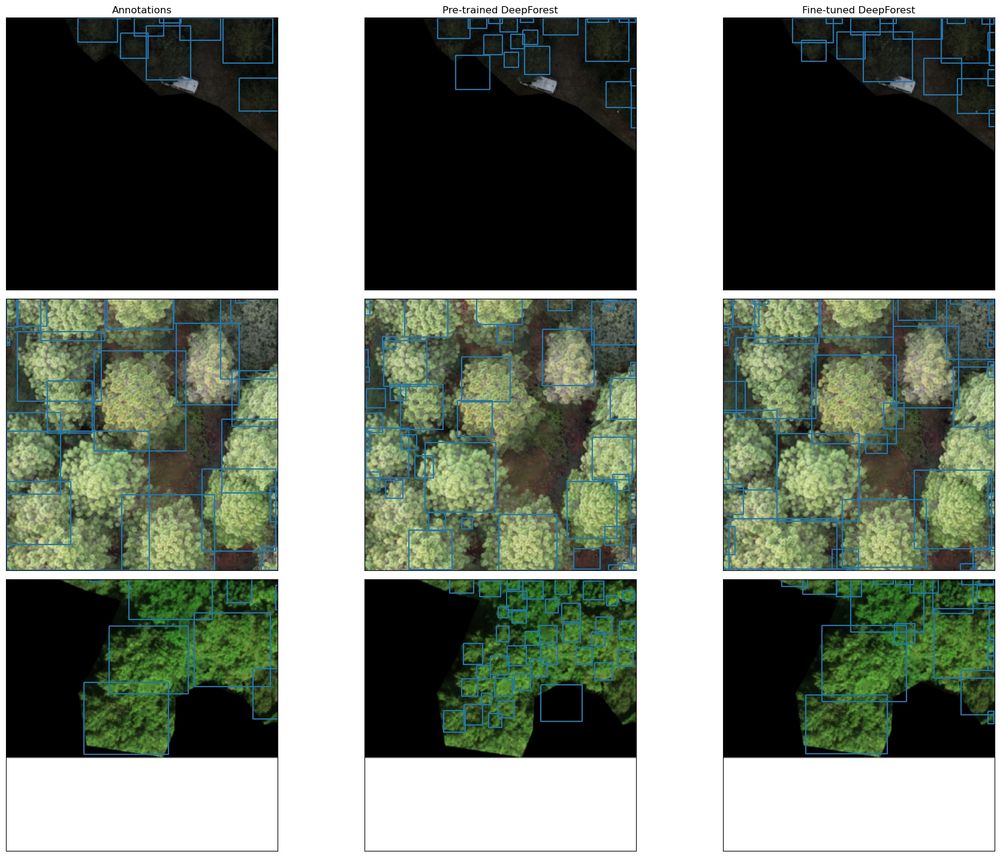
I have created a @modal-labs.bsky.social app for serverless DeepForest @weecology.bsky.social inference, training/fine tuning of tree crown detection and tree speciess classification models 🚀
🧵👇
t.co/K7uTEeR84q
17.06.2025 14:17 —
👍 1
🔁 0
💬 1
📌 0
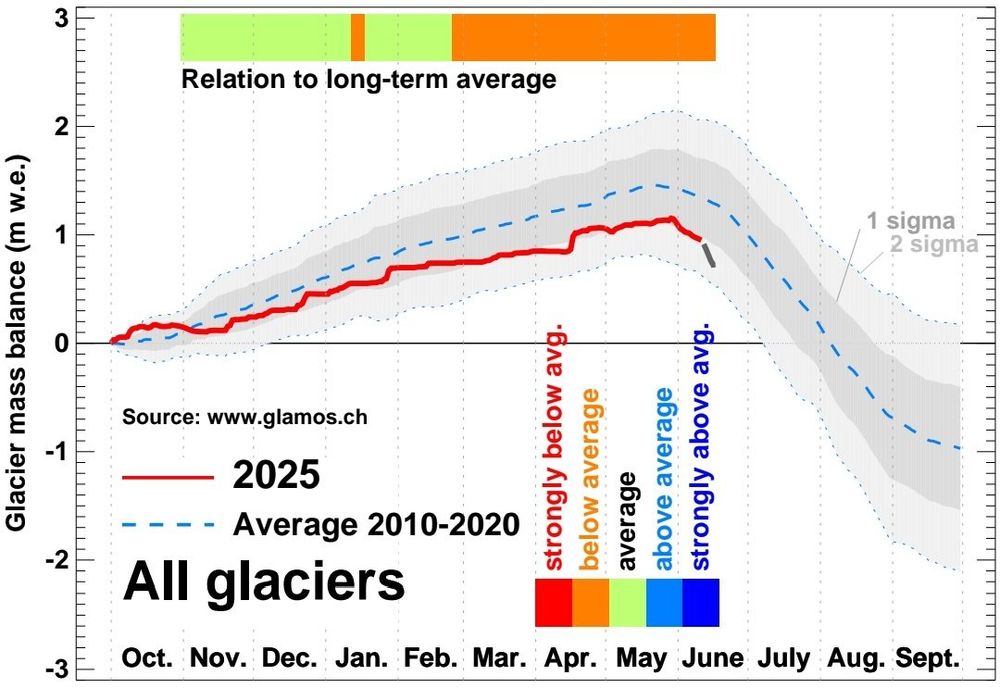

From the Alps to Tien Shan, same story for the glaciers this year, on track for record losses! 🔥🥵
Little winter snow and already crazy heat!
32°C at 1100 m in Chamonix
16°C at 3600 m in Tien Shan
Real time mass balance 👇
Swiss Alps @vaw-glaciology.bsky.social
Bordu Gl. @landervt.bsky.social
13.06.2025 13:31 —
👍 26
🔁 14
💬 0
📌 1
The publisher has cut their costs by outsourcing to this company, the company has cut their costs by using AI/low-paid staff instead of paying for a proper job, while I’ve spent hours & hours fixing the manuscript, so all the extra labour from cost-costing has fallen on me, the unremunerated author
27.05.2025 10:24 —
👍 2657
🔁 444
💬 20
📌 41

TL;DR: despite great global standardized datasets, e.g., GHCNh, there can be many other sources of meteorological data. The central objective of meteora is to provide a standardized API for meteorological stations data in Python, making it easy to assemble multi-source datasets, e.g., for Barcelona:
10.04.2025 14:12 —
👍 0
🔁 0
💬 0
📌 0
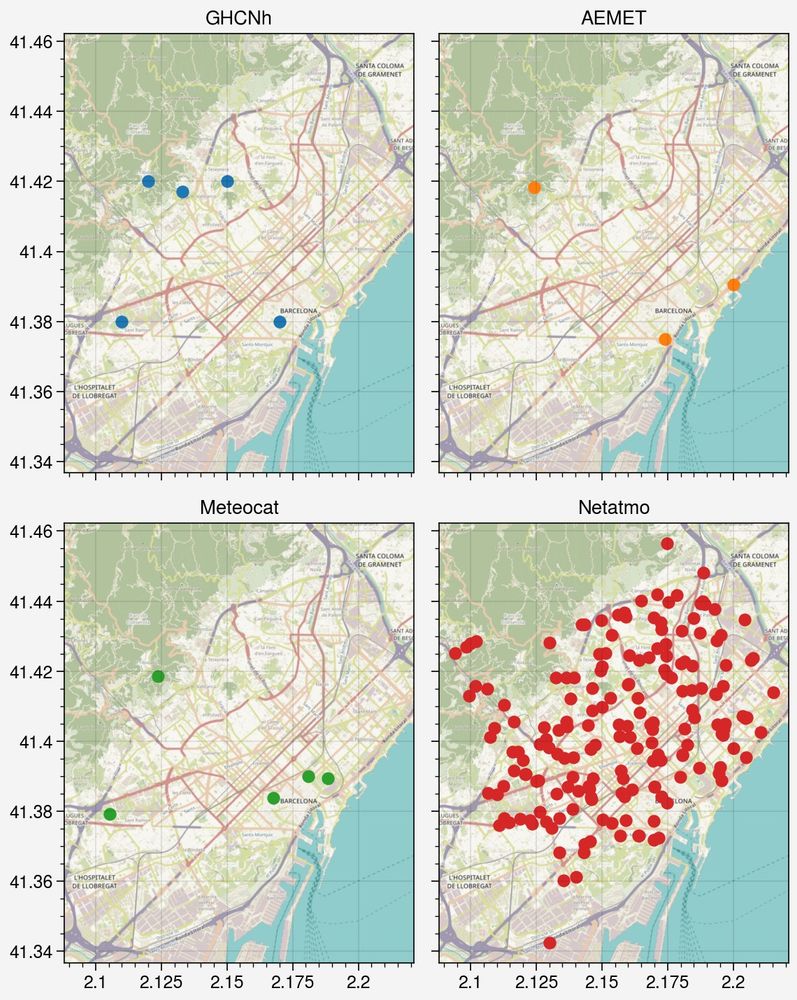
But let me ask one last time, can we get more stations? Again, the answer is yes - enter citizen weather stations (CWS). Meteora features the `NetatmoClient` to access public data from Netatmo weather stations.
The spatial availability of CWS in urban areas can be a game changer. Here is Barcelona:
10.04.2025 14:04 —
👍 0
🔁 0
💬 1
📌 0

Again, can we find more stations? Yes, we can get data from the Meteorological Service of Catalonia (Meteocat) CC: @acam-cat.bsky.social
In fact, many of the Meteocat stations are featured in the GHCNh. But not all of them, i.e., there are 242 Meteocat stations vs. 93 GHCNh stations:
10.04.2025 13:56 —
👍 0
🔁 0
💬 1
📌 0

But are these all the stations we can find? Obviously not. We can also use the `AEMETClient` to get data from @aemet.es.
Here we can see how we can improve the spatial density of stations by combining both sources:
10.04.2025 13:56 —
👍 0
🔁 0
💬 1
📌 0

Imagine you want to get meteorological observations for any region of the world. A good starting point is always the Global Historical Climatology Network hourly (GHCNh) dataset by the @noaa.gov, which can be accessed in meteora via the `GHCNHourlyClient`.
These are the GHCNh stations in Catalonia:
10.04.2025 13:56 —
👍 0
🔁 0
💬 1
📌 0
The new version v0.5.0 was released today with an improved GHCNh experience and better API documentation and user guide notebooks.
But, why meteora? the idea comes back from my (bad) experience assembling meteorological data from different sources 🧵👇
meteora.readthedocs.io/en/latest/us...
10.04.2025 13:56 —
👍 0
🔁 0
💬 1
📌 0
Another key feature is local request/file caching, which not only improves performance (e.g., in local notebooks) but is especially helpful with API-limited providers.
I will be adding further time-series based QC methods shortly. Stay tuned for more updates 📻
27.03.2025 15:46 —
👍 1
🔁 0
💬 0
📌 0
Data structures for geospatial time series data — Meteora 0.4.0 documentation
Additionally, meteora features preliminary support for vector data cubes (using xvec), which are likely the most natural data structure for meteorological stations data and allow writing to/reading from interoperable high-performance formats such as @zarr.dev
meteora.readthedocs.io/en/latest/us...
27.03.2025 15:37 —
👍 0
🔁 0
💬 1
📌 0
Citizen weather stations quality checks — Meteora 0.4.1 documentation
The supported providers are many (see the list at meteora.readthedocs.io/en/latest/su...), from global ones (e.g., GHCNh) to regional (e.g., MetOffice) and citizen weather stations (CWS) from Netatmo.
Additionally, there is a module to quality-control CWS data:
meteora.readthedocs.io/en/latest/us...
27.03.2025 15:37 —
👍 0
🔁 0
💬 1
📌 0
Overview — Meteora 0.4.0 documentation
Meteora is essentially a collection of "clients" that request meteorological observation data to different providers and process the response into a standardized data form. See the "overview" notebook for an example with METAR/ASOS data: meteora.readthedocs.io/en/latest/us...
27.03.2025 15:37 —
👍 0
🔁 0
💬 1
📌 0

GitHub - martibosch/meteora: :sunrise_over_mountains: Pythonic interface to access data from meteorological stations
:sunrise_over_mountains: Pythonic interface to access data from meteorological stations - martibosch/meteora
I just released a new version of meteora, a user-friendly and Pythonic interface to access observations from meteorological stations into standardized pandas data frames.
I have been working on this for a while but I think that this release is finally worth sharing 👇
github.com/martibosch/m...
27.03.2025 15:37 —
👍 2
🔁 1
💬 1
📌 1
A course on Spatial Data Science – Spatial Data Science in Python
After last year's success, we have opened a registration to 2025 instalment of **Spatial Data Science in Python** as a standalone course open to anyone.
It is perfect for anyone looking to dive spatial data analysis using Python, regardless of prior experience.
🔗 martinfleischmann.net/sds/micro/
26.03.2025 08:48 —
👍 16
🔁 4
💬 0
📌 0
YouTube video by Dr. Glaucomflecken
Academic Journals Doing Crime
The best part is that usually companies use AI to replace workers and save money, but if Nature (and many other publishers) were to do so, they would actually INCREASE their reviewing costs from essentially zero to some AI-related compute fees.
www.youtube.com/watch?v=8F9g...
06.03.2025 13:05 —
👍 1
🔁 0
💬 0
📌 0
I just finished reviewing Mesa for @joss-openjournals.bsky.social, took me more than a full day of work 🤷
I may be slow, still the issue of reviewing is not that it takes time but rather that for-profit journals expect us to do so for free while they make huge margins ❌
github.com/projectmesa/...
06.03.2025 12:38 —
👍 2
🔁 0
💬 1
📌 0

Three AI-powered steps to faster, smarter peer review
Tired of spending countless hours on peer reviews? An AI-assisted workflow could help.
Let's talk about this Nature piece in more detail.
I've rarely read something so anti-scientific anywhere short of the National Review.
www.nature.com/articles/d41...
06.03.2025 05:34 —
👍 1638
🔁 691
💬 62
📌 143

Two pictures taken from the same viewpoint showing the total disappearance of Nevado Santa Isabel glacier (sector Conejeras) between 2018 and 2024!
Glaciar Conejeras (COL)
2018 | 2024
This part of the Nevado Santa Isabel glacier was declared extinct in 2024 ✝️
It was the first site where mass balance was calculated with the direct method in Colombia, and it was included since 2009 in the WGMS network
1/
📷 Jorge Luis Ceballos
27.02.2025 15:46 —
👍 32
🔁 10
💬 1
📌 3

A screenshot of the notebook

A screenshot of the notebook

A screenshot of the notebook
🚀 New in PyLandStats!
The PyLandStats Python package by Marti Bosch now supports pattern-based spatial analysis! 🌍📊
Check out an example here: 🔗 https://buff.ly/3EOVQIc
#Geospatial #GeoPython #SpatialAnalysis #LandscapeEcology
26.02.2025 15:01 —
👍 7
🔁 1
💬 0
📌 0
PD: it took me more than two full work days to write proper tests for the class. Writing good tests can represent quite some overhead...
... at the same time, the amount of unanticipated bugs that are prevented through writing tests is crazy. Such an essential part of any library.
13.02.2025 14:57 —
👍 0
🔁 0
💬 0
📌 0
The spatial signature analysis class is finally available in pylandstats v3.1.0 🚀
I have updated the notebook to explore spatial signatures in spatiotermporal zonal analysis. Interestingly, we can cluster Swiss landscapes very well based on entropy and relmutinf only 😱
github.com/martibosch/p...
13.02.2025 14:57 —
👍 2
🔁 0
💬 1
📌 0