A table showing profit margins of major publishers. A snippet of text related to this table is below.
1. The four-fold drain
1.1 Money
Currently, academic publishing is dominated by profit-oriented, multinational companies for
whom scientific knowledge is a commodity to be sold back to the academic community who
created it. The dominant four are Elsevier, Springer Nature, Wiley and Taylor & Francis,
which collectively generated over US$7.1 billion in revenue from journal publishing in 2024
alone, and over US$12 billion in profits between 2019 and 2024 (Table 1A). Their profit
margins have always been over 30% in the last five years, and for the largest publisher
(Elsevier) always over 37%.
Against many comparators, across many sectors, scientific publishing is one of the most
consistently profitable industries (Table S1). These financial arrangements make a substantial
difference to science budgets. In 2024, 46% of Elsevier revenues and 53% of Taylor &
Francis revenues were generated in North America, meaning that North American
researchers were charged over US$2.27 billion by just two for-profit publishers. The
Canadian research councils and the US National Science Foundation were allocated US$9.3
billion in that year.

A figure detailing the drain on researcher time.
1. The four-fold drain
1.2 Time
The number of papers published each year is growing faster than the scientific workforce,
with the number of papers per researcher almost doubling between 1996 and 2022 (Figure
1A). This reflects the fact that publishers’ commercial desire to publish (sell) more material
has aligned well with the competitive prestige culture in which publications help secure jobs,
grants, promotions, and awards. To the extent that this growth is driven by a pressure for
profit, rather than scholarly imperatives, it distorts the way researchers spend their time.
The publishing system depends on unpaid reviewer labour, estimated to be over 130 million
unpaid hours annually in 2020 alone (9). Researchers have complained about the demands of
peer-review for decades, but the scale of the problem is now worse, with editors reporting
widespread difficulties recruiting reviewers. The growth in publications involves not only the
authors’ time, but that of academic editors and reviewers who are dealing with so many
review demands.
Even more seriously, the imperative to produce ever more articles reshapes the nature of
scientific inquiry. Evidence across multiple fields shows that more papers result in
‘ossification’, not new ideas (10). It may seem paradoxical that more papers can slow
progress until one considers how it affects researchers’ time. While rewards remain tied to
volume, prestige, and impact of publications, researchers will be nudged away from riskier,
local, interdisciplinary, and long-term work. The result is a treadmill of constant activity with
limited progress whereas core scholarly practices – such as reading, reflecting and engaging
with others’ contributions – is de-prioritized. What looks like productivity often masks
intellectual exhaustion built on a demoralizing, narrowing scientific vision.

A table of profit margins across industries. The section of text related to this table is below:
1. The four-fold drain
1.1 Money
Currently, academic publishing is dominated by profit-oriented, multinational companies for
whom scientific knowledge is a commodity to be sold back to the academic community who
created it. The dominant four are Elsevier, Springer Nature, Wiley and Taylor & Francis,
which collectively generated over US$7.1 billion in revenue from journal publishing in 2024
alone, and over US$12 billion in profits between 2019 and 2024 (Table 1A). Their profit
margins have always been over 30% in the last five years, and for the largest publisher
(Elsevier) always over 37%.
Against many comparators, across many sectors, scientific publishing is one of the most
consistently profitable industries (Table S1). These financial arrangements make a substantial
difference to science budgets. In 2024, 46% of Elsevier revenues and 53% of Taylor &
Francis revenues were generated in North America, meaning that North American
researchers were charged over US$2.27 billion by just two for-profit publishers. The
Canadian research councils and the US National Science Foundation were allocated US$9.3
billion in that year.

The costs of inaction are plain: wasted public funds, lost researcher time, compromised
scientific integrity and eroded public trust. Today, the system rewards commercial publishers
first, and science second. Without bold action from the funders we risk continuing to pour
resources into a system that prioritizes profit over the advancement of scientific knowledge.
We wrote the Strain on scientific publishing to highlight the problems of time & trust. With a fantastic group of co-authors, we present The Drain of Scientific Publishing:
a 🧵 1/n
Drain: arxiv.org/abs/2511.04820
Strain: direct.mit.edu/qss/article/...
Oligopoly: direct.mit.edu/qss/article/...
11.11.2025 11:52 —
👍 641
🔁 453
💬 8
📌 66
Enjoyed writing this. Would great to hear other points of advice from established reaserchers and opinions of those getting, or about to get, ready to embark on a new research career.
Thank you again ISPGR.
31.10.2025 17:54 —
👍 3
🔁 1
💬 0
📌 0
Brings back fond memories of spending a wonderful week on Isle of Mull in 2019. AirBnb was the converted dairy house of a working farm.
11.08.2025 17:50 —
👍 1
🔁 0
💬 0
📌 0
Good point. Wait for, "some of my newer colleagues were born during my beginning years as a prof"😬
06.08.2025 02:25 —
👍 5
🔁 0
💬 1
📌 0
what he said
08.07.2025 08:00 —
👍 5
🔁 0
💬 0
📌 0
I could not agree with this more.
02.07.2025 14:48 —
👍 1
🔁 2
💬 0
📌 0
#ISPGR2025
02.07.2025 05:01 —
👍 0
🔁 0
💬 0
📌 0

Joris Boulo talking about the affects of an inactive lifestyle on one's daily locomotor ability such as navigating crowds. If you are interested in the VR platform used that included collaboration with @anneheleneolivier.bsky.social, come see us.
02.07.2025 05:00 —
👍 7
🔁 2
💬 2
📌 0
Great discussions during and after thanks to all attending
01.07.2025 19:50 —
👍 2
🔁 1
💬 0
📌 0
Thank you Melvyn. I am very honored, especially to receive this from a society so near and dear to my heart.
01.07.2025 07:47 —
👍 7
🔁 0
💬 0
📌 0
Thank you Kim.
01.07.2025 07:41 —
👍 4
🔁 1
💬 1
📌 0

Looking forward to seeing you all in a few days time and hearing all about the exciting new work in the areas of posture and gait (and everything between!) #ISPGR2025
26.06.2025 09:03 —
👍 19
🔁 7
💬 0
📌 1
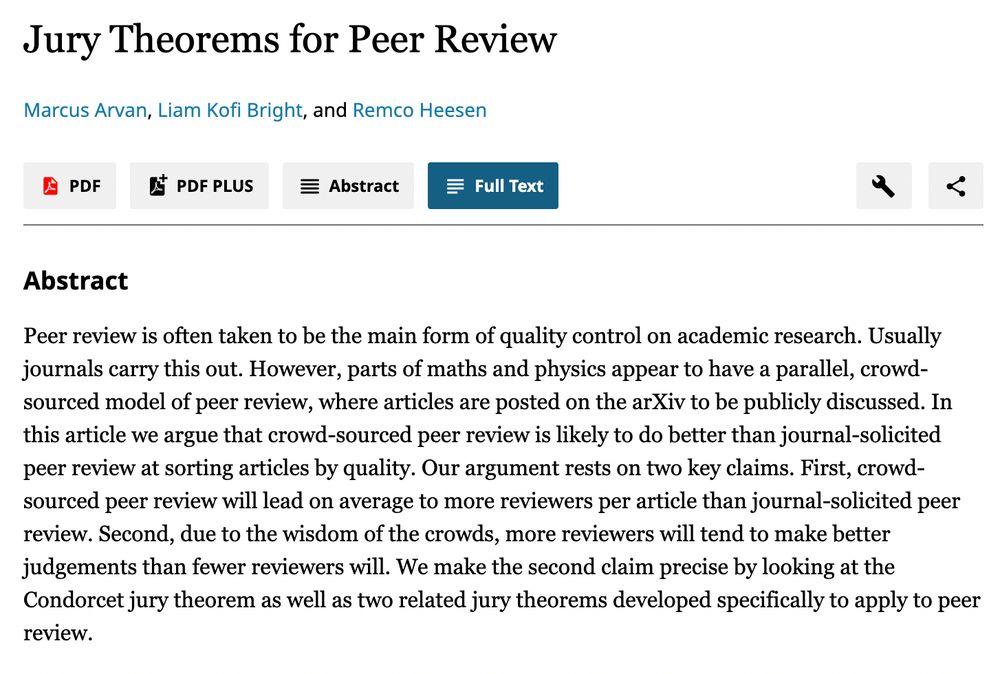
Jury Theorems for Peer Review
Marcus Arvan, Liam Kofi Bright, and Remco Heesen
Abstract:
Peer review is often taken to be the main form of quality control on academic research. Usually journals carry this out. However, parts of maths and physics appear to have a parallel, crowd-sourced model of peer review, where articles are posted on the arXiv to be publicly discussed. In this article we argue that crowd-sourced peer review is likely to do better than journal-solicited peer review at sorting articles by quality. Our argument rests on two key claims. First, crowd-sourced peer review will lead on average to more reviewers per article than journal-solicited peer review. Second, due to the wisdom of the crowds, more reviewers will tend to make better judgements than fewer reviewers will. We make the second claim precise by looking at the Condorcet jury theorem as well as two related jury theorems developed specifically to apply to peer review.
Paper is finally up and open access (www.journals.uchicago.edu/doi/10.1086/...), it's a sequel to an earlier paper where we'd argued that there's not good evidence that pre-publication peer review is a net benefit (www.journals.uchicago.edu/doi/10.1093/...). So in this one we suggest an alternative.
14.06.2025 08:28 —
👍 236
🔁 87
💬 15
📌 8

Don’t miss the deadline for this fantastic event in Montreal next Fall !
Deadline extended for early bird registration - May 28
Thank you for having me 😊🙏
iwaiworkshop.github.io
@activeinference.bsky.social
22.05.2025 06:23 —
👍 5
🔁 1
💬 0
📌 0
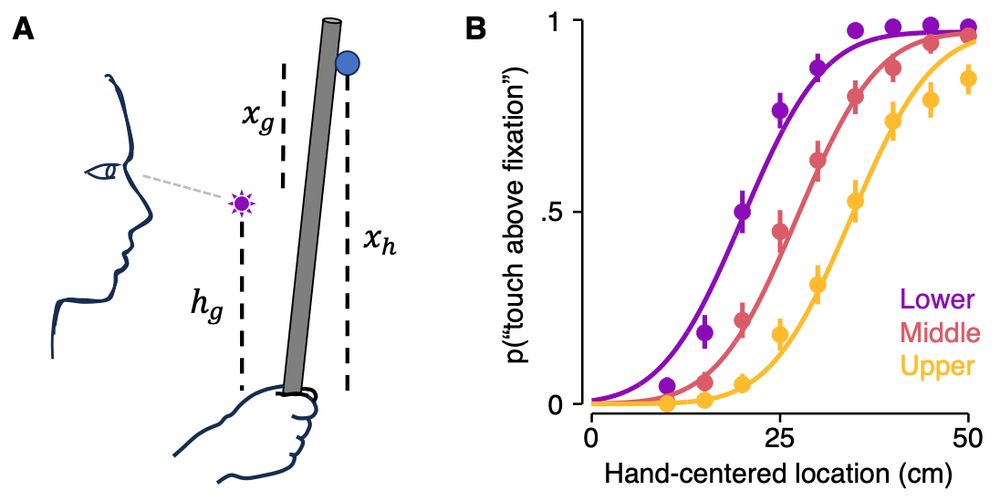
Humans project tactile sensations from a tool into space, as if part of the body. How? We show tactile feedback is projected into gaze-centered coordinates, offering a framework for tool-based sensory projection.
www.biorxiv.org/content/10.1...
@lukemillerneuro.bsky.social @pmedendorp.bsky.social
08.04.2025 07:27 —
👍 20
🔁 9
💬 1
📌 2


😃 A new article published in J Biomech by Bailey et al shows that motor fluctuations in treadmill gait of young adults were characterised by four gait fluctuation phenotypes, interpreted as repeaters, replacers, moderate fluctuators, and mixed fluctuators
👀 buff.ly/BnlohXD
#BiomechSky
13.03.2025 13:20 —
👍 3
🔁 1
💬 0
📌 0
YouTube video by Average Joes
We are Canadian.
Jeff Douglas reprises his iconic 2000 ad "I am Canadian." with "We are Canadian."
youtu.be/1LzhCLzfJFg?...
05.03.2025 21:20 —
👍 107
🔁 45
💬 5
📌 9

Come to Amsterdam this fall (Oct 8-10) for the International Motor Impairment Conference!
13.02.2025 07:20 —
👍 12
🔁 9
💬 0
📌 0

Psychonomic Society One World Seminar “How big is that bagel? Differences in size constancy for perception and action" by Mel Goodale Time: 11:15am Eastern Time on February 26. There's also a head shot of Mel Goodale, University of Western Ontario, Canada.
Really looking forward to discussing the operation of size constancy in visual perception and visually guided action as part of the Psychonomic Society's One World Seminar Series on Feb 26 at 11:15am to 1pm Eastern Time. 🧪🧠 Abstract and registration here. us02web.zoom.us/webinar/regi...
09.02.2025 17:28 —
👍 38
🔁 12
💬 0
📌 0
I loved using oscilloscopes.
07.02.2025 18:00 —
👍 0
🔁 0
💬 0
📌 0
Old school cool
07.02.2025 16:30 —
👍 14
🔁 1
💬 0
📌 1


😃New article published in J Biomech!
"Adapting lateral stepping control to walk on winding paths", by Render et al.
👀 www.sciencedirect.com/science/arti...
#journalofbiomechanics
#BiomechSky
30.01.2025 16:18 —
👍 8
🔁 2
💬 0
📌 0

Awareness of Health and Social Workers on Inclusion Health Groups in the UK
My colleague Jon Warne and two of our excellent MSc Physiotherapy students are conducting a survey on inclusion health
They’re specifically interested in awareness and knowledge of inclusion health groups among health and social workers
Completing/sharing the survey would be highly appreciated!
28.01.2025 15:29 —
👍 2
🔁 4
💬 0
📌 0

Don't let Elon Musk interfere in our elections.
Here is my letter to Elections Canada to protect our electoral process from interference by the X algorithm.
www.charlieangus.ca/_files/ugd/5...
If you are worried about Musk's extremism
please send an email to:
Stephane.Perrault@elections.ca
23.01.2025 21:49 —
👍 2551
🔁 1059
💬 252
📌 124
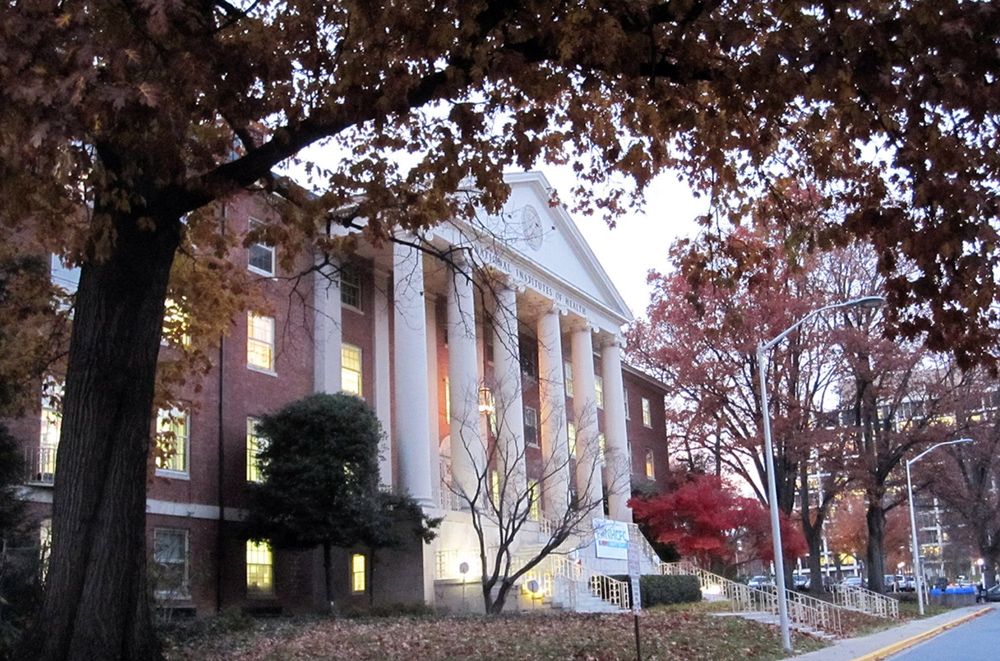
Trump hits NIH with ‘devastating’ freezes on meetings, travel, communications, and hiring
Researchers facing
“The impact of the collective executive orders and directives appears devastating.” scim.ag/40ureTO
22.01.2025 23:28 —
👍 1022
🔁 726
💬 48
📌 128
Stay safe James, you and your family
09.01.2025 15:38 —
👍 1
🔁 0
💬 1
📌 0
Sorry "academic" bsky for this politically-based message, but despite the great respect I have for my US colleagues, I am moved after the incoming US president's constant threats directed our way to point out wherever I can that Canada is the TRUE NORTH STRONG AND FREE! 🇨🇦
08.01.2025 13:08 —
👍 1
🔁 0
💬 0
📌 0